
If you've ever tried to figure out where to buy a school bus, you already know how quickly the process gets complicated. Do you go directly to a manufacturer? Work through a dealer? Request a state bid? For school districts and fleet operators navigating this process for the first time — or the first time in a decade — the landscape can feel opaque by design.
Endera supports purchases at every step, whether you're going OEM-direct, working through a dealer, or applying federal and state grant programs toward your real out-of-pocket cost. The Endera 4, 5, and 6 — available in ICE, propane, CNG, and full electric — can be purchased directly or through multiple channels.
Ready to map the right purchase path? Contact Endera's sales team today to get started.
Fleet Decision Framework: Matching the Purchase Path to Your Needs
Not Every Buyer Should Use the Same Channel
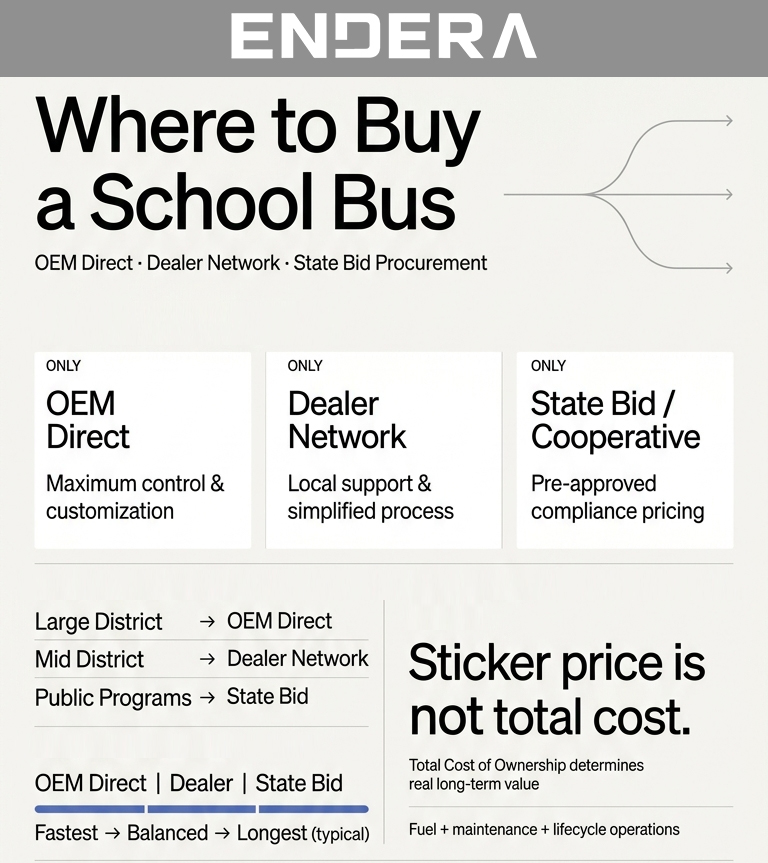
How you buy a school bus matters almost as much as which bus you buy. Research on public procurement efficiency shows that mismatches between procurement method and organizational capacity are a leading cause of delays and cost overruns in fleet acquisitions. A large district with a dedicated procurement team may be well positioned for an OEM-direct relationship, while a smaller district with limited administrative bandwidth may benefit more from working through a dealer who can handle logistics, financing, and paperwork on their behalf.
A Practical Framework for Choosing Your Purchase Path
Instead of asking "Where's the cheapest place to buy a school bus?", the better question is: "Which purchase channel best fits my district's capacity, timeline, and budget structure?" That framing leads to better decisions — and fewer costly surprises after the contract is signed.
| Buyer Profile | Recommended Channel | Why |
|---|---|---|
| Large district, dedicated procurement staff | OEM Direct | Best pricing, full customization, direct manufacturer relationship |
| Small-to-mid district, limited admin capacity | Dealer Network | Simplified process, local support, financing assistance |
| District with active state contract | State Bid / Cooperative Purchase | Streamlined compliance, pre-negotiated pricing |
| District pursuing EV grants | OEM Direct + Grant Advisory | Coordinated financing and incentive navigation |
Large districts with established procurement teams benefit most from OEM-direct relationships, where customization options are widest and per-unit pricing is most competitive at volume.
Smaller districts often get more value from a dealer relationship, where a single point of contact manages the transaction, delivery, and post-sale support without requiring internal expertise.
Grant-pursuing districts should engage the manufacturer directly early in the process —grant timelines often move faster than procurement cycles, and having the OEM involved from the start prevents costly misalignment.
Buying OEM Direct: What That Actually Means
The Advantages of Going Straight to the Source
Buying directly from Endera means working with the team that designed, engineered, and built the bus — without an intermediary layer in between. That direct relationship enables full customization across the Endera 4, 5, and 6 lineup, including section configuration, seating layout, ADA accessibility features, powertrain selection, and chassis preference (Ford or Chevrolet). It also means faster resolution when questions arise, because you're talking to the people who made the vehicle, not a reseller relaying messages.
Stock Vehicles for Faster Deployment
For districts that need buses quickly, Endera Stock lists in-stock, ready-to-deliver 2026 models available for rapid deployment — bypassing the standard build lead time entirely. This is particularly valuable for districts replacing a vehicle unexpectedly or expanding a fleet mid-year outside of the normal procurement cycle. OEM-direct doesn't always mean waiting months for a custom build; sometimes it means a bus ready to roll in weeks.
Procurement Path Timeline Comparison: Where Delays Actually Happen
The Blind Spot Most Buyers Miss
Most school bus guides describe OEM, dealer, and bid-based purchasing at a high level — but fail to show how timelines actually diverge once the process begins. Public-sector procurement is inherently multi-stage, requiring specification, stakeholder alignment, bidding or negotiation, and final approval before a single vehicle is ordered. Even in efficient systems, completing procurement steps alone can take months, with some public projects requiring close to a year before execution begins. That makes timeline visibility not just useful — it's operationally critical.
How the Three Purchase Paths Compare in Practice
Here's where friction actually occurs across each channel:
| Step | OEM Direct | Dealer | State Bid |
|---|---|---|---|
| Spec definition | You handle internally | Assisted by dealer | Pre-defined in contract |
| Pricing clarity | Medium (quote-based) | High (packaged) | High (fixed pricing) |
| Approval process | Internal + multi-stakeholder | Guided support | Pre-approved framework |
| Delivery predictability | Medium–High | Medium | Low–Medium |
| Total timeline | Variable (often fastest if aligned) | Moderate | Often longest |
Government procurement guidance confirms that procurement complexity directly impacts timelines, with more structured or regulated processes introducing additional approval layers and delays. Fleet procurement also requires coordination across finance, legal, and operations — each adding time and potential bottlenecks. The key takeaway: each channel shifts where risk lives. OEM direct compresses time but increases internal workload. Dealers reduce friction but add cost layers. State bids simplify compliance but often extend timelines. For most districts, the winning strategy isn't choosing the "cheapest" path — it's choosing the one where timeline risk is actually manageable given your internal capacity.
The Dealer Network: Local Support at Scale
What a Dealer Relationship Offers
Endera's dealer network extends the company's reach nationally, giving districts access to local sales support, vehicle demonstrations, and post-sale service without needing to work directly with the Ottawa facility. Strategic partners like Pritchard Auto Company provide financing, leasing, and rental options alongside new vehicle sales — making the purchase process more accessible for districts that prefer a single local relationship to manage the transaction end-to-end.
Trade-Ins and Pre-Owned Options
For districts replacing aging vehicles, the dealer network is also the primary channel for trade-in evaluations and pre-owned unit availability. While Endera's website focuses on new production, dealers within the network regularly handle trade-ins from districts upgrading to newer models — including pre-owned units from other manufacturers that can serve as transitional assets while a new fleet order is fulfilled. Contacting Endera's sales team directly is the most reliable way to identify current availability through the dealer network.
Total Cost of Ownership: What Your Bus Really Costs Over 10+ Years
The Purchase Price Is Only the Beginning
When evaluating where to buy a school bus, sticker price is only part of the equation. What matters more is total cost of ownership (TCO) — the combined cost of buying, fueling, maintaining, and operating the vehicle over its full lifecycle. According to the World Resources Institute, TCO analysis is essential for school districts because upfront costs alone often misrepresent long-term financial impact. The cheapest bus at purchase is rarely the cheapest bus over time.
Electric Wins the Long Game
| Factor | ICE | Propane | CNG | Electric |
|---|---|---|---|---|
| Upfront cost | Low | Medium | Medium | High |
| Fuel cost | High | Lower | Lower | Lowest |
| Maintenance | Medium | Lower | Medium | Lowest |
| 10-year TCO | — | — | — | Often lowest |
The Electric School Bus Initiative notes that electricity is cheaper and more stable than diesel, with maintenance costs significantly reduced due to fewer moving parts and no oil changes or exhaust systems. Lifecycle research shows that regenerative braking — standard on electric buses — reduces brake wear over time, with some analyses finding electric buses deliver hundreds of thousands of dollars in reduced ownership cost versus diesel over a typical service life. For Type A routes specifically, lighter vehicle weight and shorter distances mean smaller battery packs are needed — accelerating the return on investment.
Grants, Financing, and What You Actually Pay
Navigating More Than $20 Billion in Available Incentives
The upfront cost of a school bus — especially an electric one — is a real barrier, but the funding landscape has shifted dramatically in recent years. Federal programs like the EPA Clean School Bus Program have allocated billions specifically for electric school bus replacement, with awards covering a significant portion of vehicle cost for eligible districts. State-level programs like California's HVIP and equivalents in other states add further layers of available funding that can substantially reduce net purchase price.
Endera's Grant Advisory Team Does the Heavy Lifting
Endera's financing and grant advisory team helps districts identify and apply for every program they qualify for — federal, state, and local — tapping into more than $20 billion in available EV subsidies. Whether you need direct financing, capital leasing, or a fully grant-funded purchase, the team has navigated these programs before and handles the paperwork so transportation directors don't have to. For smaller districts without dedicated grant staff, this service alone can be the difference between a fleet upgrade that happens this year and one that gets pushed back indefinitely.
The Clearest Path to Your Next School Bus
Knowing where to buy a school bus is the first step — but the right answer depends on your district's size, timeline, budget structure, and readiness for electrification. Whether you buy OEM-direct for maximum customization, work through a dealer for local support, or combine both with grant advisory services to minimize net cost, Endera has the infrastructure to support every path.
Contact Endera's sales team to find the right purchase path for your district.
FAQs
Can I buy an Endera school bus directly from the manufacturer?
Yes. Endera sells direct to school districts and fleet operators, offering full customization across the Endera 4, 5, and 6 lineup. For districts needing faster delivery, Endera Stock lists ready-to-deliver 2026 models available for immediate purchase.
How much does a school bus cost?
School bus pricing varies by model, fuel type, configuration, and chassis. ICE models generally have lower upfront costs, while electric variants carry a higher purchase price that is often offset by grant funding and lower operating costs over time. Contact Endera's sales team for a current pricing quote tailored to your configuration.
What grant programs are available to help pay for a school bus?
The EPA Clean School Bus Program is the largest federal source, with additional funding available through HVIP in California and various state-level programs nationally. Endera's financing team assists districts in identifying and applying for all programs they qualify for.
How long does it take to receive a school bus after ordering?
Lead times vary by configuration and time of year. Custom builds can take several months, particularly during peak procurement season in late winter and spring. Districts with urgent needs can explore Endera's in-stock vehicles for faster deployment.
Can I buy a used Endera school bus?
Endera's primary website focuses on new production, but used and trade-in units are available through the dealer network. Contact Endera's sales team or strategic partners like Pritchard Auto Company to inquire about pre-owned availability.
Does Endera offer leasing options?
Yes. Through its financing arm and dealer partners, Endera offers capital leasing options that allow districts to use vehicles while preserving capital for other operational needs.
Are Endera school buses available on state contract?
Endera works with districts navigating cooperative purchasing and state contract frameworks. Contact Endera's sales team to discuss current state contract availability and Buy America compliance for federally funded purchases.