
California school districts aren't just buying buses — they're navigating one of the most complex fleet procurement environments in the country. CARB compliance requirements, point-of-sale incentive programs, and infrastructure funding windows all shape what a bus actually costs and whether a purchase qualifies for state support. Getting that wrong means leaving tens of thousands of dollars on the table, or buying a vehicle that doesn't meet California's tightening emissions standards.
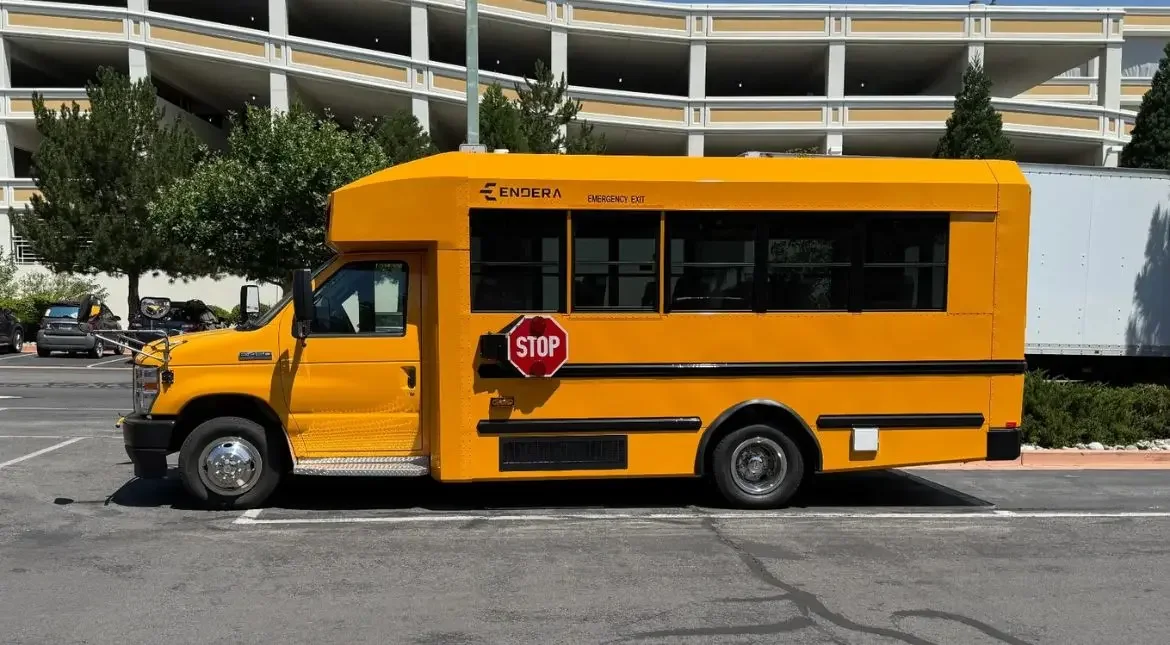
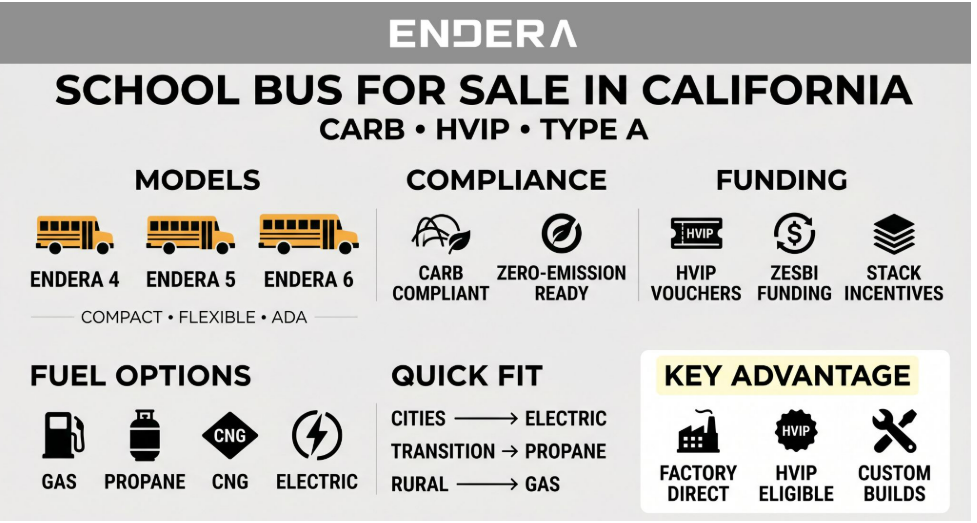
Endera manufactures CARB-compliant, HVIP-eligible Type A school buses in electric, propane, CNG, and gasoline configurations, built factory-direct in Ottawa, Ohio. Their electric models are listed in the HVIP-approved vehicle catalog and qualify for point-of-sale voucher discounts processed directly through Endera's certified dealer network.
Ready to confirm your district's eligibility before the funding window closes? Contact Endera's sales team today to review HVIP and ZESBI options.
What CARB Compliance Actually Means for School Bus Buyers
The California Air Resources Board (CARB) sets emissions standards that govern which vehicles can be sold, registered, and operated in the state. For school bus buyers, CARB compliance isn't just a checkbox — it determines eligibility for state funding programs, long-term operational legality as diesel restrictions tighten, and access to incentive stacking that can dramatically reduce net purchase cost.
Diesel school buses are not banned outright today, but California's regulatory trajectory is clear. CARB has allocated $375 million specifically to accelerate the replacement of older ICE school buses with zero-emission alternatives. Districts that purchase CARB-compliant electric buses now are positioned ahead of the 2035 mandate rather than reacting under deadline pressure.
How HVIP Works: Point-of-Sale Discounts, Not Rebates
The Hybrid and Zero-Emission Truck and Bus Voucher Incentive Project (HVIP) applies discounts at the point of sale — meaning the discount comes off the invoice price immediately, rather than requiring the buyer to pay full price and wait for reimbursement. The practical implication is that buyers work with an approved dealer who submits the voucher on their behalf.
The dealer handles the paperwork; the district pays the reduced price. Endera's certified dealer network is set up to process HVIP transactions directly, which removes the administrative burden that stops many smaller districts from accessing the program.
How Much HVIP Actually Covers
HVIP voucher amounts for school buses vary by vehicle class and applicant type. For Type A and Class 4 electric school buses, standard vouchers run approximately $108,000. Larger bus classes can reach $216,000. Public school districts and fleets serving disadvantaged communities may qualify for enhanced voucher tiers that push total incentive value higher — in some cases covering the full purchase price of a smaller electric model.
HVIP funding is first-come, first-served and operates within annual allocation windows. Districts that delay applications risk missing a funding cycle entirely, which can push a purchase into the next fiscal year.
California's Broader School Bus Funding Landscape
HVIP is not the only program available to California buyers. CARB administers a full suite of clean school bus funding programs, and understanding how they layer together is where significant additional savings exist.
The Zero-Emission School Bus and Infrastructure (ZESBI) program is now the primary state-level funding vehicle for California school districts, having replaced the earlier Public School Bus Set-Aside as of FY2023-24. Funded at $500 million total, ZESBI specifically covers both zero-emission buses and the charging or fueling infrastructure needed to operate them — with $375 million allocated to vehicles and $125 million to infrastructure. For districts concerned about the cost of installing charging stations, ZESBI removes that barrier entirely for eligible applicants — infrastructure costs including charger procurement, installation, and even staff training are covered under the program.
Who Qualifies for California School Bus Incentives
Public school districts, charter schools, and local education agencies (LEAs) are the primary eligible entities under both HVIP and ZESBI. Private schools without public funding classification have more limited access depending on the program cycle. Priority is typically given to applicants serving disadvantaged communities, high-pollution corridors, and districts replacing older, higher-emission vehicles.
Endera's grant navigation services cover California-specific program applications, including HVIP voucher processing and ZESBI eligibility assessments, as part of the purchase process.
Electric vs. ICE School Buses in California: The Real Cost Comparison
The upfront price gap between an electric Type A bus and a gasoline equivalent narrows significantly once HVIP and ZESBI incentives are applied. After a standard $108,000 HVIP voucher, an electric model's net acquisition cost can fall below that of an unsubsidized ICE bus of comparable spec — and that's before accounting for the operating cost difference over the vehicle's service life.
California's electricity rates vary by utility and time-of-use tier, but electric school buses consistently deliver lower per-mile fuel costs than diesel or gasoline equivalents in fleet settings. Endera's turnkey charging solutions include demand-based charging schedule optimization through Endera Dispatch, which reduces overnight charging costs by avoiding peak-rate windows — a meaningful factor in California where time-of-use pricing differentials are among the widest in the country.
HVIP-Approved Vehicles: What the Catalog Means for Buyers
Only vehicles listed in the HVIP-approved school bus catalog are eligible for voucher discounts. This catalog is maintained by CARB and updated as new models complete the Zero-Emission Powertrain Certification (ZEPCert) process — a federal-level certification requirement for all HVIP-eligible vehicles introduced in recent program cycles.
This distinction matters when evaluating competing manufacturers. A vehicle that isn't HVIP-listed may be compliant with federal standards but still ineligible for California's point-of-sale discount — meaning the buyer pays full price regardless of the vehicle's emissions profile. Buyers should confirm a specific model's current catalog status with Endera's sales team before building a procurement timeline around voucher eligibility.
Where California's Fleet Transition Stands in 2026
California has committed more capital to zero-emission school bus replacement than any other state. Between ZESBI, HVIP Standard, and federal EPA Clean School Bus Program allocations flowing into California, the state has already invested over $1.3 billion in incentives — funding more than 3,300 zero-emission school buses across more than 300 public school districts and charter schools. The City of Wasco was among Endera's first public sector electric bus deliveries in California under the CalACT contract — a cooperative purchasing vehicle available to California transit and education agencies that simplifies the bidding process.
Critically, California has mandated that all school district bus purchases be zero-emission technology by 2035, with rural LEAs having until 2045. This is not a voluntary target — it is a procurement deadline that affects every district in the state regardless of current fleet composition.
The Case for Acting Within the Current Funding Cycle
California's school bus incentive programs operate on allocation cycles, and HVIP in particular closes when annual funds are exhausted. Districts that apply early in a funding year access the full voucher tier; late applicants may find reduced availability or a waitlist that pushes delivery into the following fiscal year. HVIP also carries delivery window requirements — buyers must take delivery within a set timeframe after voucher approval, typically up to 540 days — which makes lead time planning a critical part of the procurement process.
For California districts ready to begin, contact Endera's sales team to discuss HVIP eligibility, ZESBI applications, and current build timelines for electric Type A models.
Frequently Asked Questions
What is the net cost of an electric school bus in California after HVIP?
After a standard HVIP voucher of approximately $108,000, the net purchase price of a Type A electric school bus can fall below that of a comparable unsubsidized gasoline model. Districts serving disadvantaged communities or replacing older high-emission vehicles may qualify for enhanced voucher tiers that reduce costs further. In some cases, stacking HVIP with ZESBI and federal EPA funding results in minimal or zero out-of-pocket cost for eligible public school districts.
Does ZESBI cover charging infrastructure as well as the bus itself?
Yes. The Zero-Emission School Bus and Infrastructure program allocates $125 million specifically for charging and fueling infrastructure, separate from the $375 million designated for vehicle purchases. This means eligible California districts can apply for infrastructure funding to cover charging station installation, grid connection, and site preparation — removing one of the most common financial objections to fleet electrification.
Are Endera school buses listed in the HVIP-approved vehicle catalog?
Yes. Endera's electric school bus models appear in the HVIP-approved school bus catalog maintained by CARB. This listing is a prerequisite for accessing point-of-sale voucher discounts in California — buyers purchasing non-listed vehicles cannot access HVIP funding regardless of the vehicle's emissions profile.
How long does the HVIP application and delivery process take in California?
HVIP vouchers are submitted by the approved dealer on the buyer's behalf at the point of sale. Once a voucher is approved, buyers typically have up to 540 days to take delivery of the vehicle. Given custom-build lead times of 60–120 days for electric models, districts should initiate the procurement process well in advance of their target delivery date to avoid conflicts with funding cycle deadlines.
Can charter schools in California access HVIP funding?
Charter schools that qualify as local education agencies (LEAs) are generally eligible for HVIP funding. Private schools operating without public funding classification have more limited access depending on the program round. Eligibility should be confirmed with CARB or through Endera's grant navigation team before committing to a purchase timeline based on expected incentive amounts.
What happens to existing diesel buses when a California district transitions to electric?
Many California school bus replacement programs, including those administered by CARB, require that the replaced vehicle be permanently retired rather than resold into secondary use. This scrappage requirement is designed to ensure that old, higher-emission buses are taken out of service entirely rather than continuing to operate elsewhere. Districts should verify the specific retirement requirements of each program they apply under, as conditions vary.
Does Endera deliver to school districts throughout California?
Yes. Endera delivers statewide through its factory-direct model and dealer network. The City of Wasco was among Endera's first California public sector deliveries under the CalACT cooperative purchasing contract, which is available to California transit and education agencies and simplifies the competitive bidding process for eligible districts.