
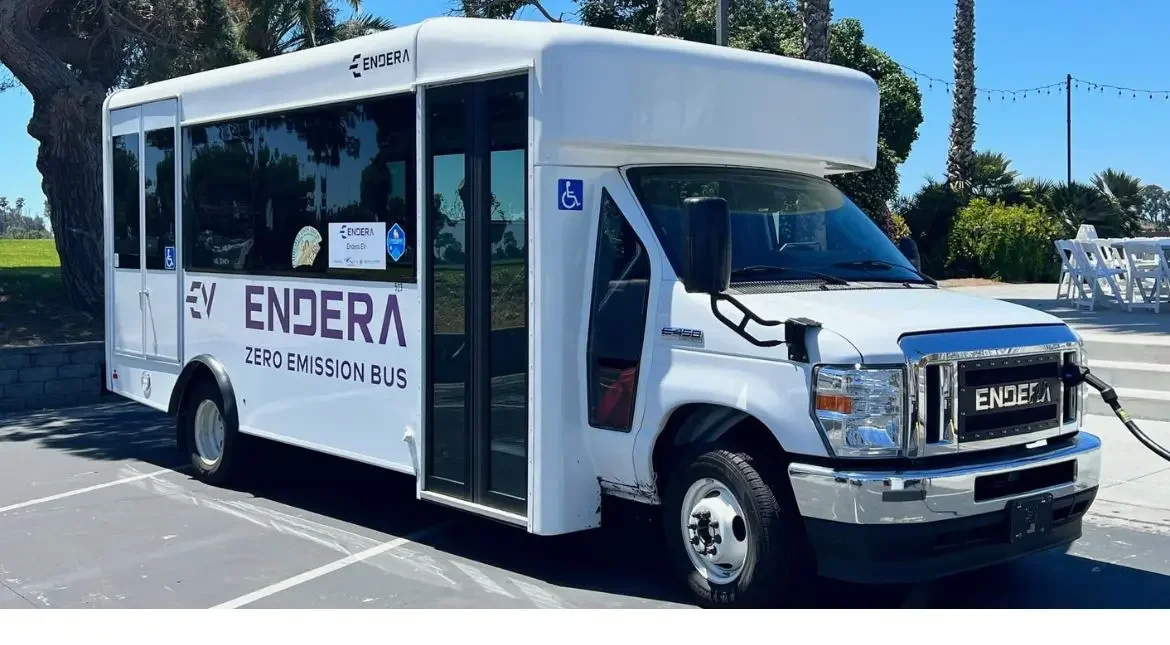
For commercial shuttle buyers, proximity to a dealer matters less than proximity to a manufacturer with a real service network. Most buyers searching locally are trying to solve three things at once: getting the right vehicle, avoiding a months-long wait, and making sure someone can service it after the sale. Those aren't dealer problems — they're manufacturer problems.
Endera sells factory-direct and through a national dealer and service network anchored by Pritchard Companies, with distribution reach across all 50 states. Their commercial shuttle lineup — the B-Series — covers gasoline, propane, CNG, and full-electric configurations in lengths from 23 to 28 feet.
Ready to find the nearest point of service for your operation? Contact Endera's team today to confirm availability and dealer reach in your region.
How Endera's Dealer Network Actually Works
Endera operates a hybrid distribution model: vehicles are manufactured at the Ottawa, Ohio facility and move through two channels — direct factory sales and a national dealer network. The anchor of that network is Pritchard Companies, a national automotive enterprise with over a century of operational history that handles distribution, financing, leasing, and trade-in valuation for Endera units across the country.
This structure means service isn't tied to geography the way a single-location dealer would be. Whether a fleet is based in California, Texas, or the Northeast, Pritchard's network provides a local point of contact for ongoing maintenance and warranty support. For buyers outside major metros, that continuity — same manufacturer, same parts ecosystem, same warranty structure — removes one of the most common reasons commercial vehicle purchases stall.
In-Stock vs. Custom-Build: What to Expect
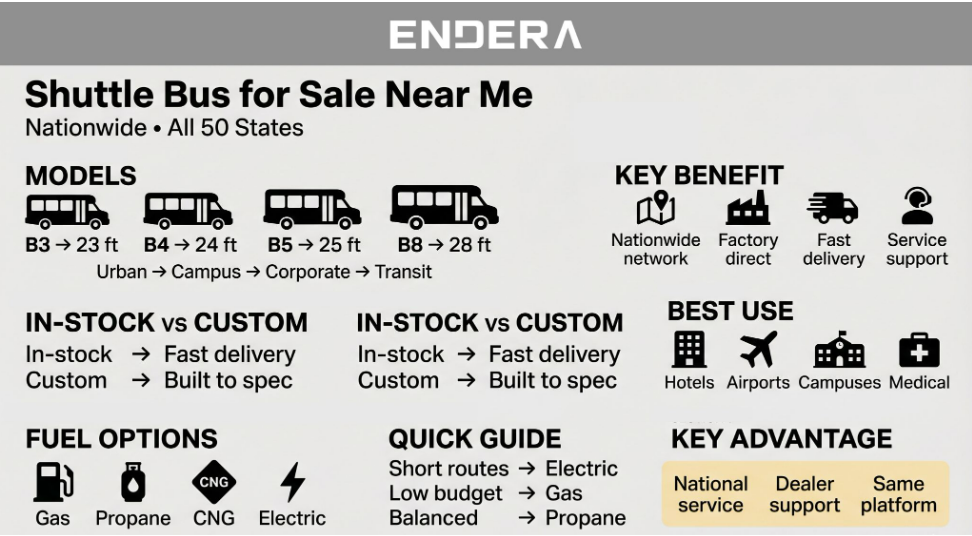
Endera maintains ready-to-deliver in-stock vehicles for buyers who need units quickly. Current inventory includes 2026 Ford E450-based shuttles in 12+2 and 8+4 passenger flat-floor configurations with 800 lb Braun ADA lifts, plus a 14-passenger rear-luggage model — all gasoline-powered, GVWR 14,500 lbs, with 70,000 BTU A/C and non-slip flooring.
Custom builds — covering propane, CNG, electric, and alternate seating or ADA configurations — are built to spec at the Ottawa plant with longer lead times depending on configuration and production volume. Because Endera controls the full build process in-house, configuration changes can be made earlier in the production cycle than with multi-stage assembly models, which reduces revision delays. Buyers with an immediate need should ask about stock units first; buyers planning ahead for a contract start date should begin the custom-build conversation 3–6 months out.
Choosing the Right Shuttle Bus Size for Your Operation
Matching the vehicle to the route is one of the most consequential decisions a fleet buyer makes — undersizing leads to repeat trips, while oversizing increases fuel and maintenance costs on routes that don't need the capacity. The B-Series runs from 23 to 28 feet, which translates to meaningful differences in passenger load and operating cost.
| Model | Length | Best Fit |
|---|---|---|
| B3 | 23 ft | Hotel shuttles, urban loops |
| B4 | 24 ft | Airport parking, university routes |
| B5 | 25 ft | Corporate campuses, employee transport |
| B8 | 28 ft | Municipal transit, high-demand routes |
The B4 and B5 are available in electric configuration and are the most common choice for hospitality and airport buyers. The B4 electric passed Altoona durability testing with a score of 90.1 — the highest in its class — which is the industry's standard benchmark for long-term reliability.
ADA Compliance: What Shuttle Bus Buyers Are Legally Required to Meet
Under ADA and DOT regulations governing private transportation providers, private entities operating fixed-route services — hotel shuttles on airport loops, campus circulators, corporate employee routes — are required to provide equivalent accessibility for passengers with disabilities. Ramps or lifts, mobility device securement systems, and accessible boarding areas are legal requirements for these operators, not optional add-ons.
Endera's B-Series shuttles are built with ADA compliance in mind, with the Braun 800 lb lift available across multiple configurations.
Paratransit and Demand-Responsive Services
For buyers operating senior living transport, non-emergency medical transport, or disability services, 49 CFR Part 37 governs service availability, route coverage, and accessibility standards at the federal level. Requirements vary depending on whether the service is fixed-route or demand-responsive.
Buyers in these segments should confirm their specific classification with legal counsel before finalizing a vehicle configuration — securement systems, lift capacity, and interior layout all affect compliance at the operational level.
Electric vs. Gas Shuttle Buses: The Operational Tradeoff
For urban and suburban routes under 100 miles per shift — which covers most hotel, airport, and campus operations — electric is consistently the lower total-cost option over a standard 8–10 year vehicle life. Fuel and maintenance savings typically offset the higher purchase price within 3–5 years depending on local electricity rates and annual mileage.
Endera's proprietary all-electric powertrain locates battery packs within the frame rails, lowering the center of gravity and protecting high-voltage components in a collision — a meaningful safety advantage over conversion-based competitors who mount battery systems externally. SP+ at San Diego International Airport projects nearly $20,000 in annual savings per vehicle versus LPG/CNG equivalents. For operators running five or more vehicles on a single route, that figure compounds into a material budget line within the first few years of operation.
When Gas or Propane Makes More Sense
Gasoline remains the lowest-barrier entry point for operators with limited capital budgets or inconsistent route mileage. Propane is the more cost-efficient bridge option for fleets running consistent daily routes — cutting fuel spend by roughly 30–40% versus gasoline — without the infrastructure commitment that CNG or electric requires.
Endera's financing options cover all powertrain types, and their grant navigation team can assess whether an electric purchase qualifies for federal or state clean vehicle incentives that close the price gap with ICE alternatives.
The Dealer Question, Answered
The more useful question isn't where the nearest dealer is — it's whether the manufacturer behind the vehicle will still be a reliable partner in year three or year seven, when a lift needs replacing, a warranty claim needs processing, or a second unit needs to match the first. Vertical integration and a national service network matter more than showroom proximity.
Endera's in-stock vehicles ship to buyers in any state, and the Pritchard-anchored dealer network provides local account management for fleets that need an ongoing service relationship. Contact the sales team to confirm availability, discuss delivery logistics, or get a configuration quote.
Frequently Asked Questions
Do I need a CDL to operate a shuttle bus?
Federal law requires a CDL for vehicles designed to carry 16 or more passengers (including the driver) or with a GVWR above 26,001 lbs. Most Endera B3 and B4 shuttles in standard configurations fall below the 16-passenger threshold, meaning many hotel, campus, and airport operators can legally run them without a CDL. State laws vary and some set lower thresholds — buyers should verify requirements with their state DMV before assuming an exemption applies.
Are private hotel and airport shuttle operators required to be ADA compliant?
Yes. The ADA applies to private entities operating fixed-route transportation, which includes most hotel shuttles on airport loops and campus circulators. These operators must provide accessible boarding, lifts or ramps, and mobility device securement. Non-compliance creates legal liability, not just a service gap — which is why ADA-ready configurations are a standard consideration for commercial shuttle buyers.
What is the difference between buying factory-direct from Endera vs. through a dealer?
Factory-direct purchases go straight from Endera's Ottawa, Ohio facility to the buyer, which can shorten the supply chain and offer more direct customization input during the build. Dealer purchases through Endera's network — primarily Pritchard Companies — add a local layer for financing, trade-in evaluation, and ongoing service relationships. Both channels sell the same vehicles under the same vehicle warranty; the right choice depends on whether the buyer values build control or local account management.
How long does delivery take for a shuttle bus ordered in another state?
In-stock units can typically be delivered within 1–2 weeks depending on transport logistics from Ottawa, Ohio. Custom-build lead times run 60–120 days for most configurations. Buyers with a hard deadline — a contract start, a hotel opening, or a fiscal year close — should contact Endera's sales team early to lock in a build and delivery timeline.
What sectors typically buy Endera B-Series shuttle buses?
Endera's commercial shuttle customers include hotels and hospitality groups, airport parking operators, university and corporate campuses, healthcare and senior living facilities, and municipal transit agencies. The B-Series is also used in non-emergency medical transport and by faith-based organizations running regular transportation programs. The range of fuel configurations means the platform fits both budget-constrained buyers and operators with sustainability mandates.
Can Endera shuttle buses be tracked and managed remotely?
Yes — every commercial shuttle comes available with Endera Dispatch, the company's fleet management platform. It provides real-time GPS tracking, geofence management, state-of-charge monitoring for EV fleets, and custom reporting dashboards. The rider-facing companion app, Endera Go, gives passengers real-time vehicle location and ETA data, which is particularly valuable for hotel and airport operators managing passenger wait expectations.
What happens if a shuttle bus needs service in a state far from the manufacturing facility?
Endera's service network operates through Pritchard Companies and a broader dealer network with national reach. Warranty claims and major service work can be coordinated through the dealer network rather than requiring a return to the Ohio facility. Buyers should confirm service coverage in their specific geography during the sales process — particularly if operating in a rural area or a region with limited commercial vehicle service infrastructure.