
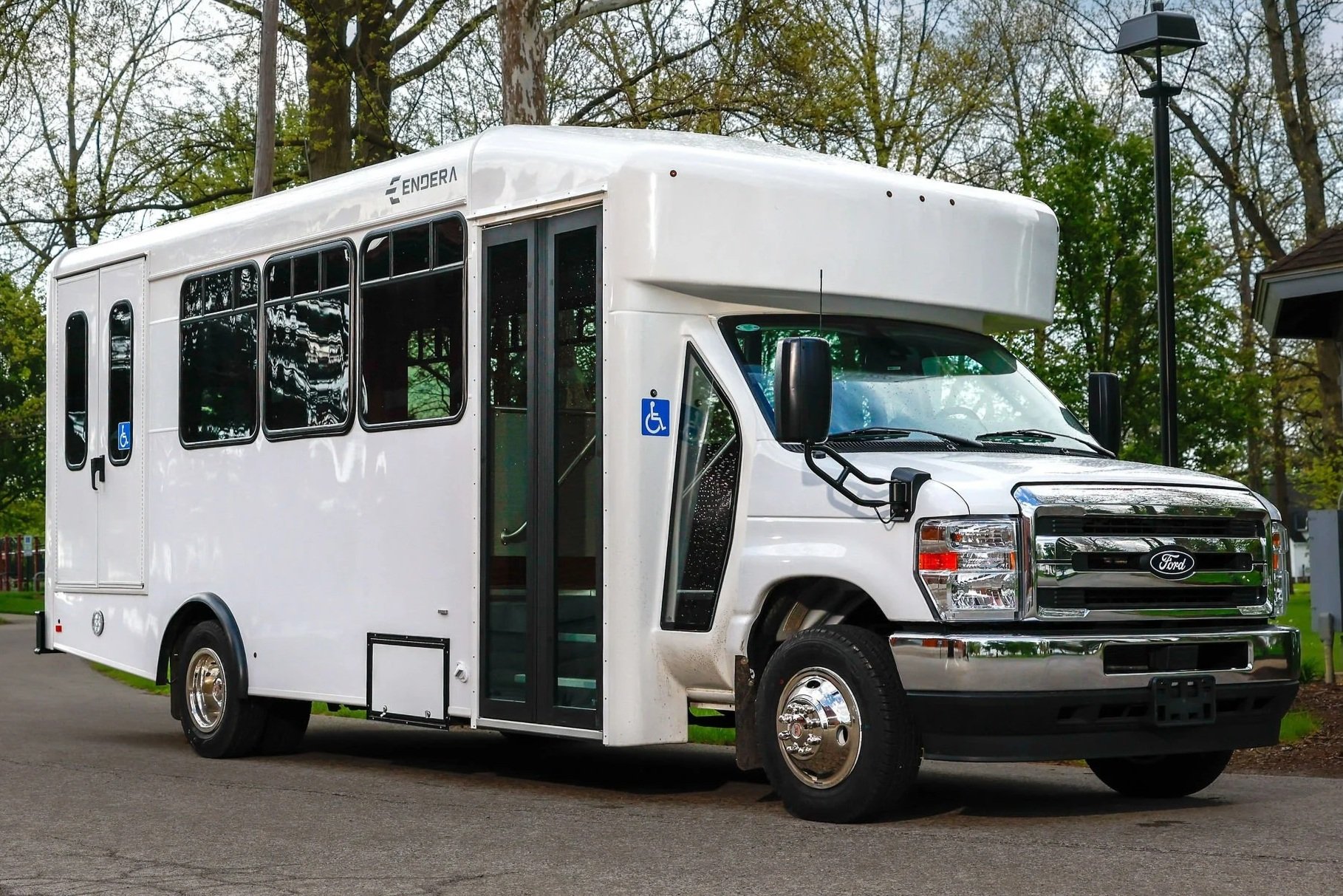
Most shuttle buses described as "ADA compliant" stop at the presence of a lift. Real accessibility compliance involves lift dimensions, securement system specifications, aisle clearance, door width, and occupant restraint requirements — all defined by federal standards that apply to commercially operated passenger vehicles regardless of operator type or route.
Endera manufactures Class 4 B-Series commercial shuttles with ADA-compliant flat-floor configurations as a standard offering. Wheelchair lifts, securement systems, and accessible seating layouts are installed at the Ottawa, Ohio manufacturing facility as part of the original build — not added by a third-party upfitter after delivery.
Ready to optimize your routes? Contact Endera's fleet specialists today to design a custom accessible configuration blueprint for your operation.
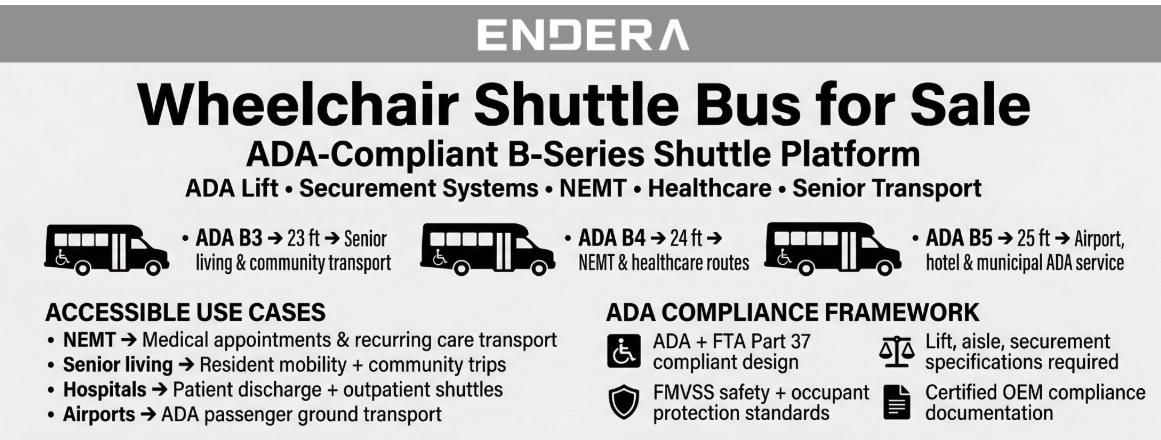
What ADA Compliance Actually Requires for Shuttle Buses
ADA accessible transportation requirements and FTA Part 37 transportation service regulations define the technical requirements for accessible commercial passenger transport. These include minimum lift platform dimensions, securement system specifications, aisle width clearances, door opening requirements, and the driver protocols that must be followed during wheelchair boarding and alighting.
The U.S. Access Board ADA transportation vehicle guidelines and U.S. DOT accessible transportation framework establish the broader compliance context. A vehicle with a lift that doesn't meet platform size requirements, or with securement anchors that don't conform to federal tie-down specifications, doesn't satisfy ADA compliance regardless of how it's marketed.
Wheelchair Lift Systems: What Fleet Buyers Need to Know
Endera's flat-floor B-Series configurations use 800 lb Braun ADA lifts installed at the manufacturing stage. The 800 lb capacity rating accommodates power wheelchairs and larger mobility equipment that lighter-rated commercial lifts cannot safely handle.
How Wheelchair Lifts Operate
Braun hydraulic lifts deploy from the side-entry door, lower to ground level, accept the wheelchair and occupant, and raise to floor height for cabin entry. Safety interlocks prevent vehicle movement while the lift is deployed. Platform size, weight rating, and interlock systems are all specified by FMVSS federal motor vehicle safety standards — Endera's OEM-installed systems meet these requirements as delivered.
Lift vs. Ramp: When Each Makes Sense
Lifts are the standard for commercial shuttle applications. They accommodate heavier mobility devices, require no manual effort from passengers, and perform reliably across a wide range of boarding environments. Ramps are faster for lighter manual wheelchairs in controlled low-curb environments but are less suited to power wheelchair weights and variable-height boarding surfaces. For NEMT, healthcare, and senior living fleets where passenger mobility devices vary, lifts are the operationally safer specification.
Wheelchair Securement Systems Explained
A wheelchair that boards the vehicle must be secured before transit. NHTSA occupant safety standards and FTA regulations require four-point tie-down securement with occupant shoulder and lap belts — one of the most commonly misunderstood aspects of ADA shuttle compliance.
Four-point securement systems use straps attached to four points on the wheelchair frame — two at the front, two at the rear — anchored to floor-mounted tracks within the securement zone. Occupant restraint belts are separate from wheelchair tie-downs and must be provided regardless of whether the passenger uses their own seatbelt. Quick-release mechanisms on floor anchors allow faster turnover between passengers on high-frequency routes.
Seating and Configuration Layouts
Accessible B-Series configurations involve a tradeoff between wheelchair positions and ambulatory seating capacity. Common layouts include:
2 wheelchair + 6 ambulatory — the most common configuration for mixed NEMT and senior transport routes
4 wheelchair + 2 ambulatory — for routes serving primarily wheelchair users
Fold-away seating — allows the same space to serve both configurations depending on route load
Endera's B-Series configurations allow seating and securement arrangements to be specified at the order stage to match actual route and passenger population requirements. The Administration for Community Living tracks accessible community transportation needs for older adults and people with disabilities, a population whose transportation requirements directly shape these configuration decisions.
Who Uses Wheelchair Shuttle Buses
Commercial wheelchair shuttle demand spans a wider range of buyers than paratransit alone:
NEMT operators — non-emergency medical transport for dialysis, oncology, and recurring medical appointments
Senior living communities — resident transport for appointments, activities, and errands
Hospitals and rehabilitation centers — patient discharge transport and outpatient shuttle operations
Airports and parking operators — accessible ground transportation meeting ADA public accommodation requirements
Hotels and resorts — property shuttle operations serving guests with mobility needs
Municipal and community transit — demand-response and paratransit services under FTA accessibility requirements
Universities — campus paratransit programs for students with disabilities
The CDC healthy aging transportation resources and Administration for Community Living both document the growing transportation gap for aging and disabled populations — a gap that accessible commercial shuttle fleets are increasingly being deployed to close.
Why ADA Accessibility Matters Beyond Legal Compliance
ADA transportation regulations establish the legal floor for accessible commercial passenger transport. But for most fleet operators, accessibility configurations are also a practical fleet decision — they expand the passenger population a vehicle can serve and reduce the need to maintain separate accessible and non-accessible fleet assets.
For hotel and airport operators, ADA compliance is a public accommodation requirement under federal law. For healthcare and senior living fleets, it's an operational necessity. For municipal transit operators, it's a condition of FTA funding. In each case, OEM-installed accessibility equipment from a vertically integrated manufacturer is a cleaner procurement choice than post-sale retrofits — one warranty, one service relationship, one compliance document.
Electric ADA Shuttle Buses: Operational Fit
Accessible shuttle fleets are often strong EV candidates. Healthcare loops, senior living circuits, and airport ground transportation routes share the operational characteristics that favor electric operation — predictable daily mileage, depot return, and scheduled overnight charging windows.
The Electrification Coalition identifies shuttle and paratransit operations among the highest-ROI EV deployment environments. The DOE Alternative Fuels Data Center tracks fleet operating costs by vehicle type — electric drivetrains reduce maintenance spend 30–40% versus diesel, a meaningful advantage for NEMT and senior living operators managing tight operational budgets. A quieter cabin also benefits passengers with sensory sensitivities, dementia, or anxiety — a practical consideration in healthcare and senior transport that doesn't appear on a spec sheet but consistently surfaces in operator feedback.
Get Your Fleet Spec'd
Several 2026 ADA-configured B-Series units are available for immediate delivery through Endera Stock. For operators working within formal procurement processes or grant-funded purchasing cycles, Endera provides full specification documentation, ADA compliance materials, and financing and grant navigation support.
To discuss accessible fleet configuration, lift specifications, or powertrain options, contact Endera's sales team.
FAQs
What federal standards define ADA compliance for wheelchair shuttle buses?
ADA accessible transportation requirements, FTA Part 37 regulations, and FMVSS safety standards collectively define the technical requirements — lift platform dimensions, securement system specifications, aisle clearance, occupant restraint requirements, and driver protocols. A vehicle marketed as ADA compliant must meet all of these, not just have a lift physically installed. Endera's OEM-installed systems are built to satisfy these standards as delivered.
What is the weight capacity of Endera's standard wheelchair lift?
Endera's flat-floor B-Series configurations include 800 lb Braun ADA lifts. The 800 lb rating accommodates power wheelchairs and heavier mobility equipment that lighter-rated commercial lifts cannot safely handle. Fleet operators serving passengers with bariatric mobility devices should confirm actual equipment weights during the specification process.
How does a four-point wheelchair securement system work?
Four-point securement uses straps attached to four points on the wheelchair frame — two front, two rear — anchored to floor-mounted tracks within the securement zone per FTA Part 37 specifications. Occupant restraint belts are provided separately and must be offered regardless of whether the passenger uses their own seatbelt. Quick-release floor anchors reduce turnover time on high-frequency routes without compromising securement integrity.
How many wheelchair positions can a B-Series shuttle accommodate?
Standard configurations support two to four wheelchair securement positions depending on layout. Common formats include 2-wheelchair/6-ambulatory and 4-wheelchair/2-ambulatory using fold-away seating. Seating and securement arrangements are specified at the order stage to match actual route and passenger population requirements. See B-Series configuration options for layout details.
Are electric ADA shuttle buses practical for NEMT and healthcare fleets?
Yes. Healthcare loops, senior living circuits, and NEMT routes typically have predictable daily mileage and overnight depot charging availability — the operational profile where electric buses perform best. Electric drivetrains reduce maintenance spend 30–40% versus diesel per DOE Alternative Fuels Data Center data, and the quieter cabin benefits passengers with sensory sensitivities. Endera's turnkey charging solutions handle depot infrastructure as a single engagement.
What is the difference between a wheelchair lift and a ramp for commercial shuttles?
Lifts are hydraulic platforms that lower to ground level and raise to floor height — accommodating power wheelchairs and heavier mobility devices across varied boarding environments, as required by U.S. Access Board vehicle guidelines. Ramps are faster for lighter manual wheelchairs in controlled low-curb settings but are less suited to power wheelchair weights and uncontrolled curbside boarding. For NEMT, healthcare, and senior living fleets where mobility devices vary, lifts are the operationally safer specification.
Do ADA shuttle buses require regular lift maintenance inspections?
Yes. Wheelchair lifts require scheduled maintenance including lubrication cycles, hydraulic fluid checks, and platform integrity testing separate from standard vehicle maintenance. CVSA inspection standards cover accessibility equipment as part of commercial vehicle compliance checks — a failed lift inspection removes the vehicle from service. Scheduling lift maintenance alongside required annual state inspections reduces fleet downtime and ensures consistent compliance standing.