
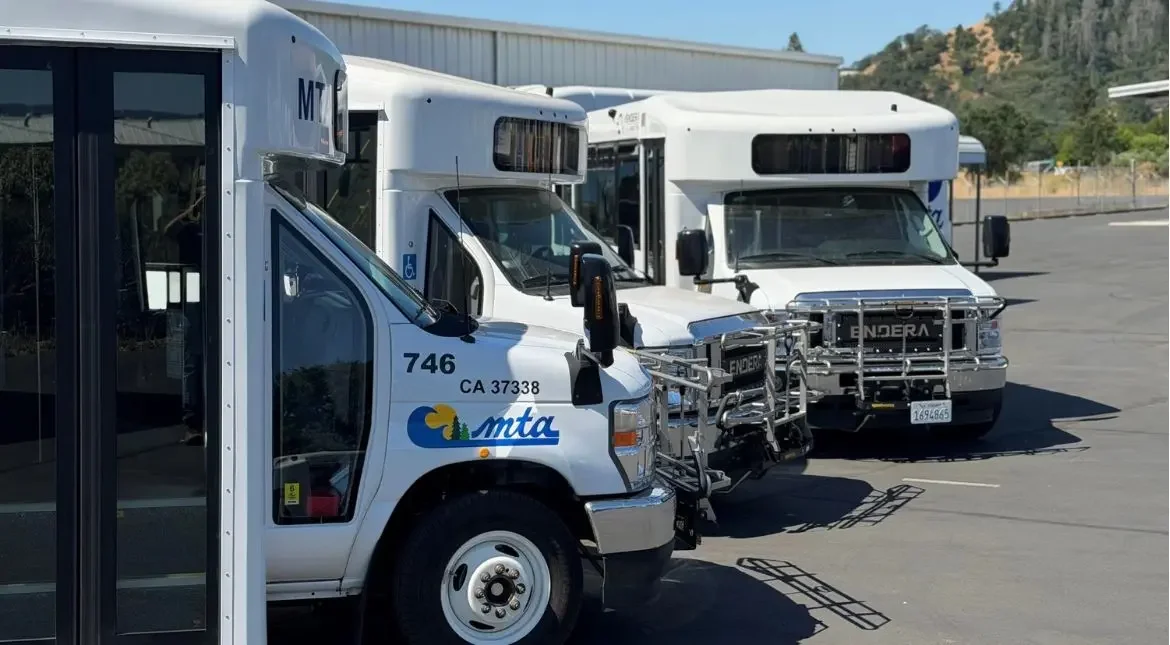
Massachusetts runs some of the most complex shuttle operations on the East Coast. Between Boston's major hospitals and medical campuses, Logan International's ground transportation network, the dense university corridor stretching from Cambridge to Worcester, and a tourism economy that fills the Cape and Islands every summer — shuttle fleets here operate under real pressure, in real traffic, in a state where winters are cold and expectations are high.
Endera builds the B-Series shuttle from the ground up — chassis integration, powertrain, body, and software — at its facility in Ottawa, Ohio. No upfitter chain, no split warranty, one team accountable for the entire vehicle. For Massachusetts operators managing high-frequency routes where downtime has direct operational consequences, that matters.
Ready to optimize your routes? Contact Endera's fleet specialists today to design a custom configuration blueprint for your Massachusetts operation.
The Endera B-Series Lineup for Massachusetts Fleets
Four Models, Built for Different Operations
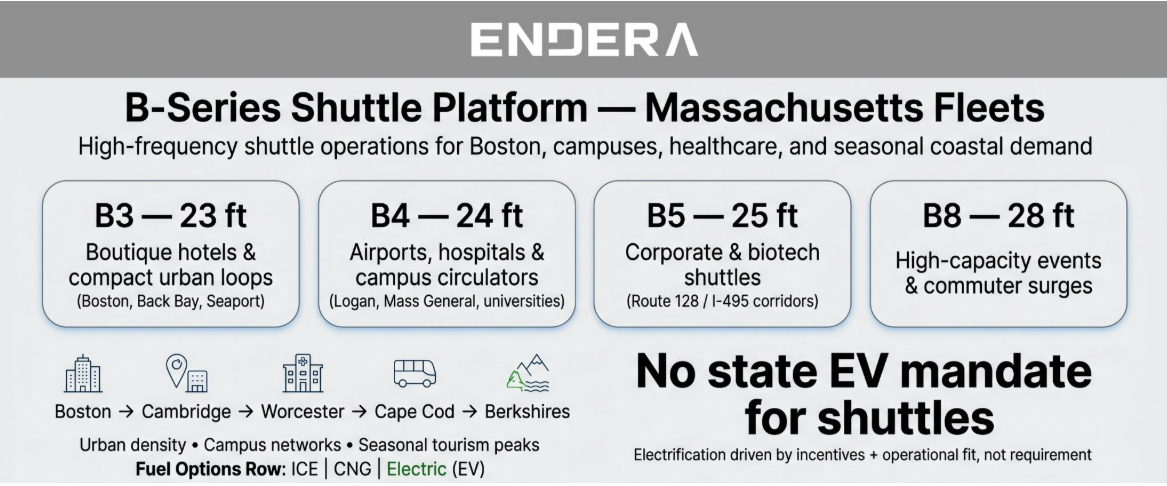
The B-Series spans 23 to 28 feet across four models, covering everything from compact hotel loops in downtown Boston to high-capacity employee shuttles on corporate campuses along Route 128. Every model is built on Ford E450 or Chevrolet Express cutaway chassis — platforms that Massachusetts service networks already know well.
Matching the Model to the Route
The B3 (23 ft) handles compact urban routes and boutique hotel operations. The B4 (24 ft) and B5 (25 ft) are available in both ICE and full-electric configurations, making them well suited for airport ground transport, university circulators, and medical campus shuttles across the state. The B8 (28 ft) covers higher-capacity needs where ridership demands more room.
Electric or ICE — What Massachusetts Operators Need to Know
The State Is Pushing Electrification — and Backing It With Money
Massachusetts has some of the most aggressive clean transportation policy in the country. The state actively funds EV fleet adoption through MassDOT and the Massachusetts Clean Energy Center (MassCEC). For fleet operators in the state, that policy environment translates into real funding opportunities — including the MOR-EV Trucks program, which offers rebates of up to $25,000 per Class 4–5 zero-emission vehicle for eligible Massachusetts businesses — that make electric models financially competitive with ICE alternatives.
Cold Weather Is a Real Variable
Massachusetts winters are a legitimate operational consideration for EV fleet planning. Cold temperatures reduce usable battery range through chemistry changes and the energy required for cabin heating — a combination that affects early morning routes most directly. The mitigation strategies that work are straightforward: pre-conditioning while plugged in, maintaining plug-in dwell time between runs, and depot storage wherever possible. Operators who plan for winter from the start rather than after the first cold snap run electric fleets successfully year-round in Massachusetts.
Where ICE Still Makes Sense
For operations running longer intercity corridors, variable routes without predictable depot access, or fleets that aren't ready to invest in charging infrastructure, ICE and CNG configurations remain practical choices. Endera's dual-track production means Massachusetts operators aren't forced into electrification before the conditions support it.
Which B-Series Model Fits Your Massachusetts Route?
Boston and Greater Boston Metro
For Logan International airport shuttle operations, medical campus transport at Mass General, Brigham and Women's, or Boston Children's, and hotel loops in the Back Bay and Seaport — the B4 and B5 are the right fit. These are structured, high-frequency routes with predictable mileage, which is exactly the duty profile where electric models perform best and where operating cost savings compound quickly at scale.
University and College Campuses
Massachusetts has one of the densest concentrations of higher education in the country. For campus circulators at Harvard, MIT, BU, BC, Northeastern, UMass Amherst, or any of the dozens of smaller colleges across the state, the B4 and B5 offer the right balance of capacity and efficiency. Structured campus schedules and centralized depot access make EV deployment particularly straightforward in this segment.
Corporate and Biotech Campuses
The Route 128 and I-495 corridors are home to major corporate and biotech campuses — Moderna, Biogen, Raytheon, and dozens of others — that run employee shuttle programs connecting offices, parking facilities, and transit hubs. The B5 is the most common fit here, with Endera Dispatch providing the route optimization and fleet visibility that corporate transportation managers need.
Seasonal and Tourism Operations
For Cape Cod, Martha's Vineyard, Nantucket, and the Berkshires, seasonal shuttle demand spikes sharply in summer and drops in the off-season. The B3 and B4 cover most of these operations, and Endera's capital leasing option is worth considering for operators who want to right-size their fleet investment to match seasonal utilization patterns.
How Massachusetts Fleets Actually Procure Shuttle Buses
Public Sector Procurement Follows State Rules
Massachusetts public agencies — transit authorities, municipalities, state agencies — procure vehicles through structured competitive processes governed by Massachusetts Operational Services Division (OSD) procurement rules. Agencies using federal transit funding from MassDOT's Office of Transportation Planning must also comply with FTA procurement requirements, including Buy America certification and pre-award audits for rolling stock.
Cooperative Purchasing Is Widely Used
Many Massachusetts public operators access vehicle contracts through COMMBUYS, the state's procurement marketplace, or through cooperative purchasing agreements that allow agencies to piggyback on pre-competed contracts. This approach significantly reduces the administrative burden of running a full RFP process and is a practical path for smaller transit agencies, municipalities, and educational institutions procuring a modest number of vehicles.
Private Operators Have More Flexibility
For private operators — hotels, healthcare systems, universities operating their own shuttles, and corporate campuses — procurement is less structured but still involves internal approval processes, capital planning cycles, and in some cases institutional purchasing board sign-off. The timeline from decision to delivery is typically shorter than public sector procurement, but planning ahead for specification alignment and financing still matters.
Who Actually Has to Sign Off
The approval chain varies significantly depending on the type of operator. For state agencies, vehicle procurement typically begins with the Massachusetts Office of Vehicle Management (OVM), which oversees fleet planning, replacement scheduling, and compliance with state fleet standards. Agencies must have the vehicle approved within their assigned fleet allocation and replacement cycle before procurement can move forward — then execute the purchase through COMMBUYS, the Commonwealth's centralized procurement platform.
Municipal fleets operate with more flexibility. Cities and towns aren't always bound to the same centralized oversight structure as state agencies. Many use COMMBUYS contracts for efficiency, but they often have independent approval authority through municipal procurement offices or city councils — which can meaningfully shorten the timeline from decision to purchase.
Universities and hospitals frequently bypass state fleet procurement entirely. Major academic medical centers and private university systems operate under their own capital planning boards and procurement departments, meaning shuttle bus purchases move through internal budgeting cycles rather than state fleet authorization. Endera's sales team works across all of these pathways — helping public agencies with specification and Buy America compliance, supporting cooperative purchasing documentation, and guiding private operators through financing and grant identification.
Software and Infrastructure Included
Fleet Management From Day One
Every Endera B-Series shuttle comes available with Endera Dispatch — built in-house and integrated directly with the vehicle. Massachusetts fleet managers get real-time vehicle tracking, route analytics, and maintenance scheduling without a separate telematics platform.
The Passenger Experience
Endera Go gives riders real-time shuttle tracking and ETA updates. For Boston's medical campuses, university shuttles, and hotel operations where passengers are often under time pressure, that visibility is a practical service improvement — not just a feature on a spec sheet.
Charging Infrastructure for EV Buyers
For Massachusetts operators selecting electric models, Endera provides full turnkey charging support — site assessment, charger procurement, and installation. One vendor handles the vehicle and the charging setup, which simplifies the project for operators managing busy facilities without dedicated infrastructure staff.
Get Your Fleet Spec'd
From Logan's ground transport network to the biotech campuses along Route 128 and the seasonal shuttles on the Cape, Massachusetts shuttle operations cover a wide range of applications — and all of them demand a vehicle that holds up. Endera's B-Series is built as a complete system, backed by real software, and supported by a team that understands how Massachusetts fleets actually operate.
To explore configurations, check in-stock availability, and find out what funding your Massachusetts operation may qualify for, contact Endera's sales team.
FAQs
Does Endera sell shuttle buses in Massachusetts?
Yes. Endera sells new B-Series shuttle buses to fleet operators throughout Massachusetts, including airport operations, hospitals and medical campuses, universities, hotels, corporate campuses, and municipal operators. The sales team can walk through configurations, financing, and applicable grant funding for your operation.
What B-Series models are available for Massachusetts operators?
Massachusetts operators can choose from the B3 (23 ft, ICE), B4 (24 ft, ICE or EV), B5 (25 ft, ICE or EV), and B8 (28 ft, ICE). The right model depends on route length, ridership, and depot infrastructure. See the full B-Series lineup for specs.
How do Massachusetts winters affect electric shuttle performance?
Cold temperatures reduce usable EV range through battery chemistry changes and cabin heating demands. Pre-conditioning while plugged in, maintaining plug-in dwell time between runs, and indoor depot storage are the primary mitigation strategies. For most structured Massachusetts routes — airport loops, campus circulators, medical campus shuttles — EV operation through winter is entirely manageable with proper planning.
What grants are available for Massachusetts shuttle operators going electric?
Massachusetts operators can access MassCEC's MOR-EV Trucks rebates of up to $25,000 per Class 4–5 zero-emission vehicle, MassEVIP charging grants, EPA clean vehicle programs, and FTA formula grants depending on operator type. Endera's grant advisory team helps identify applicable programs and manages the application process directly.
How does Massachusetts public procurement work for shuttle buses?
Public agencies procure through OSD-governed competitive processes and COMMBUYS. Agencies using federal funding must also comply with FTA procurement requirements. Cooperative purchasing agreements are widely used to reduce administrative burden. Endera's sales team supports documentation requirements across all procurement pathways.
Does Endera provide charging infrastructure for Massachusetts EV buyers?
Yes. Endera provides full turnkey charging infrastructure — site assessment, charger procurement, and installation — as part of its EV offering. Massachusetts operators work with one vendor for the vehicle and the charging setup.
What software comes with an Endera shuttle bus?
Every Endera B-Series shuttle comes available with Endera Go (real-time passenger tracking and ETA) and Endera Dispatch (fleet management, routing, and vehicle health analytics), both built in-house and integrated directly with the vehicle's hardware.