
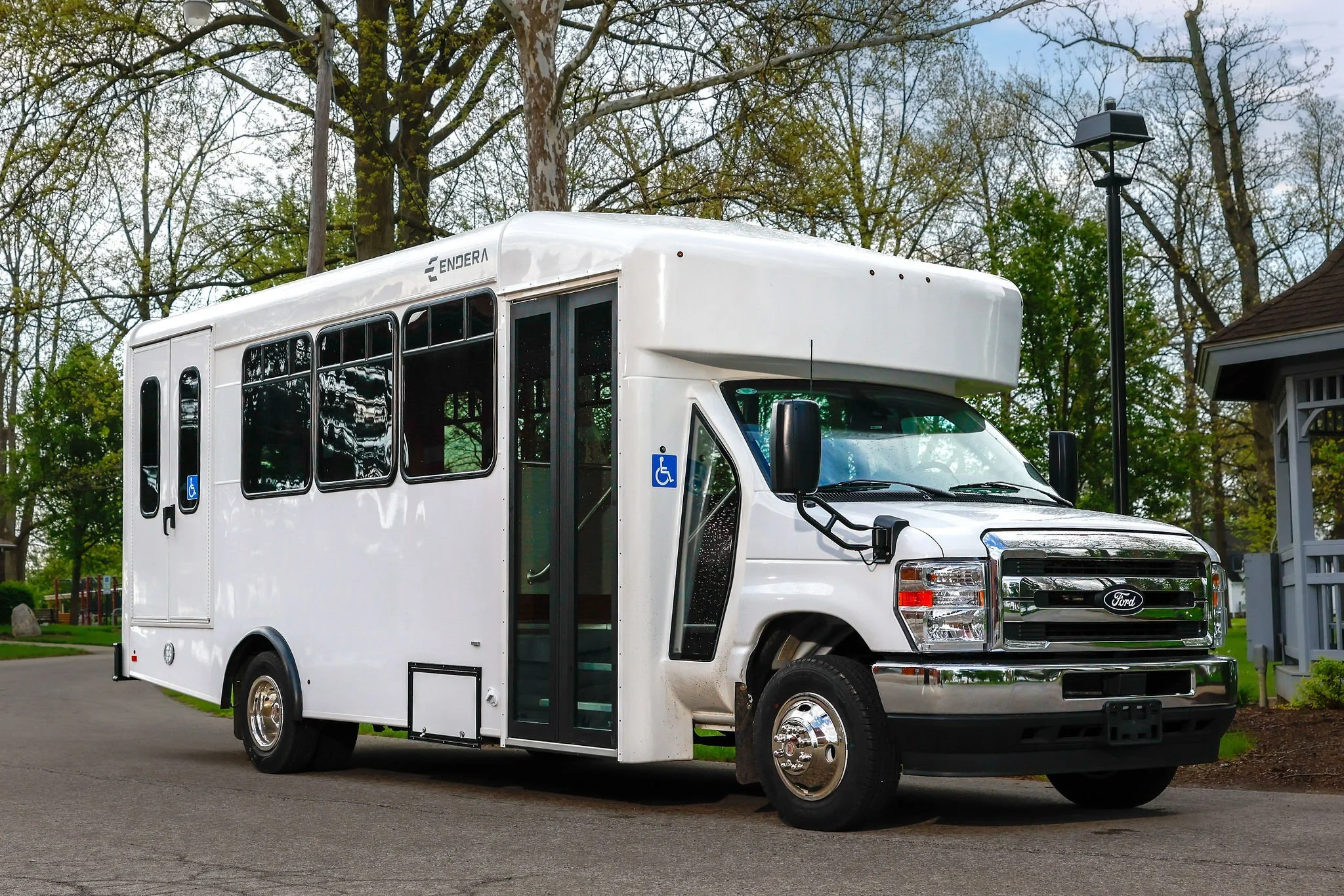
Tennessee's shuttle market is driven by hospitality, logistics, healthcare, corporate campuses, and year-round tourism in areas like Nashville, Memphis, Knoxville, Chattanooga, and the Smoky Mountains. Operators need vehicles that handle long days, high turnover, and irregular schedules. Downtime on hotel or airport routes during peak demand has an immediate operational impact.
Endera builds the B-Series shuttle from the ground up — chassis integration, powertrain, body, and software — at its 250,000-square-foot facility in Ottawa, Ohio. No upfitter chain, no split warranty, one team accountable for the entire vehicle. For Tennessee operators where downtime translates directly to missed revenue or stranded passengers, that accountability matters more than the next manufacturer's sales pitch.
Ready to optimize your routes? Contact Endera's fleet specialists today to design a custom configuration blueprint for your Tennessee operation.
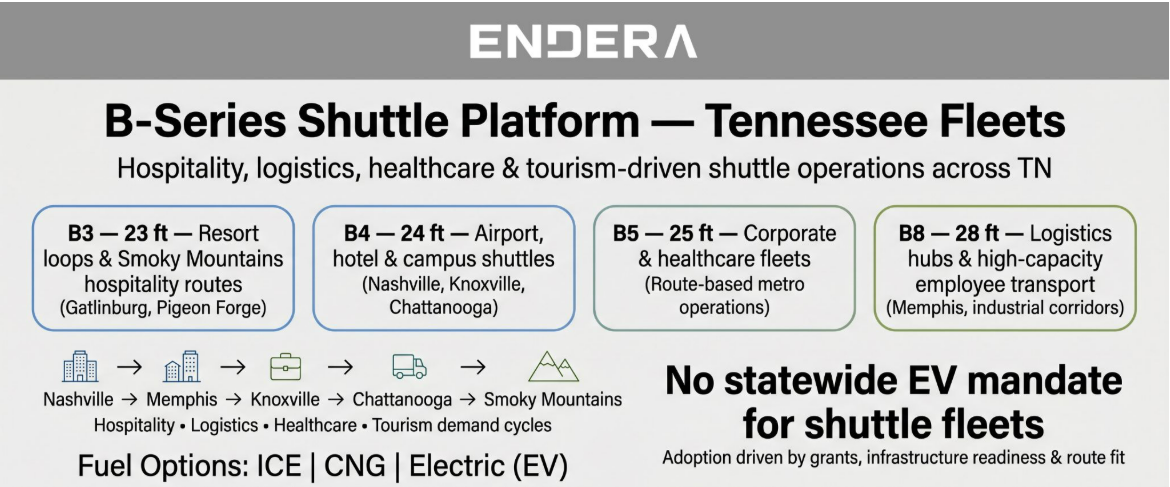
The Endera B-Series Lineup for Tennessee Fleets
Four Models for Different Operations
The B-Series spans 23 to 28 feet across four models, covering everything from compact hotel loops in downtown Nashville to high-capacity employee shuttles at Memphis distribution hubs. Every model is built on Ford E450 or Chevrolet Express cutaway chassis — platforms Tennessee service networks already support, which matters when a vehicle needs attention between runs rather than at a scheduled service appointment.
Matching the Model to the Route
The B3 (23 ft) handles compact urban routes and smaller hotel operations where maneuverability in tight drop-off zones matters. The B4 (24 ft) and B5 (25 ft) are available in both ICE and full-electric configurations, making them well suited for airport ground transport, university campuses, and corporate fleets across the state. The B8 (28 ft) covers higher-capacity needs where ridership demands more room without moving to a full transit bus platform.
Electric or ICE — What Tennessee Operators Need to Know
Tennessee's Climate Works in Both Directions
Tennessee sits in a middle ground climatically — winters are mild enough across most of the state that cold-weather battery performance isn't the concern it is further north, but summer heat and humidity in Memphis and Nashville are worth factoring into system planning. For most Tennessee operations, climate doesn't create major barriers to EV adoption. The decision comes down to route profile and infrastructure readiness, not weather.
Where Electric Makes Sense in Tennessee
For structured, depot-based routes — Nashville airport shuttles, hotel loops, university campus circulators — the B4 and B5 electric models are a strong operational fit. Predictable mileage, centralized charging, and stable fuel cost exposure make the operating economics increasingly favorable compared to conventional fuel. Tennessee is also home to a growing EV charging network supported by both state programs and TVA-backed infrastructure investment, with the Tennessee Electric Vehicle Infrastructure program expanding DC fast charger coverage across the state's major corridors.
Where ICE and CNG Still Make Sense
For longer rural corridors, logistics hub connections, or operations without reliable depot infrastructure, ICE and CNG configurations remain the practical choice. Endera's dual-track production means Tennessee operators can mix powertrains across their fleet without switching manufacturers — running electric where it works and conventional fuel where it doesn't. That flexibility is built into the B-Series platform by design, not offered reluctantly.
Which B-Series Model Fits Your Tennessee Route?
Nashville and the Mid-State
Nashville's shuttle market is one of the fastest-growing in the Southeast. Between BNA airport operations, the downtown hotel circuit, and a corporate campus expansion driven by companies relocating to the region, there's genuine diversity in the duty cycles operators are running day to day. The B4 and B5 cover the majority of these applications, with electric configurations well suited to the structured, depot-charged routes that dominate airport and hotel operations in a market where routes are predictable and overnight charging is easy to plan around.
Memphis and West Tennessee
Memphis operations skew toward logistics, healthcare, and employee transport — routes that tend to be longer and less structured than Nashville's hospitality-driven market. ICE and CNG configurations are the more practical fit for most West Tennessee operations today. That said, the Alternative Fuels Data Center tracks active Tennessee incentive programs for commercial EV and alternative-fuel fleet adoption, and the picture for Memphis metro operators is shifting as infrastructure investment reaches the western part of the state.
Knoxville, Chattanooga, and East Tennessee
Knoxville's University of Tennessee corridor and Chattanooga's corporate and tourism base drive steady shuttle demand in East Tennessee. Campus circulators, hotel loops, and corporate routes align well with B4 and B5 vehicles. Chattanooga is also active in transit electrification, supported by TDEC Volkswagen Settlement funding. Mountainous terrain in the region should be considered in EV range planning for routes extending beyond urban cores.
Smoky Mountains and Tourism Routes
For resort shuttles, attraction circulators, and hotel operations in Gatlinburg, Pigeon Forge, and the broader Smoky Mountains corridor, the B3 and B4 handle most applications. These routes are typically short and high-frequency during peak season, with significant demand fluctuation between summer and winter months. Endera's capital leasing option is worth a serious look for operators who want to right-size their financial commitment to actual annual utilization rather than peak-season projections.
Grants and Financing for Tennessee Fleets
Two Programs Worth Knowing Before You Buy
Tennessee operators have access to meaningful state-level grant funding that most manufacturers don't actively help them navigate. The difference between accessing these programs and missing them often comes down to whether a fleet engaged with the application process early enough — not whether they were eligible.
The first is TDEC's Medium- and Heavy-Duty Vehicle Grant Program, funded through Tennessee's allocation of the Volkswagen Diesel Settlement Environmental Mitigation Trust. This program provides financial assistance to public, nonprofit, and private fleets to replace eligible Class 4–8 shuttle and transit buses with alternate-fuel or all-electric vehicles — covering up to 90% of project costs for all-electric purchases. Both public and private operators — including hotels, healthcare systems, and corporate fleets — are eligible to apply.
The second is the federal EPA Clean School Bus Program for qualifying student transport operations, and FTA formula grants available to public transit agencies and qualifying contracted operators. For Nashville and Memphis metro operators in particular, regional air quality programs connected to ozone nonattainment designations may open additional incentive pathways. Endera's grant advisory team helps Tennessee operators identify which programs apply to their specific operation structure and manages the application process directly — removing the administrative burden that causes most smaller fleets to leave available funding unclaimed.
Flexible Options for Every Operator Type
Beyond grants, Endera's financing options include direct vehicle financing and capital leasing. For Tennessee's tourism and hospitality operators — where shuttle utilization peaks sharply in summer and tapers in the off-season — leasing preserves capital during slower months in a way that outright purchase doesn't. A Smoky Mountains resort running three times the shuttle volume in July compared to January has a fundamentally different cash flow profile than a year-round airport contractor, and the financing structure should reflect that difference.
Software and Infrastructure Included
Fleet Management From Day One
Every Endera B-Series shuttle comes available with Endera Dispatch — built in-house and integrated directly with the vehicle's hardware. Tennessee fleet managers get real-time vehicle tracking, route analytics, and maintenance scheduling without a separate telematics platform or third-party integration. Because the software is built by the same team that built the vehicle, the operational data it surfaces reflects how the bus actually performs across real routes — not adapted from a platform designed for a different vehicle class.
The Passenger Experience
Endera Go gives riders real-time shuttle tracking and ETA updates. For Nashville's hotel and entertainment district operations — where guests are often navigating an unfamiliar city under time pressure — that visibility is a practical improvement to the guest experience. For corporate campuses and healthcare shuttles where riders expect schedule reliability, it also reduces inbound calls to dispatch from passengers who don't know where the vehicle is.
Charging Infrastructure for EV Buyers
For Tennessee operators selecting electric models, Endera provides full turnkey charging support — site assessment, charger procurement, and installation. One vendor handles the vehicle and the charging setup, which simplifies the project for operators who don't have dedicated infrastructure staff to manage a separate contractor. It also simplifies capital approval: a single turnkey proposal for a board or ownership review is a cleaner ask than a split-scope arrangement with two separate vendors and two separate timelines.
Get Your Fleet Spec'd
From BNA's airport ground transport to resort loops in the Smokies and employee shuttles across Memphis's logistics corridor, Tennessee shuttle operations run hard across a wide range of environments. Endera's B-Series is built as a complete system — not assembled by multiple vendors — and backed by a team that understands what fleet operators actually need from a manufacturer, and what funding is available to help them get there.
To explore configurations, check availability, and find out what funding your Tennessee operation may qualify for, contact Endera's sales team.
FAQs
Does Endera sell shuttle buses in Tennessee?
Yes. Endera sells new B-Series shuttle buses to fleet operators throughout Tennessee, including airport operations, hotels and resorts, healthcare campuses, universities, logistics operators, and corporate fleets. The sales team can walk through configurations, financing, and applicable grant funding for your specific operation.
What B-Series models are available for Tennessee operators?
Tennessee operators can choose from the B3 (23 ft, ICE), B4 (24 ft, ICE or EV), B5 (25 ft, ICE or EV), and B8 (28 ft, ICE). The right model depends on route profile, ridership volume, and depot infrastructure. See the full B-Series lineup for specs.
Does Tennessee's climate affect electric shuttle performance?
Tennessee's climate is generally favorable for EV operation — mild winters mean cold-weather range loss is less of a concern than in northern states. Summer heat in Memphis and Nashville is worth factoring into system planning, but doesn't typically create significant operational barriers. Route profile and depot infrastructure are the primary decision drivers for most Tennessee operators.
Are Endera shuttles eligible for Tennessee grant funding?
Yes. Tennessee operators may qualify for TDEC's VW Settlement Medium- and Heavy-Duty Vehicle Grant Program, which covers Class 4–8 shuttle bus replacement with alternate-fuel or all-electric vehicles — up to 90% of costs for EV projects. Both public and private fleets are eligible. Endera's grant advisory team helps operators identify applicable programs and manages the process directly.
How does Tennessee public procurement work for shuttle buses?
Public agencies procure through Tennessee Department of General Services-governed processes and cooperative purchasing programs including NASPO ValuePoint and Sourcewell. Agencies using federal funding must comply with FTA procurement requirements. Endera's sales team supports documentation across all procurement pathways.
Does Endera provide charging infrastructure for Tennessee EV buyers?
Yes. Endera provides full turnkey charging infrastructure — site assessment, charger procurement, and installation — as part of its EV offering. Tennessee operators work with one vendor for both the vehicle and the charging setup.
What software comes with an Endera shuttle bus?
Every Endera B-Series shuttle comes available with Endera Go (real-time passenger tracking and ETA) and Endera Dispatch (fleet management, routing, and vehicle health analytics), both built in-house and integrated directly with the vehicle's hardware.