
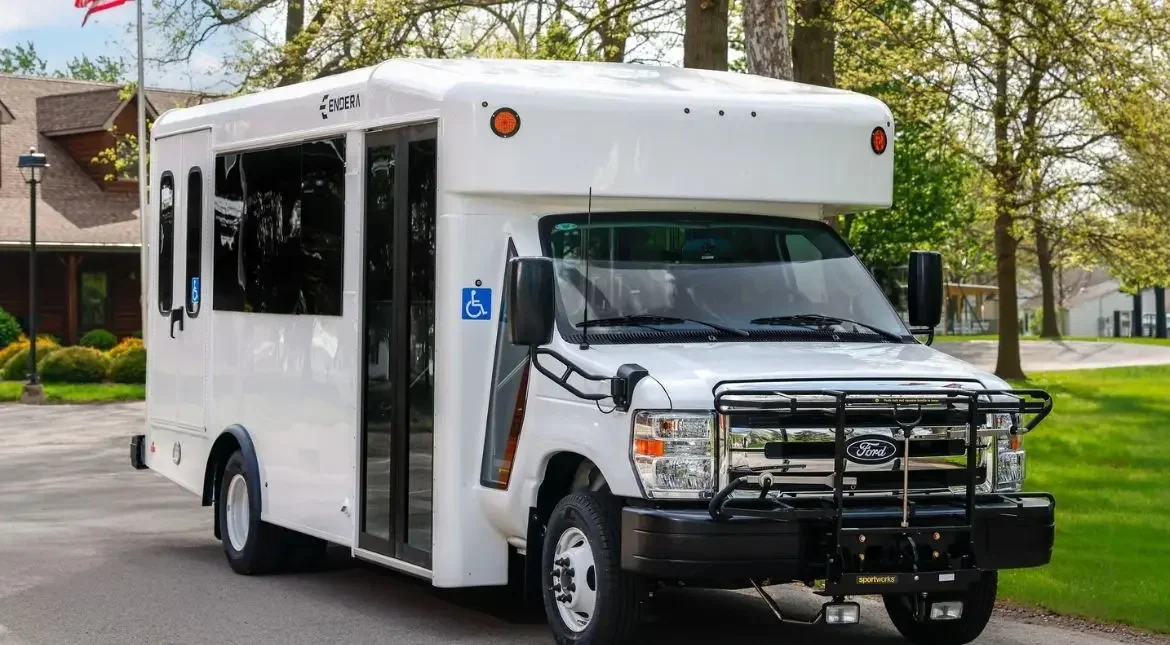
Accessibility Built Into the Floor Plan, Not Added to It
When Lift Placement Is an Afterthought, Capacity Pays the Price
Most body builders working on a Ford E450 or GM cutaway chassis start from a fixed floor plan and adapt it for accessibility — a lift gets specified, securement tracks get installed, and aisle width becomes whatever space is left over. The result is a vehicle where accessible features and passenger capacity compete with each other rather than being designed around the same layout. Endera builds the B-Series commercial shuttle and Type A school bus as a vertically integrated OEM — body and powertrain assembled under one roof in Ottawa, Ohio — which means lift placement, securement position, aisle width, and seating section layout are first-order design decisions, not field modifications.
One Manufacturer, One Accountability Structure
Organizations buying ADA-accessible shuttles are solving specific needs — from senior living transportation and university campus transit to NEMT providers and public transit agencies. Each has different capacity, usage, and compliance requirements. Endera’s configurable floor plans across the B-Series and Type A school bus line are designed to meet those varied needs instead of forcing a one-size-fits-all accessible layout.
Ready to spec your fleet? Contact Endera's fleet specialists today to design a custom configuration blueprint for your operation.
B-Series vs. Type A: Choosing the Right Platform
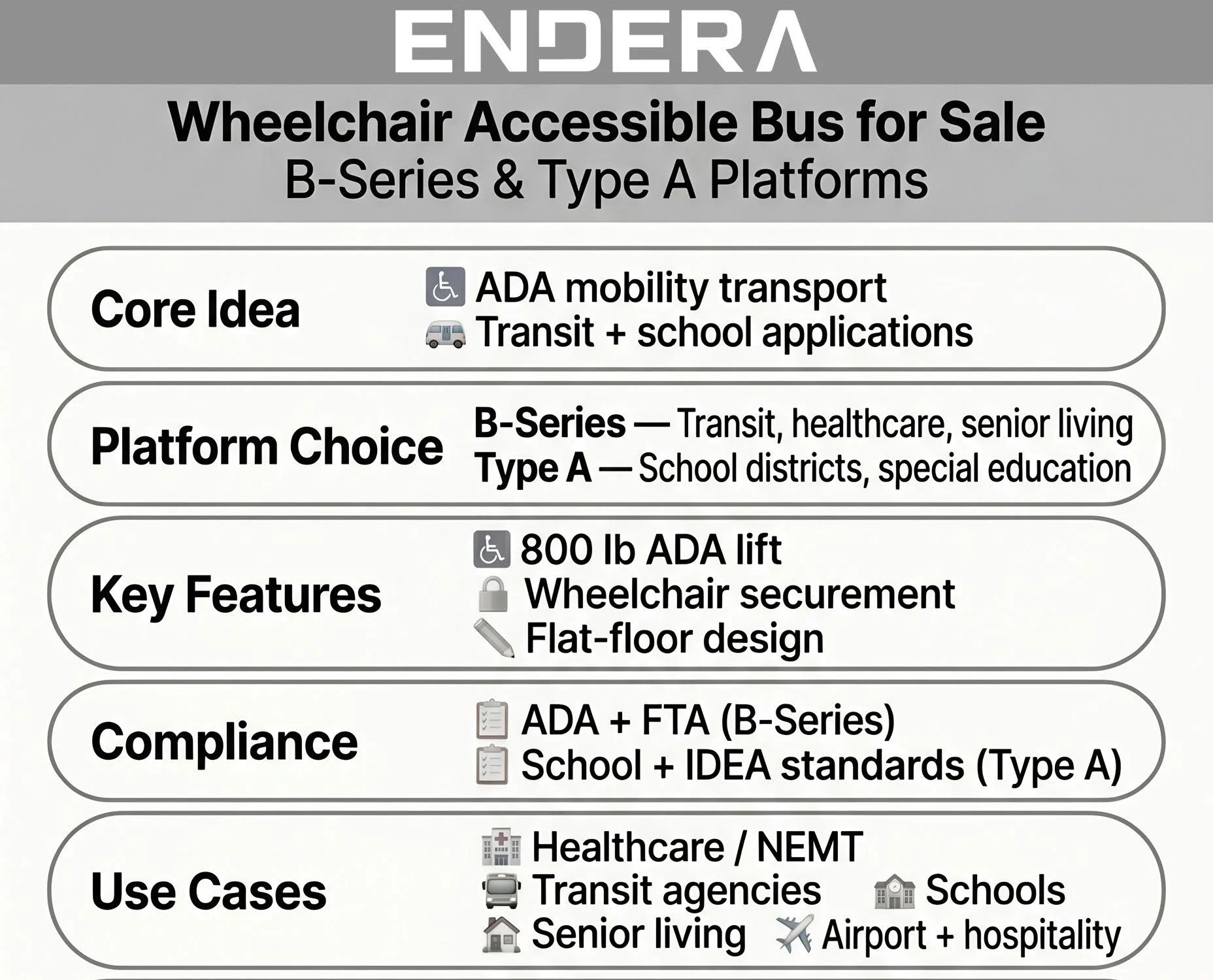
The B-Series and Type A models share a flat-floor design and ADA lift capability, but serve different operational environments. Understanding which fits your use case is the starting point for any accessible fleet purchase.
| Feature | B-Series Shuttle | Type A School Bus |
|---|---|---|
| Primary market | Transit, healthcare, hospitality, senior living | School districts, special education, childcare |
| GVWR | 14,500 lbs | 14,500 lbs |
| Models | B3, B4, B5, B8 | Endera 4, 5, 6 |
| Powertrain | ICE, Propane, CNG, Electric | ICE, Propane, CNG, Electric |
| ADA lift | 800 lb Braun (standard) | 800 lb Braun (standard) |
| Compliance framework | FTA Part 37, ADA Title II/III | FMVSS, state school bus standards, IDEA |
Both platforms are built on Ford E450 and Chevrolet Express cutaway chassis and receive OEM-installed accessibility equipment at the manufacturing stage — not as aftermarket additions. That distinction matters for warranty accountability, compliance documentation, and long-term service reliability: one manufacturer, one warranty, one point of contact for any post-sale issue.
Why OEM Installation Matters for Accessible Fleets
Post-sale upfitter modifications split accountability between the chassis manufacturer and the body modifier — creating gaps in warranty coverage precisely where accessible fleet operators need clarity most. When a lift system fails on an OEM-installed vehicle, the manufacturer owns the issue.
When it fails on a retrofitted vehicle, the question of who is responsible can delay resolution and increase downtime. For healthcare and transit operators whose passengers depend on that equipment daily, that accountability difference has operational consequences beyond the paperwork.
What "ADA-Ready" Actually Means
Most pages describe accessible buses as "ADA compliant" without explaining what that requires. Official ADA vehicle accessibility guidance and ADA accessibility standards define the engineering requirements — lift platform dimensions, aisle clearance minimums, door opening widths, handrail placement, and floor-surface specifications.
ADA accessible transportation requirements extend to maneuvering space, pull-cord accessibility, and usability standards for passengers with varying mobility limitations. A vehicle with a lift that doesn't meet platform size requirements, or aisle widths that prevent safe wheelchair maneuvering, doesn't satisfy ADA compliance regardless of how it's marketed.
Federal Engineering Standards
Federal ADA vehicle accessibility guidelines set the standard that OEM manufacturing must meet. Access Board demand-response vehicle accessibility rules specifically cover the vehicle configurations used in paratransit and community transit applications — the same formats Endera's B-Series and Type A models are built for.
Wheelchair Securement: How It Works and Why It Matters
Boarding is only half the compliance requirement. DOT wheelchair securement rules mandate four-point tie-down securement with separate occupant shoulder and lap restraints. ADA securement interpretation guidance clarifies the legal expectations for tie-down geometry and passenger protection during transit.
Wheelchair transportation safety guidance from United Spinal reinforces that securement systems must accommodate the actual mobility devices passengers use — not just an average wheelchair profile.
Lift Capacity and Power Wheelchair Accommodation
The 800 lb Braun lift capacity on Endera's standard configurations accommodates power wheelchairs and heavier mobility equipment that lighter-rated systems can't safely handle. For NEMT and healthcare operators, this matters practically — dialysis patients often use power wheelchairs that exceed the rated capacity of lighter commercial lift systems. A lift failure during medical transport carries patient safety implications that a lift failure in a hotel shuttle doesn't.
Who Uses Wheelchair Accessible Buses
ADA transportation obligations apply to a wider range of operators than most buyers realize. The Northeast ADA Center's overview of transportation providers clarifies how accessibility requirements extend across both public and private sectors.
Common buyer profiles include:
Transit agencies — demand-response and complementary paratransit under ADA Title II obligations
Healthcare and NEMT — dialysis transport, hospital discharge programs, rehabilitation center shuttles
Senior living communities — resident mobility for appointments, activities, and errands
School districts — special education routes under IDEA and ADA requirements
Airports and hospitality — ground transportation for travelers with mobility needs
Churches and nonprofits — community mobility programs for members with disabilities
Universities — campus paratransit for students with disabilities under ADA Title II
Healthcare, NEMT, and the Aging Population
Research on transportation barriers to healthcare access documents measurable clinical impact — missed dialysis appointments and delayed discharge are directly tied to inadequate accessible vehicle fleets. Healthcare transportation accessibility research reinforces that healthcare systems investing in purpose-built accessible vehicles reduce friction in care pathways.
The demographic pressure behind accessible fleet demand isn't cyclical. NADTC aging and disability transportation data and research on older adult public transportation use document consistent structural growth in accessible transit demand.
The Mobility Gap in Aging America
The West Health mobility crisis analysis frames the transportation gap for aging Americans as an active investment priority — not a niche market. Transit agencies, healthcare providers, and senior living operators are buying accessible vehicles because their passenger populations require them, and because compliance obligations attach to that requirement.
Paratransit and Demand-Response Operations
ADA complementary paratransit requirements define the service standards transit agencies must meet — origin-to-destination service within three-quarters of a mile of fixed routes at comparable fares and hours. NADTC ADA paratransit operational standards outline rider eligibility, service coverage, and operational compliance expectations.
Driver assistance obligations define what operators must do at boarding and alighting — requirements that make vehicle layout decisions as operationally significant as equipment specifications. The Omnitrans ADA paratransit rider guide and Community Rides ADA service guide document how real-world boarding, securement, and rider accommodation workflows shape fleet configuration decisions.
Rural Paratransit Considerations
Rural demand-response operations require flexible, multi-purpose accessible vehicles capable of longer routes with lower trip density. ICE and propane configurations serve rural demand-response well — broad parts availability, no charging infrastructure dependency, and configurable seating that handles the varied loads typical of rural service days.
Electric Accessible Shuttles and School Buses
Both the B-Series and Type A models are available in full-electric configurations on the same 14,500 lb GVWR platform. Electric drivetrains produce significantly less cabin noise than diesel equivalents — reducing sensory stress for passengers with autism spectrum conditions, dementia, or anxiety during transport.
Endera's grant navigation services help operators identify applicable federal and state programs for accessible fleet electrification. Both platforms are FTA-eligible and Buy America compliant, meeting the federal procurement requirements attached to accessible transit and school bus funding programs.
Ready to Spec an Accessible Bus for Your Fleet?
New 2026 ADA-configured B-Series and Type A models are available for immediate delivery through Endera Stock. For operators working within formal procurement cycles, Endera provides full specification documentation, ADA compliance materials, and Buy America certification.
Contact Endera's fleet specialists to discuss accessible fleet configuration, lift specifications, or financing.
Frequently Asked Questions
What is the difference between the B-Series and Type A for wheelchair accessible applications?
The B-Series serves commercial and institutional operators — transit agencies, healthcare systems, senior living, hospitality. Type A school buses serve school districts and special education programs. Both have the same 800 lb Braun lift, but operate under different compliance frameworks: FTA Part 37 for the B-Series, and state school bus standards plus IDEA for Type A.
How many wheelchair positions fit in an accessible B-Series or Type A bus?
Standard configurations support two to four securement positions. Common layouts are 2-wheelchair/6-ambulatory for mixed loads and 4-wheelchair/2-ambulatory for routes serving primarily wheelchair users. Configurations are specified at the order stage to match actual passenger population requirements.
What is the difference between a wheelchair lift and a ramp?
Lifts are hydraulic platforms that lower to ground level and raise to floor height — accommodating power wheelchairs and heavier mobility devices across variable boarding environments. Ramps suit lighter manual wheelchairs at controlled low-curb stops but are less appropriate for power wheelchair weights. For NEMT and senior living fleets, lifts are the operationally safer specification.
Do wheelchair accessible buses require a CDL?
Most B-Series and Type A configurations fall below the federal CDL threshold — under 26,001 lbs GVWR and fewer than 16 passengers including the driver. For-hire commercial transport may add state-specific licensing requirements. Operators should confirm applicable rules for their route type and compensation model.
Are electric wheelchair accessible buses available from Endera?
Yes. Both the B-Series and Type A are available in full-electric configurations. DC fast charging is standard on every EV unit. Electric models reduce maintenance spend and produce quieter cabin environments that benefit passengers with sensory sensitivities.
What federal funding programs support wheelchair accessible bus purchases?
FTA Section 5310 funds accessible vehicle purchases for operators serving seniors and people with disabilities. FTA Bus and Bus Facilities grants and Low-No Emission grants are accessible to qualifying transit operators. Endera's vehicles are Buy America compliant and FTA-eligible. Grant navigation services help operators identify applicable programs based on ownership structure.
What driver training is required for wheelchair accessible bus operations?
ADA regulations require drivers to provide assistance at boarding and alighting, operate lift equipment correctly, and secure wheelchairs using four-point tie-down systems. DOT driver assistance obligations apply to both transit and commercial for-hire operators. Proper securement training is standard in accessible fleet driver onboarding.