
Accessibility Built Into the Floor Plan, Not Added to It
When Lift Placement Is an Afterthought, Capacity Pays the Price
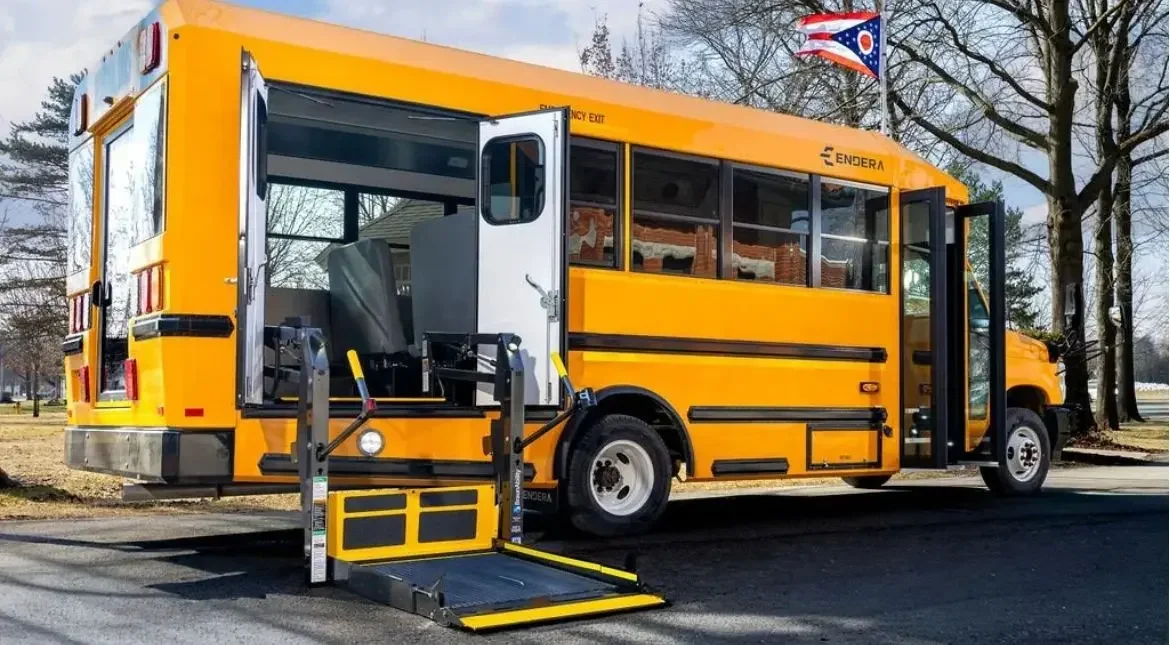
Most body builders working on a Ford E450 or GM cutaway chassis start from a fixed floor plan and adapt it for accessibility — a lift gets specified, securement tracks get installed, and aisle width becomes whatever space is left over. The result is a vehicle where accessible features and passenger capacity compete with each other rather than being designed around the same layout. Endera builds the B-Series commercial shuttle and Type A school bus as a vertically integrated OEM — body and powertrain assembled under one roof in Ottawa, Ohio — which means lift placement, securement position, aisle width, and seating section layout are first-order design decisions, not field modifications.
One Manufacturer, One Accountability Structure
Organizations buying ADA-accessible shuttles are solving specific needs — from senior living transportation and university campus transit to NEMT providers and public transit agencies. Each has different capacity, usage, and compliance requirements. Endera’s configurable floor plans across the B-Series and Type A school bus line are designed to meet those varied needs instead of forcing a one-size-fits-all accessible layout.
Ready to spec your fleet? Contact Endera's fleet specialists today to design a custom configuration blueprint for your operation.
What Federal ADA Requirements Actually Require
The Regulatory Framework: 49 CFR Part 38
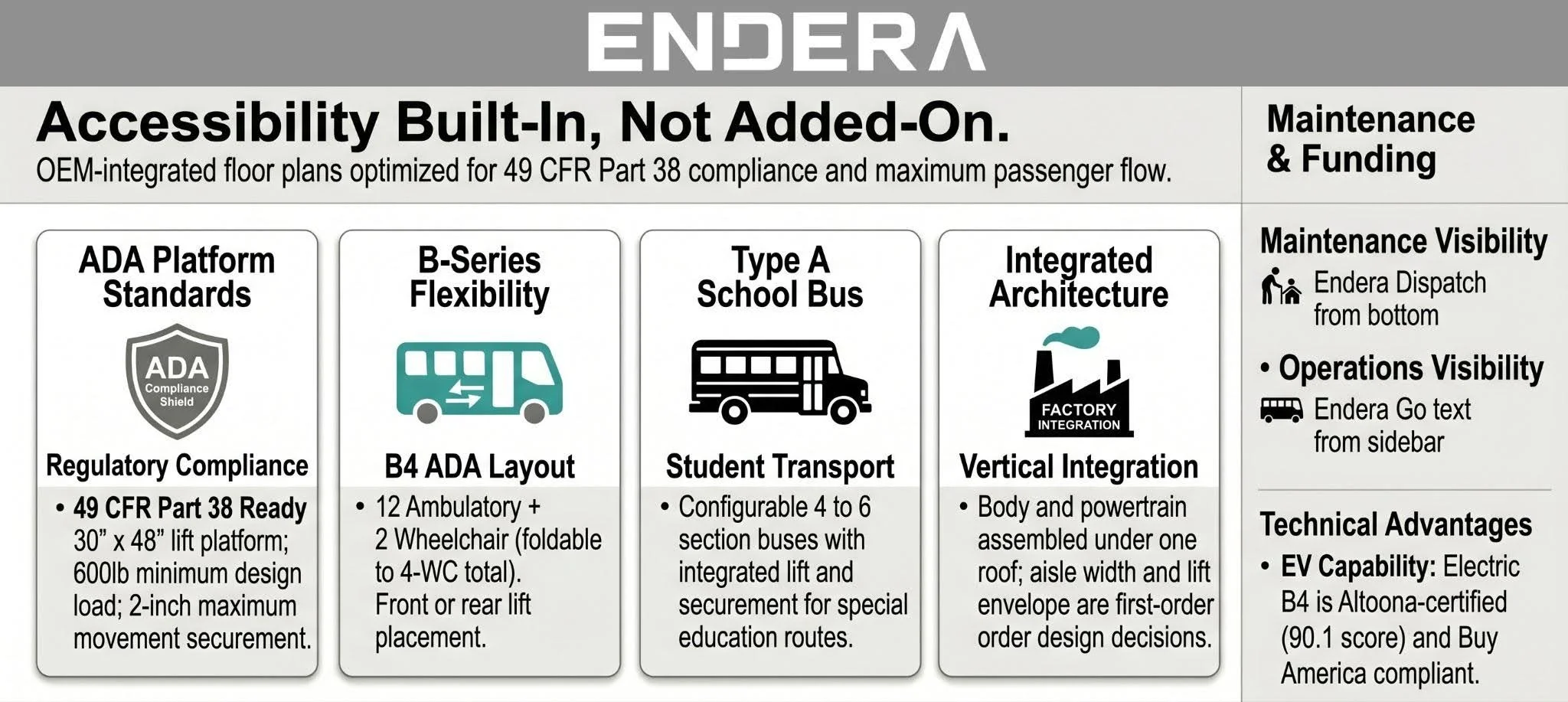
Federal ADA accessibility requirements for transit vehicles are governed by 49 CFR Part 38, which establishes technical standards for lifts, ramps, securement systems, handrails, and aisle dimensions. Vehicles over 22 feet must accommodate at least two wheelchair securement positions; vehicles 22 feet and under must accommodate at least one. The securement system must limit movement of an occupied wheelchair to no more than two inches in any direction under normal operating conditions, and must include a separate seatbelt and shoulder harness for the wheelchair occupant.
Lift Requirements and What They Mean in Practice
The lift platform minimum under 49 CFR Part 38 is 30 inches by 48 inches — sized to accommodate standard wheelchairs and most power mobility devices. The lift must support 600 pounds with a safety factor of at least six. Handrails must be provided at 30 to 38 inches in height with a minimum 8-inch usable length. For fleet operators, the practical implication is that lift specification and placement need to be evaluated before purchase, not after — a vehicle with a lift that doesn't meet Part 38 or that's positioned in a way that restricts aisle access creates compliance exposure for publicly funded operations.
Maintenance Requirements for Accessible Features
DOT's ADA regulations under 49 CFR Part 37 require operators to maintain all accessibility features — lifts, securement devices, signage, and communication systems — in operative condition. When an accessibility feature is out of service, operators are required to take reasonable steps to accommodate riders who would otherwise use it. For fleet managers, that means accessibility feature reliability isn't just a passenger service issue — it's a compliance obligation that can trigger liability exposure if features fail and aren't repaired promptly.
OEM EV vs. Conversion ADA Shuttle Architecture
How the Build Approach Affects Real-World Usability
A key distinction in the ADA shuttle market is whether a vehicle is built on a purpose-built OEM electric platform or adapted from a cutaway chassis conversion. While both can be configured to meet ADA requirements under federal standards, the way those requirements are achieved has a direct impact on usability, safety, and long-term performance. In conversion-based ADA shuttles, accessibility features are typically added after the base vehicle architecture is already defined — a lift system installed into a pre-existing floor structure, securement zones configured around drivetrain placement, step height, and fixed structural cross-members.
What "Overlay" Accessibility Looks Like in Practice
That approach often leads to compromises in aisle geometry, turning radius for mobility devices, and the balance between seating capacity and accessible positions. OEM-integrated electric shuttle platforms, by contrast, incorporate aisle width, securement geometry, and lift envelope into the structural design from the beginning rather than adapting afterward. This allows the manufacturer to optimize both passenger flow and ADA compliance simultaneously, instead of trading one against the other.
What Federal Standards Do — and Don't — Require
49 CFR Part 38 establishes minimum requirements for boarding devices, securement systems, and interior circulation in transit vehicles, but it does not dictate how those systems must be structurally integrated. The regulatory baseline is the same whether a vehicle is purpose-built or converted — which means the engineering approach can significantly influence real-world usability even when both configurations meet the same compliance threshold. For buyers evaluating accessible shuttles, that distinction is worth understanding before a purchase decision is made.
Endera's ADA Configuration Options
B-Series Shuttle: Front and Rear Lift Placement
The B-Series commercial shuttle is available in ADA-configured floor plans with wheelchair lift placement at either the front or rear of the vehicle. The B4 (24 feet) accommodates up to 12 ambulatory passengers plus two wheelchair positions in a standard ADA configuration, with the option to fold additional seats to accommodate up to four wheelchairs when needed.
Aisle width, handrail placement, and securement track positioning are designed into the floor plan rather than adapted from a non-accessible base layout. Available in both ICE and electric variants, the B-Series ADA configuration serves airport ground transport, senior living facilities, corporate campus programs, and public transit routes.
Type A School Bus: ADA Options for Student Transport
Endera's Type A school bus lineup — the Endera 4, 5, and 6 — is configurable with ADA-compliant lift and securement options for special education routes and student transport programs serving riders with mobility limitations. Districts can select from 4 to 6 section configurations, choosing lift placement location, securement quantity, and seating layout in combination. Because Endera controls the floor plan as the vertically integrated manufacturer, these configurations are build decisions rather than field modifications — which means the structural and accessibility design are integrated from the start rather than adapted after assembly.
What Vertical Integration Means for ADA Buyers
Most body builders adapting a standard floor plan for accessibility are working within constraints set before the accessibility decision was made. Endera's vertical integration — body and powertrain developed in-house — means the accessible floor plan is a first-order design decision.
Single-Vendor Accountability in Practice
For ADA buyers, that matters in two concrete ways: the lift and securement system are positioned to maximize both accessibility and remaining passenger capacity, and there is one manufacturer accountable for the entire vehicle rather than a chassis supplier, a body builder, and a separate accessibility equipment installer.
Funding and Procurement for ADA-Accessible Shuttles
FTA Programs for Accessible Transit
The FTA Low or No Emission Vehicle Program and the Buses and Bus Facilities Program both fund accessible transit vehicle purchases for eligible operators. For NEMT providers, Medicaid administrative matching funds can offset vehicle acquisition costs when the purchase is documented within the appropriate program framework. Endera assists operators in identifying applicable funding and managing the application process directly — removing the administrative burden from fleet managers and transportation directors who are managing procurement alongside daily operational responsibilities.
Section 5310: Enhanced Mobility for Seniors and Individuals With Disabilities
The FTA Section 5310 program provides formula funding specifically to support the mobility of seniors and individuals with disabilities — either through capital funding for vehicles and equipment, or operating assistance for transportation services. Eligible recipients include states, designated recipients, and nonprofit organizations. For senior living operators, NEMT providers, and community organizations that don't qualify for standard transit capital programs, Section 5310 is often the most direct funding pathway for accessible vehicle acquisition. Endera's team works with buyers to assess program eligibility before the purchase process begins.
How Endera's ADA Shuttle Compares to Other Options
What the Accessible Shuttle Market Offers
The accessible shuttle market has several established competitors. Glaval Bus specializes in customized ADA-compliant commercial buses across a wide length range and has deep experience in the NEMT and paratransit segment. Collins Bus — now part of Forest River — brings Type A school bus expertise into the accessible commercial market. Both are legitimate options for buyers who prioritize established dealer relationships, customization depth, or specific body configurations that fall outside Endera's current lineup.
Where Endera's Position in the Market Is Distinct
Where Endera differs is in being a vertically integrated manufacturer — the EV powertrain, the body, and the fleet management software are all developed and assembled under one roof. For ADA buyers specifically, the integrated software stack matters: Endera Dispatch provides real-time vehicle health monitoring that supports the maintenance compliance obligations operators have under Part 37, and Endera Go provides passenger-facing real-time tracking relevant for paratransit and scheduled accessible service operations. For operators who want a single-vendor platform covering the vehicle, the EV charging infrastructure, and the fleet management software — including for ADA-configured vehicles — Endera is the only American manufacturer that offers all three from one source.
Accessibility Built Into the Vehicle, Not Added to It
For operators who need a wheelchair-accessible shuttle that holds up under daily use, meets federal requirements, and doesn't require managing separate vendors for the vehicle, the lift system, and the fleet software — Endera's ADA-configured B-Series and Type A school buses are built as complete systems by one manufacturer accountable for the whole vehicle.
Contact Endera's fleet specialists to discuss your accessibility requirements, review floor plan configurations, and find out what funding your operation may qualify for.
FAQs
1. What ADA configurations are available on Endera's B-Series shuttle?
The B-Series is available with front or rear lift placement and multiple securement configurations. The B4 in ADA configuration accommodates up to 12 ambulatory passengers plus two wheelchair positions, with fold-down seats allowing up to four wheelchair positions when needed. Contact Endera's sales team to review current floor plan options.
2. Does Endera's ADA shuttle meet 49 CFR Part 38 requirements?
Yes. Endera's ADA-configured vehicles meet the federal accessibility technical standards under 49 CFR Part 38, including lift platform dimensions, securement system specifications, handrail requirements, and aisle width standards.
3. Is the Endera ADA shuttle available in electric?
Yes. The B4 and B5 electric variants are available with ADA configurations. The electric B4 is Altoona-certified with a score of 90.1 — required for FTA-funded purchases — and Buy America compliant.
4. What funding is available for ADA-accessible shuttle purchases?
Eligible operators can access the FTA Section 5310 program for seniors and individuals with disabilities, the FTA Low or No Emission program for electric models, and the Buses and Bus Facilities program. NEMT providers may also access Medicaid matching funds. Endera's team helps buyers identify and pursue applicable programs.
5. Does Endera offer ADA configurations on its Type A school bus?
Yes. The Endera 4, 5, and 6 school buses are configurable with ADA-compliant lifts and securement systems. Districts select lift placement and securement count as part of the floor plan configuration. See the school bus lineup for current options.
6. What software supports ADA fleet compliance documentation?
Endera Dispatch provides vehicle health monitoring and maintenance tracking built into the fleet management platform. For NEMT and paratransit operators with compliance documentation requirements, Dispatch provides the operational data needed for program reporting.
7. Does Endera offer financing for ADA shuttle purchases?
Yes. Endera offers direct vehicle financing and capital leasing through its financing platform. Capital leasing preserves operating funds while building fleet capacity, which is relevant for nonprofit organizations and smaller operators managing ADA transport programs alongside other program costs.