
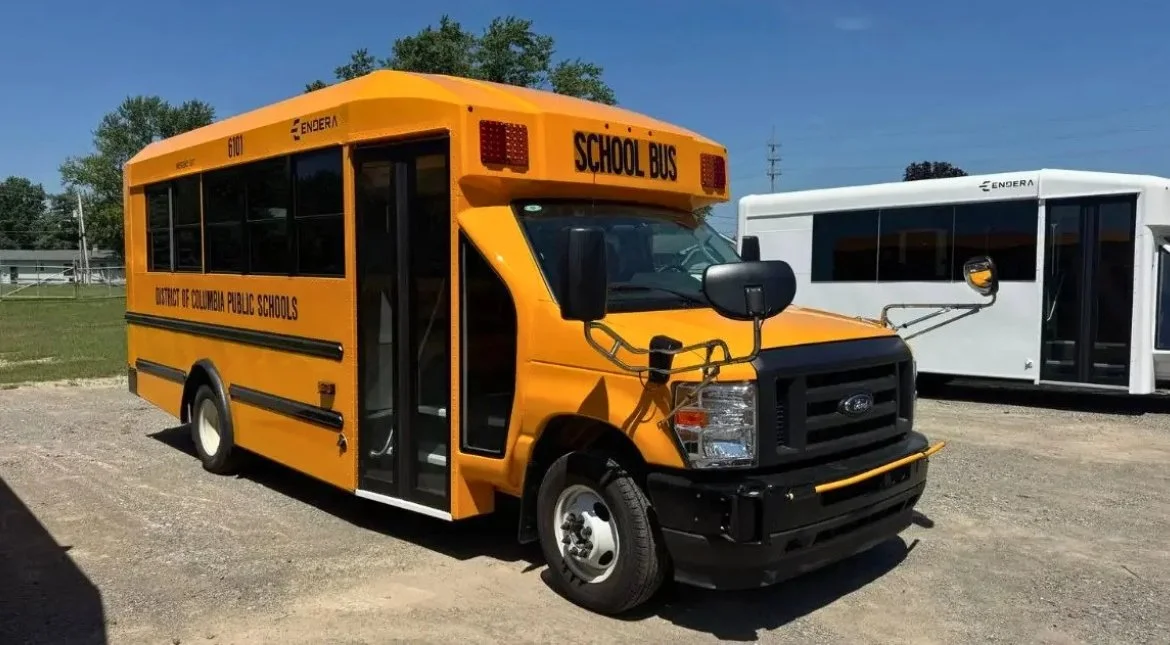
The Program Has Changed — Here Is Where It Stands
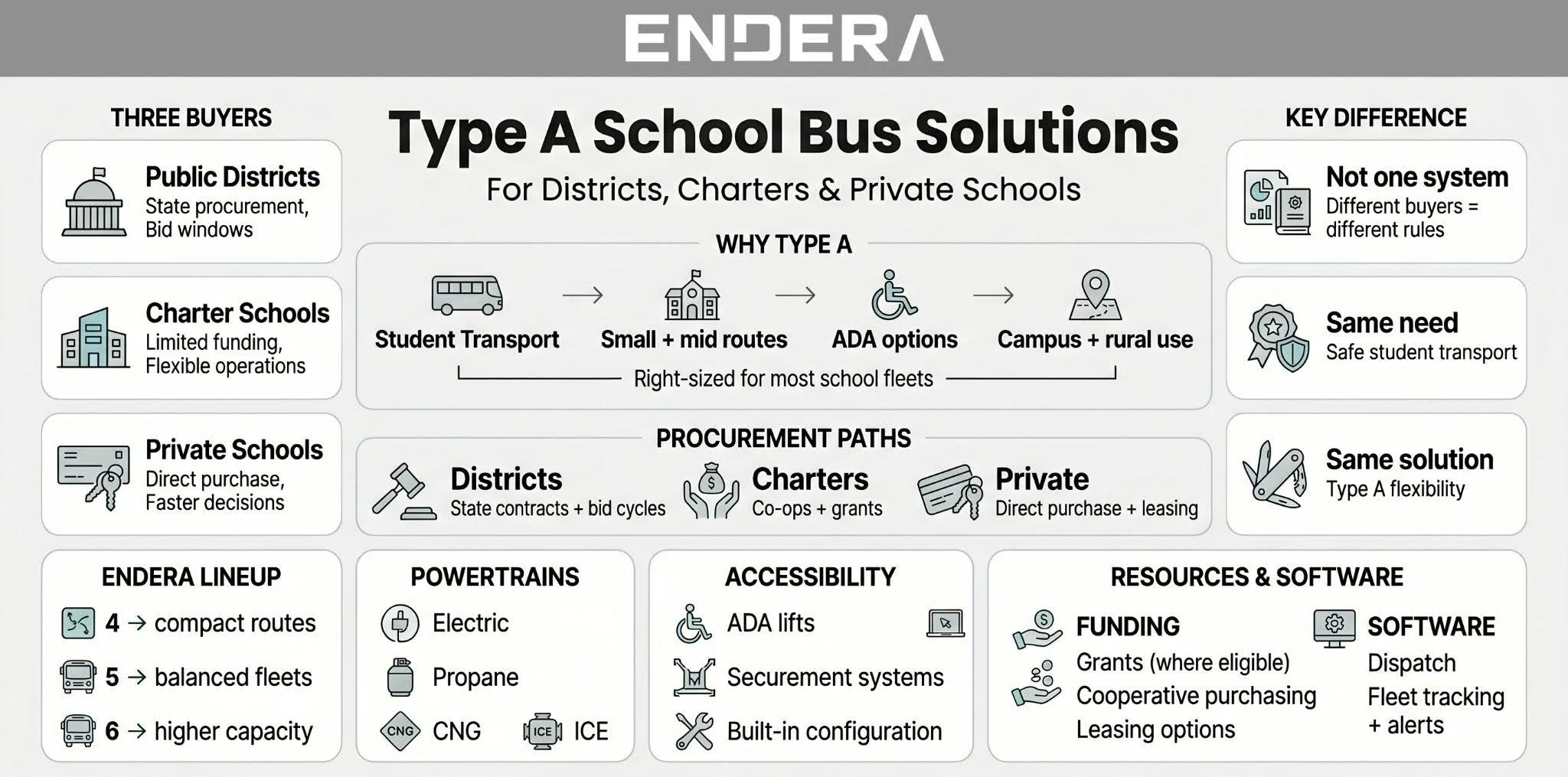
Three Operator Types, Three Different Procurement Realities
School districts, charter schools, and private schools all move students — but how they buy vehicles, how they fund them, and what compliance obligations they carry differ in ways that matter when evaluating a bus purchase. A public district working through a state ordering window operates under different constraints than a charter school managing its own fleet or a private school procuring outside the public bid system entirely.
Why Endera Serves All Three
Endera builds Type A school buses for all three operator types — the Endera 4, 5, and 6 — with configurations, powertrain options, and procurement support that fit each organization's actual situation rather than a single template.
Why Type A Is the Right Starting Point for Most of These Operations
The Type A school bus is built on a cutaway van chassis and designed for routes, environments, and student populations that don't require a full-size 40-foot conventional bus. Special education routes, lower-enrollment schools, rural pickups, and tight campus environments are all natural fits.
Operational and Staffing Advantages
For charter schools running their own transportation programs and private schools building a fleet from scratch, the Type A's lower cost, smaller operational footprint, and broader driver licensing flexibility make it a practical first vehicle in a way that a 72-passenger Type C is not.
Not sure which model or procurement path fits your organization? Endera's team works with districts, charters, and private schools alike — bring your routes and requirements and we'll help you work through the options.
Public School Districts: Procurement Structure and What It Means for Bus Selection
State Ordering Windows and Specifications
Most public school districts purchase school buses through a state-managed procurement framework. That framework typically includes a state bid or state contract with approved vendors, a minimum specification manual that buses must meet, and an annual or biennial ordering window with specific deadlines. Missing an ordering window can mean waiting an entire additional procurement cycle — operating aging buses for another year or two while the budget waits.
How Endera Fits Into State Procurement
Endera's Type A school buses are designed to meet or exceed state minimum specification standards across the markets the company serves. Because Endera builds vehicles as a vertically integrated manufacturer — constructing both the EV powertrain and the bus body at its Ottawa, Ohio facility — specification alignment is handled in-house rather than coordinated across multiple vendors. The Endera sales team works with districts ahead of ordering windows to confirm compliance, prepare documentation, and identify applicable grant funding.
Federal Funding for Public Districts
Public school districts have access to the widest range of federal and state funding for bus replacement. The EPA Clean School Bus Program — with $5 billion allocated under the Bipartisan Infrastructure Law — has been the largest single federal source, and a new 2026 grant round with expanded fuel eligibility is expected later this year.
Stacking State and Federal Incentives
State-level programs such as California's HVIP, Texas TERP/TCSB, and various clean fleet incentives available across other states can often be combined with federal funding to further reduce net purchase cost. Endera assists public district clients in navigating these programs directly, including grant application support and documentation.
Charter Schools: Transportation Funding Gaps and Fleet Ownership
The Charter School Transportation Problem
Charter school transportation is one of the more complex areas in student transportation policy. Of the 46 states with charter school laws, only 33 allocate state transportation funding for charter students, and only 17 require transportation services to be provided at all. Charter school enrollment has grown consistently, but funding structures haven't always kept pace — leaving many charter schools to fund and operate their own transportation programs with less support than neighboring public districts receive.
Why Charter Schools Often Choose to Own Their Fleet
Charter schools serving dispersed student populations often find that contracted transportation is expensive, inflexible, and difficult to schedule around the school's specific bell times and route needs. Owning a Type A bus gives a charter school direct control over schedules, driver hiring, and route design. It also gives the school an asset that can be used for field trips, extracurricular transport, and other program needs without incurring per-trip contract costs.
Procurement Options for Charter Schools
Charter schools organized as nonprofit or government-affiliated entities can often access cooperative purchasing agreements that allow them to buy from competitively bid contracts without running their own full RFP process. Programs like Sourcewell and NASPO ValuePoint include school buses in their contract portfolios, and participation is generally free for eligible public and nonprofit education organizations.
Funding Sources Available to Charter Schools
The EPA Clean School Bus Program explicitly lists public charter school districts as eligible applicants. State-level clean vehicle incentives vary in their charter school eligibility — some are limited to traditional public districts, while others extend to any educational institution. Endera's grant navigation support helps charter school administrators understand which programs apply to their specific organizational structure and state before pursuing a vehicle purchase.
Private Schools: Procurement Outside the Public Bid System
How Private Schools Buy Buses
Private schools — religious schools, independent schools, and other non-public educational institutions — generally don't operate under the same procurement rules as public entities. They aren't subject to state bid requirements and typically don't have access to public cooperative purchasing contracts unless they hold a specific eligible status. This means private schools can move faster on a purchase decision, but often pay more without the leverage that cooperative agreements provide.
What Private Schools Need From a Type A Bus
For most private schools, a Type A bus is a general-purpose student transportation vehicle — used for daily pickup routes, field trips, athletic transport, and campus-to-campus movement. A school serving students with disabilities needs ADA-compliant lift integration and securement positions built into the floor plan. A school running general education routes primarily cares about seating capacity, reliability, and cost of ownership over a multi-year service cycle.
Configuration Flexibility for Private Buyers
Endera's section-based configuration system — 4, 5, or 6 sections — lets private schools specify exactly what they need rather than adapting a fixed production template. The section count determines overall length, seating capacity, and how ADA positions fit alongside standard seating rows.
Financing Without Public Grant Access
Private schools generally don't qualify for the federal and state grant programs that reduce purchase costs for public districts and charter schools, which makes financing structure more important. Endera offers capital leasing alongside direct purchase, allowing a private school to access a new vehicle without a large upfront capital commitment — a meaningful option for independent schools managing cash flow carefully.
The Endera Type A Lineup Across All Three Operator Types
Endera 4, 5, and 6: Configuration Flexibility
The three models in Endera's school bus lineup differ by section count — 4, 5, or 6 — which determines overall length, seating capacity, and ADA configuration options. All three are available in ICE, propane, CNG, and electric powertrains. A public district with charging infrastructure and EPA funding support might spec an electric Endera 5; a charter school without clean vehicle incentives might choose a propane Endera 4 for its lower operating costs; a private school prioritizing upfront cost might select an ICE Endera 4 for a moderate-volume route.
Safety Engineering as the Constant Across All Configurations
Regardless of section count, powertrain, or operator type, Endera's school buses are built to the same structural standard — a fully welded tubular steel roll cage framework, galvanized steel cage construction for corrosion resistance, and high gloss fiberglass exterior wall material. These aren't features that vary by configuration tier; they're built into every bus that comes off the Ottawa production line.
The Vertical Integration Advantage
Endera builds both the body and the powertrain under one roof, which eliminates the structural inconsistencies that can appear when body assembly is handled by a separate upfitter working from a third-party spec. For districts and schools evaluating long-term durability and warranty accountability, a single manufacturer responsible for the entire vehicle is a meaningful distinction.
Software Included Regardless of Buyer Type
Every Endera school bus comes available with Endera Dispatch — providing real-time GPS tracking, geofence management, route performance data, and state-of-charge visibility for electric vehicles. Custom reporting tools are available at no additional cost, which supports the administrative visibility that principals, transportation coordinators, and board members ask for when the bus program is part of a budget conversation.
The Right Bus Depends on Who Is Buying It and What They Need
Public districts, charter schools, and private schools all need reliable student transportation — but the procurement path, the funding available, and the configuration requirements are different for each. Endera builds the Type A school bus lineup to serve all three, with configurations that adapt to the specific student population, a sales team that understands the procurement frameworks each operator type works within, and financing options that account for the reality that not every buyer has access to the same grant programs.
Have a conversation with Endera's team to discuss which configuration fits your organization, what procurement pathway makes sense, and what funding may be available for your specific situation.
Frequently Asked Questions
1. Can charter schools buy Endera school buses directly?
Yes. Charter schools can purchase Endera school buses directly through the Endera sales team or through dealer partners. Charter schools organized as nonprofit or government-affiliated entities may also be eligible for cooperative purchasing programs like Sourcewell, which can simplify the procurement process and provide competitive pricing without requiring an independent RFP.
2. Are private schools eligible for EPA Clean School Bus Program funding?
Generally, no. The EPA Clean School Bus Program is limited to public school districts, state and local governments, federally recognized Indian tribes, non-profit organizations, and eligible contractors providing public school transportation. Non-profit private schools should confirm their eligibility with Endera's grant navigation team based on their specific organizational status.
3. What Endera school bus configurations are available for special education routes?
All three Endera models — the 4, 5, and 6 — are configurable with ADA-compliant lifts and wheelchair securement systems. Accessibility options are built into the floor plan design from the start, not added afterward. The section count chosen affects how many securement positions fit alongside standard seating rows, which should be discussed with the Endera sales team during the configuration process.
4. How do public districts typically procure Endera school buses?
Most public districts purchase through their state's school bus ordering system, which operates on an annual or biennial cycle with defined specification requirements and submission deadlines. Endera's sales team works with districts ahead of those windows to confirm specification alignment and prepare procurement documentation. Districts can also engage Endera through cooperative purchasing agreements where available.
5. What powertrain options are available for Type A school buses?
The Endera 4, 5, and 6 are all available in ICE, propane, CNG, and electric powertrains. The right choice depends on the operator's infrastructure, route profile, state incentive eligibility, and budget structure. Endera's team helps operators evaluate which powertrain fits their specific situation rather than defaulting to a single recommendation.
6. Does Endera offer financing for private schools and charter schools?
Yes. Endera offers capital leasing alongside direct purchase, which allows schools to access new vehicles without a large upfront capital commitment. This is particularly relevant for private schools and smaller charter operations that manage cash flow carefully and don't have access to the grant programs available to public districts.
7. What makes the Endera Type A different from other school buses in its class?
Endera is the only American vertically integrated OEM building both the EV powertrain and the bus body under one roof. The structural frame, battery placement, and body dimensions are engineered together rather than assembled by separate vendors — resulting in tighter quality control, a more coherent warranty relationship, and software that is native to the hardware rather than added through a third-party telematics layer.