
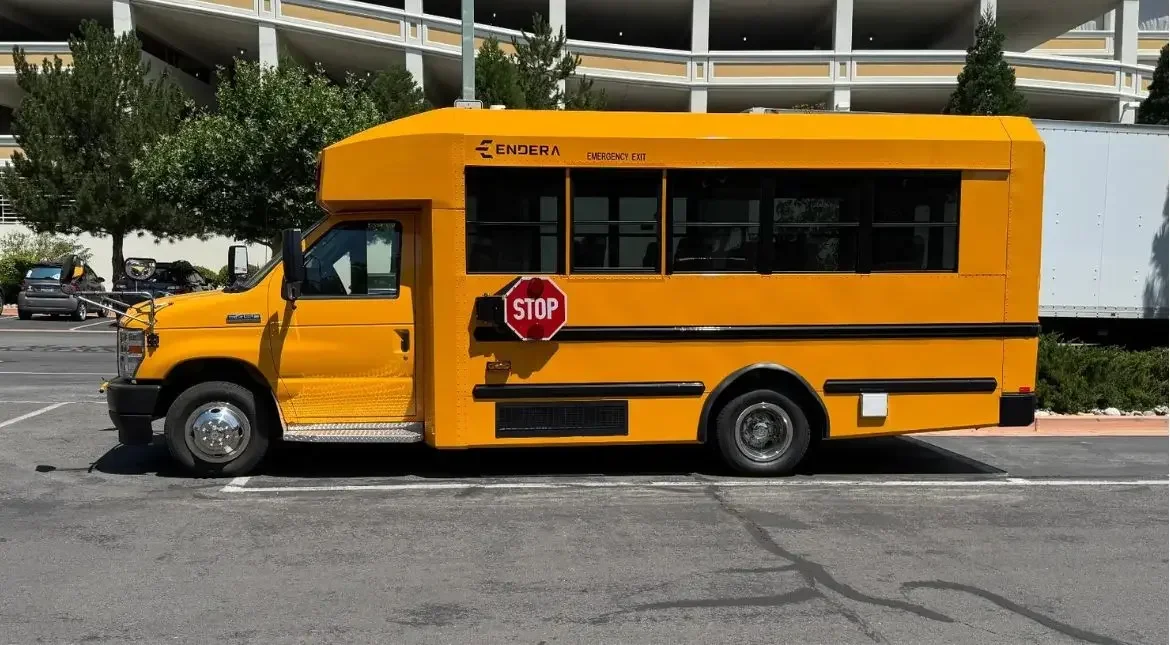
The Program Has Changed — Here Is Where It Stands
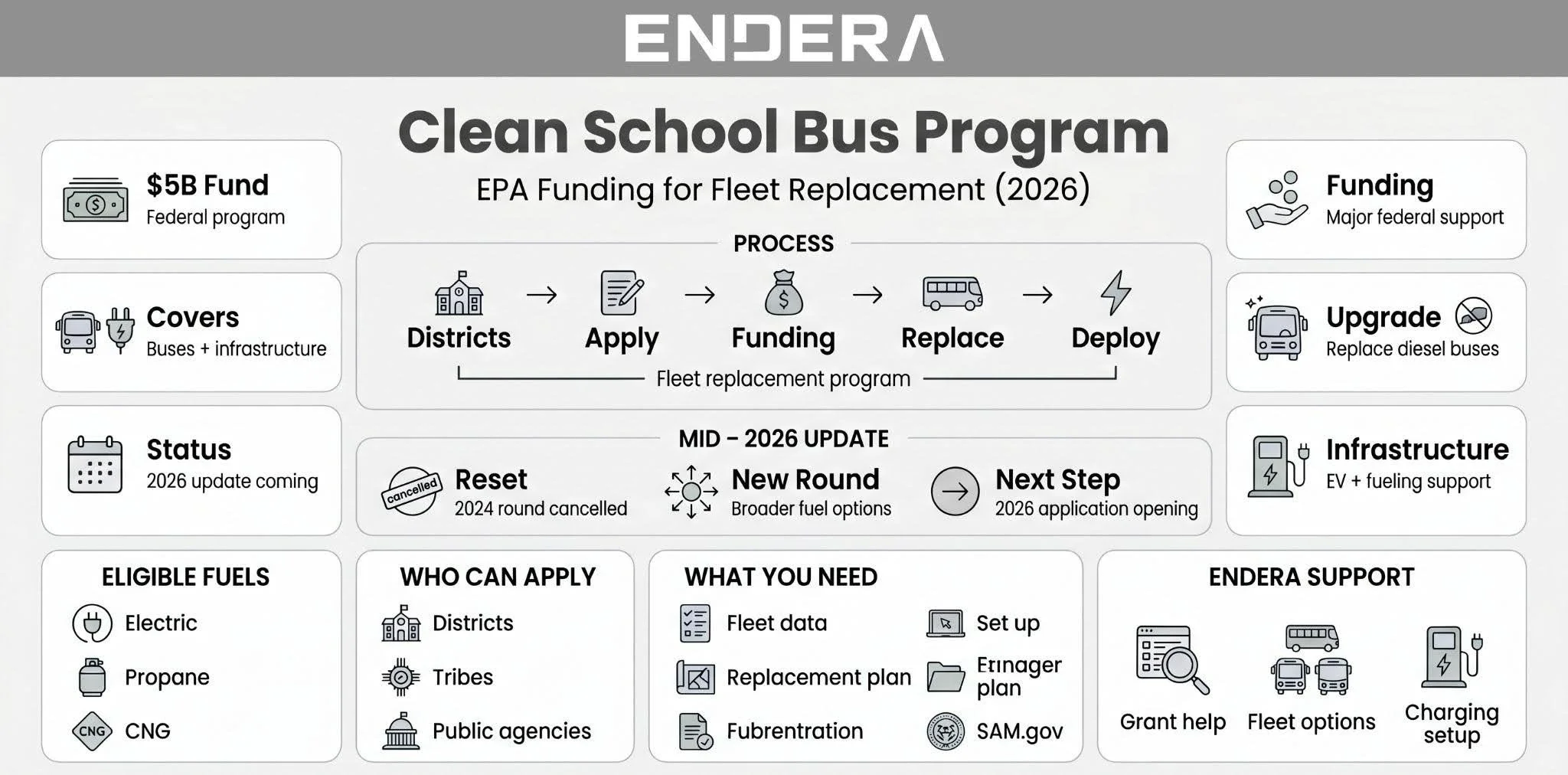
What the Program Is and Where the Money Comes From
The EPA Clean School Bus Program was created under the 2021 Bipartisan Infrastructure Law, which directed EPA to allocate $5 billion over five fiscal years — 2022 through 2026 — for replacing existing school buses with cleaner alternatives. The program covers vehicle replacement costs, fueling and charging infrastructure, workforce training, and in some configurations, consulting costs and bus warranty expenses.
The Largest Federal Funding Source in School Transportation
For school districts replacing aging diesel fleets, the Clean School Bus Program has been the single largest source of federal funding available. With the 2026 round still ahead, it remains the most significant procurement opportunity in the school transportation sector — and one that districts should be actively preparing for now, not waiting on.
What Changed in February 2026
On February 19, 2026, EPA announced a significant restructuring of the program. The 2024 rebate round — which had drawn over $900 million in applications — was cancelled. EPA confirmed that no funds will be awarded under that process, and districts that applied in 2024 will need to reapply under the forthcoming 2026 grant framework.
The 2026 Round and What to Expect
The agency issued a Request for Information on alternative fuels to inform the design of the next round, which is expected to expand eligible fuel types beyond electric to include CNG, LNG, propane, hydrogen, and biofuels. A Notice of Funding Opportunity for the 2026 round is expected later in 2026. Districts planning around any prior application should treat that process as closed and prepare to engage with the new framework when it opens.
The 2026 grant window is coming — work with Endera's team now to get your fleet data, SAM.gov registration, and fuel selection ready before the Notice of Funding Opportunity drops.
What the 2026 Round Is Expected to Look Like
Expanded Fuel Eligibility
Previous funding rounds directed the large majority of awards toward electric buses, with propane representing a small share of prior allocations. The 2026 round is structured differently. EPA's RFI explicitly gathered input on CNG, LNG, propane, hydrogen, and biofuels alongside electric — and the agency has confirmed the new round will provide districts with broader fuel choice rather than directing most funding toward a single technology.
Electric Buses Remain Eligible
The underlying statute requires that at least 50% of program funding go to zero-emission buses, so electric remains a significant part of the program. But districts running routes where electric isn't operationally viable — long rural corridors, cold climates, operations without charging infrastructure — now have a clearer path to funding for alternative fuel options that fit their actual conditions.
What the Funding Can Cover
Based on the structure of previous rounds, eligible costs have included the full purchase price of replacement buses, charging or fueling infrastructure, workforce development and training, consulting costs related to bus deployment, bus warranty costs, and additional funding for ADA-compliant buses. Previous rounds allowed applicants to request funding for up to 50 buses per application, with per-bus maximums reaching up to $375,000 for electric buses including charging infrastructure and up to $65,000 for propane and CNG.
Priority Applicants
Across prior rounds, EPA consistently prioritized high-need local education agencies, low-income districts, rural and tribal schools, and applications that incorporated cost-sharing through public-private partnerships, other grants, or school bonds. That prioritization framework is expected to continue in the 2026 round. Districts in these categories have historically received higher per-bus funding amounts and favorable review weighting.
Who Is Eligible to Apply
Eligible Applicants
Eligible applicants under the Clean School Bus Program include public school districts, state and local governments, federally recognized tribes, nonprofits, eligible transportation contractors, and public charter school districts. Private schools are generally not eligible unless applying through a public-school transportation contract.
The Bus Replacement Requirement
The program is a replacement program — not an expansion program. Funded buses must replace existing school buses that are currently in operation, not add capacity to a fleet. The buses being replaced typically need to be older diesel models, and the condition and age of the buses being replaced factors into application scoring. Older, higher-mileage diesel buses with documented maintenance costs represent the strongest replacement justification.
SAM.gov Registration
Applicants must be registered in the System for Award Management (SAM.gov) before applying. SAM.gov registration is a federal requirement for any organization receiving federal funds and needs to be active — not just completed — at the time of application. EPA has consistently advised applicants to maintain their SAM.gov registration by logging in periodically, since a lapsed registration can disqualify an otherwise eligible application. Districts that have not previously applied for federal funding should begin the SAM.gov process well in advance of the application window opening.
Building a Competitive Application
Fleet Data Is the Foundation
The applications that have performed best in prior rounds were built on documented fleet data rather than general descriptions of need. Six categories matter most: current bus inventory by VIN, model year, and fuel type; per-bus maintenance costs from two to three years of records; fuel consumption data; downtime and breakdown history; inspection and compliance records; and fleet composition showing how many buses are diesel versus cleaner alternatives.
Why That Data Matters
This documentation substantiates the replacement justification, demonstrates the environmental benefit of the swap, and gives reviewers quantitative evidence to evaluate rather than narrative claims. Districts that can show the operational burden of their current fleet — fuel costs, repair frequency, downtime — build a more competitive application than those applying with vague replacement rationale.
Matching Fuel Type to Route Reality
The strongest applications don't request the highest-funded fuel type — they document why the chosen fuel fits the specific routes, infrastructure, and operational conditions of the district. A rural district applying for propane buses on long-haul routes with no charging infrastructure has a more defensible application than one requesting electric buses for routes where the range and charging logistics haven't been worked out. With the 2026 round expanding fuel eligibility, districts have more room to align their application with operational reality.
Application Timing and the NOFO
Districts shouldn’t wait for the NOFO to begin preparation. In past rounds, the 10–14 week window between release and deadline was often too short for approvals, registrations, and planning. The most competitive applicants prepare in advance by gathering fleet data, confirming SAM.gov status, and drafting replacement plans before the application period begins.
How Endera Supports the Application Process
Grant Navigation as Part of the Purchase Relationship
Endera assists clients in identifying applicable federal, state, and local funding and supports the application process directly. This isn't a referral to a grants database — it's active assistance with documentation, eligibility assessment, and submission workflow that smaller districts and under-staffed transportation departments often don't have internal resources to handle. Endera's access to over $20 billion in available federal, state, and local EV subsidies gives the team visibility into stacking opportunities that can further reduce effective purchase costs.
Propane and CNG as Part of Endera's Lineup
Endera builds its school bus lineup — the Endera 4, 5, and 6 — across ICE, propane, CNG, and electric powertrains. With the 2026 round expanding Clean School Bus eligibility to include propane and CNG alongside electric, districts working with Endera have access to the full range of fundable configurations from a single manufacturer. A district that needs electric on urban routes and propane on longer rural routes can source both from Endera and address both within a single application.
Charging Infrastructure Support for EV Applications
For districts applying for electric bus funding, charging infrastructure is an eligible cost — and a significant one. Endera provides turnkey charging infrastructure — site assessment, charger procurement, and installation — as part of its EV offering. Including properly scoped charging infrastructure in a Clean School Bus application strengthens the submission by demonstrating a complete deployment plan. Districts that have worked through their charging setup before applying are better positioned to execute quickly after selection, which matters for program compliance timelines.
The 2026 Round Represents a Real Opportunity — Preparation Determines Outcomes
The Clean School Bus Program has funded over 8,500 buses across more than 1,200 districts in previous rounds. The 2026 round, with expanded fuel eligibility and a redesigned grant framework, is expected to be competitive. Districts that begin preparing now — documenting fleet condition, confirming SAM.gov registration, and engaging manufacturer partners on configurations and infrastructure — will be in a materially stronger position when the Notice of Funding Opportunity is released than those that wait for the window to open.
Get in touch with Endera's team to discuss your district's fleet, applicable funding, and how to position your program for the 2026 grant round.
FAQs
1. Is the EPA Clean School Bus Program still accepting applications in 2026?
As of May 2026, no active application window is open. EPA cancelled the 2024 rebate round in February 2026 and is designing a new 2026 grant round based on public input gathered through an RFI. A Notice of Funding Opportunity is expected later in 2026. Districts should monitor epa.gov/cleanschoolbus for updates and use the current period to prepare application materials.
2. What fuel types are eligible under the 2026 Clean School Bus Program?
The 2026 round is expected to expand eligibility to include electric, propane, CNG, LNG, hydrogen, and biofuels — a significant change from previous rounds that directed the majority of funding toward electric only. The statute still requires that at least 50% of program funding go to zero-emission buses. Districts should align their fuel choice with their actual route conditions and document why that choice makes operational sense.
3. What happened to the 2024 Clean School Bus rebate applications?
EPA confirmed in February 2026 that no funds will be awarded under the 2024 rebate round. Districts that applied are encouraged to reapply under the forthcoming 2026 grant framework. Prior applications are not carried over — a new application will be required when the 2026 NOFO opens.
4. Who is eligible to apply for Clean School Bus Program funding?
Eligible applicants include public school districts, state and local governments, federally recognized Indian tribes, non-profit organizations, and eligible contractors providing public school transportation services. Public charter school districts are also eligible. SAM.gov registration must be active at the time of application.
5. How much funding can a district receive per bus?
Previous rounds provided up to $375,000 per electric bus including charging infrastructure, and up to $65,000 per propane or CNG bus. Priority applicants — low-income, rural, and tribal districts — have historically been eligible for higher amounts. The 2026 round will define its own per-bus maximums in the Notice of Funding Opportunity.
6. Does Endera help school districts apply for Clean School Bus Program funding?
Yes. Endera assists clients with identifying applicable federal, state, and local funding and supports the application process directly — including documentation, eligibility assessment, and grant navigation. Endera also provides turnkey charging infrastructure for EV applications, ensuring districts can submit a complete deployment plan rather than a vehicle-only request.
7. Can a district stack EPA Clean School Bus funding with state-level incentives?
In many cases, yes. State-level programs — such as California's HVIP, state clean fleet programs, and utility-based incentives — can often be combined with federal Clean School Bus Program funds to further reduce the net cost of a bus purchase. Endera's grant navigation support includes identifying stacking opportunities specific to each district's state and program eligibility.