
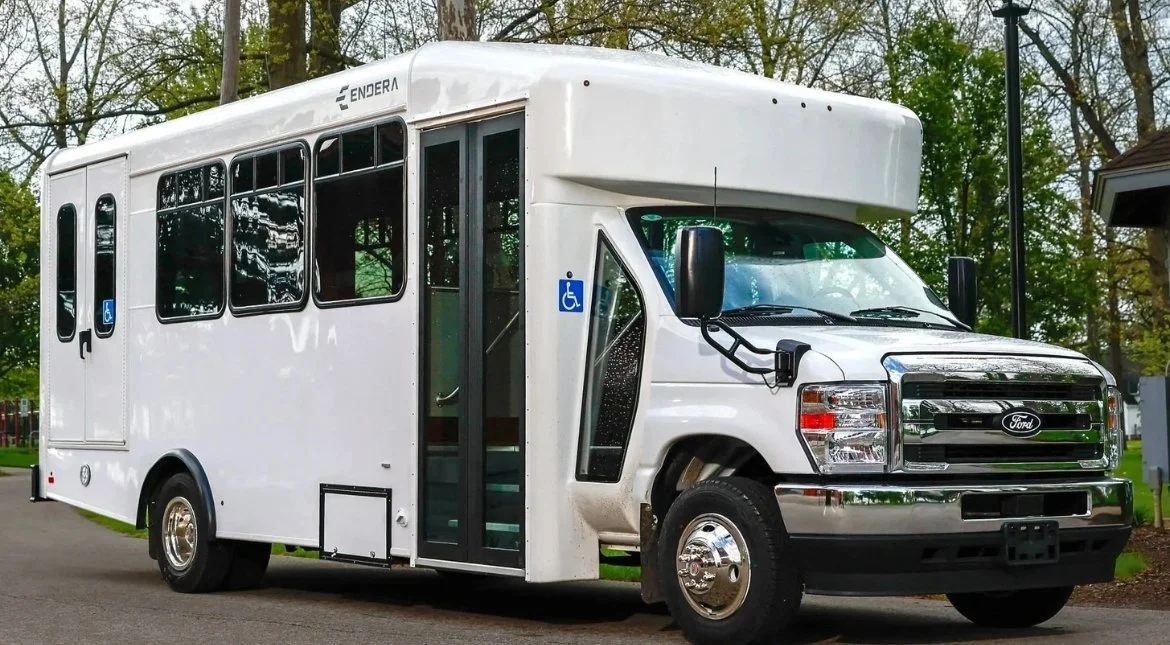
The Vehicle Is Only Part of What NEMT and Healthcare Transport Require
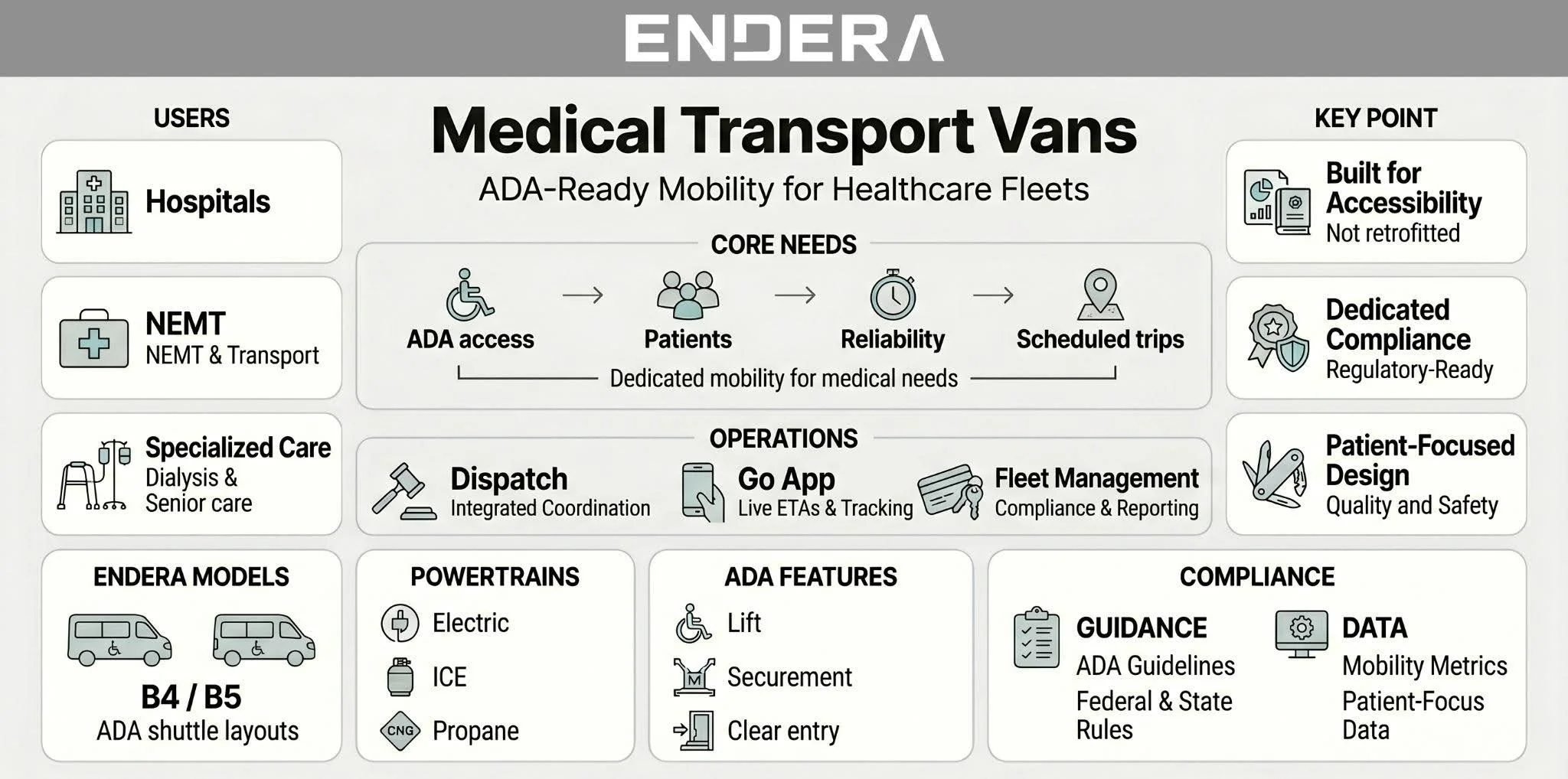
Who Is Running These Fleets and What They Actually Need
Non-emergency medical transportation, hospital system shuttles, senior care facilities, dialysis centers, and outpatient clinic networks all move patients who need reliable, accessible ground transport — but can't or shouldn't use an ambulance. The organizations running these programs range from large hospital systems with dedicated fleet managers to small NEMT providers managing two or three vehicles.
What They Share
What every healthcare transport operator needs is a vehicle that is genuinely built for accessible passenger transport — not a cargo van with a lift bolted on — and a manufacturer relationship that understands what ADA compliance means in an operational context, not just on a spec sheet.
Where Endera Fits
Endera builds the B-Series commercial shuttle line with ADA-compliant floor plan configurations, lift integration, and securement systems designed as part of the vehicle from the start — not added after delivery.
Why Vehicle Selection Matters for NEMT Compliance
NEMT providers operating under Medicaid contracts, state broker agreements, or federal transit funding face vehicle compliance requirements that directly affect their ability to bill, operate, and renew contracts. A vehicle that fails a lift load test, or has securement areas that don't meet minimum clear floor dimensions, creates compliance exposure that affects the entire program — not just one vehicle.
Speccing a vehicle for a healthcare or NEMT program? Endera's team understands the compliance requirements that govern these fleets — walk us through your routes and we'll help you find the right fit.
Federal ADA Standards for Medical Transport Vehicles
Lift Capacity and Platform Requirements
Under 49 CFR Part 38, vehicle lifts used in accessible transit must support a minimum design load of 600 pounds and must permit both inboard and outboard facing of wheelchair and scooter users on the platform. Many state Medicaid programs and broker networks require higher lift ratings — 800 to 1,000 pounds — because modern power wheelchairs and their users often exceed the federal minimum.
Confirming Requirements Before Purchase
NEMT operators specifying a vehicle should confirm the lift rating against both the federal floor and their state or broker contract requirements before finalizing a purchase. A vehicle that meets federal minimums but falls short of a broker's contractual threshold will fail enrollment regardless of how new or well-maintained it is.
Securement Area Dimensions
The federal minimum for wheelchair securement areas is 30 inches wide by 48 inches long — a clear, unobstructed floor area positioned as near to the accessible entrance as practicable. Securement areas must be forward-facing or rear-facing with a padded barrier; side-facing securement is not permitted under U.S. DOT regulations.
Industry Guidance on Larger Dimensions
The Transportation Cooperative Research Program recommends operators consider accommodating at least 30 inches by 54 inches to handle larger power wheelchairs that are increasingly common among passengers with complex mobility needs. Operators whose state programs or broker contracts specify dimensions beyond federal minimums should confirm configuration options with Endera during the specification process.
Door Clearance and Interior Height
Vehicles under 22 feet in length must provide a minimum door height of 56 inches for accessible entry; larger vehicles must meet a 68-inch minimum. Interior floor-to-ceiling height at the securement area affects both lift usability and an attendant's ability to assist passengers safely once on board. These dimensions are determined at the body and floor plan design stage — not adjustable after the vehicle is built.
Endera's B-Series for Healthcare and NEMT Applications
ADA Configuration Built Into the Floor Plan
Endera builds its B-Series shuttles with ADA-compliant lift integration and securement positioning as a floor plan option — not as an aftermarket modification. A lift installed after the vehicle body is complete requires modifications to the floor structure, door frame, and sometimes the body itself. Those modifications introduce variables that aren't present when the lift position and securement layout were designed alongside the body from the start.
The Vertical Integration Advantage for Compliance
Endera's vertically integrated manufacturing process — building both the body and the EV powertrain at its Ottawa, Ohio facility — means the floor plan is engineered to the operator's configuration at the production stage. For NEMT operators whose compliance depends on consistent lift performance and securement integrity over years of daily use, that design coherence matters more than it might appear on a spec sheet.
Composite Body Construction for Healthcare Environments
Endera builds its B-Series with a composite shell — salt and water tested before installation — which is a meaningful specification for NEMT operators running vehicles through frequent cleaning cycles or operating in high-humidity environments. The composite body is also lighter than conventional steel body construction, contributing to range on electric variants and reducing suspension wear over a high-cycle duty schedule typical of daily medical transport routes.
B4 and B5 for NEMT and Healthcare Shuttle Operations
The B4 at 24 feet is the most widely deployed configuration in accessible shuttle operations. It accommodates ADA securement positions alongside standard ambulatory seating and is available in both ICE and electric powertrains. The B5 at 25 feet provides additional capacity for hospital system shuttles moving patients between campuses or from a main facility to a satellite clinic.
ICE and Electric Options for Medical Transport Fleets
Where Electric Fits Healthcare Operations
Healthcare and NEMT shuttle routes tend to be short, frequent, and return-to-base — characteristics that suit electric powertrains well. A dialysis center shuttle running patients to and from appointments throughout the day follows a predictable schedule, and the vehicle returns to a staging area where it can charge between runs. The lower per-mile fuel cost and reduced maintenance overhead of an electric B4 or B5 represent measurable budget improvements over the vehicle's service cycle.
When ICE or Propane Is the Practical Answer
For NEMT providers covering longer distances, operating in areas without reliable charging infrastructure, or running routes that don't return to a central base regularly, ICE or propane remains the more practical powertrain. Endera's dual-track model — building ICE, propane, CNG, and electric variants on the same platform — means an operator can match powertrain to route profile without switching manufacturers.
A Mixed Fleet From One Vendor
A fleet running city dialysis routes on electric and longer rural Medicaid transport routes on propane can source both vehicle types from a single vendor relationship. That consistency simplifies procurement, parts management, and driver training across the full fleet.
Charging Infrastructure for Healthcare Facilities
For healthcare systems or large NEMT providers adding electric vehicles, Endera provides turnkey charging infrastructure alongside the vehicle — site assessment, charger procurement, and installation. Handling both the vehicle and the charging setup through one vendor simplifies procurement and ensures the infrastructure is sized for the vehicles it's meant to support.
Software for Medical Transport Fleet Management
Real-Time Visibility for Patient-Facing Operations
Endera Dispatch gives fleet managers real-time GPS tracking, route performance data, geofence management, and state-of-charge visibility across the fleet from a single dashboard. For healthcare transport coordinators managing multiple vehicles on overlapping routes, this visibility reduces the overhead of coordinating pickups, responding to delays, and confirming vehicle locations when a patient is waiting.
Native Hardware, Not a Third-Party Add-On
The system is built on onboard hardware native to the vehicle — not a telematics device installed after delivery. That means the data is live and accurate rather than approximated through a sensor that wasn't designed for this platform. For operators whose compliance documentation requires accurate trip records, the integrity of that data source matters.
Passenger-Facing ETAs With Endera Go
Endera Go provides passengers with real-time vehicle location and precise estimated arrival times through a mobile app powered by onboard vehicle technology and Google API. For patients coordinating medical appointments around shuttle arrivals, a live ETA is a meaningful reliability improvement over a scheduled estimate that doesn't account for traffic.
Feedback Into Fleet Operations
Rider feedback collected through Go feeds into the Dispatch dashboard, giving transport coordinators a continuous signal on service performance from the patient perspective. For healthcare operators accountable to facility administrators or Medicaid broker performance standards, that operational feedback loop supports the documentation of service quality over time.
Medical Transport Requires a Vehicle Built for the Job
A retrofitted cargo van with an aftermarket lift meets the minimum definition of an accessible transport vehicle. It doesn't necessarily meet the operational demands of daily patient transport — a duty cycle that requires consistent lift performance, reliable boarding procedures for passengers with varying mobility needs, and a vehicle that holds up structurally over years of service.
Endera's B-Series is built as a complete accessible transport system — floor plan, lift integration, securement layout, body construction, and software — from a manufacturer that treats accessibility as a design input, not a modification.
Get in touch with Endera's team to discuss which configuration fits your healthcare or NEMT operation, what powertrain makes sense for your route profile, and what current availability looks like for your fleet.
FAQs
1. Does the Endera B-Series meet ADA requirements for medical transport vehicles?
Yes. Endera configures the B-Series with ADA-compliant lift integration and wheelchair securement systems built into the floor plan design from the production stage. Lift specifications and securement area dimensions meet federal minimums under 49 CFR Parts 37 and 38. Operators with state Medicaid or broker contract requirements that exceed federal minimums should confirm specific configuration details with the Endera sales team.
2. What lift capacity is available on ADA-configured Endera shuttles?
Lift specifications should be confirmed with Endera directly, as configuration options depend on the model and floor plan selected. Federal minimums require a 600-pound lift design load, but many NEMT operators and state programs require 800 to 1,000 pounds to accommodate modern power wheelchairs. Endera's sales team can confirm available lift options during the specification process.
3. Which Endera models are most commonly used for NEMT and healthcare transport?
The B4 (24 feet) is the most widely deployed configuration for accessible shuttle operations. It accommodates ADA securement positions alongside standard ambulatory seating and is available in both ICE and electric powertrains. The B5 (25 feet) is appropriate for hospital system shuttles with higher passenger volume. Both are built on the Ford E450 cutaway chassis.
4. Are electric Endera shuttles practical for dialysis and outpatient transport routes?
Yes, for most dialysis and outpatient transport operations. These routes are typically short, frequent, and return-to-base — characteristics that suit electric vehicle performance well. Endera provides turnkey charging infrastructure alongside the vehicle, so operators don't need to coordinate the charging setup separately. For longer or non-base-return routes, ICE or propane variants remain available on the same platform.
5. Does Endera provide fleet management software for healthcare transport operations?
Yes. Every Endera commercial shuttle comes available with Endera Dispatch — providing real-time GPS tracking, route monitoring, geofence management, and state-of-charge visibility for EV fleets. Endera Go provides passengers with live ETAs through a mobile app. Both platforms run on hardware built into the vehicle rather than a third-party telematics add-on.
6. Can Endera handle both the vehicle and charging infrastructure for a healthcare system fleet?
Yes. Endera provides turnkey charging infrastructure as part of its EV offering — covering site assessment, charger procurement, and installation. This allows healthcare systems and NEMT providers to handle both procurement items through one vendor relationship rather than coordinating two separate projects.
7. How does Endera's vertical integration benefit NEMT operators specifically?
Because Endera builds both the body and the powertrain at its Ohio facility, ADA configurations — lift position, securement layout, floor structure — are engineered into the vehicle from the start rather than modified after the fact. This produces more consistent compliance outcomes, a cleaner warranty structure, and a vehicle where the structural and mechanical systems were designed to work together.