
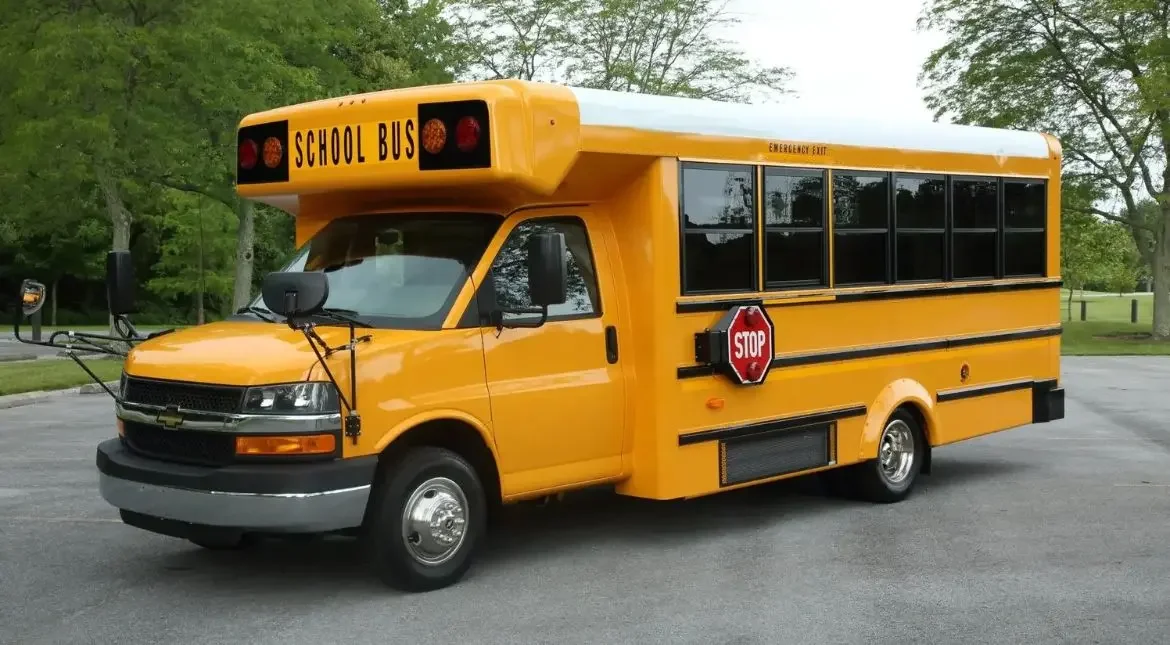
Texas school districts operate under procurement realities that don't apply everywhere else: long rural routes that stretch vehicle range, summer heat that taxes both passengers and battery systems, and a state funding landscape with specific programs most manufacturers don't know how to navigate. Getting the right bus is a spec decision, a budget decision, and a compliance decision — often all at once.
Endera manufactures Type A school buses in gasoline, propane, CNG, and full-electric configurations, factory-direct from Ottawa, Ohio, with Buy America compliance built in — a requirement for most Texas public transit and district contracts. Their Type A school bus lineup is customizable across seating configuration, ADA accessibility, and powertrain.
Ready to build a spec that works for Texas routes and budgets? Contact Endera's sales team today to review funding options alongside configurations.
Texas School Bus Funding: What Districts Can Actually Claim
The cost question for Texas buyers isn't simply "what does the bus cost" — it's "what does it cost after incentives." The EPA's Clean School Bus Program, part of the Infrastructure Investment and Jobs Act, allocated $5 billion nationally between 2022 and 2026, with individual electric bus awards reaching up to $375,000 per vehicle for the highest-priority applicants. Texas districts have received awards in multiple funding rounds under this program.
At the state level, the Texas Emissions Reduction Plan (TERP) funds the Texas Clean School Bus Program, which provides grants to replace older, higher-emission school buses operating in non-attainment and affected counties — including the Houston-Galveston area, Dallas-Fort Worth, and the Beaumont-Port Arthur region. Most TERP awards require the old vehicle to be scrapped rather than resold.
Endera's grant navigation services cover both federal and state program applications as part of the purchasing process, which matters for smaller districts that don't have dedicated grant staff.
Electric vs ICE for Texas Routes: A Realistic Assessment
The electric versus ICE decision looks different in Texas than in most states, for reasons that are geographic as much as financial. Texas operates more rural route miles than almost any other state, and range is a real constraint for electric Type A buses in low-density areas where charging infrastructure isn't yet established. Battery performance in sustained heat — ambient temperatures regularly exceeding 100°F in summer — also adds thermal management load that reduces effective range compared to manufacturer specs tested in moderate climates.
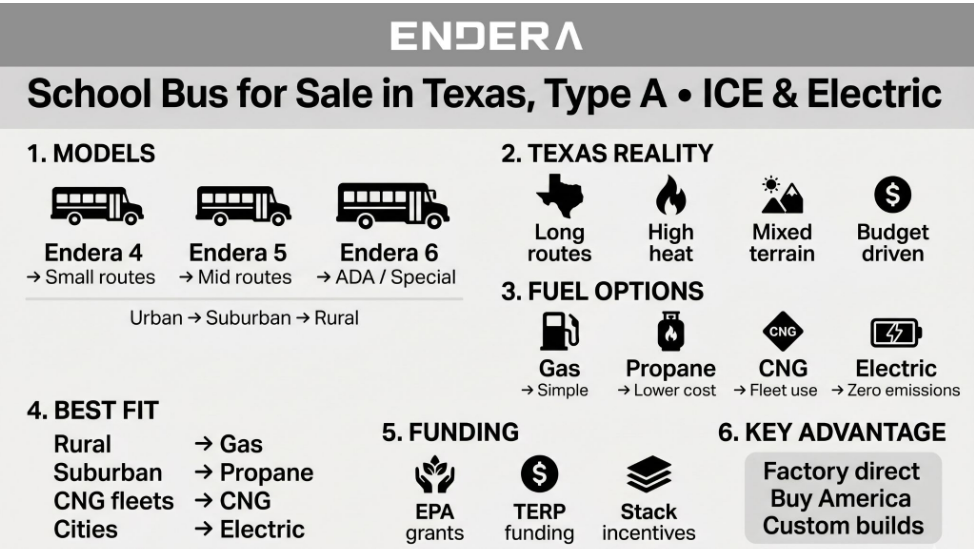
That said, urban and suburban Texas districts present a strong case for electrification. Short-haul routes in Houston, Austin, San Antonio, and DFW typically fall well within the 100+ mile range of a fully charged Type A EV, and the lower per-mile operating cost compounds quickly across large fleets. The table below gives Texas buyers a practical starting framework:
| Fuel Type | Best Fit | Key Texas Consideration |
|---|---|---|
| Gasoline | Rural routes, small fleets, limited capital budgets | Lowest upfront cost; no infrastructure changes needed |
| Propane | Suburban districts, church/private school fleets | 30–40% fuel cost reduction vs gasoline; mature TX fueling network |
| CNG | Districts already running CNG; urban transit operators | Lowest per-mile fuel cost; requires on-site or nearby fueling station |
| Electric | Urban/suburban districts; grant-eligible buyers | Highest savings potential long-term; TERP + EPA funding available |
Endera's dual-track production — building ICE and EV on the same platform — means a district can start with propane or gasoline and transition to electric on a subsequent procurement cycle without changing manufacturers or service relationships.
Who Buys Type A School Buses in Texas
Type A buses serve a wider range of Texas buyers than most people assume. Independent School Districts (ISDs) are the most visible purchaser, typically using Type A models for special education routes, smaller campuses, and rural runs where a full-size Type C or D bus would run under capacity. But the Texas buyer pool extends well beyond public districts.
Charter schools, private academies, and faith-based groups—particularly in DFW, Houston, and the Rio Grande Valley—maintain some of the state's largest Type A fleets. Additionally, assisted living and adult day programs utilize these buses to satisfy specific state licensing and Medicaid transport requirements. For these operators, the Type A bus provides the ideal balance: the maneuverability and low cost of a smaller vehicle paired with the safety of a federally certified school bus.
What Texas Requires From School Bus Operators
Texas school bus drivers must hold a valid Commercial Driver's License with a Passenger (P) endorsement and a School Bus (S) endorsement, as required by the Texas Department of Public Safety. This applies regardless of vehicle GVWR for any driver transporting school-age children under a district or contracted route — meaning the CDL exemption that applies in some general-use contexts does not apply to school transportation in Texas.
Beyond driver licensing, Texas requires that school buses meet specifications governed by the Texas Education Agency and pass an annual safety inspection conducted by a DPS-certified inspector. Endera builds its Type A models to meet or exceed federal FMVSS standards and the state-level procurement specifications used in Texas district bids, including brake system requirements, mirror configurations, and emergency exit standards. For districts preparing an RFP, Endera's sales team can provide spec documentation on request.
Charging Infrastructure for Texas School Fleets
Texas districts often worry that electric buses require expensive grid upgrades, but this is rarely the case. Most Type A EVs utilize DC fast charging that typically only requires a service panel upgrade rather than a new substation. Furthermore, the cost of this infrastructure is often covered by the same federal and state grants used to purchase the vehicle.
Endera provides turnkey charging solutions that include site assessments, procurement of standalone DC fast charging stations, and metering system installation. Their software platform, Endera Dispatch, manages state-of-charge monitoring and demand-based charging schedules — which matters in Texas, where time-of-use electricity rates can significantly affect overnight charging costs depending on the utility provider.
Navigating the Texas Procurement Landscape
Texas school transportation buyers are operating in one of the more complex procurement environments in the country — state-specific grant programs, climate-driven range considerations, and district bid requirements that vary by region. The clearest path to a sound purchase is working directly with a manufacturer that builds to Buy America standards, knows the funding landscape, and can configure the vehicle to the route rather than the other way around.
Endera's in-stock vehicles are available for immediate delivery for districts with near-term needs. For custom builds — including electric models eligible for TERP and EPA funding — contact the sales team to begin the specification process ahead of your district's procurement cycle.
Frequently Asked Questions
Does Texas have its own school bus grant program separate from the federal EPA program?
Yes — the Texas Emissions Reduction Plan (TERP) funds the Texas Clean School Bus Program, which provides grants to replace older, higher-emission school buses in counties that don't meet federal air quality standards. This program operates independently of the EPA's Clean School Bus Program, meaning eligible Texas districts may be able to stack state and federal funding on a single bus purchase. The Texas Commission on Environmental Quality (TCEQ) administers TERP grants.
How does Texas heat affect electric school bus performance?
High ambient temperatures increase the thermal load on battery systems, which can reduce effective range by 10–20% in sustained heat compared to manufacturer specs measured in moderate climates. Districts running long rural routes in West Texas or the Panhandle should account for this in range planning. Urban and suburban districts with routes under 80 miles per day are generally well within operating range even under peak Texas summer conditions.
Are Endera school buses Buy America compliant for Texas public contracts?
Yes. Endera sources 65% of its supply chain from within Ohio and manufactures its vehicles domestically, making its products Buy America compliant — a requirement for federally funded public transit and education contracts in Texas. This compliance is relevant for ISDs using federal Title I or IDEA transportation funds as well as any district participating in FTA-funded programs.
What is the typical timeline for a Texas school district to receive a custom-built bus?
Custom build timelines depend on configuration, powertrain type, and production volume at the time of order. Districts with a specific delivery deadline — particularly those tied to a new school year or grant disbursement window — should contact Endera's sales team at least 3–6 months in advance. In-stock gasoline models are available for faster deployment when lead time is a constraint.
Do Texas private schools and charter schools qualify for school bus grants?
Federal EPA Clean School Bus Program eligibility extends to local educational agencies, which includes charter schools in most funding rounds. Private schools without public funding may have limited eligibility for state TERP grants depending on program rules in a given cycle. Endera's grant navigation team can assess eligibility based on the buyer's organizational classification and funding source.
Can a Type A school bus be used for non-school transportation in Texas?
Yes — many Texas operators run Type A school buses for purposes beyond K–12 student transport, including adult day programs, assisted living facility transport, and Medicaid non-emergency medical transport. Licensing and inspection requirements vary by use case and are governed by the Texas Department of Motor Vehicles and, in some cases, TxDOT. Buyers should confirm licensing requirements with the relevant state agency for their specific application.
What warranty coverage comes with an Endera school bus?
Endera provides separate warranty documents for electric vehicles and school buses, both available at enderamotors.com/warranty. Because Endera is a vertically integrated manufacturer — building both the body and the powertrain in-house — warranty responsibility is consolidated under a single document rather than split between a chassis supplier and a body builder, which simplifies claims for fleet operators.