
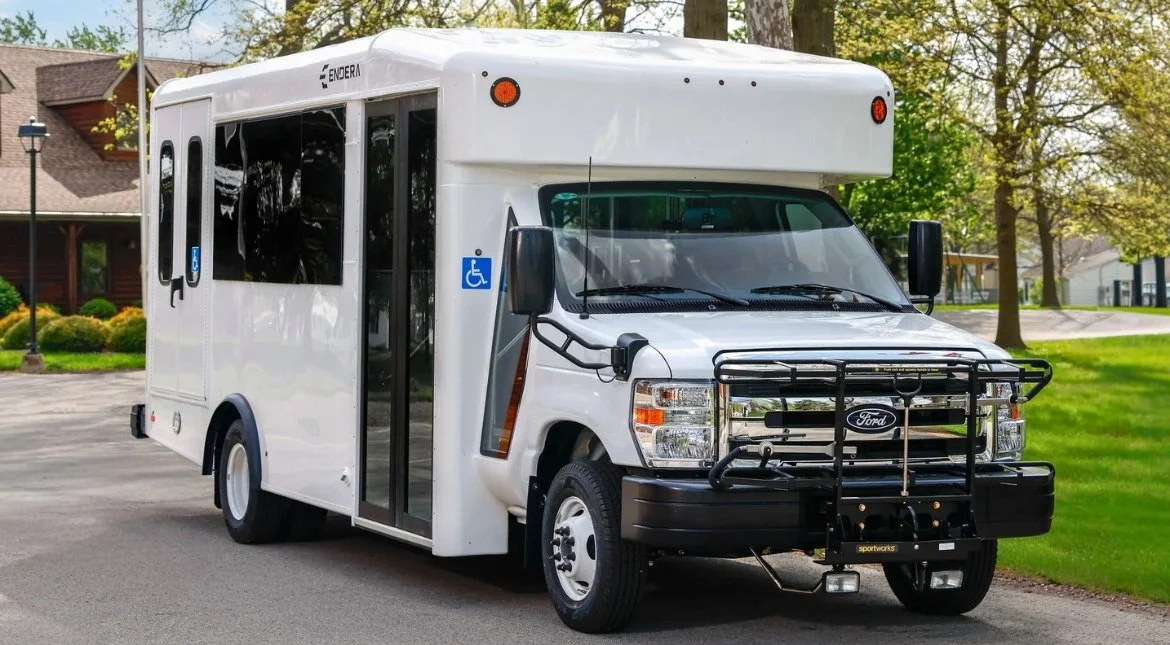
Wisconsin shuttle operations don't get the benefit of mild weather year-round. Milwaukee in January and Milwaukee in July require different things from the same vehicle, and operators who've run shuttles through a Wisconsin winter know that a vehicle built for a warm-climate market doesn't always hold up. Endera builds the B-Series as a complete system — vehicle, powertrain, software, and charging infrastructure — assembled under one roof in Ottawa, Ohio, less than five hours from Milwaukee. That proximity matters for delivery timelines and service response in ways that a manufacturer based on either coast simply can't offer.
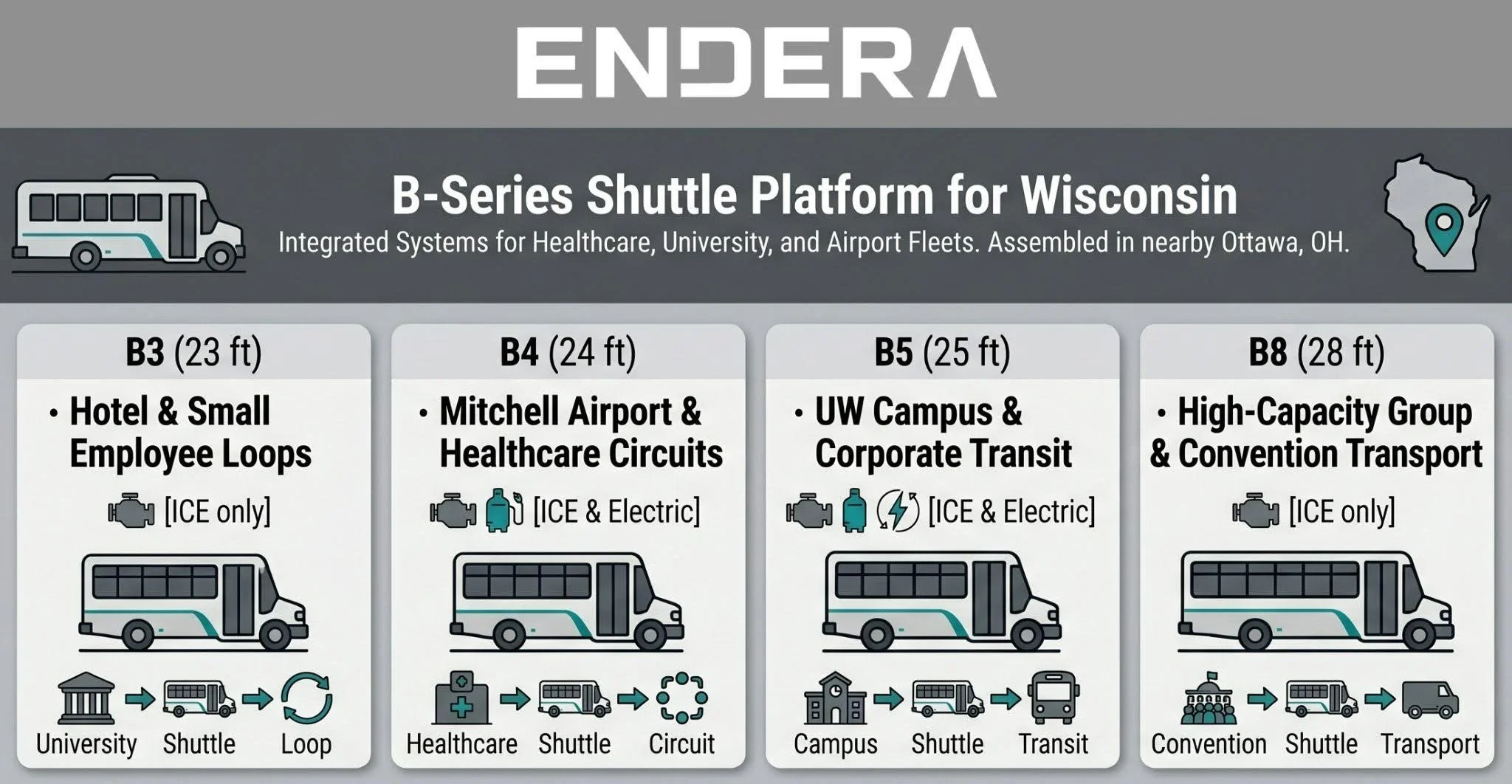
Wisconsin's shuttle demand runs across a wider range than the Milwaukee metro suggests. University transit at UW–Madison and UW–Milwaukee, airport ground transport at Milwaukee Mitchell International, resort and hospitality operations in the Wisconsin Dells and Door County, Fox Cities manufacturing and logistics, and healthcare campus shuttles across Green Bay and Appleton all represent distinct markets with different capacity requirements, duty cycles, and powertrain considerations. For Wisconsin operators evaluating a new shuttle or fleet refresh, Endera's B-Series lineup spans the B3, B4, B5, and B8 in 23–28 foot configurations, with ICE and full-electric powertrains available and route-specific customization handled at the factory level.
Ready to spec your fleet? Contact Endera's fleet specialists today to design a custom configuration blueprint for your operation.
The B-Series Lineup and What Each Model Is Built For
Four Models, Multiple Fuel Options
Endera's B-Series runs from 23 to 28 feet, built on the Ford E450 and Chevrolet Express cutaway chassis — platforms with an established dealer and service network throughout Wisconsin. The B3 at 23 feet suits smaller hotel loops and employee shuttles. The B4 and B5 — available in both ICE and electric — cover the mid-size range most commonly used by airports, corporate campuses, and university transit systems. The B8 at 28 feet handles high-volume convention and group transport where passenger capacity is the deciding factor.
ICE or Electric: An Honest Assessment for Wisconsin
Wisconsin's winters create a real range consideration for EV operators. Real-world testing shows EVs typically lose 20–40% of their range in cold weather, driven by battery chemistry changes and the energy required to heat both the cabin and the battery pack itself. For transit buses specifically, a Cornell University study published in 2025 found that electric buses consumed up to 48% more energy in cold weather conditions — with a large share of that increase going toward battery thermal management and interior heating rather than propulsion.
Why Pre-Conditioning and Plug-In Strategy Matter
Unlike ICE vehicles, which use engine waste heat to warm the cabin, EVs draw entirely from stored battery energy for heating — which is why depot charging strategy matters as much as the vehicle itself. Wisconsin EV shuttle operations are typically structured around continuous plug-in strategies: vehicles stay connected between runs and are pre-conditioned before service, drawing heating energy from the grid rather than the battery. Consumer Reports testing found that short trips with frequent stops in cold weather — exactly the pattern of urban shuttle routes — can see the steepest range reductions, which makes overnight pre-conditioning and between-run plug-in time operationally important for Wisconsin operators.
Where ICE Still Holds an Advantage
For operations with controlled dwell time and depot charging overnight — university campus loops, airport parking shuttles, Milwaukee hotel circuits — the electric B4 and B5 perform reliably through Wisconsin winters when pre-conditioning protocols are in place. For operators covering longer rural routes in northern Wisconsin or running extended shifts without depot access, the ICE variants are the more practical choice. ICE engines maintain consistent range regardless of heating demand, which matters when a vehicle needs to complete a route before it can return to a charger. Endera builds both on the same platform, which means the fuel decision doesn't have to foreclose future options as depot infrastructure improves.
Who Makes the Shuttle Purchase Decision in Wisconsin Organizations
The Operational Side of the Table
In Wisconsin shuttle operations — whether that's a university transportation department, a hospital system, or a resort property — the transportation director or fleet manager defines what the vehicle needs to do. They know the routes, the duty cycles, the seasonal patterns, and where the current fleet falls short. That operational knowledge shapes the specifications that go into a purchase request. But the approval authority usually sits elsewhere.
The Approval Side of the Table
For public-sector buyers — UW campuses, state agencies, or transit authorities — procurement follows the Wisconsin DOA State Bureau of Procurement framework, with motor vehicle purchases subject to state approval. When federal transit funding is involved, FTA procurement compliance standards apply. For private operators — resort groups, healthcare systems, or manufacturing companies — the approval chain typically runs through a CFO or operations director weighing total cost of ownership alongside capital budget availability. Endera's financing options — direct financing, capital leasing, and grant navigation — are structured for both types of buyers.
How B-Series Compares to Other Wisconsin-Available Shuttle Buses
The Shared Platform Reality
In Wisconsin, most shuttle buses share the same Ford E450 or GM cutaway chassis, and the differences between manufacturers come down to integration depth, configuration flexibility, and single-vendor accountability. For public-sector buyers using federal transit funding, compliance is a concrete constraint. Any shuttle purchased with federal dollars must meet FTA Buy America requirements, including domestic content thresholds and U.S. final assembly standards — which narrows the field to manufacturers that can certify compliance and support pre-award and post-delivery audit requirements.
Where Endera Differs — and Where It Doesn't
Competing manufacturers like Starcraft, Turtle Top, and ElDorado typically operate as body builders on shared chassis — a reasonable fit for operators who prioritize low upfront cost, rapid availability, or an existing dealer relationship. Where Endera's B-Series differs is in being a fully integrated platform — vehicle, powertrain, software, and charging infrastructure — from a single manufacturer. For Wisconsin operators where winter maintenance demands and service response time are real concerns, single-vendor accountability reduces the complexity of managing a fleet when something needs attention.
What That Means at Procurement
Body-builder configurations often require third-party telematics, separate charging vendors for EV units, and more coordination across procurement and ongoing service. Under federal procurement rules, public agencies must verify compliance certifications before contract award — a process that becomes more complex when multiple vendors are involved. In practice: single-vendor accountability and integrated software favor the B-Series; lowest initial cost or compatibility with an existing dealer service relationship may favor traditional manufacturers. Wisconsin operators should evaluate both honestly against their actual operational priorities.
Funding and Incentives for Wisconsin Shuttle Buyers
WisDOT's Wisconsin Electric Vehicle Infrastructure Program
WisDOT's Wisconsin Electric Vehicle Infrastructure (WEVI) Program distributes NEVI Formula Program funds to eligible entities for the installation, operation, and maintenance of EV charging stations across the state. With approximately $78 million in NEVI funds allocated to Wisconsin over five years, the program is actively expanding charging infrastructure along the state's Alternative Fuel Corridors. For shuttle operators considering electric models, this infrastructure expansion changes the operational feasibility of longer routes that might not have worked a few years ago.
Wisconsin DNR Clean Diesel Grants
The Wisconsin Department of Natural Resources administers EPA DERA funding for projects that reduce diesel emissions in Wisconsin. Funding covering 25% to 100% of eligible project costs is available to businesses, nonprofits, and public entities replacing diesel engines or purchasing new vehicles. Eligible projects include transit buses and commercial vehicles — making this a relevant pathway for Wisconsin operators replacing aging diesel shuttle fleets, whether they're transitioning to electric or to cleaner ICE alternatives. Endera assists operators in identifying applicable funding and managing applications directly.
Endera's Software Stack: What It Does for Wisconsin Fleet Managers
Real-Time Visibility for Passengers and Operators
Every Endera B-Series shuttle comes available with two integrated software tools built in-house. Endera Go gives passengers real-time vehicle location, ETA updates, and occupancy data — useful for airport shuttle services, university transit, and resort operations where wait time directly affects the passenger experience. Endera Dispatch handles the fleet management side: routing optimization, vehicle health analytics, and for EV operators, state-of-charge monitoring that allows managers to plan routes around battery availability rather than discovering range issues mid-shift.
No Third-Party Integration Required
Both tools are integrated directly with the vehicle's hardware — no separate telematics license, no integration project, no data gap between what the vehicle is doing and what the software is reporting. For Wisconsin operators managing fleets across multiple locations or seasonal service patterns, that real-time visibility is useful day to day. For operators building the internal case for electrification, the utilization and cost-per-mile data Dispatch generates is what a budget officer or procurement committee needs to evaluate the business case.
Wisconsin Shuttle Operators Need a Vehicle That Holds Up Year-Round
From Mitchell Airport parking loops and Froedtert campus shuttles in Milwaukee, to UW–Madison transit and Fox Cities manufacturing corridors, Wisconsin shuttle operations run across a wide range of environments and demands. Endera's B-Series is built as a complete system — vehicle, powertrain, software, and charging infrastructure — by one manufacturer close enough to Wisconsin that delivery and service response are both realistic, with the fuel flexibility to meet operators wherever they are in the transition to cleaner transportation.
Contact Endera's fleet specialists to explore configurations, check current availability, and find out what funding your Wisconsin operation may qualify for.
FAQs
1. What B-Series models are available for Wisconsin buyers?
The B-Series runs from the B3 (23 feet) through the B8 (28 feet). The B4 and B5 are available in both ICE and electric configurations. The B3 and B8 are currently ICE only. Endera's sales team can confirm current in-stock availability and lead times for Wisconsin delivery.
2. How does Wisconsin's winter climate affect EV shuttle performance?
Cold temperatures reduce usable battery range, which matters most on longer routes without mid-shift charging access. For campus loops, airport shuttles, and hotel circuits with overnight depot charging, the electric variants perform reliably through Wisconsin winters — especially when vehicles stay plugged in between runs. For longer rural routes or extended shifts without depot access, ICE models are the more practical choice.
3. Can Wisconsin shuttle operators access DNR clean diesel grant funding?
Yes. The Wisconsin DNR DERA program funds projects that reduce diesel emissions, including replacement of eligible diesel transit and commercial vehicles. Eligibility and funding percentages vary by applicant and project type. Endera's team helps operators assess eligibility as part of the sales process.
4. Does Endera provide charging infrastructure for Wisconsin EV buyers?
Yes. Endera provides full turnkey charging infrastructure — site assessment, charger sourcing, and installation — as part of its EV offering. Wisconsin operators work with one vendor for both the vehicle and the charging setup.
5. How does Wisconsin public procurement work for shuttle buses?
Public agencies in Wisconsin procure through the DOA State Bureau of Procurement, with motor vehicle purchases subject to state approval. Federal transit funding purchases are subject to FTA requirements. Endera's team supports operators through cooperative purchasing pathways and procurement documentation.
6. What software comes with a B-Series shuttle?
Every B-Series shuttle comes available with Endera Go and Endera Dispatch — real-time passenger tracking, fleet management, routing, and vehicle health analytics — both built in-house and integrated directly with the vehicle's hardware.
7. Does Endera offer financing for Wisconsin buyers?
Yes. Endera offers direct vehicle financing and capital leasing through its financing platform. Capital leasing preserves working capital and aligns vehicle costs with revenue cycles. Endera also assists with grant identification and application for buyers pursuing public funding.