
Washington is one of the most active states in the country for fleet electrification — King County Metro, Sound Transit, and Seattle City Light are executing zero-emission transitions that have moved from policy to procurement. Tech campuses, university systems, rural communities, and a ferry-connected island network all generate distinct shuttle demand that a single fleet format can't serve universally.
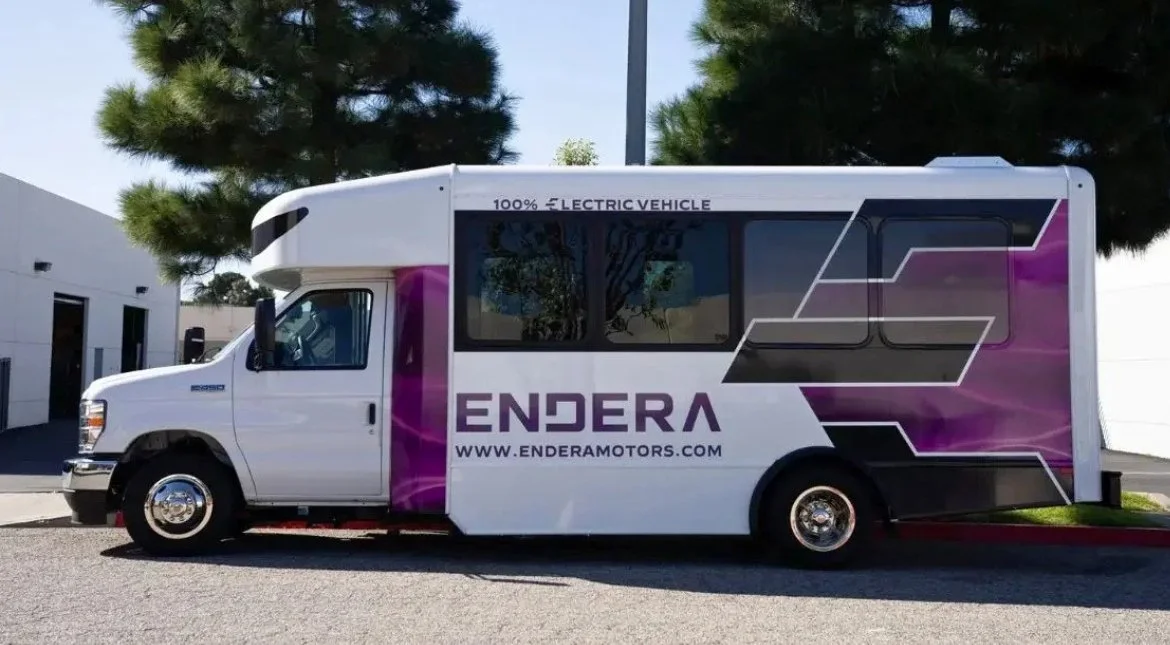
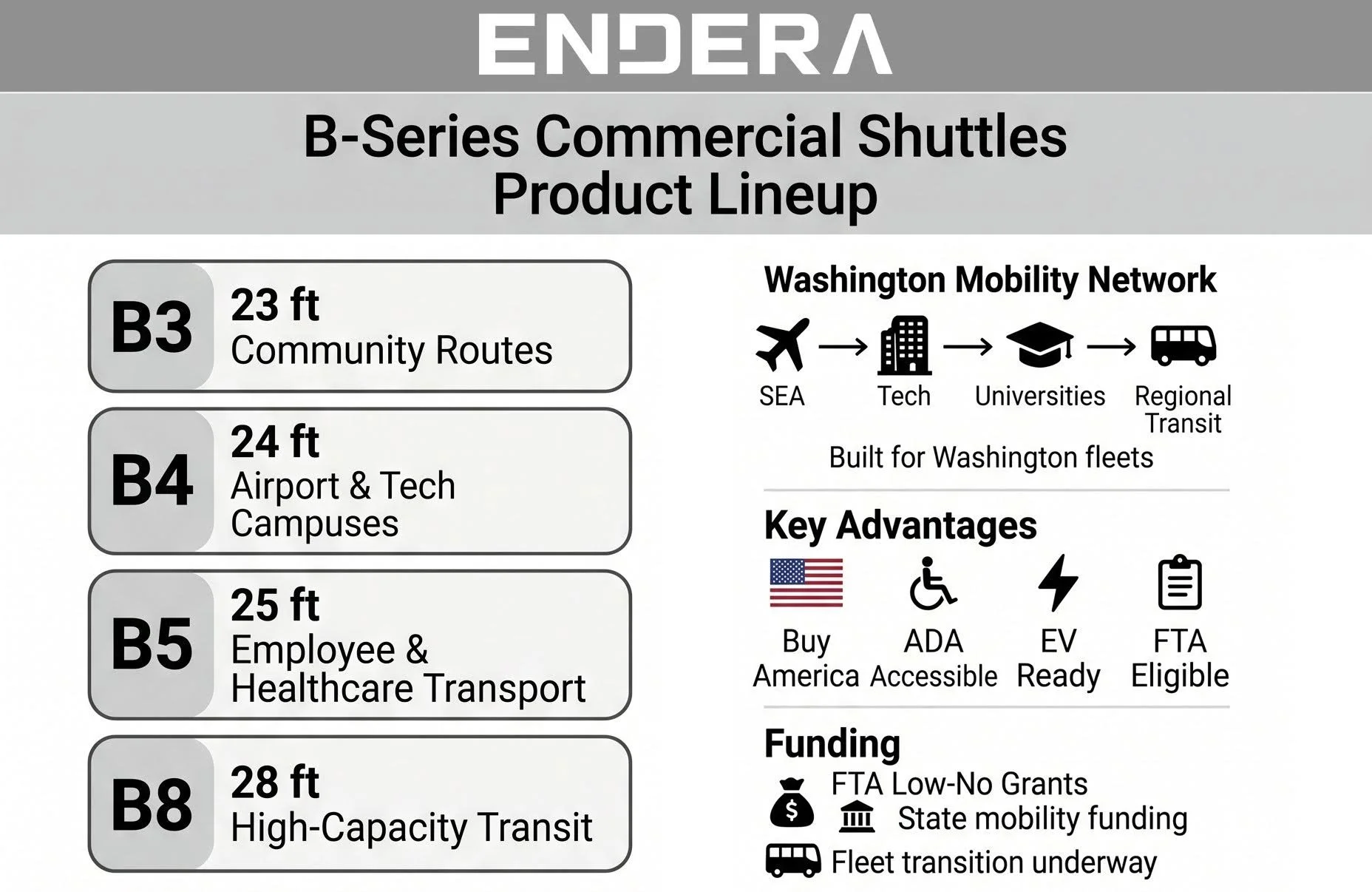
Endera manufactures Class 4 B-Series commercial shuttles in ICE, propane, CNG, and full-electric configurations on Ford E450 and Chevrolet Express cutaway chassis. The B-Series is FTA-eligible and Buy America compliant — meeting the federal procurement requirements that Washington transit agencies, universities, and municipal operators need for federally funded fleet purchases. For Washington operators evaluating a new shuttle or fleet refresh, Endera's B-Series lineup spans the B3, B4, B5, and B8 in 23–28 foot configurations, with ADA-accessible flat-floor models and route-specific customization handled at the factory level.
Ready to spec your fleet? Contact Endera's fleet specialists today to design a custom configuration blueprint for your operation.
Washington's Zero-Emission Fleet Leadership
King County Metro's Zero Emissions Fleet Initiative is one of the most ambitious EV transit programs in the country — targeting a fully battery-electric fleet with charging infrastructure deployed across multiple bus bases. Seattle City Light's public transit electrification program supports utility-transit partnerships that fund charging infrastructure alongside vehicle acquisition.
Washington State's open transportation electrification funding opportunities include regional mobility grants, charging equipment funding, and zero-emission fleet transition support accessible to qualifying operators. Endera's grant navigation services help Washington operators identify applicable programs and build procurement-ready documentation for competitive grant applications.
The B-Series Lineup for Washington Fleets
| Model | Length | Fuel | Best Fit |
|---|---|---|---|
| B3 B4 B5 |
23 ft 24 ft 25 ft |
ICE ICE & EV ICE & EV |
Lodge loops, community transit, small urban routes Airport shuttles, campus loops, tech campus transport Employee transport, commuter corridors, healthcare |
| B8 | 28 ft | ICE | High-volume municipal and group transport |
ADA-configured flat-floor models with 800 lb Braun lifts are available across the lineup, meeting ADA accessible transportation requirements and FTA Part 37 transportation service regulations as delivered.
Washington Shuttle Use Cases: Where the B-Series Fits
Washington's shuttle demand spans dense urban corridors, major tech campuses, rural communities, and a growing BRT network that creates consistent demand for mid-size commercial fleet vehicles. What differentiates Washington from most states is the breadth of institutional buyers — public transit agencies, tech employers, research universities, ferry systems, and rural demand-response operators all represent active fleet procurement markets with overlapping vehicle requirements.
Seattle, Airports, and Tech Campus Transportation
Seattle-Tacoma International Airport generates high-frequency parking and hotel shuttle demand suited to the B4's fixed-route efficiency. The tech corridor between Seattle, Bellevue, and Redmond — home to Microsoft, Amazon, and their supplier ecosystems — operates employee shuttle programs where daily reliability, ADA accessibility, and EV compatibility are standard expectations.
Washington's first electric Amtrak bus route out of Seattle signals the broader intercity electrification momentum that commercial operators are following.
University and Campus Transportation
Washington State University's electrifying student transportation program is actively supporting campus fleet transitions to electric. The University of Washington's transit electrification research examines bus base electrification, charging facility conversion, and public-private infrastructure models — institutional groundwork that reflects how seriously Washington universities are approaching fleet modernization. Endera's Endera Dispatch software provides AI-powered routing, real-time GPS tracking, and state-of-charge monitoring suited to multi-stop campus operations.
Rural and Regional Community Transit
Clallam Transit on the Olympic Peninsula and Jefferson Transit Authority operate dial-a-ride and paratransit services in communities where fixed-route transit isn't viable. Pierce Transit manages a mixed fleet including battery-electric buses, hybrids, and paratransit vehicles serving Tacoma and surrounding areas. For Washington's rural operators, ICE and propane B-Series configurations serve demand-response routes well — broad parts availability and no charging infrastructure dependency for communities where depot buildout isn't yet feasible.
BRT Expansion and Growing Transit Demand
Washington's bus rapid transit network is expanding significantly. The Stride Bus Rapid Transit system connecting Everett, Bellevue, and Renton is built around electric buses. RapidRide G Line adds dedicated bus corridors in Seattle. The Vine BRT serves the Vancouver, WA corridor in Southwest Washington.
This infrastructure investment signals sustained fleet demand — and for commercial shuttle operators, BRT expansion creates first-mile/last-mile connectivity opportunities that mid-size shuttle vehicles serve better than full-size transit buses. As riders use BRT as the spine of their commute, demand for connecting shuttle services at both ends of the route grows — a procurement opportunity that municipalities and private operators are actively filling with commercially built mid-size vehicles.
Total Cost of Ownership in Washington's EV Market
Washington's electricity rates are among the lowest in the country — a structural advantage for electric shuttle operators that compounds over a 10-to-12-year service lifecycle. The per-mile fuel cost differential between electric and gasoline is more favorable in Washington than in most other states, which strengthens the financial case for EV even before federal funding is applied. For Washington operators modeling fleet economics, that rate advantage is worth quantifying against actual route mileage before finalizing powertrain specifications.
Charging Infrastructure for Washington EV Fleets
WTA's zero-emission bus planning documents the operational challenges Washington agencies face — range planning, phased fleet replacement, infrastructure cost, and route optimization for electric models. These are the same considerations commercial shuttle operators need to work through before specifying EV.
DC fast charging is standard on every Endera EV unit. Endera's turnkey charging platform handles depot site assessments, charger procurement, and metering installation as a single engagement. For Washington operators building out charging at multiple locations — tech campuses, airport depots, or university facilities — the platform scales without requiring operators to manage separate infrastructure vendors for each site.
ADA Accessibility for Washington Transit Fleets
Washington's transit and paratransit operators must meet ADA accessible transportation requirements and FTA Part 37 regulations for commercially operated accessible transport — standards that apply to Pierce Transit paratransit contracts, rural dial-a-ride programs, and any fleet accepting federal funding.
Endera's flat-floor B-Series configurations include 800 lb Braun ADA lifts installed at the manufacturing stage. For Washington NEMT operators, senior living communities, and rural transit agencies, OEM-installed equipment provides unified warranty coverage and cleaner compliance documentation than post-sale retrofits.
Ready to Spec a Shuttle for Your Washington Fleet?
Several 2026 B-Series units are available for immediate delivery through Endera Stock, including ADA-configured flat-floor models and standard passenger layouts. For operators working within Washington's formal procurement process or FTA grant-aligned purchasing cycles, Endera provides full specification documentation, Buy America compliance materials, and grant application support.
Contact Endera's fleet specialists to discuss fleet configuration, EV range estimates for Washington routes, or financing options.
FAQs
How is Washington's transit electrification different from other states?
Washington combines utility-transit partnerships, active state funding programs, and institutional research at UW and WSU that most states don't have. King County Metro's zero-emissions initiative and Seattle City Light's charging infrastructure program are executing at a scale that has made Washington a national reference point for transit electrification. Commercial shuttle operators in the state benefit from that ecosystem — mature infrastructure planning, active grant cycles, and a procurement environment that rewards early movers.
What Washington funding programs support commercial shuttle fleet electrification?
Washington Commerce's open transportation electrification funding includes regional mobility grants, charging equipment support, and zero-emission fleet transition funding for qualifying operators. FTA Low-No Emission grants and Bus and Bus Facilities program funding are accessible to transit agencies and contracted operators. Endera's grant navigation services identify applicable programs based on operator structure and fleet profile.
How does BRT expansion in Washington affect shuttle bus demand?
Washington's BRT expansion — Stride connecting Everett to Renton, RapidRide G in Seattle, The Vine in Vancouver — creates first-mile/last-mile connectivity gaps that mid-size shuttle vehicles fill better than full-size buses. As transit riders increasingly use BRT as the spine of their commute, demand for connecting shuttle services at both ends grows. This is a growing procurement opportunity for commercial operators and municipalities.
Are electric B-Series shuttles compatible with Washington's tech campus fleet requirements?
Yes. The B4 and B5 handle tech campus employee circuits efficiently — ADA-configured, electric-capable, and compatible with Endera Dispatch for real-time routing and state-of-charge monitoring. Microsoft, Amazon, and their supplier networks typically require daily reliability, accessibility compliance, and sustainability-aligned procurement documentation — all of which Endera's vertically integrated manufacturing and compliance package satisfies.
How does the B-Series serve rural Washington transit operators?
ICE and propane B-Series configurations serve rural Washington demand-response operations well — Clallam Transit on the Olympic Peninsula and Jefferson Transit Authority both operate in areas where charging infrastructure isn't yet viable for full electrification. Broad parts availability, no depot buildout requirement, and ADA-configured models suited to dial-a-ride operations make ICE and propane the current-cycle solution for Washington's rural transit agencies.
What ADA configurations are available for Washington paratransit and community transit operators?
Flat-floor B-Series configurations include 800 lb Braun ADA lifts installed at the manufacturing stage, meeting FTA Part 37 requirements. Seating is configurable across 4-to-6 section layouts for mixed wheelchair and ambulatory configurations. For Pierce Transit paratransit contractors and rural dial-a-ride programs, OEM-installed equipment provides unified warranty coverage and cleaner compliance documentation than post-sale retrofits.
Do B-Series shuttle buses require a CDL in Washington?
Most B-Series configurations fall below the federal CDL threshold — under 26,001 lbs GVWR and fewer than 16 passengers, including the driver. Washington operators running for-hire commercial transport should confirm state-specific licensing requirements, as Washington for-hire passenger carrier rules may add licensing layers beyond the standard federal CDL threshold.