
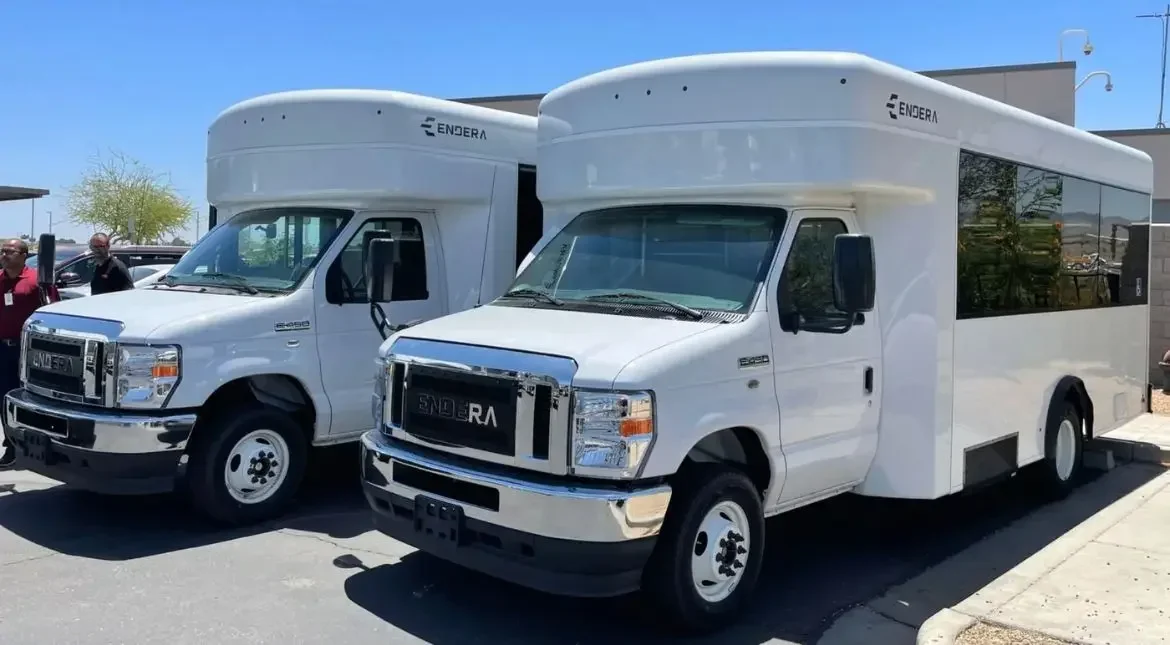
Maryland's commercial shuttle market is shaped by the Baltimore–Washington corridor — one of the densest transit environments on the East Coast. Airport connectivity at BWI, DCA, and IAD, major university campuses with their own transit systems, a federal contractor and government workforce requiring reliable employee transport, and healthcare campuses spanning both metro and suburban areas all create consistent, overlapping shuttle demand that generic fleet solutions don't address well.
Endera manufactures Class 4 B-Series commercial shuttles in ICE, propane, CNG, and full-electric configurations on Ford E450 and Chevrolet Express cutaway chassis. The B-Series is FTA-eligible and Buy America compliant — meeting the federal procurement requirements that Maryland transit agencies, universities, and municipal operators need for federally funded fleet purchases. For Maryland operators evaluating a new shuttle or fleet refresh, Endera's B-Series lineup spans the B3, B4, B5, and B8 in 23–28 foot configurations, with ADA-accessible flat-floor models and route-specific customization handled at the factory level.
Ready to spec your fleet? Contact Endera's fleet specialists today to design a custom configuration blueprint for your operation.
Maryland's Zero-Emission Transit Mandate
Maryland has a zero-emission bus acquisition requirement that places fleet electrification on a statutory timeline — making EV readiness a procurement planning consideration for Maryland transit agencies, not a future option. The Maryland Transit Administration has been actively purchasing hybrid and battery-electric buses alongside charging infrastructure, demonstrating that fleet modernization is already in execution rather than planning stages.
WMATA, the regional transit authority serving the DC-Maryland-Virginia corridor, has received a $50.3 million federal grant for bus fleet modernization — reinforcing that federal investment is actively flowing into the region's transit infrastructure.
Funding Pathways for Maryland Fleet Operators
For Maryland operators pursuing clean fleet purchases, FTA Low-No Emission grant funding provides a direct pathway to offset acquisition costs. Private commercial operators outside public transit structures should confirm applicable funding pathways — federal programs are structured differently for transit agencies versus contracted private operators.
Maryland's zero-emission mandate also creates a timing advantage for operators who act early. Competitive federal grant cycles reward agencies with procurement-ready specifications and compliance documentation in hand. Endera's grant navigation services help Maryland operators identify applicable programs, confirm Buy America compliance, and manage applications alongside procurement — reducing the administrative burden that causes many operators to miss funding windows entirely.
The B-Series Lineup for Maryland Fleets
| Model | Length | Fuel | Best Fit |
|---|---|---|---|
| B3 B4 B5 |
23 ft 24 ft 25 ft |
ICE ICE & EV ICE & EV |
Hotel loops, community transit, government campuses Airport shuttles, campus loops, healthcare transport Employee transport, commuter corridors, higher-capacity routes |
| B8 | 28 ft | ICE | High-volume municipal and group transport |
ADA-configured flat-floor models with 800 lb Braun lifts are available across the lineup, meeting ADA accessible transportation requirements and FTA Part 37 transportation service regulations as delivered.
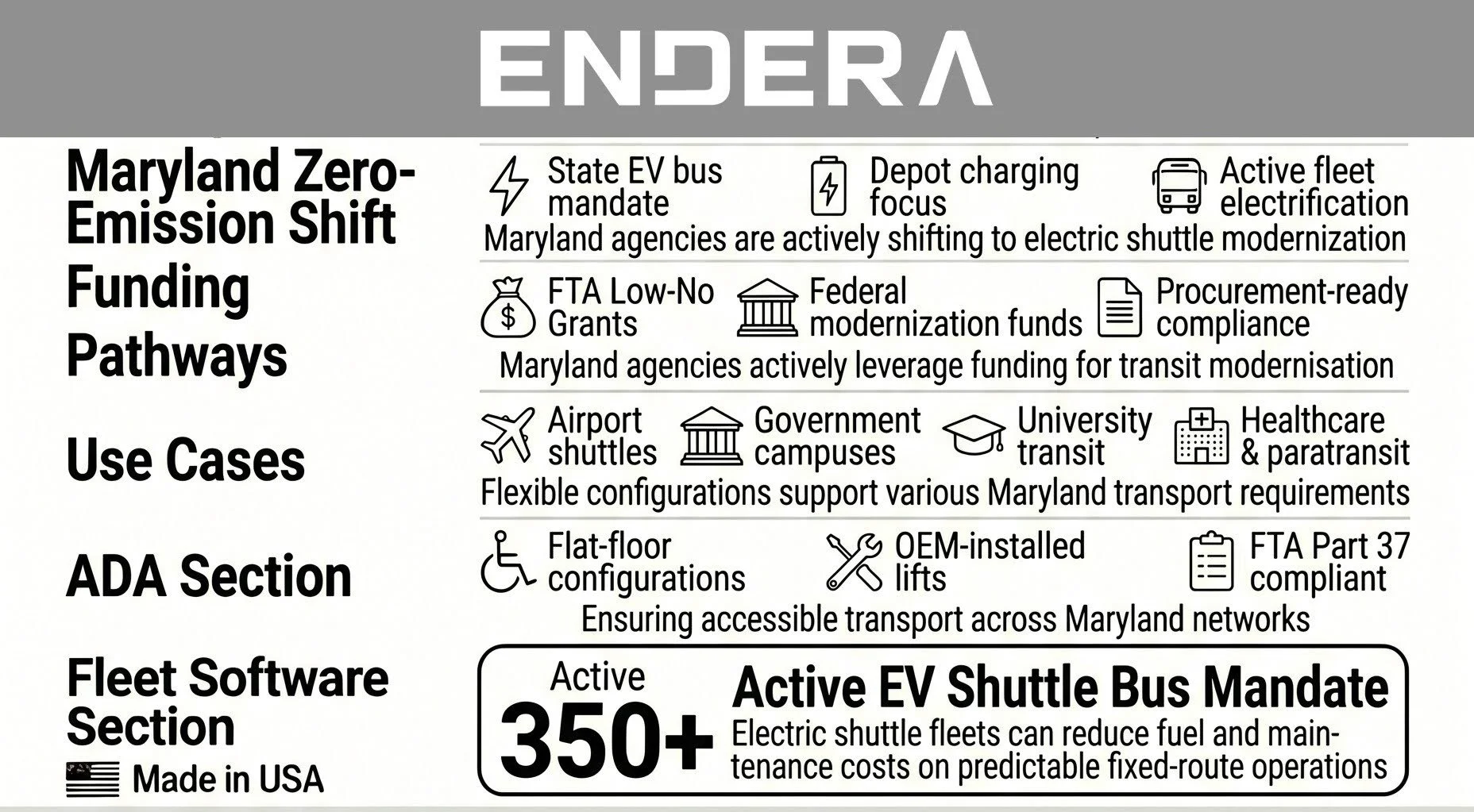
Maryland Shuttle Use Cases: Where the B-Series Fits
Maryland's shuttle demand concentrates across several distinct markets with different operational profiles.
Airports, Government, and DC Corridor Transportation
BWI Marshall Airport and the Washington Dulles and Reagan National corridors generate consistent parking and hotel shuttle demand. Maryland's concentration of federal agencies, defense contractors, and government campuses creates institutional employee transport demand that requires reliable daily cycles, ADA accessibility, and vehicles compatible with secure facility access requirements.
The B4's compact footprint navigates tight government campus drop-off areas efficiently — a practical advantage in environments designed for pedestrians and passenger vehicles, not full-size buses.
University Campus Transportation
The University of Maryland's Shuttle-UM system operates one of the most extensive campus shuttle networks in the Mid-Atlantic — high-frequency, ADA-accessible, and sustainability-focused. In 2024, the University of Maryland was awarded nearly $40 million to fund electric shuttle buses, making it one of the highest-profile university EV shuttle commitments in the region. UMBC's transit system and the campuses at Johns Hopkins, Towson, and Morgan State add further institutional shuttle demand across the Baltimore metro.
Healthcare, Senior Living, and Paratransit
Maryland's major health systems — Johns Hopkins Medicine, University of Maryland Medical System, and MedStar — operate patient transport and inter-facility shuttle programs requiring accessible configurations and consistent daily reliability. The Regional Transportation Agency of Central Maryland and Central Maryland Regional Transit serve paratransit and demand-response needs across suburban counties.
Endera's Endera Dispatch software provides AI-powered routing, real-time GPS tracking, and state-of-charge monitoring suited to both healthcare and paratransit operational requirements.
Electric vs. ICE for Maryland's Dense Corridor Environment
Maryland's stop-and-go corridor traffic — I-95, I-270, and the Baltimore Beltway — actually improves electric shuttle efficiency through regenerative braking. High-cycle urban and suburban routes with predictable daily mileage and overnight depot charging are the operational profile where electric B4 and B5 models perform best.
Maryland's zero-emission bus acquisition requirement means operators planning fleet replacement cycles over the next five to ten years should be specifying electric-ready platforms now.
Charging Infrastructure for Maryland EV Fleets
Depot readiness is the primary planning step for Maryland operators considering electric. DC fast charging is standard on every Endera EV unit, enabling rapid turnaround between shifts for high-cycle corridor operations. Endera's turnkey charging platform handles site assessments, charger procurement, and metering installation as a single engagement — removing infrastructure coordination from fleet managers managing other procurement priorities simultaneously.
The Corridor Cities Transitway proposal and ongoing BRT expansion in Montgomery and Prince George's Counties signal continued infrastructure investment that strengthens the long-term EV operating case for Maryland corridor operators. Operators who invest in depot charging now will be better positioned when the zero-emission acquisition timeline tightens.
When ICE or Propane Bridges the Gap
Maryland operators with irregular routes, multiple unconnected depot locations, or procurement timelines that don't align with a charging buildout should consider ICE or propane as a current-cycle solution. Propane reduces fuel costs 30–40% versus gasoline and qualifies for clean fuel incentive programs that diesel replacements typically cannot access — a practical step toward Maryland's clean transportation goals without the infrastructure investment of full electrification.
All B-Series configurations share the same platform. Standardizing on Endera now doesn't foreclose an EV transition on the next procurement cycle.
ADA Accessibility for Maryland Fleets
Maryland's transit and paratransit operators must meet ADA accessible transportation requirements and FTA Part 37 transportation service regulations for commercially operated accessible transport — standards that apply to MTA paratransit contractors, university accessible shuttle systems, healthcare transport programs, and any fleet accepting federal funding.
Endera's flat-floor B-Series configurations include 800 lb Braun ADA lifts installed at the manufacturing stage. For Maryland NEMT operators, senior living communities, and regional transit agencies, OEM-installed equipment provides unified warranty coverage and cleaner compliance documentation than aftermarket modifications.
Ready to Spec a Shuttle for Your Maryland Fleet?
Several 2026 B-Series units are available for immediate delivery through Endera Stock, including ADA-configured flat-floor models and standard passenger layouts. For operators working within Maryland's formal procurement process or FTA grant-aligned purchasing cycles, Endera provides full specification documentation, Buy America compliance materials, and grant application support.
Contact Endera's fleet specialists to discuss fleet configuration, EV range estimates for Maryland routes, or financing options.
FAQs
What is Maryland's zero-emission bus acquisition requirement and how does it affect fleet purchases?
Maryland law requires transit agencies to acquire zero-emission buses on a phased timeline — making EV readiness a statutory procurement consideration rather than a preference. Operators planning fleet replacement cycles over the next decade should be specifying electric-compatible platforms now to stay ahead of compliance windows and maximize access to federal funding that prioritizes zero-emission purchases.
How does stop-and-go corridor traffic affect electric shuttle efficiency in Maryland?
Dense Maryland corridor traffic — I-95, I-270, the Baltimore Beltway — actually improves electric efficiency. Regenerative braking recaptures energy on every deceleration cycle, reducing per-mile energy consumption compared to constant-speed highway operation. High-cycle urban routes with frequent stops are where electric shuttles deliver their strongest efficiency advantage over diesel or gasoline equivalents.
What university shuttle programs operate in Maryland and how does the B-Series serve them?
The University of Maryland's Shuttle-UM system is one of the largest campus shuttle networks in the Mid-Atlantic — and UMD recently received nearly $40 million for electric shuttle buses. UMBC, Johns Hopkins, Towson, and Morgan State also operate campus transit programs. The B4 handles high-frequency campus loops efficiently, and Endera Dispatch provides the routing optimization and real-time tracking that campus transit systems require.
Are there federal funding programs for Maryland shuttle fleet electrification?
Yes. FTA Low-No Emission grants and Bus and Bus Facilities program funding are accessible to Maryland transit agencies and qualifying contracted operators. WMATA's $50.3 million federal modernization grant illustrates the scale of investment flowing into the region. Maryland's own zero-emission bus mandate creates additional urgency to align purchases with available funding cycles. Endera's grant navigation services help identify applicable programs based on operator structure.
What ADA configurations are available for Maryland paratransit and healthcare operators?
Flat-floor B-Series configurations include 800 lb Braun ADA lifts installed at the manufacturing stage, meeting FTA Part 37 accessibility requirements. Seating is configurable across 4-to-6 section layouts for mixed wheelchair and ambulatory configurations. For Maryland NEMT operators and regional paratransit contractors, OEM-installed equipment provides unified warranty coverage and cleaner compliance documentation than post-sale retrofits.
How does the B-Series handle Maryland's government and federal contractor shuttle requirements?
Government campus shuttle programs require reliable daily cycles, ADA accessibility, and vehicles compatible with secure facility access. The B4's compact footprint navigates tight government drop-off areas efficiently, and Endera's vertically integrated manufacturing produces a single warranty document and compliance certification — simplifying the procurement documentation that government contractor vehicle purchases typically require.
Do B-Series shuttle buses require a CDL in Maryland?
Most B-Series configurations fall below the federal CDL threshold — under 26,001 lbs GVWR and fewer than 16 passengers, including the driver. Maryland operators running for-hire commercial transport should confirm state-specific licensing requirements, as Maryland for-hire passenger carrier rules may add licensing layers beyond the standard federal CDL threshold.