
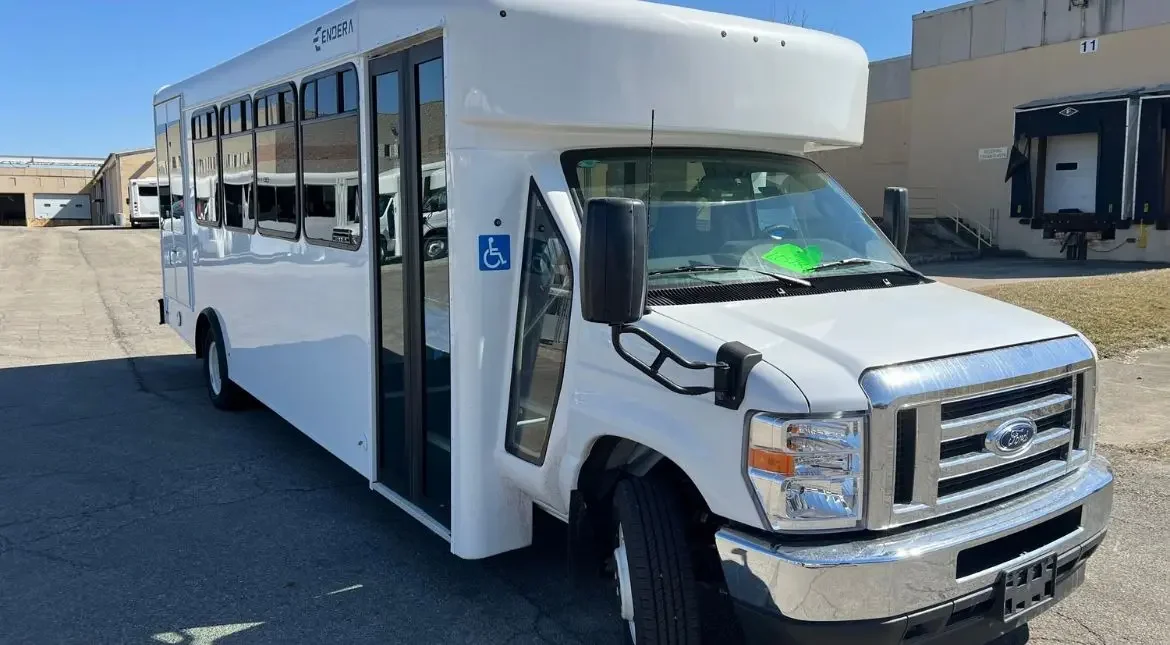
West Virginia's shuttle market is heavily shaped by its mountainous terrain and dispersed population. Operations include seasonal resort loops in Snowshoe and Canaan Valley, campus transit at West Virginia University in Morgantown, and medical shuttles in cities like Charleston and Huntington. Along corridors like I-64 and I-77, hospitality and tourism routes rely on dependable, cost-effective transport despite limited dense urban infrastructure.
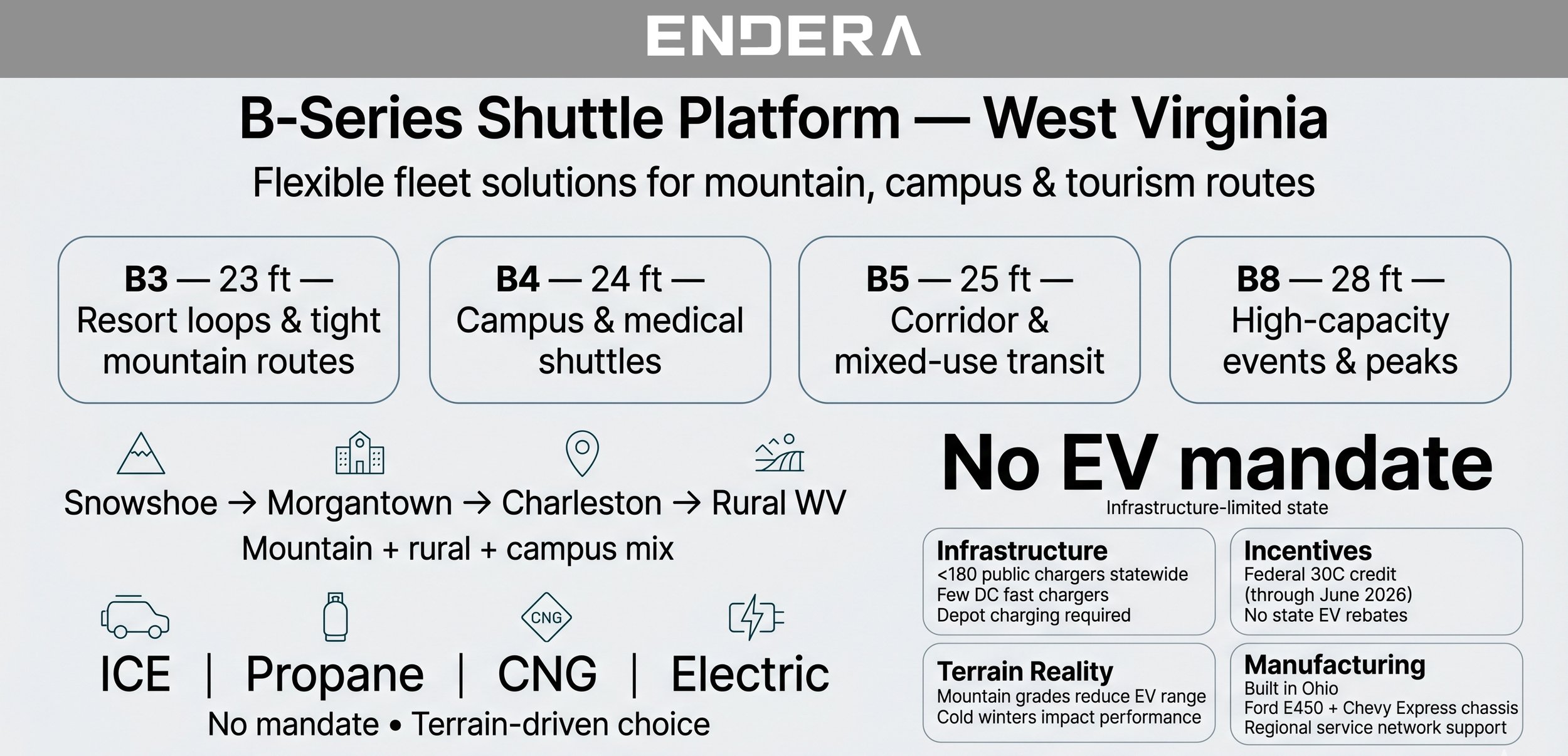
Endera's B-Series — the B3, B4, B5, and B8, ranging from 23 to 28 feet — was built for exactly this kind of operational diversity. ICE, propane, CNG, and electric configurations are available on Ford E450 and Chevrolet Express cutaway chassis, manufactured at Endera's Ottawa, Ohio facility. For West Virginia operators, the multi-fuel flexibility isn't a secondary feature — in a state with limited EV infrastructure and mountainous terrain, it's often the deciding factor.
Don't let terrain or infrastructure gaps limit your options — connect with an Endera specialist today to find the right B-Series configuration for your West Virginia routes.
West Virginia's Fleet Landscape: Honest Conditions for Shuttle Operators
No Mandate, Thin Incentives, and a Practical Policy Posture
West Virginia has no statewide electrification requirement for commercial fleets, no state-level EV purchase rebate, and no utility EV charger rebate programs. The state charges EV owners a $200 annual registration fee on top of standard vehicle registration costs — a policy intended to offset lost gasoline tax revenue.
The state's Green Fleet Initiative for government vehicles explicitly conditions alternative fuel procurement on whether fueling infrastructure is already in place. That posture reflects genuine infrastructure constraints rather than ideology: West Virginia has fewer than 180 public charging stations and 55 DC fast chargers statewide — one of the thinnest public charging networks in the country for a state its size.
What That Means for Fleet Operators Practically
For West Virginia shuttle operators, electrification decisions are mainly driven by operational needs rather than incentives. Federal support like the 30C charging credit (through June 2026) is still available, but there’s little state-level backing to supplement it.
CNG offers some fuel tax advantages for municipal fleets, while propane remains a stable-cost option. As a result, ICE, propane, or CNG are often the most practical choices today, with EVs becoming more viable once depot charging infrastructure is in place.
The B-Series Lineup for West Virginia Operations
Four Models Built for WV's Operating Environments
The B3 (23 ft) is a compact ICE model suited for hotel loops, campus routes, and tight mountain-road operations. The B4 (24 ft) and B5 (25 ft) offer more capacity with ICE and electric options, ideal for WVU transit, medical shuttles, and hospitality routes along major corridors. The B8 (28 ft) is designed for high-volume use like resorts, events, and peak shuttle demand.
Chassis Serviceability in a State With Limited Urban Centers
All B-Series models are available on Ford E450 or Chevrolet Express cutaway chassis — two of the most broadly serviced commercial platforms in the country. For West Virginia operators in markets far from major service centers, that regional Ford and GM dealer network coverage is a practical operational advantage. A specialized bus service network doesn't serve most of rural West Virginia — a mainstream commercial chassis does.
Why Fixed Routes Fail in Rural West Virginia
The Urban Transit Model Doesn't Transfer
Most shuttle planning content assumes demand looks like a city — dense, predictable, and well-suited to fixed-route schedules. West Virginia operates under a different reality. The state's mobility challenge is low-density, rural demand, where WVU transportation research has documented that traditional fixed-route transit often fails economically because sufficient ridership to sustain it simply doesn't exist across much of the state.
Even WVU's own campus transportation — among the most structured transit environments in West Virginia — combines public buses, campus systems, and privately operated apartment shuttles layered together. That fragmentation isn't inefficiency; it's adaptation to variable, uneven demand that no single fixed-route system can serve cost-effectively.
What Actually Works in WV's Shuttle Market
For West Virginia shuttle operators, flexible or demand-based routing often works better than rigid fixed schedules, especially in tourism and university markets where ridership varies seasonally.
Right-sized 23–25 ft vehicles help match lower average demand while still handling peak periods efficiently. The B3, B4, and B5 are designed for this balance, offering operational flexibility and efficiency without needing larger buses.
Fleet Decision Framework: West Virginia Routes and the Right Configuration
Terrain, Distance, and Fuel Choice in WV
| Use Case | Recommended Model | Fuel Type | Why |
|---|---|---|---|
| Mountain resort loop (Snowshoe, Canaan Valley) |
B3 / B4 | ICE or Propane | Seasonal, variable terrain, fuel flexibility |
| WVU campus transit (Morgantown) |
B4 / B5 | ICE or EV | Defined routes; EV viable with depot charging |
| Medical center shuttle (Charleston, Huntington) |
B4 / B5 | ICE or Propane | Reliability priority, year-round demand |
| I-64 / I-77 corridor hospitality | B4 / B5 | ICE or CNG | Highway-adjacent routes, CNG tax exemption |
| High-volume resort / event transport | B8 | ICE / CNG | Maximum capacity, seasonal peak demand |
For WVU campus operations — where defined route cycles and depot charging infrastructure are potentially achievable — the electric B4 and B5 are worth evaluating alongside the operating savings data. Operators at San Diego International Airport, a comparable high-frequency deployment, have forecasted nearly $20,000 in annual savings per vehicle versus LPG or CNG. For operators running mountain terrain routes with variable conditions and limited charging access, ICE and propane deliver the reliability and fuel flexibility those conditions require.
Terrain, Temperature, and EV Performance in West Virginia
What Mountain Routes Actually Do to EV Range
West Virginia's terrain creates EV performance considerations that flat-state content rarely addresses. Sustained grades on mountain routes increase energy consumption significantly — regenerative braking recovers some energy on descents, but the net effect on hilly routes is a material reduction in effective range compared to flat-road specs.
Research on EV energy consumption confirms that grade, speed variation, and stop-start frequency all affect actual versus rated range in ways that matter for route planning. For WV operators evaluating electric configurations, the relevant range number isn't what the spec sheet says on flat ground — it's what the vehicle delivers on the specific grades your routes run.
Cold Winters Add Another Variable
West Virginia's winters — particularly in the higher elevations of the eastern panhandle and mountain counties — add cold-weather range reduction to the terrain consideration. Heating systems draw significant battery power at low temperatures, compressing effective range further. Short, predictable depot-based routes in Morgantown or Charleston can absorb both variables with careful planning. Longer resort shuttle circuits at elevation in January are a different calculation entirely.
Endera's Dispatch platform provides real-time state-of-charge monitoring that helps operators manage these seasonal and terrain-driven variables during operation — but the route assessment needs to happen before the vehicles arrive, not after.
Incentives: What's Actually Available for WV Fleet Operators
Federal Programs Are the Only Meaningful Tool
With no state vehicle purchase rebate, no utility incentive programs, and no layered incentive stack, West Virginia fleet operators considering electrification have federal programs as their primary financial tool.
The 30C charging equipment tax credit covers up to $100,000 per installed charging port through June 2026 — the most actionable near-term program for WV operators planning depot charging installations. Any future EPA fleet programs that open for commercial operators would apply to West Virginia fleets. For municipal operators, the CNG bulk purchase tax exemption reduces fuel costs for fleets already running natural gas.
True Cost and Cash Flow for WV Operators
Electric shuttles offer lower long-term operating costs through reduced fuel use and maintenance. However, in West Virginia, limited incentives and challenging terrain can narrow the short-term cost advantage compared to ICE vehicles.
Endera’s financing team can help model full lifecycle costs based on local routes, terrain, and infrastructure, allowing operators to make decisions grounded in real operating conditions rather than national averages.
Built for West Virginia's Real Operating Conditions
West Virginia operators need shuttles that handle mountain terrain, hold up through harsh winters, and are supported by a manufacturer that doesn't require dense urban infrastructure to be useful. The B-Series delivers across four models, four fuel types, and two chassis options — with fleet software, financing support, and a team that gives West Virginia operations the same attention as a major coastal fleet.
Your routes are demanding. Your shuttle should be too. Connect with an Endera fleet specialist today to find the right B-Series configuration for your West Virginia operation.
FAQs
Which B-Series models are available for West Virginia operators?
All four models — B3 (23 ft), B4 (24 ft), B5 (25 ft), and B8 (28 ft) — are available in West Virginia in ICE, propane, CNG, and electric configurations depending on model. Contact Endera's sales team for current availability and lead times.
Does West Virginia have state EV incentives for fleet purchases?
No. West Virginia has no state-level EV vehicle purchase rebate and no utility EV charger rebate programs. The primary financial tool for WV operators is the federal 30C charging equipment credit (through June 2026) and any applicable federal fleet programs.
How does West Virginia's terrain affect EV shuttle performance?
Mountain grades increase energy consumption and reduce effective range compared to flat-road specs. Cold winters at higher elevations add further range compression from heating load. Short, depot-based routes in urban areas can absorb these variables; longer mountain resort circuits require careful route-level assessment before committing to electric configurations.
Is CNG a good option for West Virginia shuttle operators?
Yes. West Virginia offers a CNG bulk purchase tax exemption for municipal vehicles, making it a financially supported option for eligible operators. CNG offers lower emissions than gasoline, stable fuel costs, and no charging infrastructure requirement.
What chassis options are available in West Virginia?
All B-Series models are available on Ford E450 and Chevrolet Express cutaway chassis, serviced through regional dealer networks across West Virginia, including markets well outside the major urban centers.
Do Endera shuttles comply with Buy America requirements?
Yes. With approximately 65% of components sourced domestically, Endera's manufacturing supports Buy America compliance for federally funded West Virginia procurement contracts.
Can I get an in-stock 2026 shuttle for fast delivery in West Virginia?
Yes. Endera Stock lists ready-to-deliver 2026 models for rapid deployment without a custom build lead time.