
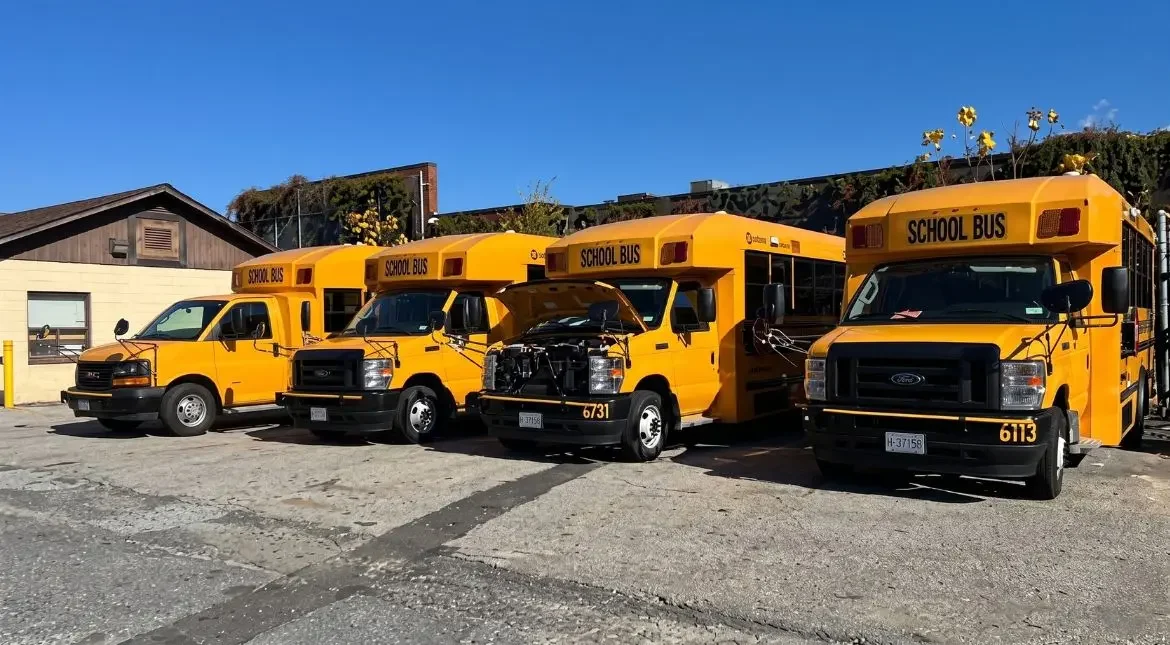
Maine school districts face a procurement challenge most urban buyers don't: rural routes, cold winters, and limited administrative capacity to navigate complex funding programs. The result is that many districts are operating aging diesel equipment longer than they should — not because newer options aren't available, but because the path to acquiring them isn't straightforward.
Endera manufactures Type A school buses in ICE, propane, CNG, and full-electric configurations on Ford E450 and Chevrolet Express cutaway chassis. For Maine's dispersed, lower-density districts, the Type A format — smaller, flexible, configurable — fits the operational reality that larger buses don't.
The path to a new bus doesn't have to be complicated — contact Endera's sales team today to get the documentation, funding assessment, and configuration guidance your district needs to move forward.
How Maine Schools Pay for New School Buses
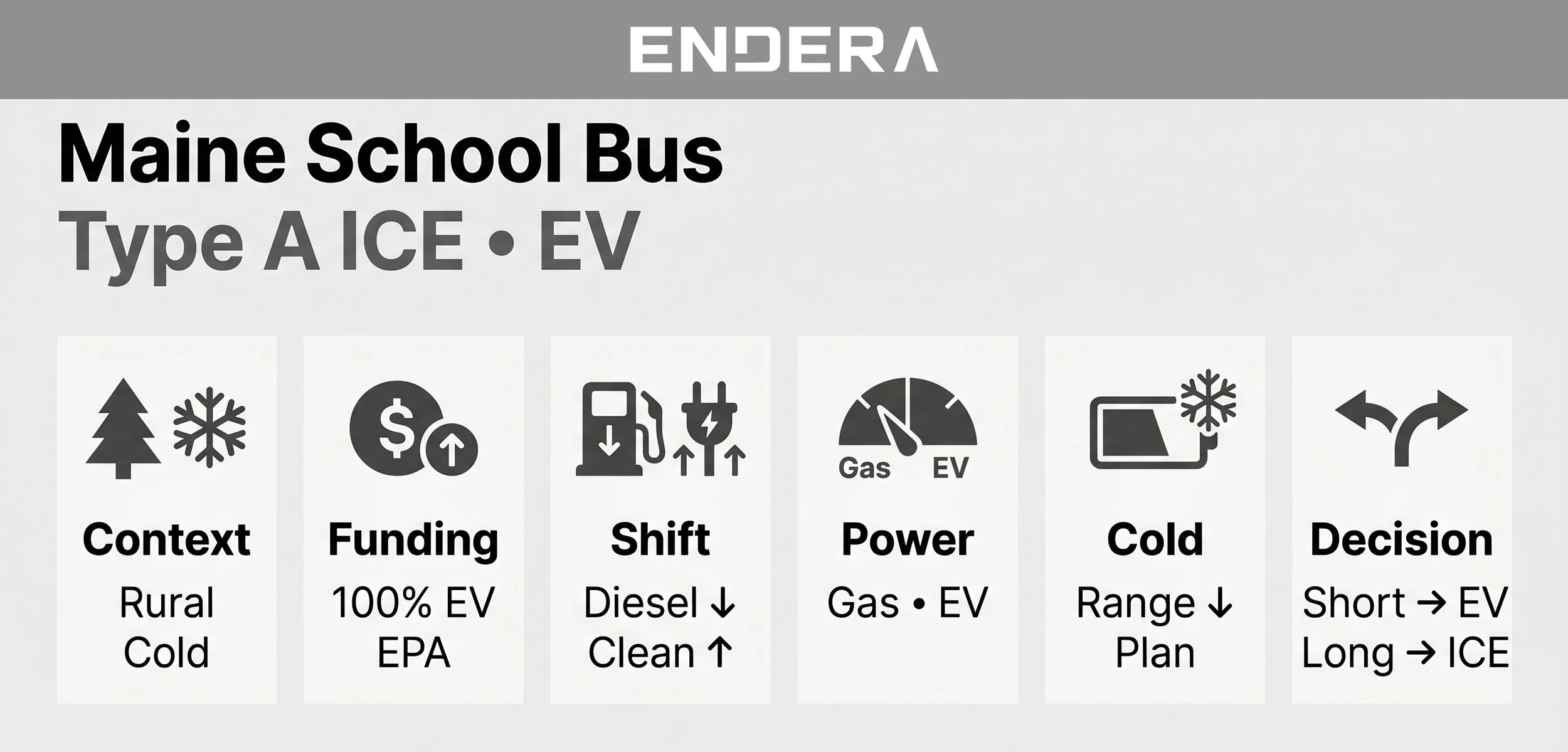
Maine has one of the more accessible funding structures for school bus replacement in the Northeast. The Maine Clean School Bus Program, administered through the Department of Education, offers up to 100% funding for electric school bus purchases — covering both vehicles and charging infrastructure. Eligible districts can receive funding for up to 25 electric buses per application cycle, making full fleet electrification a realistic option for districts that have historically viewed EVs as out of reach.
Federal funding stacks on top. EPA Clean School Bus Program rebates in Maine have reached up to $375,000 per bus and approximately $20,000 per charging station — figures that effectively eliminate the price premium of electric over ICE for qualifying districts. Nationwide, roughly $3 billion has already been distributed and over 8,000 buses replaced through EPA funding alone. Endera's grant navigation services help Maine districts identify applicable state and federal programs and manage the application process without diverting internal transportation staff.
Why Maine Schools Are Moving Away from Diesel
The case against diesel isn't only environmental. According to Maine DOE clean bus program materials, diesel buses can expose students to 5 to 10 times more pollutants inside the cabin than exist in outside air — a concentration effect driven by exhaust recirculation into the passenger area during operation.
For Maine districts with students riding long rural routes, cumulative exposure over a school year is significant. The health argument and the funding argument now point in the same direction: the cost of transitioning to cleaner equipment has dropped substantially, while the documented risks of continuing to operate older diesel fleets have become harder to justify administratively.
Electric vs. ICE in Cold Climates: The Maine-Specific Answer
Cold weather is the most common objection to electric school buses in Maine — and it deserves a direct answer rather than a dismissal. Battery performance does degrade in sub-freezing temperatures, and districts with long rural routes need to account for reduced range before committing to an electric purchase.
Real-world testing in Maine addresses this directly. A cold-climate performance study conducted at Mount Desert Island High School evaluated electric bus reliability and route performance under Maine winter conditions. The findings confirmed that electric buses can operate effectively on typical Maine district routes with appropriate planning — pre-conditioning the battery while still plugged in is the primary operational adjustment that protects range in cold weather.
When Electric Is the Right Call
Fixed routes with predictable daily mileage and overnight depot charging are where electric Type A buses perform best. Districts running special education transport or suburban loops — often 30 to 60 miles per day — are well within the operational envelope even in winter, particularly with DC fast charging available as a midday option. The combination of state funding up to 100% and federal rebates up to $375,000 per bus removes the financial barrier that has historically made ICE the default.
When ICE or Bridge Fuels Make More Sense
Districts with long, irregular routes across remote terrain, no existing charging infrastructure, or procurement timelines that can't absorb a depot buildout should consider ICE, propane, or CNG as a current-cycle solution. Endera builds all configurations on the same Type A platform — meaning a district can standardize on a single manufacturer and transition to electric units on subsequent procurement cycles without switching vendors or retraining staff on a new platform.
Maine Is Already Running Electric School Buses
The cold-weather practicality question isn't theoretical for Maine anymore. A rural tribal school in Maine successfully electrified its school bus fleet through EPA funding and has since expanded the program. The deployment demonstrates that even small, resource-limited Maine districts can execute an EV transition — the infrastructure and funding mechanisms exist for districts willing to apply.
That adoption pattern mirrors the national picture. The electric school bus market has moved from pilot programs to active fleet replacement, with roughly $3 billion distributed and over 8,000 buses replaced through federal funding — a scale that has normalized EV procurement even for small, rural districts that once considered it out of reach. For Maine, where smaller district size was historically a barrier to ambitious fleet decisions, the combination of 100% state funding eligibility and federal rebate stacking has changed the calculus considerably.
Beyond Transport: How Electric Buses Can Generate Energy Value
This section covers ground most school bus purchasing conversations never reach, but it's financially relevant for Maine districts evaluating the full lifecycle economics of an electric purchase.
Maine's legislature has explored a Vehicle-to-Grid (V2G) pilot program specifically for electric school buses. V2G technology allows electric buses parked at a depot to discharge stored energy back to the grid during peak demand periods — effectively turning idle fleet assets into distributed energy resources. The Efficiency Maine report identifies V2G as a viable revenue or cost-offset mechanism for school districts, particularly during summer months and school breaks when buses sit unused for extended periods.
Districts evaluating electric buses purely on transportation cost should factor in the potential energy value of the battery asset when it isn't moving students.
Is a Type A Bus Right for Your Maine District?
Type A school buses are built for routes where a full-size bus is operationally inefficient — lower student densities, narrower rural roads, special education transport, and routes where flexibility in seating and accessibility configuration matters more than raw passenger capacity. Maine's district geography fits this profile consistently outside of the state's few urban centers.
Endera's Endera 4, 5, and 6 models are configurable across 4-to-6 section layouts with ADA-compliant lift options and custom storage. All three are available in ICE, propane, CNG, and full-electric powertrains — and because Endera manufactures both the body and the powertrain at its Ottawa, Ohio facility, buyers receive a single warranty document rather than split coverage from a chassis supplier and a separate body upfitter.
Maine's Next Bus Purchase Starts Here
New 2026 Type A models are available for immediate delivery through Endera Stock for districts with pressing replacement timelines. For districts working within Maine's structured bid and approval process, Endera's sales team provides full specification documentation, compliance materials, and grant application support.
Don't let an aging fleet outlast your patience for a complicated procurement process. Contact Endera's sales team today to discuss cold-weather performance expectations, configuration options, and funding strategy for your Maine district.
Frequently Asked Questions
Can Maine school districts get 100% funding for a new electric school bus?
Maine's Clean School Bus Program offers up to 100% funding for electric purchases, covering vehicles and charging infrastructure. Federal EPA rebates stack on top — up to $375,000 per bus in Maine — meaning qualified districts can fully offset acquisition cost, sometimes paying less net than a standard ICE replacement.
How does cold weather affect electric school bus range in Maine?
Sub-freezing temperatures typically reduce usable range by 15 to 25%. Pre-conditioning the battery while still plugged in before departure is the primary mitigation. Real-world testing at Mount Desert Island High School confirmed electric buses remain operationally viable on typical Maine routes with this adjustment built into daily scheduling.
What is the difference between Endera's Type A school bus models?
The Endera 4, 5, and 6 differ in body section count, which determines seating capacity, storage layout, and ADA configuration options. All three are available in ICE, propane, CNG, and electric powertrains. Districts configure seating and accessibility across 4-to-6 sections at the specification stage — not as a post-purchase modification.
What is Vehicle-to-Grid (V2G) technology and is it relevant for Maine schools?
V2G allows a parked electric bus to discharge stored energy back to the grid, generating revenue or offsetting energy costs. Maine's Efficiency Maine has explored a V2G pilot specifically for school buses, identifying it as a viable financial tool — particularly during summers and school breaks when buses sit idle for extended periods.
Does Maine have a structured procurement process for school bus purchases?
Yes. Maine uses state-managed approval and bidding processes, and clean bus funding is priority-based rather than automatic. Endera's sales team provides specification documentation and compliance materials to support formal bid submissions, and can help identify the right procurement pathway for state-funded versus federally funded purchases.
Are Endera's Type A buses compliant with Maine's school bus standards?
Endera's Type A buses exceed federal structural integrity standards and are available in ADA-compliant configurations. For FTA-funded purchases, vehicles are Buy America compliant. Endera provides full technical documentation for districts reviewing alignment with Maine DOE specification requirements during procurement.
How do ICE, propane, CNG, and electric powertrains compare over 10 years for a Maine district?
Electric carries higher upfront cost but lower fuel and maintenance expenses that compound over a 10-to-12-year lifespan. Propane and CNG offer a middle path — cleaner than diesel, less infrastructure-dependent than EV. ICE remains the lowest-friction option for districts with irregular routes and no charging setup. Endera builds all four configurations on the same Type A platform, so districts aren't locked into a single choice at the manufacturer level.