
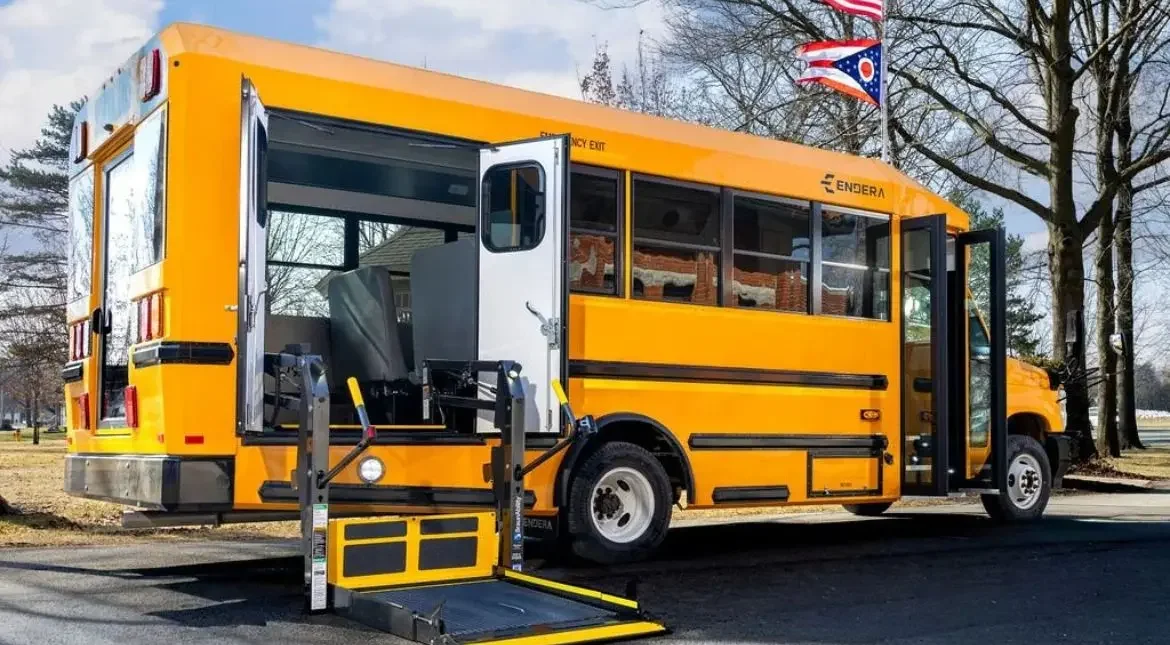
Connecticut school districts aren't just evaluating a bus purchase — they're making a fleet strategy decision with a statutory deadline attached. State policy is moving CT toward zero-emission school buses by 2040, with an alternative fuel requirement by 2035. That timeline transforms the ICE-versus-electric question from a preference into a planning exercise.
Endera manufactures Type A school buses in ICE, propane, CNG, and full-electric configurations on Ford E450 and Chevrolet Express cutaway chassis. For Connecticut districts balancing compliance timelines, active funding programs, and day-to-day operational requirements, the Type A platform offers a transition path that doesn't require committing to a single powertrain across an entire fleet at once.
Connecticut's 2035 deadline is closer than it looks — contact Endera's sales team today to build a transition plan that keeps your district ahead of the mandate.
Connecticut's Push Toward Zero-Emission School Bus Fleets
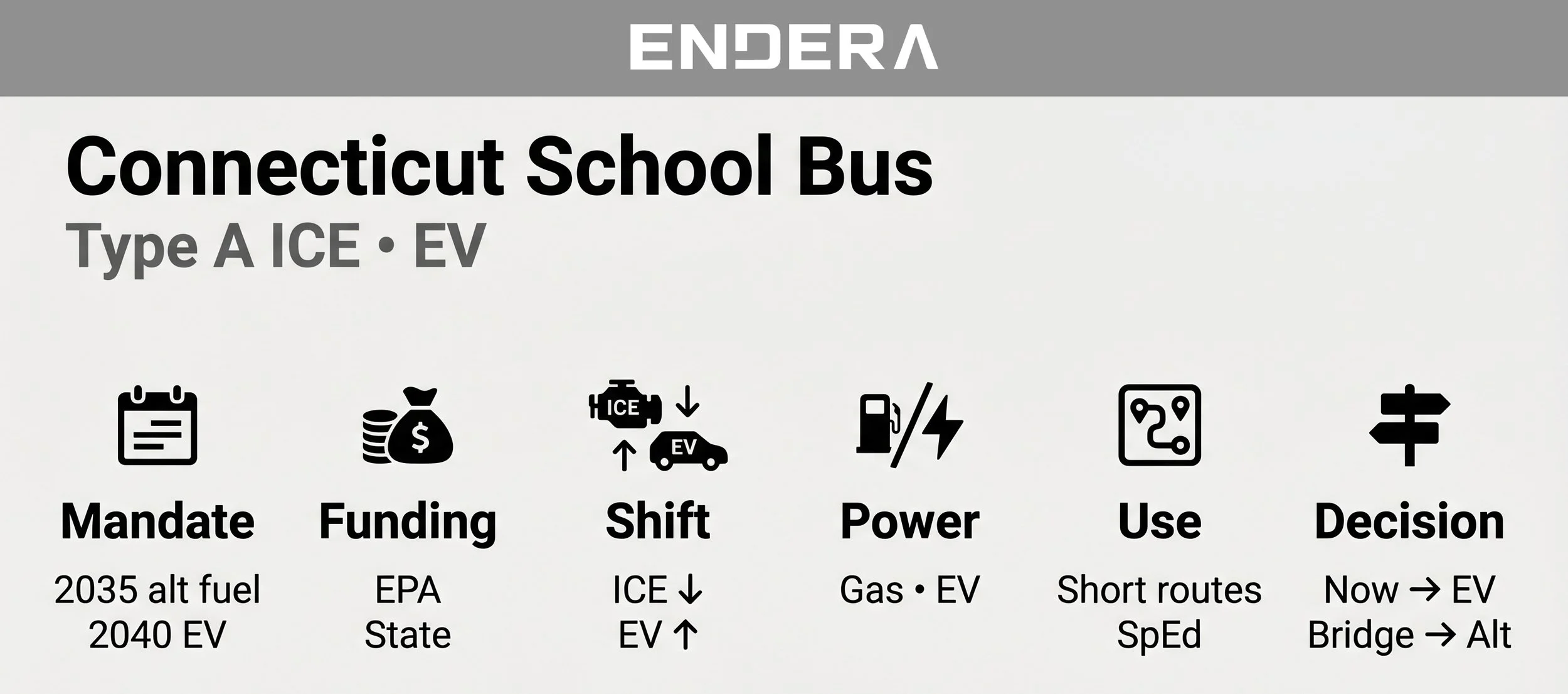
Connecticut has set two firm deadlines shaping every school bus procurement decision in the state. Under state legislation advancing through the General Assembly, the transition timeline breaks down as follows:
| Deadline | Requirement |
|---|---|
| 2035 | All new school bus purchases must be zero-emission or alternative fuel |
| 2040 | Full fleet transition to zero-emission required statewide |
These aren't targets — they're procurement constraints that will disqualify standard diesel purchases within a procurement cycle or two. A district buying a new ICE bus today is purchasing a vehicle it will be required to retire or replace before the end of its useful life. ICE and bridge-fuel purchases still make operational sense in the near term for districts not yet ready to support charging infrastructure — but the planning horizon for any new bus purchase now extends through the compliance deadline.
How Connecticut Schools Fund New School Bus Purchases
Connecticut's funding environment for clean school buses is among the more layered in the Northeast. The CT DEEP Clean School Bus Program offers supplemental state grants that stack directly with federal EPA funding — covering electric buses and charging infrastructure for eligible districts.
Federal support is substantial. The EPA has awarded $21.5 million in rebates to Connecticut districts, funding over 90 clean school buses across six districts in a single round. The cumulative impact across funding rounds reaches $52.1 million deployed statewide, covering 181 buses. Nationally, approximately $3 billion has been distributed and 8,500 buses funded through EPA programs — and demand continues to outpace available funding in each cycle.
Stacking Grants, Loans, and State Programs
Districts aren't limited to a single funding source. Hartford Public Schools structured a purchase using a $1 million CT Green Bank loan stacked with a $9.7 million federal grant and state funding — a model that demonstrates how districts with budget constraints can close any remaining gap between grant coverage and acquisition cost.
The $5 billion federal Clean School Bus Program runs through 2026, with individual funding rounds distributing approximately $1 billion at a time. Districts that haven't yet applied are still within the funding window — but application cycles are competitive and prioritize districts with clear procurement plans. Endera's grant navigation services help Connecticut districts build those plans and manage submissions without diverting transportation staff to grant administration.
ICE vs. Electric: Making the Right Call for CT Districts
Connecticut's 2035 and 2040 mandates don't make ICE buses irrelevant today — but they do change the calculus. A new ICE bus purchased now carries a 10-to-12-year service life, which runs directly into the alternative fuel compliance window. Districts need to weigh that overlap against their current infrastructure readiness and budget cycle.
When Electric Makes Sense Now
Connecticut's dense geography and shorter average route distances make it a strong environment for electric Type A buses. Most Connecticut district routes fall well within the daily range of Endera's electric models, and state and federal funding can cover vehicles and charging infrastructure simultaneously. Districts operating special education routes or predictable suburban loops — and with access to depot charging — are well-positioned to transition now and maximize funding availability before program cycles close.
When ICE or Bridge Fuels Are the Bridge
Districts without charging infrastructure, facing procurement timelines that don't align with a depot buildout, or managing routes with irregular mileage should consider propane or CNG as an interim solution. These powertrains satisfy the 2035 alternative fuel requirement while keeping infrastructure costs manageable. Endera builds ICE, propane, CNG, and electric configurations on the same Type A platform — so a district can standardize on one manufacturer and add electric units on subsequent procurement cycles as conditions allow.
Connecticut School Bus Compliance Requirements
Connecticut school buses must meet state construction and equipment standards, federal Motor Vehicle Safety Standards (FMVSS), and pass annual inspections to remain registered and operational. Type A buses in Connecticut are defined by specific weight classifications (A-1 and A-2), and vehicles must carry the correct identification markings, safety equipment, and documentation before they can legally transport students.
Endera's Type A school buses are engineered to exceed federal structural integrity standards and are available in ADA-compliant configurations. For FTA-funded purchases, vehicles are Buy America compliant and carry the documentation Connecticut districts need for federally funded procurement. Key compliance checkpoints for CT districts include:
FMVSS compliance — federal construction and safety equipment standards
CT weight classification — A-1 or A-2 designation based on GVWR
Annual state inspection — required for registration and legal operation
ADA configuration — required for routes serving students with disabilities
Buy America documentation — required for federally funded procurement
Endera's sales team provides full specification and compliance materials to support formal bid submissions aligned with Connecticut's procurement process.
Is a Type A Bus Right for Your Connecticut District?
Type A buses are the standard choice for special education transport, smaller district routes, and any application where a full-size Type C or D bus creates more operational overhead than the route demands. Connecticut's compact geography reinforces the case — most in-state routes are shorter than those in rural states, and the Type A format handles them efficiently without the fuel and maintenance overhead of a larger vehicle.
Endera's Endera 4, 5, and 6 models are configurable across 4-to-6 section layouts with ADA-compliant lift options. All three are available in ICE, propane, CNG, and full-electric powertrains, and because Endera manufactures both the body and powertrain at a single facility, buyers receive unified warranty coverage rather than split documentation from separate vendors.
Where Connecticut Districts Start the Conversation
New 2026 Type A models are available for immediate delivery through Endera Stock for districts with urgent replacement timelines. For districts working within Connecticut's structured procurement process, Endera provides specification documentation, compliance materials, and grant application support from the initial specification call through delivery.
Connecticut's 2035 alternative fuel requirement isn't years away — it's the next fleet cycle. Contact Endera's sales team today to discuss configuration options, compliance documentation, or funding strategy for your district.
Frequently Asked Questions
When does Connecticut require school buses to be zero-emission?
Connecticut's legislation requires all new school bus purchases to be zero-emission or alternative fuel by 2035, with full fleet transition to zero-emission by 2040. A new ICE bus purchased today will likely need to be retired or replaced before the end of its standard service life to meet the 2040 deadline — a factor that should be built into any current procurement decision.
How much federal and state funding is available for Connecticut school bus purchases?
Connecticut has received $52.1 million in combined funding covering 181 buses to date, with $21.5 million awarded in a single EPA rebate round across six districts. State DEEP grants stack with federal EPA funding and can also cover charging infrastructure. Districts that haven't yet applied to federal rounds are still within the $5 billion program window running through 2026.
Can Connecticut school districts combine grants and loans to fund a bus purchase?
Yes. Hartford Public Schools used a $1 million CT Green Bank loan alongside a $9.7 million federal grant and state funding to finance its electric fleet — a structure that works for districts whose grant coverage doesn't fully close the acquisition gap. The CT Green Bank and DEEP both offer financing options designed to complement, not replace, grant funding.
What are Connecticut's Type A school bus weight classifications?
Connecticut defines Type A school buses by weight class: A-1 and A-2. These classifications determine applicable construction standards, safety equipment requirements, and inspection criteria. Endera's Type A models are built to meet or exceed the federal and state standards applicable to both classifications. Districts should confirm specific classification requirements with their Connecticut DOT liaison during procurement.
Does Endera provide documentation for Connecticut's formal procurement process?
Yes. Endera's sales team provides full specification sheets, Buy America compliance documentation, and FMVSS certification materials to support formal bid submissions. For federally funded purchases, all necessary FTA-eligibility documentation is available at the point of sale.
How does Connecticut's 2035 alternative fuel mandate affect a bus purchased today?
A bus purchased today in ICE configuration will reach the end of its typical 10-to-12-year service life around the compliance window. Districts buying ICE now should plan their next procurement cycle to align with the 2035 deadline — or transition to propane or CNG now to satisfy the alternative fuel requirement. Endera builds all configurations on the same Type A platform, so switching powertrain on the next purchase doesn't require switching manufacturers.
What software does Endera provide to help Connecticut districts manage their fleets?
Every Endera school bus is compatible with Endera Dispatch, which includes real-time GPS tracking, geofence management, AI-powered routing, and state-of-charge monitoring for electric units. For districts managing a mixed ICE and EV fleet during transition, Dispatch provides unified visibility across both powertrain types from a single dashboard.