
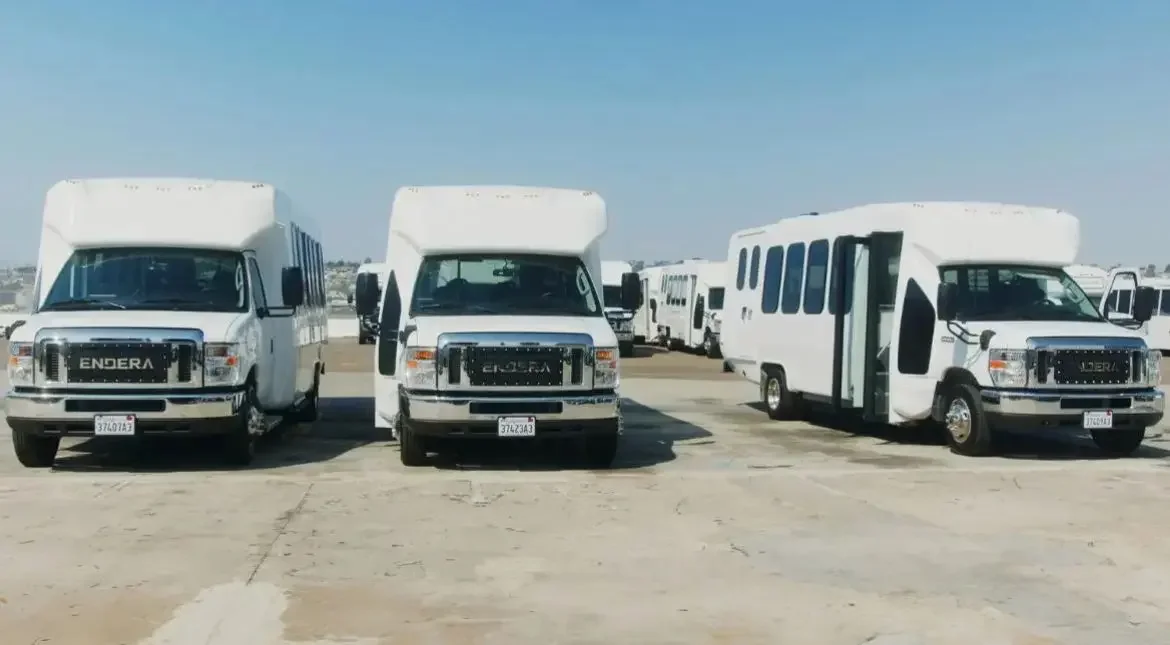
Vermont's shuttle market combines strong EV-friendly policies with challenging operating conditions. The state follows California's Advanced Clean Cars II and Advanced Clean Trucks standards, but harsh winters, mountainous terrain, and rural routes create real operational challenges for EVs. At the same time, key state EV fleet incentives are currently out of funding, adding uncertainty despite the supportive policy direction.
For commercial shuttle operators in Vermont, that combination means vehicle and fuel decisions need to be grounded in operating conditions, not just policy alignment. Endera's B-Series — the B3, B4, B5, and B8, ranging from 23 to 28 feet — covers the full range. ICE, propane, CNG, and electric configurations are available on Ford E450 and Chevrolet Express cutaway chassis, manufactured at Endera's Ottawa, Ohio facility.
Vermont's terrain makes the wrong fuel choice expensive to live with — connect with an Endera fleet specialist today to find the configuration that fits your actual routes.
The E350 is the right platform for operators who need a right-sized vehicle without the footprint of a larger bus. The E450 handles higher capacity and heavier payload — which is why Endera's B-Series lineup is built on the E450 for its larger configurations. For operators comparing the two, the practical question is daily passenger count: if routes regularly carry 15 or more passengers, the E450's structural rating and passenger capacity are worth the step up.
Vermont's Fleet Landscape: Pro-EV Policy, Ended State Incentives
Most Vermont electric utilities continue offering incentives for EVs and charging infrastructure. Burlington Electric Department offers commercial EV rebates and reduced EV charging rates for business customers. Vermont Electric Coop offers $500 per connection credits for Level 2 and DC fast charging installations. Stowe Electric offers rebates for workplace and public charging.
On the infrastructure finance side, the Vermont State Infrastructure Bank offers EV charging station loans up to $100,000 at 1% fixed rate, and VEDA's EV Workplace Charging Station Loan Program provides additional financing for qualifying operators. The federal 30C charging equipment credit — up to $100,000 per installed port — expires June 30, 2026 and remains the most significant near-term federal tool for Vermont operators installing depot charging.
Vermont Didn't Lose Incentives — It Lost the Economic Model
What the Stacked Funding Era Actually Provided
Between 2020 and 2024, Vermont operators could stack multiple programs—state fleet grants, vehicle incentives, utility rebates, and federal credits—to significantly reduce EV upfront costs.
Those combined incentives made electrification financially feasible for smaller fleets. That level of funding support is no longer available today.
| Component | 2022–2024 Stack | 2026 Reality |
|---|---|---|
| State fleet rebate | Up to $2,500–$5,000 per vehicle | $0 (program closed) |
| Utility incentives | Stackable ($500–$2,500+) | Still available, but smaller |
| Federal credits | Up to $7,500 + charging credits | Still available (time-limited) |
| Total stack impact | Meaningful % of vehicle cost offset | Partial, inconsistent support |
Who Gets Priced Out — and Who Doesn't
The removal of state incentives increases upfront EV costs by about $2,500–$5,000 per vehicle, which can quickly add up to a six-figure gap for fleets. Small operators are most affected, as they previously relied on grants and have less access to capital markets.
Mid-size fleets can still proceed with phased deployment and financing, while large operators are least impacted due to scale and long-term ROI. Overall, Vermont has shifted EV adoption from grant-supported to a balance-sheet-driven decision, with financing playing a key role.
Vermont Terrain and Winter: What They Do to EV Performance
Mountain Routes Change the Range Equation
Vermont’s terrain is a key factor in EV performance. Steep grades, rural roads, and stop-start routes significantly increase energy use compared to flat-road conditions.
Shuttle routes to ski areas like Stowe Mountain Resort or Sugarbush require more energy than urban routes in places like Burlington, meaning real-world range can differ substantially from standard specs.
Cold Weather Compounds the Terrain Variable
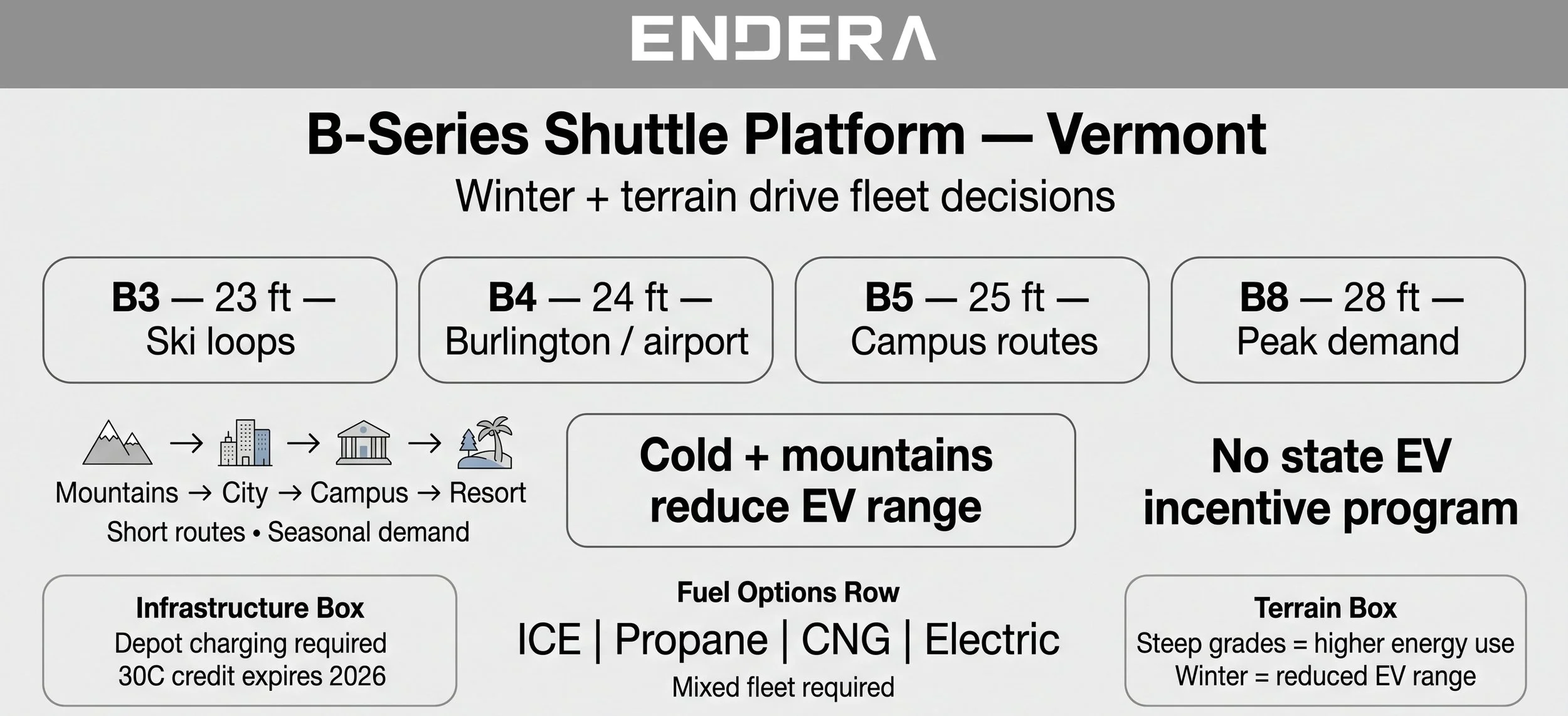
Vermont winters add a second layer. Cold temperatures reduce battery performance and require significant heating energy — the combination of sub-zero conditions and sustained grades creates the most demanding EV operating environment of any state we serve. For ski resort operators running early-morning shuttle loops from base lodges to village parking, that means starting each day with a full charge and building in range margins that account for both the cold and the terrain.
Overnight depot charging is the only operationally reliable foundation for Vermont EV fleet operations — public charging along ski corridors isn't designed for fleet throughput. Endera's Dispatch platform provides real-time state-of-charge monitoring that gives Vermont operators visibility into these variables during operation, not after a vehicle runs short.
The B-Series Lineup for Vermont Operations
Four Models for Vermont's Shuttle Markets
The B3 (23 ft) is a compact ICE model suited for ski resort loops, hotel shuttles, and small campus routes. The B4 (24 ft) and B5 (25 ft) offer more capacity with ICE and electric options, ideal for airport operations, university transit, and ski connector routes. The B8 (28 ft) is designed for high-volume needs like peak-season resorts, events, and busy valley shuttle networks.
Chassis Serviceability in a Rural State
All B-Series models are available on Ford E450 or Chevrolet Express cutaway chassis — platforms with regional dealer and service networks across Vermont, including in smaller markets well outside Burlington. For resort operators in Killington, Mad River Glen, or Burke Mountain where a specialized bus service center isn't close, chassis serviceability through a regional Ford or GM dealer matters practically when something needs attention mid-season.
Fleet Decision Framework: Vermont Routes and the Right Configuration
Matching the Vehicle to Vermont's Operating Environments
| Use Case | Recommended Model | Fuel Type | Why |
|---|---|---|---|
| Ski resort base loop (Stowe, Killington) |
B3 / B4 | ICE or EV | Short cycles; EV viable with depot charging |
| Burlington hotel / airport (BTV) |
B4 / B5 | EV or ICE | Flat urban routes; strong utility incentives |
| UVM campus transit | B4 / B5 | EV or CNG | Defined routes, campus infrastructure |
| Mountain resort connector | B4 / B5 | ICE or Propane | Grade + cold weather; fuel flexibility preferred |
| Peak season resort / event | B8 | ICE / CNG | High volume, variable demand |
For Burlington-based operators with depot charging and relatively flat urban routes, the electric B4 and B5 are operationally well matched — and Burlington Electric Department's commercial EV programs reduce both vehicle and charging costs. For mountain resort operators running grades in January, ICE and propane configurations deliver the reliability and fuel flexibility those conditions require without depending on charging infrastructure that may not exist at elevation.
Incentives: What Vermont Operators Can Actually Access in 2026
The Honest Incentive Picture
With state fleet programs closed and no new appropriations expected, Vermont shuttle operators in 2026 are working with utility programs, the 30C federal charging credit, and infrastructure loan products. That's a thinner stack than the 2022–2024 environment — but it's not nothing.
For Burlington-area operators served by BED, the combination of commercial EV rebates and reduced charging rates provides ongoing operating cost savings. For operators outside Burlington, utility programs vary by provider — Drive Electric Vermont and VEIC both offer free fleet electrification consultations to help Vermont operators understand what's actually available in their utility territory.
The 30C Credit Before It Closes
The 30C charging equipment credit — up to $100,000 per installed charging port — expires June 30, 2026. For Vermont operators planning depot charging installations, that deadline is real and imminent.
Equipment must be physically placed in service by that date. Given Vermont's rural geography and contractor availability, starting the infrastructure planning process now — rather than in spring 2026 — is what makes June 30 achievable. Endera's turnkey depot charging services handle site assessment, equipment procurement, and installation, and the team coordinates with utility programs to stack available rebates alongside the federal credit.
True Cost vs. Cash Flow for Vermont Operators
The Electric Case Without the State Program Stack
Vermont’s state EV incentives previously strengthened the financial case for electric buses, but with those programs now closed, operators must rely on utility support, the 30C credit, and long-term operating savings.
The Electric School Bus Initiative estimates over $170,000 in fuel and maintenance savings over a bus’s lifetime, which can apply to similar shuttle operations. In Vermont, the value case is strongest for high-utilization urban routes, while mountain resort routes require more route-specific analysis.
Financing Options When Grants Aren't Available
Endera's financing team offers direct financing and capital leasing options for Vermont operators who want to deploy electric configurations now without waiting for a future state program. Capital leasing in particular allows operators to use vehicles while preserving capital — a useful structure when the upfront cost gap between ICE and EV can't be offset by a state grant that no longer exists.
Built for Vermont's Demanding Shuttle Market
Vermont operators need vehicles that hold up in cold winters, handle mountain terrain, and come from a manufacturer that offers genuine fuel flexibility rather than a single-path EV pitch. The B-Series delivers across four models, four fuel types, and two chassis options — with fleet software, financing support, and the infrastructure coordination to make deployment operationally sound in one of the most challenging EV environments in the country.
Vermont's terrain will expose the wrong fuel choice quickly. Talk to an Endera specialist today to find the right B-Series configuration for your Vermont fleet.
FAQs
Which B-Series models are available for Vermont operators?
All four models — B3 (23 ft), B4 (24 ft), B5 (25 ft), and B8 (28 ft) — are available in Vermont in ICE, propane, CNG, and electric configurations depending on model. Contact Endera's sales team for current availability and lead times.
Are Vermont's state fleet EV incentive programs still available?
No. Vermont's state-funded fleet incentive programs, including the Electrify Your Fleet program, are closed. No additional funds were appropriated in the 2025 legislative session. Utility programs from Burlington Electric, Vermont Electric Coop, and Stowe Electric remain active.
What is the 30C deadline for Vermont operators?
The 30C charging equipment credit — up to $100,000 per installed charging port — expires June 30, 2026. Vermont operators planning depot charging installations should begin the process now given rural contractor availability and utility coordination timelines.
How do Vermont's winters and mountain terrain affect EV performance?
Cold temperatures reduce battery performance and require significant heating energy. Mountain grades increase energy consumption beyond flat-road specs. Together, they create the most demanding EV operating environment of any state in this series. Short, depot-based routes in Burlington and lower-elevation markets absorb both variables well. Mountain resort circuits require careful route-level assessment.
Can I get free EV fleet planning support in Vermont?
Yes. Drive Electric Vermont and VEIC both offer free consultations for Vermont operators to assess fleet electrification options, utility incentives available in their territory, and infrastructure planning.
Do Endera shuttles comply with Buy America requirements?
Yes. With approximately 65% of components sourced domestically, Endera's manufacturing supports Buy America compliance for federally funded Vermont procurement contracts.
Can I get an in-stock 2026 shuttle for fast delivery in Vermont?
Yes. Endera Stock lists ready-to-deliver 2026 models for rapid deployment without a custom build lead time.