

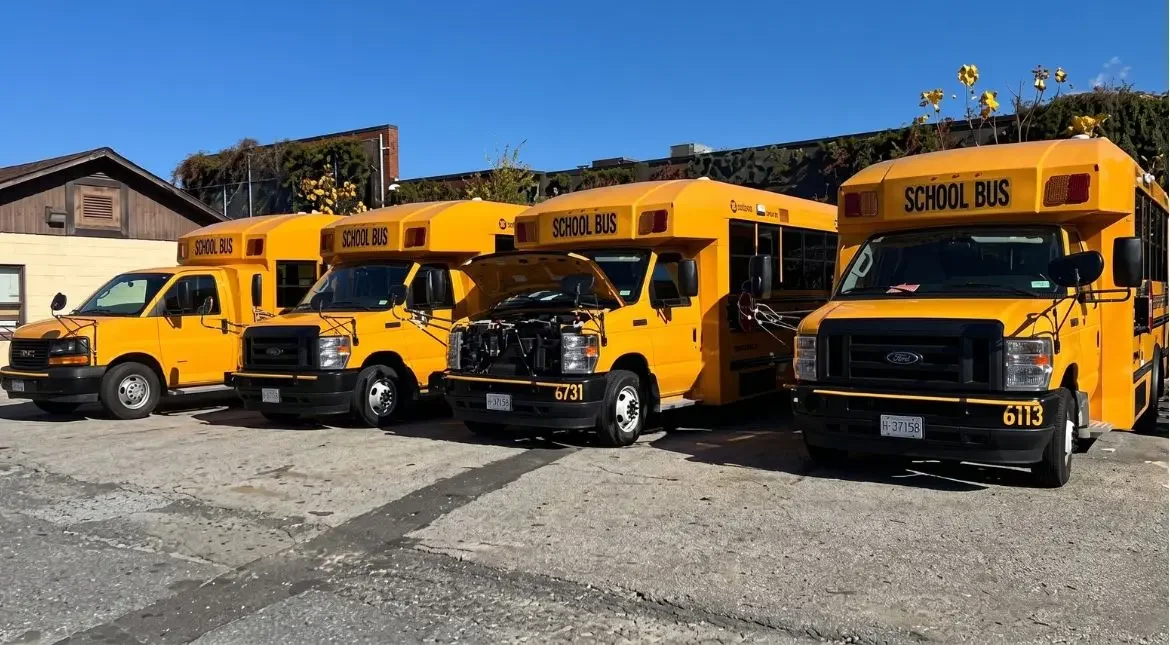
Yes — private individuals, businesses, churches, nonprofits, and organizations of all kinds can legally purchase school buses. There are no federal restrictions limiting school bus sales to school districts. The more relevant questions are what type of bus fits the intended use, what it costs new versus used, and whether the buyer needs a CDL to operate it.
Endera manufactures Type A school buses for commercial, institutional, and fleet buyers in ICE, propane, CNG, and full-electric configurations. For buyers who need a purpose-built vehicle rather than a used district surplus bus, understanding the new bus ordering process is where the conversation starts.
Ready to move past the basics and get into a real configuration conversation? Contact Endera’s sales team today to discuss what’s available and what fits your intended use.
Who Actually Buys School Buses?
School districts are the most visible buyers, but they represent a fraction of total school bus transactions. According to Bureau of Transportation Statistics data, student transportation is one segment of a broader passenger mobility market that includes institutional, commercial, and private buyers with overlapping vehicle needs.
Common non-district buyers include:
-
Churches and religious organizations — Sunday service transport, youth programs, event shuttles
-
Daycares and private schools — student pickup and drop-off on non-public routes
-
Camps and youth programs — seasonal transport for activities and field trips
-
Tour and charter operators — group mobility with the safety profile of a school bus
-
Mobile businesses — food trucks, mobile clinics, tutoring buses, and retail conversions
-
Skoolie and RV converters — school buses converted into campers or mobile living spaces
-
Nonprofits and community organizations — senior transport, meal delivery, community programs
-
Corporate and institutional fleets — employee or patient transport requiring a compliant commercial vehicle
The National Congress on School Transportation establishes the specifications and procedures that define school buses as a vehicle category — but those standards apply to vehicles operating as school buses, not to any sale of the physical vehicle.
New vs. Used: What School Buses Actually Cost
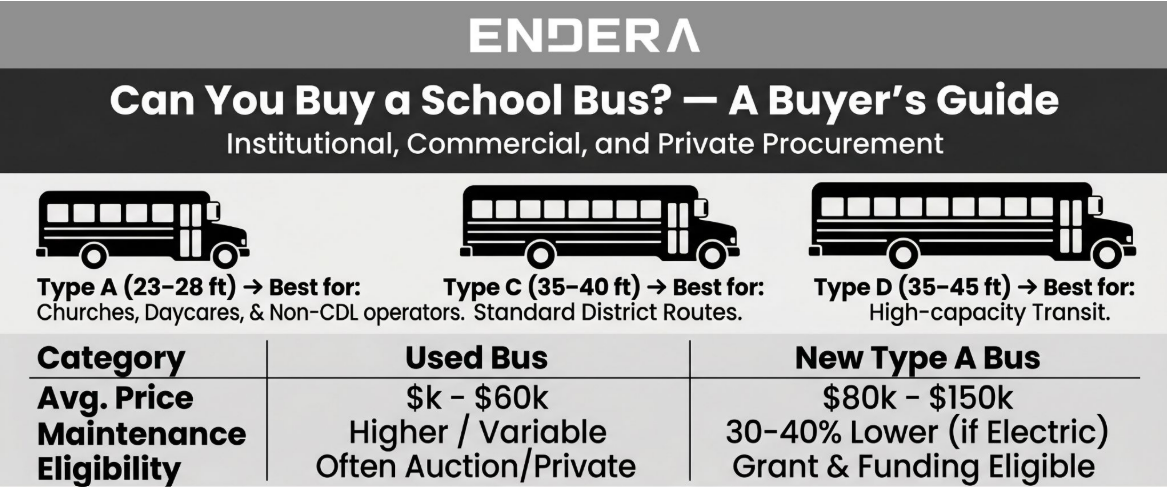
School bus pricing varies significantly by type, age, and condition. Used Type C and D buses can be found at municipal auctions starting in the low thousands for high-mileage vehicles, scaling up to $30,000–$60,000 for recent models in good mechanical condition. Conversion buyers often target this segment for the combination of structural durability and low acquisition cost.
New school buses are a different investment. A new Type A bus typically starts around $80,000 and can exceed $150,000 depending on powertrain and configuration. According to the World Resources Institute’s electric school bus buyer’s guide, electric school bus prices have been declining as production scales — and when federal and state funding is applied, net cost for electric models can fall below equivalent ICE pricing.
Total Cost of Ownership Beyond Purchase Price
Acquisition cost is the starting point, not the full picture. The DOE Alternative Fuels Data Center tracks fleet operating costs by fuel type — electric drivetrains typically reduce maintenance spend by 30–40% relative to diesel. Propane and CNG carry lower per-mile fuel costs than gasoline, while diesel remains the most common choice for used bus buyers.
Buyers should also budget for insurance, state registration, and inspection costs. CVSA commercial vehicle inspection standards apply to buses operating in commercial or for-hire service — requirements that affect annual operational overhead beyond the initial purchase.
School Bus Types Explained
School bus buyers — especially first-timers — are often confused by the type classification system. The NHTSA school bus safety framework defines school buses as among the safest vehicles on the road, with the type system reflecting different safety and operational profiles:
| Type | Size | Chassis | Common Use |
|---|---|---|---|
| Type A | 23–28 ft | Ford E450 / Chevrolet cutaway | Special ed, smaller districts, institutional |
| Type C | 35–40 ft | Conventional cab-over engine | Standard district transport |
| Type D | 35–45 ft | Transit-style, flat nose | High-capacity district routes |
Type A buses are the most accessible for non-district buyers. They’re built on familiar commercial chassis, easier to insure and register outside a school fleet context, and available in configurations that suit church, camp, NEMT, and institutional use without the operational complexity of a full-size bus.
CDL Requirements: What Bus Buyers Need to Know
Federal CDL requirements apply to vehicles over 26,001 lbs GVWR or designed for 16 or more passengers including the driver. Most Type A school buses fall below both thresholds — meaning churches, daycares, and small organizations can operate them without a CDL in many states.
State rules vary, and for-hire passenger transport adds additional licensing layers. NHTSA’s vehicle classification research documents how GVWR classifications interact with safety and licensing standards across commercial passenger applications. The CDL question is answerable with a state-specific check — it shouldn’t be a reason to avoid the purchase.
ADA Accessibility: When It’s Required and When It’s Worth Specifying
If the bus will transport passengers with mobility limitations, ADA-compliant configuration should be specified at the point of purchase rather than retrofitted later. ADA transportation guidelines and FTA accessible vehicle specifications define what commercial operators must provide for accessible passenger transport.
For church operators, NEMT providers, senior programs, and daycares, ADA lift systems are frequently a practical requirement regardless of legal mandate. Endera’s flat-floor Type A configurations include 800 lb Braun ADA lifts built into the vehicle at the manufacturing stage — not retrofitted by a third party after sale.
How to Order a New School Bus
New school bus purchasing follows a different process than buying a used vehicle. The Washington State school bus purchasing guide provides a practical walkthrough covering budgeting, optional feature selection, financing, and procurement timelines. Kentucky’s bus purchasing specifications illustrates how formal procurement requirements layer on top for publicly funded buyers.
For non-district buyers, the process is more direct:
-
Define the use case — route type, daily passenger count, ADA requirements, and storage needs
-
Select the powertrain — ICE, propane, CNG, or electric based on infrastructure and cost goals
-
Identify applicable funding — federal and state programs may reduce net acquisition cost
-
Confirm compliance requirements — CDL thresholds, registration rules, and for-hire licensing
-
Specify and order — custom builds run several months; in-stock units ship faster
Endera’s financing and grant navigation services assist buyers with identifying applicable programs and structuring the acquisition accordingly.
Can You Convert a School Bus Into an RV or Business Vehicle?
Yes — and the market for converted school buses is substantial. “Skoolie” conversions, mobile businesses, and commercial vehicle repurposing are all legitimate uses for retired school buses. The practical considerations are mechanical condition, structural integrity, rust assessment, and post-conversion registration.
Buyers using a conversion bus commercially — transporting clients or operating a mobile business — need to confirm the vehicle meets applicable state commercial vehicle standards. A bus operating as a for-hire transport vehicle after conversion re-enters the commercial compliance framework regardless of its prior registration status.
The Right Bus for the Right Buyer
New 2026 Type A models are available for immediate delivery through Endera Stock. For buyers with specific route requirements, accessibility needs, or funding questions, Endera’s sales team works through the specification and ordering process from initial inquiry through delivery.
Whatever your intended use, there’s a configuration built for it. Contact Endera’s sales team today to discuss bus configuration, powertrain options, or ordering timelines.
Frequently Asked Questions
Can a private individual buy a school bus?
Yes. There are no federal restrictions on who can purchase a school bus. Private individuals, churches, businesses, and nonprofits buy school buses regularly for conversion, transport, and institutional use. The relevant questions are how the bus will be used, whether CDL requirements apply, and what state registration category it falls into after purchase.
How much does a new Type A school bus cost?
New Type A school buses typically start around $80,000 and range to $150,000 depending on powertrain and configuration. Federal and state funding programs — including EPA Clean School Bus rebates — can significantly reduce net cost for qualifying institutional buyers. Used Type A buses in good condition typically run $20,000–$60,000 depending on age and mileage.
Do you need a CDL to drive a school bus?
Most Type A school buses fall below the federal CDL threshold — under 26,001 lbs GVWR and fewer than 16 passengers including the driver. Many operators can legally drive them without a CDL. State rules vary, and for-hire commercial transport adds additional licensing requirements depending on the state and operation type.
What is the safest type of school bus?
NHTSA considers school buses among the safest vehicles on the road — a result of their structural requirements, visibility features, and passive occupant protection design. All school bus types meet federal safety standards under NHTSA’s framework, with differences in size and chassis rather than fundamental safety architecture.
How long does it take to order a custom school bus?
Custom school bus builds typically require several months from order to delivery depending on manufacturer capacity and specification complexity. In-stock units are available for faster delivery — typically weeks rather than months. Buyers with hard deadlines should confirm timelines with the manufacturer’s sales team before committing to a custom specification.
What’s the difference between a school bus and a shuttle bus?
School buses are built to NHTSA school bus safety standards and typically operate under state education department oversight. Shuttle buses are commercial passenger vehicles built to commercial safety standards for hotel, airport, campus, and corporate transport. Type A school buses and commercial shuttles share similar chassis platforms but carry different certification and compliance documentation.
Can nonprofits or churches get funding to buy a new school bus?
Federal programs like the EPA Clean School Bus Program target school districts primarily, but nonprofits and churches operating student transport may qualify depending on program eligibility. State grant programs vary in scope. Endera’s grant navigation services help buyers identify which programs apply to their organizational structure and purchasing situation.
For Burlington-based operators with depot charging and relatively flat urban routes, the electric B4 and B5 are operationally well matched — and Burlington Electric Department’s commercial EV programs reduce both vehicle and charging costs. For mountain resort operators running grades in January, ICE and propane configurations deliver the reliability and fuel flexibility those conditions require without depending on charging infrastructure that may not exist at elevation.
Incentives: What Vermont Operators Can Actually Access in 2026
The Honest Incentive Picture
With state fleet programs closed and no new appropriations expected, Vermont shuttle operators in 2026 are working with utility programs, the 30C federal charging credit, and infrastructure loan products. That’s a thinner stack than the 2022–2024 environment — but it’s not nothing.
For Burlington-area operators served by BED, the combination of commercial EV rebates and reduced charging rates provides ongoing operating cost savings. For operators outside Burlington, utility programs vary by provider — Drive Electric Vermont and VEIC both offer free fleet electrification consultations to help Vermont operators understand what’s actually available in their utility territory.
The 30C Credit Before It Closes
The 30C charging equipment credit — up to $100,000 per installed charging port — expires June 30, 2026. For Vermont operators planning depot charging installations, that deadline is real and imminent.
Equipment must be physically placed in service by that date. Given Vermont’s rural geography and contractor availability, starting the infrastructure planning process now — rather than in spring 2026 — is what makes June 30 achievable. Endera’s turnkey depot charging services handle site assessment, equipment procurement, and installation, and the team coordinates with utility programs to stack available rebates alongside the federal credit.
True Cost vs. Cash Flow for Vermont Operators
The Electric Case Without the State Program Stack
Vermont’s state EV incentives previously strengthened the financial case for electric buses, but with those programs now closed, operators must rely on utility support, the 30C credit, and long-term operating savings.
The Electric School Bus Initiative estimates over $170,000 in fuel and maintenance savings over a bus’s lifetime, which can apply to similar shuttle operations. In Vermont, the value case is strongest for high-utilization urban routes, while mountain resort routes require more route-specific analysis.
Financing Options When Grants Aren’t Available
Endera’s financing team offers direct financing and capital leasing options for Vermont operators who want to deploy electric configurations now without waiting for a future state program. Capital leasing in particular allows operators to use vehicles while preserving capital — a useful structure when the upfront cost gap between ICE and EV can’t be offset by a state grant that no longer exists.
Built for Vermont’s Demanding Shuttle Market
Vermont operators need vehicles that hold up in cold winters, handle mountain terrain, and come from a manufacturer that offers genuine fuel flexibility rather than a single-path EV pitch. The B-Series delivers across four models, four fuel types, and two chassis options — with fleet software, financing support, and the infrastructure coordination to make deployment operationally sound in one of the most challenging EV environments in the country.
Vermont’s terrain will expose the wrong fuel choice quickly. Talk to an Endera specialist today to find the right B-Series configuration for your Vermont fleet.
FAQs
Which B-Series models are available for Vermont operators?
All four models — B3 (23 ft), B4 (24 ft), B5 (25 ft), and B8 (28 ft) — are available in Vermont in ICE, propane, CNG, and electric configurations depending on model. Contact Endera’s sales team for current availability and lead times.
Are Vermont’s state fleet EV incentive programs still available?
No. Vermont’s state-funded fleet incentive programs, including the Electrify Your Fleet program, are closed. No additional funds were appropriated in the 2025 legislative session. Utility programs from Burlington Electric, Vermont Electric Coop, and Stowe Electric remain active.
What is the 30C deadline for Vermont operators?
The 30C charging equipment credit — up to $100,000 per installed charging port — expires June 30, 2026. Vermont operators planning depot charging installations should begin the process now given rural contractor availability and utility coordination timelines.
How do Vermont’s winters and mountain terrain affect EV performance?
Cold temperatures reduce battery performance and require significant heating energy. Mountain grades increase energy consumption beyond flat-road specs. Together, they create the most demanding EV operating environment of any state in this series. Short, depot-based routes in Burlington and lower-elevation markets absorb both variables well. Mountain resort circuits require careful route-level assessment.
Can I get free EV fleet planning support in Vermont?
Yes. Drive Electric Vermont and VEIC both offer free consultations for Vermont operators to assess fleet electrification options, utility incentives available in their territory, and infrastructure planning.
Do Endera shuttles comply with Buy America requirements?
Yes. With approximately 65% of components sourced domestically, Endera’s manufacturing supports Buy America compliance for federally funded Vermont procurement contracts.
Can I get an in-stock 2026 shuttle for fast delivery in Vermont?
Yes. Endera Stock lists ready-to-deliver 2026 models for rapid deployment without a custom build lead time.