
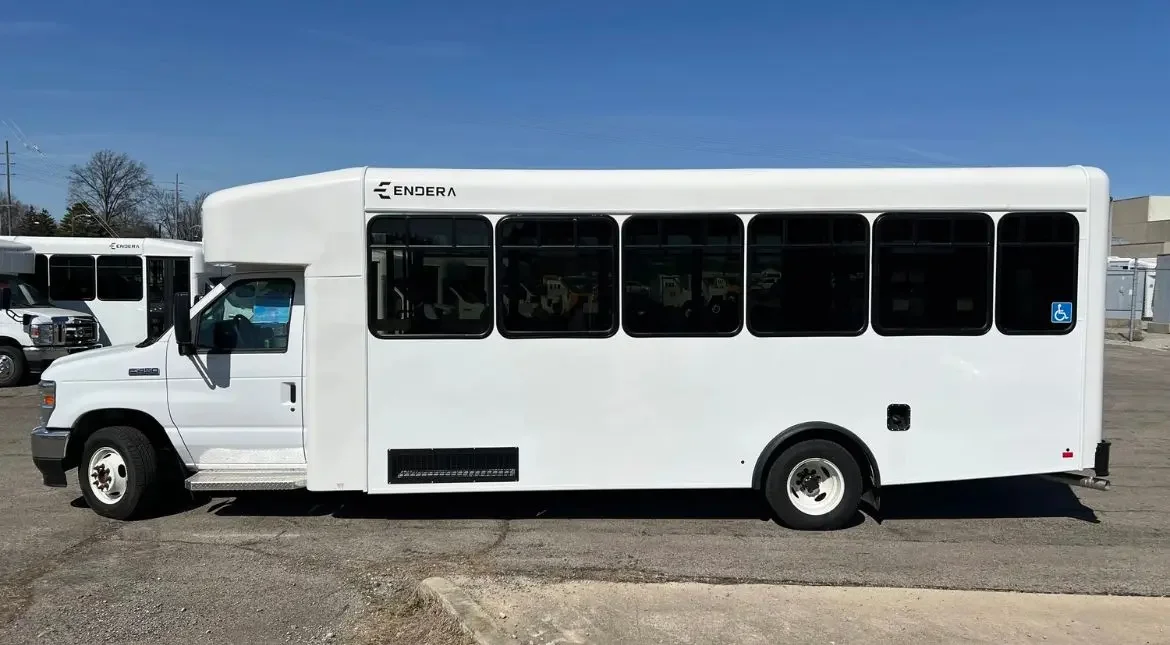
The Ford E350 has been a commercial shuttle chassis for decades for a straightforward reason: it works. Hotels, airports, churches, senior transport providers, and corporate operators have run E350-based shuttles through heavy daily cycles because the platform is mechanically proven, widely serviced, and available in configurations that fit most mid-size passenger transport needs without the licensing overhead of a full commercial bus.
Endera manufactures Class 4 commercial shuttles on Ford E-Series cutaway chassis, combining the platform's commercial track record with purpose-built body assembly and powertrain integration handled at a single manufacturing facility in Ottawa, Ohio. The result is a commercially built shuttle — not a van conversion — with unified warranty coverage and documentation from one manufacturer.
Ready to put a proven platform to work for your operation? Connect with an Endera specialist today to review configuration options and current availability.
Ford E350 vs. E450: Which Chassis Is Right for Your Fleet?
The E350 and E450 are both Ford Pro commercial shuttle platforms, but they serve different capacity and use-case profiles. Understanding the difference is the first practical decision for any commercial shuttle buyer.
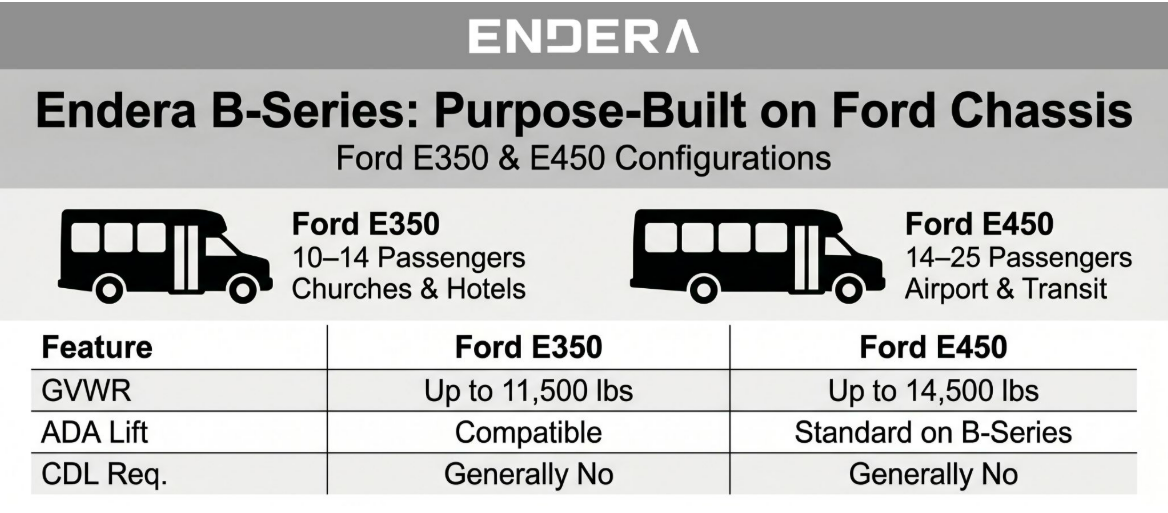
| Feature | Ford E350 | Ford E450 |
|---|---|---|
| GVWR | Up to 11,500 lbs | Up to 14,500 lbs |
| Typical seating | 10–14 passengers | 14–25 passengers |
| CDL required? | Generally not (under 26,001 lbs) | Generally not (under 26,001 lbs) |
| ADA lift compatible | Yes | Yes |
| Best fit | Churches, hotels, small corporate fleets | Airport, campus, transit, larger operations |
The E350 is the right platform for operators who need a right-sized vehicle without the footprint of a larger bus. The E450 handles higher capacity and heavier payload — which is why Endera's B-Series lineup is built on the E450 for its larger configurations. For operators comparing the two, the practical question is daily passenger count: if routes regularly carry 15 or more passengers, the E450's structural rating and passenger capacity are worth the step up.
CDL Requirements: What Shuttle Bus Operators Need to Know
CDL requirements are one of the most common purchase decision factors for church groups, hotel operators, and small commercial fleets. The federal CDL threshold applies to vehicles with a GVWR over 26,001 lbs or those designed to transport 16 or more passengers including the driver — most E350 and E450 shuttle configurations fall below both thresholds.
That said, state rules vary, and for-hire passenger transport adds another layer. Operators transporting passengers commercially — airports, NEMT providers, contracted shuttle services — should confirm specific licensing requirements with their state DMV and, where applicable, their state transportation authority. NHTSA's vehicle classification research provides the regulatory framework for how GVWR classifications affect safety standards and driver licensing across different commercial passenger vehicle applications.
ADA Accessibility: What Commercial Shuttle Operators Must Know
A large share of commercial shuttle buyers need ADA-compliant configurations — senior transport, NEMT, university paratransit, and airport operators serving travelers with mobility needs. Federal accessibility requirements under the ADA transportation guidelines and FTA accessible vehicle specifications define the equipment and layout standards that commercially operated passenger vehicles must meet.
Endera's flat-floor B-Series configurations are available with 800 lb Braun ADA lifts as standard equipment — built into the vehicle at the manufacturing stage, not retrofitted after the fact. That matters for NEMT and paratransit operators whose vehicles are subject to inspection against federal accessibility standards. A lift system installed by the OEM as part of the build carries different documentation and warranty standing than a post-sale upfitter modification.
Common Business Uses for Ford E350 Shuttle Buses
The E350 platform's longevity in commercial transport comes from its versatility across use cases that share similar daily operational demands: fixed or semi-fixed routes, moderate passenger counts, and high cycle frequency. Common applications include:
Hotels and hospitality — property-to-airport loops, valet and parking shuttles
Airport parking operators — high-frequency lot-to-terminal runs
Churches and religious organizations — Sunday service and event transport, typically non-CDL operators
Senior living and NEMT — scheduled medical transport, ADA-lift equipped configurations
Corporate campuses — employee transport on fixed or on-call circuits
Universities — campus loops, off-campus student transport, ADA paratransit
According to Bureau of Transportation Statistics data, demand for shuttle transportation across airport, senior, and group mobility categories has grown consistently as fleet operators seek right-sized alternatives to full-size buses for mid-volume routes.
Reliability, Lifespan, and Maintenance Considerations
Commercial shuttle operators run vehicles hard. Daily cycle counts of 8 to 15 runs, frequent stop-and-go patterns, and passenger loads near vehicle capacity compress the maintenance timeline compared to light-duty personal use. The Ford E-Series chassis has maintained its position in commercial fleets partly because parts availability is broad, technician familiarity is high, and service intervals are predictable.
CVSA commercial vehicle inspection standards provide the framework for what commercial shuttle operators are evaluated against during fleet inspections — braking systems, lighting, structural integrity, and safety equipment. Purpose-built commercial shuttle bodies from OEM manufacturers like Endera are engineered to meet these standards as delivered, rather than relying on post-sale modifications to bring a converted van into compliance.
For operators evaluating total cost of ownership across ICE and alternative fuel options, the U.S. Department of Energy's Alternative Fuels Data Center provides fleet efficiency and fuel cost data by vehicle class — a useful reference for modeling operating costs over a 10-to-12-year service lifecycle.
Altoona Testing and What It Means for Fleet Buyers
Commercial shuttle buses used in transit-funded applications are subject to FTA Bus Testing Program evaluation at Altoona — a federal certification that tests durability, structural integrity, maintainability, and safety performance across a simulated service lifecycle. For fleet operators purchasing vehicles for FTA-funded transit contracts, Altoona certification isn't optional; it's a procurement requirement.
Endera's B4 electric shuttle completed Altoona testing with a score of 90.1 — the highest in its class. That score is a quantifiable proof point for transit procurement bids that require documented durability certification, and it represents a benchmark that modified van-based alternatives built outside a proper manufacturing process can't match.
New vs. Used: Making the Right Call
The used shuttle bus market carries genuine value for operators with tight acquisition budgets — but the tradeoffs are specific and worth evaluating clearly. Used E350 shuttles typically range widely in price depending on age, mileage, and configuration, and lower acquisition cost often comes with deferred maintenance cycles, no manufacturer warranty, and compliance uncertainty for operators in federally funded procurement.
New vehicles from an OEM manufacturer carry the documentation, warranty, and baseline compliance that grant-funded purchases require. For operators accessing federal programs — FTA grants, EPA clean vehicle incentives, or state transit funding — used bus purchases are typically ineligible regardless of vehicle condition. If grant funding is part of the acquisition strategy, new is the only qualifying path.
Ready to Spec a Ford-Chassis Commercial Shuttle?
Endera's in-stock 2026 units are available for immediate delivery through Endera Stock, built on 2026 Ford E450 chassis with a 14,500 lb GVWR. Configurations include flat-floor ADA-lift models, standard passenger layouts, and multiple seating arrangements ready for commercial deployment.
Your next commercial shuttle is already on the lot. Contact Endera's sales team today to compare chassis configurations, powertrain options, or fleet financing.
Frequently Asked Questions
Do you need a CDL to drive a Ford E350 shuttle bus?
Most Ford E350 shuttle configurations fall below the federal CDL threshold of 26,001 lbs GVWR and under 16 passengers including the driver. That means many operators — churches, hotels, small corporate fleets — can operate E350 shuttles without a CDL. For-hire commercial transport may have additional state-level licensing requirements that vary by state and operation type.
How many passengers does a Ford E350 shuttle bus hold?
Standard Ford E350 shuttle configurations typically seat 10 to 14 passengers depending on body length and seating layout. ADA-configured models with a wheelchair lift and fold-away seating reduce passenger count to accommodate mobility equipment. Operators needing 15 or more seats consistently should consider the E450 platform, which supports 14-to-25-passenger configurations.
What is the difference between a Ford E350 and E450 for commercial shuttle use?
The E350 has a GVWR up to 11,500 lbs and suits smaller-capacity applications — churches, hotels, and small corporate fleets. The E450 steps up to 14,500 lbs GVWR and supports higher passenger counts and heavier payload, making it the standard choice for airport, campus, and transit applications. Both platforms are commercially rated cutaway chassis, not van conversions.
Are Ford E-Series shuttle buses ADA compliant?
ADA compliance depends on the body configuration — not the chassis alone. Endera's flat-floor B-Series models are available with 800 lb Braun ADA lifts built into the vehicle at the manufacturing stage, meeting FTA accessible vehicle specifications. Operators running NEMT, paratransit, or any service subject to federal accessibility requirements should specify ADA-configured models rather than retrofitting standard units.
How long do commercial Ford E-Series shuttle buses last?
Purpose-built commercial shuttle buses on Ford E-Series cutaway chassis typically operate for 10 to 12 years under daily commercial use with proper maintenance. Service life depends heavily on cycle intensity and maintenance adherence — high-frequency airport and hotel operators running 10-plus daily cycles compress that timeline versus lower-intensity church or campus operations.
What should fleet buyers check before purchasing a used Ford E350 shuttle bus?
Key inspection points include transmission condition, lift system operation (if ADA-equipped), brake system integrity per CVSA inspection standards, frame corrosion, and odometer verification. Used shuttle buses in federally funded procurement programs are typically ineligible for grant funding regardless of condition. Buyers should also confirm whether the vehicle carries documentation that meets state commercial vehicle registration requirements.
Can Ford E-Series shuttle buses be used for transit contracts?
Yes, with the right specifications. FTA-funded transit contracts require vehicles to be Buy America compliant and, for transit applications, Altoona-tested. Endera's B-Series shuttles on Ford E450 chassis meet both requirements. The B4 electric shuttle's Altoona score of 90.1 — highest in its class — satisfies the durability certification requirement that transit procurement bids typically specify.