
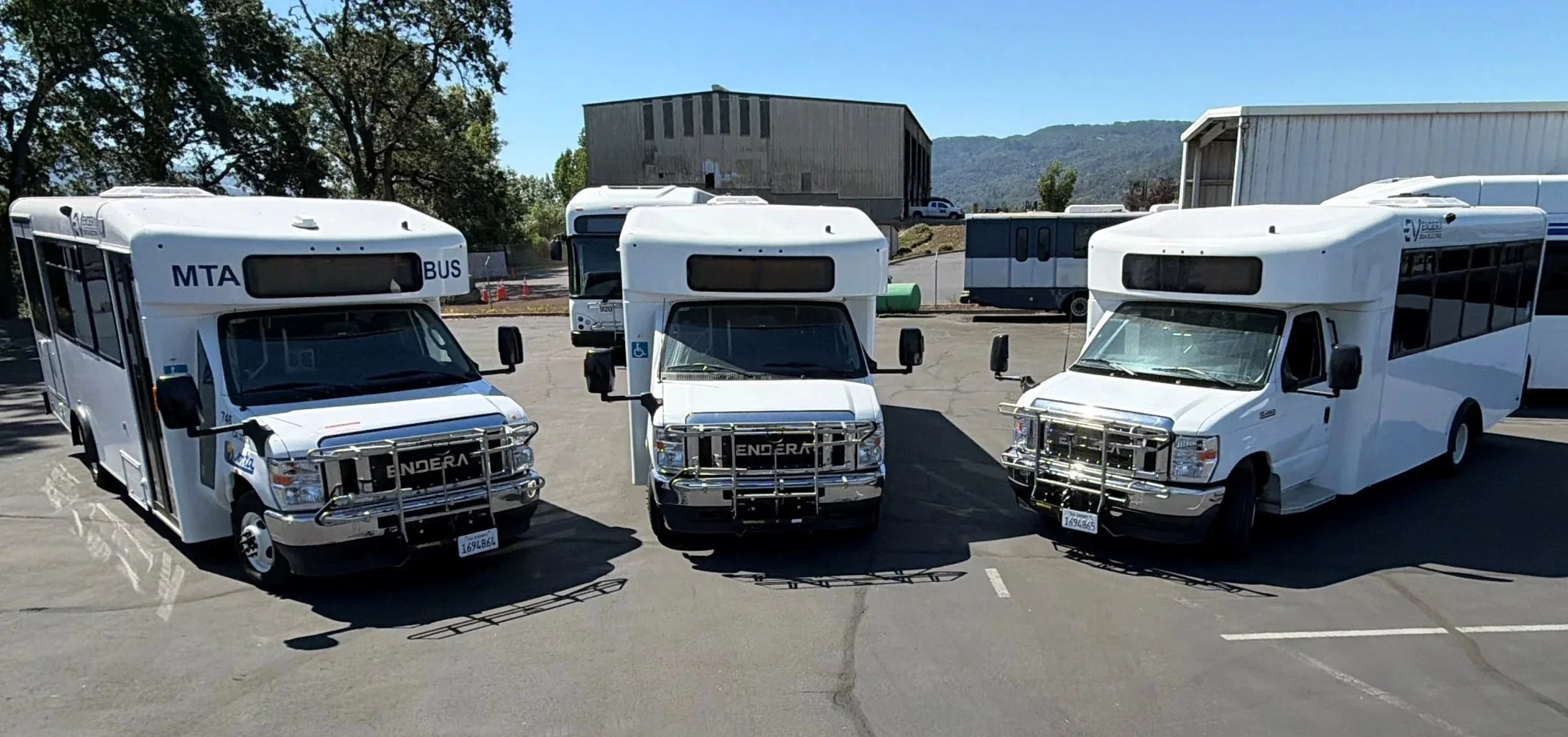
Montana's shuttle fleet market is shaped by geography more than population. Long distances between communities, seasonal tourism surges at national park gateways and ski resorts, limited public transit outside Missoula and Billings, and winter conditions that test vehicle reliability in ways warmer states don't — these are the operational realities that determine which vehicles survive in Montana fleet service and which don't.
Endera manufactures Class 4 B-Series commercial shuttles in ICE, propane, CNG, and full-electric configurations on Ford E450 and Chevrolet Express cutaway chassis. For Montana resorts, airports, universities, healthcare systems, and tribal transit operators, the B-Series is purpose-built for sustained daily commercial use — not adapted from light-duty platforms that accumulate fatigue on demanding routes.
Ready to optimize your routes? Contact Endera's fleet specialists today to design a custom configuration blueprint for your Montana operation.
Why Montana Fleets Choose B-Series Shuttles
The Montana Department of Transportation oversees a transportation network that spans some of the least-dense roadways in the country. For commercial shuttle operators, that geography creates operational requirements that urban-centric fleet platforms don't address well — long inter-stop distances, variable road surfaces, and temperature swings that affect vehicle reliability from October through April.
The B-Series is built on medium-duty Ford E450 and Chevrolet Express cutaway chassis — commercial platforms engineered for sustained daily use, not converted from personal vehicle configurations. Endera is the only American vertically integrated OEM for Class 4 electric shuttles, which means body assembly and powertrain installation happen at the same Ottawa, Ohio facility under a single quality control process. Montana fleet operators receive one warranty document and one point of service accountability.
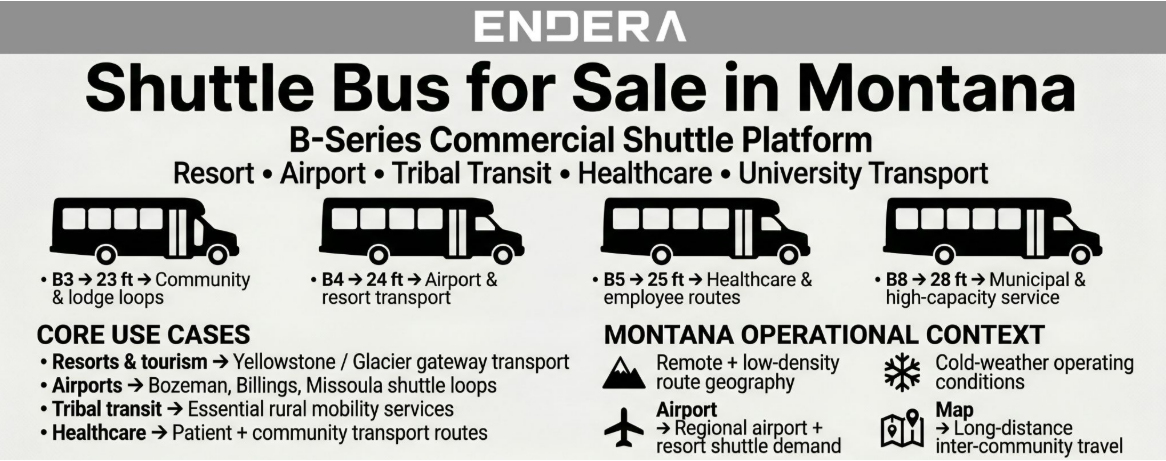
The B-Series Lineup for Montana Fleets
ADA-configured flat-floor models with 800 lb Braun lifts are available across the lineup. All models meet ADA accessible transportation requirements and FTA Part 37 transportation service regulations as delivered — without aftermarket modification.
Montana Shuttle Use Cases: Where the B-Series Fits
Montana's shuttle demand is concentrated in a handful of distinct markets, each with different operational demands.
Resorts, National Parks, and Tourism
Glacier National Park, Yellowstone's gateway communities, Big Sky Resort, and Whitefish Mountain generate seasonal shuttle demand that requires vehicle reliability in remote settings with limited nearby service options. Resort operators running property loops and airport transfers need vehicles built for daily high-cycle use without the maintenance overhead of modified alternatives.
Airports and Regional Transportation
Missoula, Bozeman, Billings, and Great Falls airports support parking and hotel shuttle operations that favor the B4's fixed-route efficiency. The electric B4 is well-suited here — predictable daily mileage, overnight depot charging, and the operational characteristics of airport ground transportation align with electric strengths.
Universities, Healthcare, and Tribal Transit
University of Montana, Montana State, and the state's major health systems operate campus circulation and patient transport programs requiring ADA configurations and real-time dispatch capability. Montana's tribal transit operators — providing essential mobility in communities where no alternative transport exists — represent a buyer profile that values durability and parts availability over any other specification.
Endera Dispatch provides AI-powered routing, real-time GPS tracking, and state-of-charge monitoring suited to both institutional and tribal fleet operations.
Electric vs. ICE: The Montana Fleet Decision
Montana's operational diversity means neither powertrain is universally correct. The Mountain Line electric bus fleet in Missoula has demonstrated that EV transit operation is viable in Montana's climate — but the lessons from Mountain Line's electrification journey also show that infrastructure readiness and route structure matter as much as vehicle selection.
When Electric Makes Sense for Montana Fleets
Fixed-route operations with overnight depot charging — airport loops, resort shuttles, university campus circuits — are the strongest candidates for electric B4 and B5 models. The DOE Alternative Fuels Data Center provides route-specific charging cost modeling tools for operators evaluating EV deployment in Montana conditions.
Cold Weather and EV Range Planning
Montana winters reduce battery range 15–25% in sustained sub-freezing conditions. Pre-conditioning the battery while still plugged in before departure mitigates range loss. Operators evaluating electric should confirm winter-adjusted route mileage against daily distance requirements before specifying EV. The DOE Alternative Fuels Data Center provides route-specific charging cost modeling tools for operators working through the math before committing.
When ICE or Propane Is the Right Call
Remote Montana operators with long irregular routes, no existing charging infrastructure, or facilities far from electrical grid capacity should consider ICE or propane as a current-cycle solution. All B-Series configurations share the same platform — standardizing on Endera now doesn't foreclose an EV transition on the next procurement cycle as Montana's charging infrastructure expands under the state's NEVI program.
Montana Fleet Electrification Momentum
Montana's clean transportation trajectory is building steadily. The Montana DEQ's Alternative Fuels & Transportation program offers grants for the replacement of qualifying medium- and heavy-duty diesel transit and shuttle buses with new all-electric, hybrid, CNG, or propane vehicles — funded by Montana's allocation of the Volkswagen Environmental Mitigation Trust. Both public and private fleets are eligible.
The FTA Low or No Emission Vehicle Program provides federal funding for electric shuttle purchases by transit agencies and qualifying contracted operators — a program Montana transit authorities have increasingly accessed as fleet replacement cycles align with electrification goals.
The Electrification Coalition provides fleet electrification planning resources that Montana operators can use to evaluate charging strategy and operational readiness before purchasing.
Montana's relatively low electricity rates
Montana's relatively low electricity rates make EV operating economics more favorable than in higher-cost states. The U.S. Energy Information Administration publishes current Montana electricity rates for operators modeling per-mile energy cost against existing diesel or propane baselines.
Operating Cost Advantage at Fleet Scale
For a Montana resort or airport operator running four to six vehicles, the per-mile fuel cost differential between electric and gasoline compounds meaningfully over a full service lifecycle. Operations where vehicles idle frequently between passenger runs benefit further — electric motors draw zero energy at idle versus a running combustion engine.
Endera's grant navigation and financing services help Montana operators identify applicable federal and state programs and structure purchases accordingly.
Get Your Fleet Spec'd
Several 2026 B-Series units are available for immediate delivery through Endera Stock, including ADA-configured flat-floor models and standard passenger layouts. For operators working within formal procurement or grant-aligned purchasing cycles, Endera provides full specification documentation and compliance materials.
To discuss fleet configuration, cold-weather EV performance, or financing for your Montana operation, contact Endera's sales team.
FAQs
Are electric shuttle buses practical in Montana's climate?
Yes, for fixed-route operations with depot charging. Battery range drops 15–25% in sustained sub-freezing conditions — operators should confirm winter-adjusted daily mileage before specifying electric. The DOE Alternative Fuels Data Center provides modeling tools to help operators plan for Montana's conditions before committing.
What B-Series configuration works best for Montana resort and tourism operations?
The B4 (24 ft) handles most Montana resort loops and airport transfers efficiently — fixed routes, predictable mileage, and overnight depot charging suit electric operation well. Remote lodge operators or those running irregular long-distance routes should consider ICE as the current-cycle choice. The B5 (25 ft) works for higher-capacity circuits or employee transport at larger Montana employer operations.
Can the B-Series handle Montana's mountain roads and winter conditions?
Yes. The B-Series is built on medium-duty Ford E450 and Chevrolet Express cutaway chassis — commercial platforms rated for the load and cycle intensity of daily commercial operations. Composite body construction resists moisture and salt exposure. ICE and propane models use standard block heater setups familiar to Montana fleet operators, and electric models support battery pre-conditioning for cold-weather departure.
Are there federal funding programs for Montana shuttle fleet operators?
Yes. The FTA Low or No Emission Vehicle Program funds electric shuttle purchases for transit agencies and qualifying contracted operators. The Montana DEQ VW Settlement grant program also provides funding for shuttle and transit bus replacement with alternative-fuel or all-electric vehicles for eligible public and private fleets. Montana tribal transit operators may access additional federal mobility funding. Endera's grant navigation team helps operators identify which programs apply to their ownership structure and fleet profile.
What ADA accessibility options are available for Montana fleet operators?
Flat-floor B-Series configurations include 800 lb Braun ADA lifts installed at the manufacturing stage, meeting FTA Part 37 accessibility requirements without aftermarket modification. For Montana NEMT operators, senior living communities, and tribal transit programs serving passengers with mobility needs, OEM-installed lift systems provide unified warranty coverage and cleaner compliance documentation.
How does the B-Series perform for tribal transit and rural community transport in Montana?
Montana tribal transit operators prioritize durability, parts availability, and vehicle reliability over any other specification — requirements the B-Series meets through its medium-duty Ford E450 and Chevrolet Express chassis base, which have broad parts and service networks across rural Montana. Endera Dispatch provides GPS tracking and routing suited to demand-response operations, and all models are FTA-eligible for tribal transit procurement through federal mobility funding programs.
What is the total cost of ownership difference between electric and ICE shuttle buses?
Electric drivetrains reduce maintenance spend 30–40% versus diesel — fewer moving parts, no oil changes, and regenerative braking extending pad life on high-cycle routes. The DOE Alternative Fuels Data Center provides fleet-specific operating cost data for Montana operators modeling lifecycle economics. For Montana resort and airport operators running 8 to 12 daily cycles, fuel savings compound significantly over a 10-to-12-year service life.