
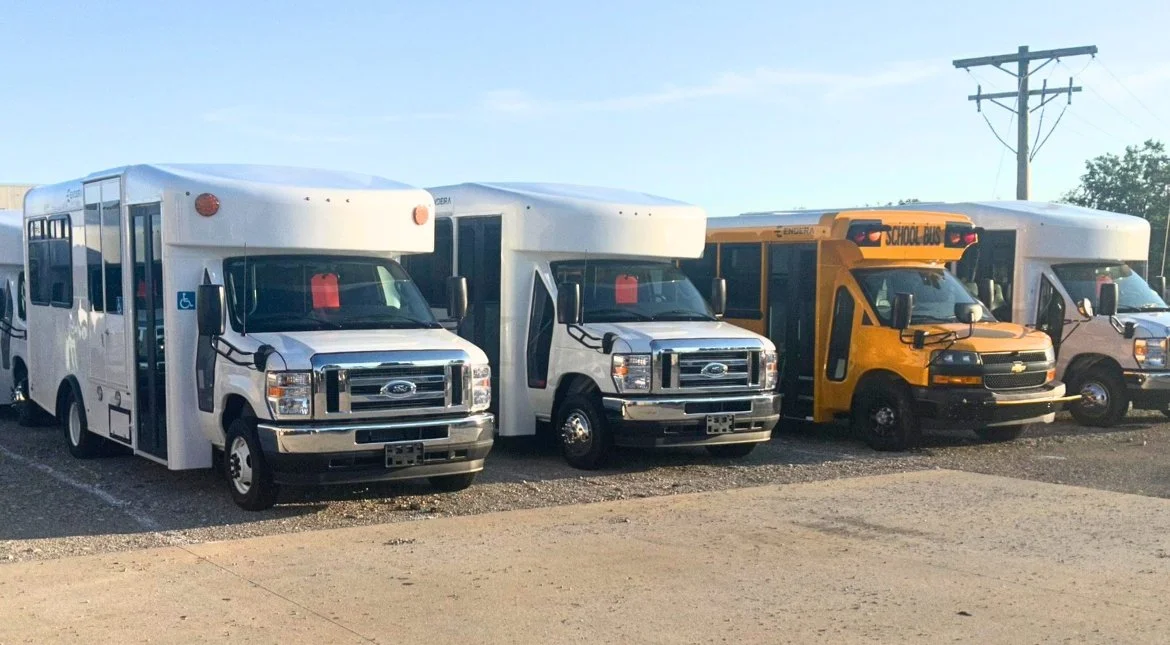
North Carolina's transit landscape is evolving faster than most states its size. Population growth across the Research Triangle, Charlotte, and the Triad is driving investment in regional transit systems, while rural counties are expanding on-demand and microtransit services to close mobility gaps that fixed-route buses can't address. For transit agencies, municipalities, universities, and commercial fleet operators across the state, the shuttle bus decision is increasingly a transit strategy decision — not just a vehicle purchase.
Endera manufactures Class 4 B-Series commercial shuttles in ICE, propane, CNG, and full-electric configurations on Ford E450 and Chevrolet Express cutaway chassis. The B-Series is FTA-eligible and Buy America compliant — meeting the federal procurement requirements that North Carolina transit agencies, municipalities, and contracted operators need for federally funded fleet purchases.
Know what routes you're running? Let Endera's team help you spec the right vehicle for your North Carolina operation.

North Carolina Transit Funding and Fleet Modernization
North Carolina's transit investment infrastructure gives operators more funding pathways than most buyers realize. NCDOT's transit discretionary grants and unified grant application system provide centralized access to capital and operating funding for fleet replacement, on-demand service expansion, and ADA-accessible vehicle acquisition across the state.
The FTA Section 5311 rural formula grant program funds non-urban public transportation systems across North Carolina's rural counties — providing the operating and capital assistance that smaller transit agencies use to purchase accessible shuttle vehicles. FTA FY25 Bus and Low-No Emission grant awards include North Carolina transit agencies in active fleet replacement cycles. Endera's grant navigation services help NC operators identify applicable programs and manage applications alongside procurement.
VW Settlement and Clean Fleet Funding
North Carolina's VW settlement funding program provides dedicated resources for replacing older diesel shuttle and transit buses with cleaner alternatives — a direct procurement pathway for NC fleet operators seeking to modernize aging diesel vehicles. This funding stacks with federal Low-No Emission grants for operators pursuing electric or propane replacements, making the net acquisition cost of a new clean-fuel vehicle substantially lower than sticker price.
North Carolina's Microtransit and On-Demand Transit Growth
North Carolina is one of the more active states in the country on microtransit expansion. A case study on North Carolina's statewide approach to on-demand transit documents how the state has built flexible, technology-integrated transportation systems serving both urban and rural communities — an approach that creates consistent procurement demand for mid-size commercial shuttles capable of both fixed-route and demand-response deployment.
FTA research on the Wilson, North Carolina rural microtransit pilot provides a localized case study in on-demand transit operation — documenting rider flexibility, operational efficiency, and technology integration in a real North Carolina community. Federal funding supporting rural microtransit expansion is accelerating these programs across the state.
Why Mid-Size Shuttles Are Central to Microtransit
On-demand and flexible-route transit operations require vehicles that can handle varied passenger loads, frequent stops, and route adjustments within a service day. Full-size transit buses are operationally wasteful for microtransit demand profiles.
The B3 and B4's compact footprint, ADA capability, and compatibility with Endera's Endera Dispatch software — which includes AI-powered routing and real-time GPS tracking — make them purpose-suited to the microtransit operational model.
North Carolina Shuttle Use Cases: Where the B-Series Fits
North Carolina's shuttle demand spans several distinct buyer profiles with different operational requirements.
Airports, Hotels, and the Research Triangle
Raleigh-Durham International, Charlotte Douglas International, and Piedmont Triad International all support high-frequency parking and hotel shuttle operations. The Research Triangle's corporate and university corridor generates employee and campus shuttle demand alongside airport operations. The B4 handles fixed-route airport and campus circuits efficiently — and its electric configuration suits the predictable daily mileage and overnight depot charging these applications provide.
Universities and Campus Transportation
UNC Chapel Hill, Duke, NC State, Wake Forest, and the state's extensive UNC system all operate campus and off-campus transportation programs. The Fayetteville Area MPO rural operating assistance program illustrates how North Carolina's metropolitan planning organizations layer federal and state funding to support community and institutional transportation — a model that university-adjacent transit programs draw from. Endera Dispatch provides AI-powered routing and state-of-charge monitoring suited to multi-stop campus and community operations.
Healthcare and Senior Transportation
FTA Section 5310 funding administered through CAMPO supports transportation for elderly passengers and individuals with disabilities across North Carolina's metropolitan and rural areas.
Healthcare systems across the Triangle, Charlotte, and Asheville run patient transport and campus shuttle programs that require ADA-configured vehicles and reliable daily performance. Senior living communities statewide depend on accessible resident transport that the flat-floor B-Series with 800 lb Braun lift satisfies as a standard configuration.
ADA Accessibility for North Carolina Transit Fleets
North Carolina transit agencies, healthcare operators, and paratransit contractors must meet ADA accessible transportation requirements and FTA Part 37 regulations for commercially operated accessible transport. These standards apply to on-demand microtransit programs, university paratransit services, and any fleet accepting federal funding.
Endera's flat-floor B-Series configurations include 800 lb Braun ADA lifts installed at the manufacturing stage. For North Carolina NEMT operators, rural transit agencies, and senior living communities, OEM-installed equipment provides unified warranty coverage and cleaner compliance documentation than post-sale retrofits.
The B-Series Lineup for North Carolina Fleets
| Model | Length | Fuel Options | Best Fit |
|---|---|---|---|
| B3 | 23 ft | ICE | Rural microtransit, community transit, church transport |
| B4 | 24 ft | ICE & EV | Airport shuttles, campus loops, on-demand transit |
| B5 | 25 ft | ICE & EV | Employee transport, healthcare, higher-capacity routes |
| B8 | 28 ft | ICE | High-volume municipal and group transport |
The B4 electric shuttle holds the highest Altoona durability test score in its class at 90.1 — satisfying the quantitative certification requirement that FTA-funded procurement bids specify.
Electric vs. ICE for North Carolina Fleets
North Carolina's mild climate makes it a favorable EV operating environment across most of the state. Fixed-route airport, campus, and healthcare operations with overnight depot charging are the strongest candidates for electric B4 and B5 models. For rural operators with long irregular routes or no existing charging infrastructure, ICE or propane remains the current-cycle solution.
Propane reduces fuel costs 30–40% versus gasoline per DOE Alternative Fuels Data Center data and qualifies for clean fuel programs including North Carolina's VW settlement program. All B-Series configurations share the same platform — standardizing on Endera now doesn't foreclose an EV transition on the next procurement cycle.
Ready to Spec a Shuttle for Your North Carolina Fleet?
Several 2026 B-Series units are available for immediate delivery through Endera Stock, including ADA-configured flat-floor models and standard passenger layouts. For agencies working within North Carolina's formal procurement process or grant-aligned purchasing cycles, Endera provides full specification documentation, Buy America compliance materials, and grant application support.
Reach out to Endera's team to discuss fleet configuration, FTA eligibility documentation, or financing for your North Carolina operation.
Frequently Asked Questions
What funding programs are available for North Carolina transit fleet purchases?
NCDOT's discretionary grant program and unified grant application system provide centralized access to state and federal fleet funding. FTA Section 5311 rural grants, Section 5310 elderly/disabled transportation funding, and the FY25 Low-No Emission grant awards all support North Carolina fleet replacement. North Carolina's VW settlement program adds dedicated funding for replacing older diesel vehicles with cleaner alternatives.
What is microtransit and how does it affect shuttle bus procurement in North Carolina?
Microtransit refers to on-demand or flexible-route service using smaller vehicles that close first-mile/last-mile gaps fixed-route buses don't serve. North Carolina has built statewide on-demand transit infrastructure with active federal support — the Wilson rural microtransit pilot is one documented example. Mid-size B-Series shuttles are well-matched to this use case given their size, ADA capability, and Dispatch software compatibility.
Are Endera B-Series shuttles FTA-eligible for North Carolina transit procurement?
Yes. Endera's B-Series shuttles are Buy America compliant and FTA-eligible, meeting the federal procurement requirements attached to FTA-funded vehicle purchases. The B4 electric shuttle holds an Altoona durability test score of 90.1 — satisfying the quantitative certification requirement that NC FTA-funded procurement bids specify.
What ADA accessibility options are available for North Carolina transit operators?
Flat-floor B-Series configurations include 800 lb Braun ADA lifts installed at the manufacturing stage, meeting FTA Part 37 requirements. For North Carolina NEMT operators, paratransit agencies, and senior living communities, OEM-installed equipment provides unified warranty coverage and cleaner compliance documentation than aftermarket modifications.
How does North Carolina's VW settlement funding apply to shuttle fleet purchases?
North Carolina's VW Environmental Mitigation Trust allocation provides dedicated funding for replacing older diesel shuttle and transit buses with cleaner alternatives — electric, propane, or CNG models. This funding can stack with federal Low-No Emission grants for operators pursuing electric replacements, substantially reducing net acquisition cost. Endera's grant navigation services help operators identify how these programs apply to their specific fleet profile.
What makes the B-Series well-suited to North Carolina's on-demand transit programs?
On-demand and microtransit operations require vehicles with flexible routing capability, ADA accessibility, and real-time dispatch integration. The B3 and B4's compact footprint handles varied route structures efficiently. Endera Dispatch provides AI-powered routing, geofence management, and real-time GPS tracking — tools that align with the operational requirements of demand-response transit programs across North Carolina.
Do B-Series shuttle buses require a CDL in North Carolina?
Most B-Series configurations fall below the federal CDL threshold — under 26,001 lbs GVWR and fewer than 16 passengers including the driver. North Carolina operators running for-hire commercial transport should confirm state-specific licensing requirements, as for-hire passenger carrier rules may add licensing layers beyond the standard federal CDL threshold.