
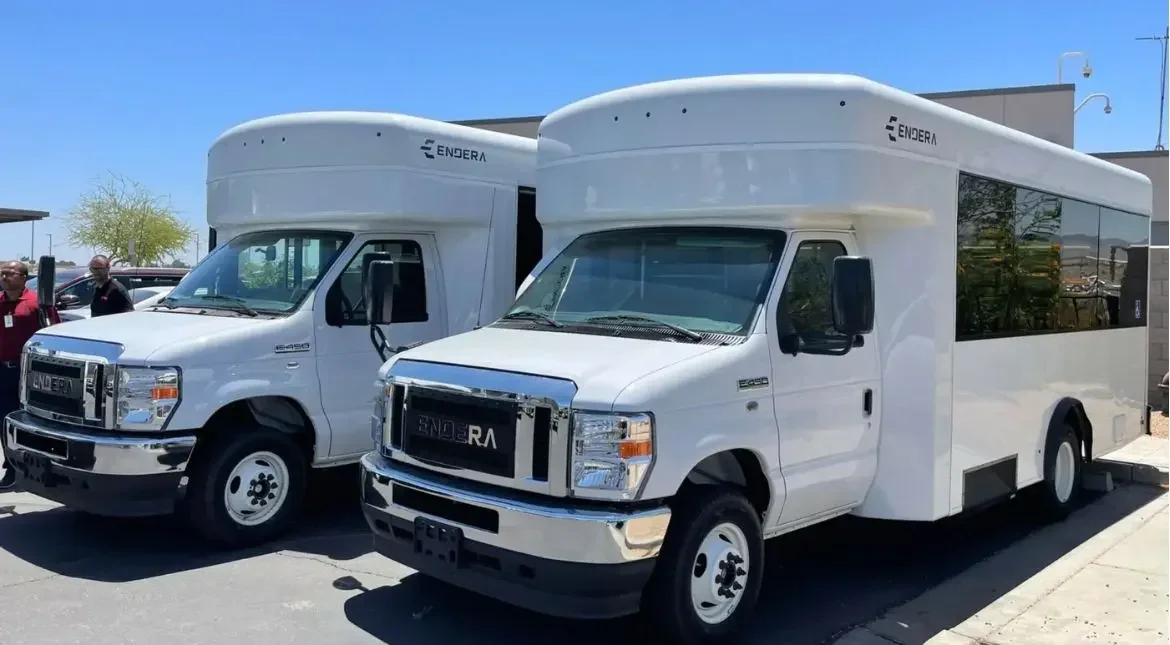
Rhode Island’s shuttle market is geographically small but highly concentrated, with demand driven by T.F. Green International Airport, Providence’s healthcare and university sector, and Newport’s hospitality and event industry. State fleet mandates pushing alternative fuel and zero-emission vehicle adoption also shape public-sector purchasing. Endera builds the B-Series commercial shuttle as a complete system — vehicle, powertrain, software, and charging infrastructure — with both ICE and electric variants to fit Rhode Island’s range of operators and route types.
Rhode Island’s moderate coastal climate makes it more favorable for electric shuttle deployment than many New England states. For airport loops, campus transit, and resort circuits with depot charging access, Endera’s electric B4 and B5 are practical year-round options. For longer regional routes where charging infrastructure is less established, ICE variants provide greater range certainty. Endera builds both on the same platform to support different operating needs.
Building out your Rhode Island fleet? Reach out to Endera's team and we'll put together the right configuration for your routes.
The B-Series Lineup and What Each Model Is Built For
From 23 to 28 Feet, on Proven Platforms
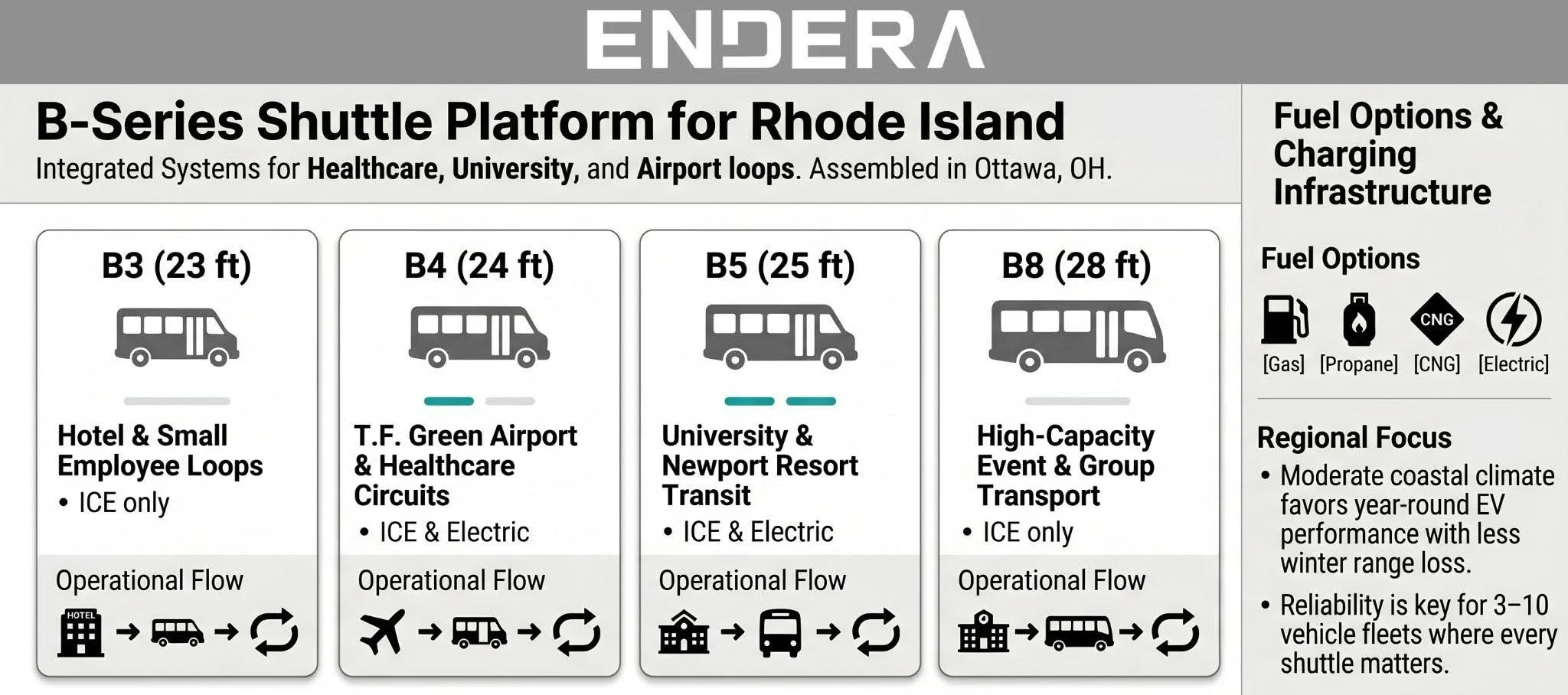
Endera's B-Series runs from 23 to 28 feet, built on the Ford E450 and Chevrolet Express cutaway chassis — platforms with dealer and service coverage across Rhode Island and the broader southern New England market. The B3 at 23 feet handles smaller hotel loops and employee shuttles. The B4 and B5 — available in both ICE and electric — cover the mid-size range most used by airports, healthcare campuses, universities, and resort properties. The B8 at 28 feet handles higher-volume event and group transport where capacity is the constraint.
ICE or Electric: Rhode Island's Honest Assessment
For Rhode Island operators, the EV decision is more straightforward than in colder New England states. The state's coastal moderation means winter battery reduction is less severe, and the short, predictable route profiles that define most Rhode Island shuttle operations — airport parking circuits, campus loops, Newport hotel transfers — fall comfortably within the electric B4 and B5's Standard Range.
Rhode Island Energy's up-to-100% installation cost rebate for commercial charging infrastructure removes the depot setup barrier more completely than most states. For operators with longer routes or variable schedules, the ICE models remain available on the same platform.
Why Reliability Matters More in Small Shuttle Fleets
Fewer Vehicles Means Less Margin for Downtime
Rhode Island's shuttle operators — hospitals, universities, airport parking companies, and Newport hospitality groups — typically run small fleets of three to ten vehicles rather than large reserve pools. In that environment, a single shuttle out of service can immediately disrupt route coverage, staffing schedules, and passenger throughput.
Utilization rates are higher per unit because there are fewer spare vehicles to absorb downtime. Airport parking operators near T.F. Green, for example, rely on tightly scheduled loops where a single unavailable shuttle increases passenger wait times and reduces lot turnover efficiency. Healthcare and university systems face similar exposure during shift changes and peak campus movement periods.
What Transit Asset Management Research Says
The FTA's Transit Asset Management program identifies vehicle reliability and preventative maintenance as critical components of operational continuity and lifecycle cost management — specifically because unscheduled downtime affects service delivery in ways that compound quickly in small fleet environments.
The DOE Vehicle Technologies Office supports connected vehicle diagnostics and predictive maintenance research aimed at reducing unexpected breakdowns and improving fleet utilization efficiency. For smaller Rhode Island fleets, integrated diagnostics and real-time vehicle health monitoring matter more than they would in a large transit system with spare capacity — which is where Endera's manufacturer-integrated Dispatch software provides an operational advantage a third-party telematics overlay doesn't replicate.
Where Rhode Island Operators Are Actually Running Shuttles
T.F. Green Airport and the Warwick Corridor
Rhode Island T.F. Green International Airport is the state's primary air travel hub, located ten minutes from downtown Providence. Off-site parking operators, hotel ground transport along the Warwick corridor, and ground transportation contractors serving the terminal generate consistent mid-size shuttle demand year-round. For airport parking shuttle operators specifically, the duty cycle — short loops, high frequency, overnight depot return — is one of the cleaner use cases for the electric B4 and B5. The NREL research on airport shuttle electrification specifically identifies centralized depots and repeatable routes as the primary factors that make airport ground transport strong candidates for fleet electrification.
Providence: Healthcare, University, and State Government
Providence's healthcare sector generates substantial campus shuttle demand. Rhode Island Hospital, The Miriam Hospital, and Hasbro Children's Hospital — all part of the Lifespan system — operate across a dense cluster of facilities in Providence's Wayland Square and South Providence neighborhoods.
Care New England adds Women & Infants Hospital and Butler Hospital to the regional healthcare campus picture. Brown University and the Rhode Island School of Design run campus transit connecting academic buildings, residential areas, and satellite facilities. The state government campus on Smith Hill, and the Providence Convention Center add institutional shuttle demand that runs on predictable schedules. For public-sector procurement, Rhode Island state agencies purchase through the Rhode Island Division of Purchases under the state's procurement framework.
Newport: Hospitality, Events, and the Mansion Corridor
Newport generates some of the most consistent hospitality shuttle demand in New England. The city's hotel corridor, event venues along Bellevue Avenue, Salve Regina University, and the Aquidneck Island resort and conference market all create mid-size shuttle demand that peaks in summer and fall around the Newport Jazz and Folk Festivals, America's Cup events, and the fall wedding and conference season.
The B4 and B5 fit Newport's typical route profiles well — hotel-to-venue transfers, off-site parking circuits, and event group transport are all within the range and capacity parameters of the mid-size B-Series models.
University of Rhode Island and South County
The University of Rhode Island in Kingston runs campus transit across a spread-out campus that connects academic buildings, residential halls, athletic facilities, and the Kingston Amtrak station. URI's campus is about 20 miles south of Providence, with T.F. Green Airport 20 minutes away — positioning it as a candidate for both ICE and electric shuttle use depending on route length and depot charging availability. South County's growing healthcare and hospitality sector, including South County Hospital and the Watch Hill resort area, add institutional and hospitality shuttle demand across Washington County.
Who Makes the Shuttle Purchase Decision in Rhode Island Organizations
The Operational Side of the Table
In Rhode Island shuttle operations — whether a hospital system, a university transportation department, or a Newport resort property — the transportation director or fleet manager defines what the vehicle needs to do. They know the routes, the seasonal patterns, and where the current fleet falls short. That operational knowledge drives specifications. But approval authority typically sits elsewhere.
The Approval Side of the Table
For public-sector buyers — state agencies, URI, or RIPTA — procurement follows the Rhode Island Division of Purchases framework under the Department of Administration, with competitive solicitations and statewide contracts.
Rhode Island's state fleet mandate requires 75% alternative fuel vehicles and 25% ZEVs in new acquisitions — which means fleet managers at state agencies are already operating under a policy direction that favors Endera's electric and alternative fuel options. When federal transit funding is involved, FTA procurement standards apply. For private operators in healthcare or hospitality, approval typically runs through a CFO or general manager weighing total cost of ownership alongside capital availability.
Endera's Software Stack: What It Does for Rhode Island Fleet Managers
Real-Time Visibility for Passengers and Operators
Every Endera B-Series shuttle comes available with two integrated software tools built in-house. Endera Go gives passengers real-time vehicle location, ETA updates, and occupancy data — useful for airport ground transport, university campus transit, and Newport event shuttle programs where passenger visibility affects the experience. Endera Dispatch handles fleet management: routing optimization, vehicle health analytics, and state-of-charge monitoring for EV operators.
No Third-Party Integration Required
Both tools are integrated directly with the vehicle's hardware — no separate telematics license, no integration project, no data gap between what the vehicle is doing and what the software reports. For Rhode Island operators managing small fleets where every vehicle counts, that visibility means problems surface before they become service failures. The cost-per-mile and utilization data Dispatch generates also supports the reporting requirements that come with publicly funded procurement under Rhode Island's fleet mandate.
Rhode Island's Shuttle Market Is Small. That Makes Vehicle Reliability More Consequential, Not Less.
In a small fleet environment, one vehicle out of service is a larger operational disruption than it would be in a 50-vehicle pool. Endera's B-Series is built as a complete system — vehicle, powertrain, software, and charging infrastructure — by one manufacturer accountable for the whole thing, with ICE and electric variants and one of the most favorable charging infrastructure rebate environments in New England backing the EV option.
Get in touch with Endera's sales team to explore configurations, check current availability, and find out what funding your Rhode Island operation may qualify for.
FAQs
1. What B-Series models are available for Rhode Island buyers?
The B-Series runs from the B3 (23 feet) through the B8 (28 feet). The B4 and B5 are available in both ICE and electric. The B3 and B8 are currently ICE only. Endera's sales team can confirm availability and delivery lead times for Rhode Island.
2. Is the electric B-Series practical for Rhode Island's climate?
Yes. Rhode Island's coastal moderation means winter battery reduction is less severe than in inland northern states. Airport loops, campus transit, and Newport hotel circuits with overnight depot access are all viable EV applications year-round with pre-conditioning protocols.
3. What is the DRIVE EV Fleet rebate and does it apply to Endera shuttles?
The DRIVE EV Fleet program provides $3,000 per new BEV for small businesses, nonprofits, and public entities — up to 5 vehicles per two-year period. Endera assists operators with DRIVE EV Fleet documentation as part of the sales process.
4. Does Rhode Island Energy cover charging infrastructure costs?
Yes. Rhode Island Energy offers up to 100% of installation costs for Level 2 and DC fast charging at commercial sites including workplaces, universities, and medical campuses. Endera's turnkey charging service coordinates with this rebate directly.
5. How does Rhode Island public procurement work for shuttle buses?
State agencies and eligible entities procure through the Rhode Island Division of Purchases. Rhode Island's state fleet mandate requires 75% AFVs and 25% ZEVs in new acquisitions. Federal transit funding purchases are subject to FTA requirements.