
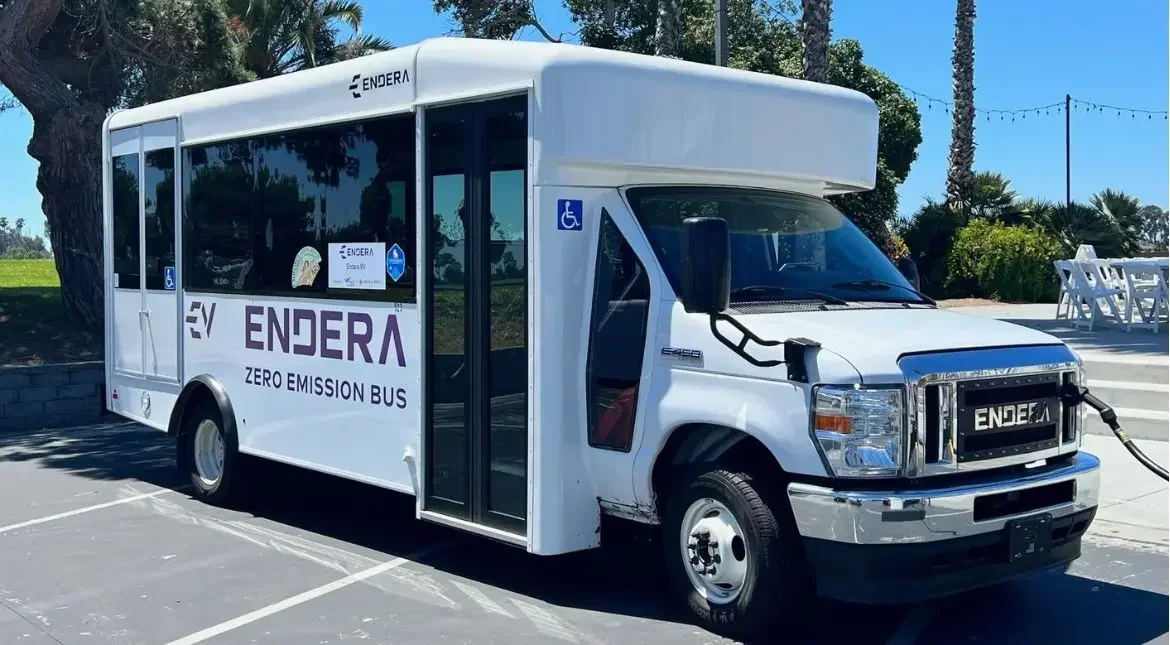
Endera builds the B-Series commercial shuttle as a complete system — vehicle, powertrain, software, and charging infrastructure — assembled in Ottawa, Ohio for practical delivery and service support to Massachusetts operators.
Massachusetts offers one of the country’s stronger EV policy environments, with state fleet mandates, MassEVIP grants, charging rebates, and utility infrastructure support helping fleet operators adopt electric vehicles. For Boston-area airport, healthcare, and university shuttle routes with depot charging access, Endera’s electric B4 and B5 are practical options. For longer inter-city or multi-shift operations, ICE variants remain the more practical choice. Endera builds both on the same platform.
Putting together your Massachusetts fleet? Connect with Endera's team to work through configurations, availability, and funding options for your operation.
The B-Series Lineup and What Each Model Is Built For
From 23 to 28 Feet, on Proven Platforms
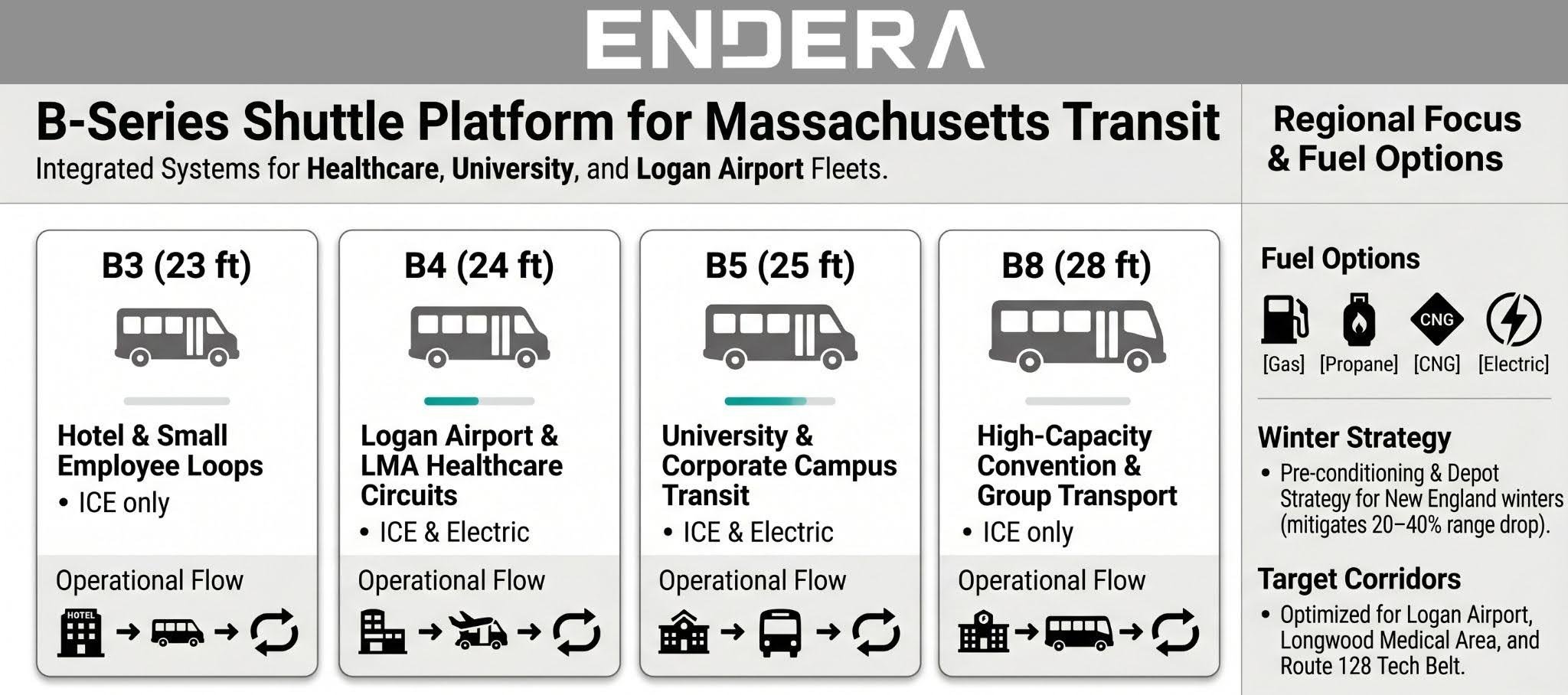
Endera's B-Series runs from 23 to 28 feet, built on the Ford E450 and Chevrolet Express cutaway chassis — platforms with dealer and service coverage across Massachusetts. The B3 at 23 feet handles smaller hotel loops and employee shuttles. The B4 and B5 — available in both ICE and electric — cover the mid-size range most used by airports, healthcare campuses, universities, and corporate programs. The B8 at 28 feet handles higher-volume convention and group transport.
ICE or Electric: Massachusetts's Honest Assessment
Massachusetts winters create real battery range reduction — the same 20–40% cold-weather range drop that affects EV operations across New England applies here. For Boston-area operations with short, predictable loops and overnight depot charging, the electric B4 and B5 perform reliably with pre-conditioning protocols. For longer routes across the state's interior — Springfield, Pittsfield, New Bedford, and the Cape — and for manufacturing employee shuttles in the Pioneer Valley, the ICE models are the more operationally reliable choice. Endera's sales team works through route and depot conditions before recommending a configuration.
What Winter EV Shuttle Operations Actually Require in Massachusetts
Cold Weather Range Reduction — What the Data Shows for New England Fleets
Electric shuttle deployment in Massachusetts requires realistic winter operating planning, not just a summer-range estimate. The U.S. Department of Energy notes that EV range can drop by up to 32% in freezing temperatures as cold slows battery chemistry and increases energy demand from cabin heating systems — and fueleconomy.gov data puts the drop as high as 41% in mixed city and highway driving with heavy cabin heat use. For Massachusetts operators, that range reduction is the starting point for route and charging strategy planning, not a footnote.
Pre-Conditioning, Depot Strategy, and Urban Stop-and-Go
The DOE recommends pre-conditioning — warming the battery and cabin while the vehicle is still plugged in — as the primary strategy for improving winter EV range, because it draws heating energy from the grid rather than the battery. For shuttle fleets, overnight charging and pre-conditioning at depot before morning dispatch is the standard approach. In dense urban environments like Boston, stop-and-go traffic increases heating demand because vehicles spend more time at low speeds with doors opening frequently — conditions that accelerate energy draw beyond what highway-cycle estimates suggest. Snow and icy conditions also reduce regenerative braking effectiveness, shifting more braking load to friction brakes during storms.
Where Winter Operations Favor ICE — and Where EV Still Works
Logan Airport loops, LMA healthcare campus circuits, and university shuttle routes remain among the stronger winter EV applications in Massachusetts because they operate on short, predictable duty cycles with overnight depot return. Longer statewide routes toward Springfield, Pittsfield, Cape Cod, or New Bedford become more operationally difficult in winter because cold-weather range variability leaves less buffer for congestion or extended idle time.
The Mass Fleet Advisor program through MassCEC offers free technical assistance for businesses and nonprofits electrifying medium- and heavy-duty fleets — specifically emphasizing route analysis and charging strategy as core components of successful fleet electrification planning. Endera's sales team works through the same assessment with operators before recommending a configuration.
Where Massachusetts Operators Are Actually Running Shuttles
Logan Airport and the Boston Airport Corridor
Logan International Airport handles direct flights to more than 80 domestic destinations and over 50 nonstop international routes, anchoring one of the most active airport ground transport corridors in the Northeast. Off-site parking operators, hotel shuttles along the airport hotel strip, rental car circuits, and ground transportation contractors serving Logan's terminals run continuous high-frequency operations. For airport parking shuttle operators specifically, the duty cycle — short loops, high frequency, overnight depot return — is one of the stronger use cases for the electric B4 and B5. Endera's Dispatch software gives operators running multiple vehicles real-time fleet visibility across simultaneous circuits.
Longwood Medical and the Boston Healthcare Corridor
The Longwood Medical and Academic Area is one of the largest healthcare employment clusters in the country. With 21 institutions and 73,000 employees, the LMA operates shuttle services connecting facilities, parking structures, MBTA Green Line access points, and satellite campuses continuously across shift changes and peak movement periods.
Mass General Hospital in the West End, Tufts Medical Center, and Beth Israel Deaconess Medical Center add to the healthcare campus shuttle demand across the broader Boston metro. For these operations, the predictable duty cycles and institutional infrastructure for overnight charging make the electric B4 and B5 practical options where depot access is available.
University Campus Transit
Harvard, MIT, Boston University, and Tufts all operate campus shuttle programs connecting main campuses with satellite facilities, residential areas, and MBTA connections. The UMass system — Amherst, Boston, Lowell, Dartmouth, and Worcester — adds to the statewide university campus transit picture.
Campus loops are short, overnight depot charging is generally available, and the institutional procurement framework at Massachusetts public universities runs through the Commonwealth's COMMBUYS statewide contract system. For procurement, state agencies and public colleges and universities access vehicle contracts through OSD's COMMBUYS platform under the VEH110 statewide contract.
Route 128, Kendall Square, and Corporate Campus Transit
The technology and life sciences corridor stretching from Kendall Square through the Route 128 belt generates significant corporate campus shuttle demand. Biogen, Moderna, Pfizer's Cambridge campus, and hundreds of smaller life sciences and tech employers run employee shuttles connecting office campuses, transit stations, and parking facilities. These operations typically run on predictable schedules with fixed endpoints — exactly the duty cycle where the electric B4 and B5 perform well in Massachusetts's climate when depot charging is in place.
Worcester, Springfield, and Statewide Secondary Markets
Worcester's medical and university sector — UMass Medical, Reliant Medical Group, and Worcester Polytechnic Institute — generates consistent mid-size shuttle demand. Springfield's healthcare corridor and manufacturing base, including Baystate Health and the Pioneer Valley manufacturing corridor, anchor institutional transit demand in western Massachusetts. For manufacturing employee shuttles running multi-shift operations across the Pioneer Valley and along I-90, the ICE variants provide the operational simplicity and range certainty that shift-based schedules require.
Endera's Software Stack: What It Does for Massachusetts Fleet Managers
Real-Time Visibility for Passengers and Operators
Every Endera B-Series shuttle comes available with two integrated software tools built in-house. Endera Go gives passengers real-time vehicle location, ETA updates, and occupancy data — directly relevant for LMA healthcare campus shuttles, airport ground transport, and university transit where wait time affects the passenger experience. Endera Dispatch handles fleet management: routing optimization, vehicle health analytics, and state-of-charge monitoring for EV operators.
No Third-Party Integration Required
Both tools are integrated directly with the vehicle's hardware — no separate telematics license, no integration project, no data gap between what the vehicle is doing and what the software reports. For Massachusetts operators managing fleets across multiple facilities or high-frequency urban routes, that visibility is operationally useful every shift. For operators building the internal case for electrification — particularly in applying for MassEVIP Fleet grants where vehicle utilization documentation supports the application — the data Dispatch generates supports both operational management and program reporting.
Massachusetts Runs Some of the Most Active Shuttle Corridors on the East Coast
From Logan airport loops and Longwood Medical Area campus shuttles to MIT and Harvard campus transit and Route 128 corporate employee programs, Massachusetts shuttle operations run at the pace and scale of one of the country's densest institutional markets. Endera's B-Series is built as a complete system — vehicle, powertrain, software, and charging infrastructure — by one manufacturer accountable for the whole thing, in ICE and electric variants supported by one of the stronger fleet EV funding environments in the country.
Drop us a line to explore configurations, check current availability, and find out what funding your Massachusetts operation may qualify for.
FAQs
1. What B-Series models are available for Massachusetts buyers?
The B-Series runs from the B3 (23 feet) through the B8 (28 feet). The B4 and B5 are available in both ICE and electric. The B3 and B8 are currently ICE only. Endera's sales team can confirm availability and delivery lead times for Massachusetts.
2. Does Massachusetts's winter climate affect EV shuttle performance?
Yes. Massachusetts operators should plan for 20–40% battery range reduction in winter months. For Boston-area campus loops and airport circuits with overnight depot access and pre-conditioning, the electric variants work well. For longer statewide routes and multi-shift manufacturing transit, ICE models are the more reliable choice.
3. What is MassEVIP and does it apply to Endera shuttles?
MassEVIP Fleet Vehicles provides grants up to $7,500 per vehicle for public entities purchasing EVs. MassEVIP Workplace & Fleet Charging covers up to 60% of Level 2 charging installation costs. Endera assists with application documentation as part of the sales process.
4. How does Massachusetts public procurement work for shuttle buses?
State agencies and public universities procure vehicles through the OSD COMMBUYS platform under the VEH110 statewide contract. The state fleet mandate requires ZEVs for vehicles under 14,000 lbs GVW. Federal transit funding purchases are subject to FTA requirements.
5. Does Endera provide charging infrastructure for Massachusetts EV buyers?
Yes. Endera provides full turnkey charging infrastructure — site assessment, charger sourcing, and installation — and coordinates with MassEVIP Charging rebate applications.
6. What software comes with a B-Series shuttle?
Every B-Series shuttle comes available with Endera Go and Endera Dispatch — real-time tracking, fleet management, routing, and vehicle health analytics — integrated directly with the vehicle's hardware.
7. Does Endera offer financing for Massachusetts buyers?
Yes. Endera offers direct financing and capital leasing through its financing platform. Capital leasing preserves working capital and aligns vehicle costs with revenue cycles. Endera also assists with grant identification and application management.