
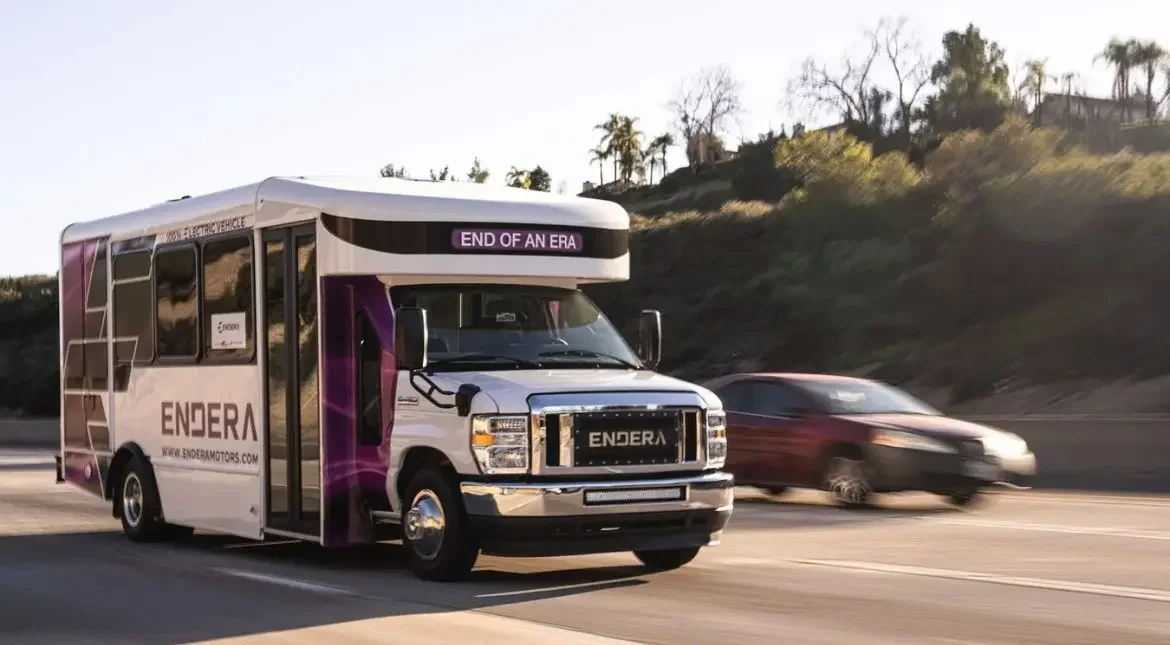
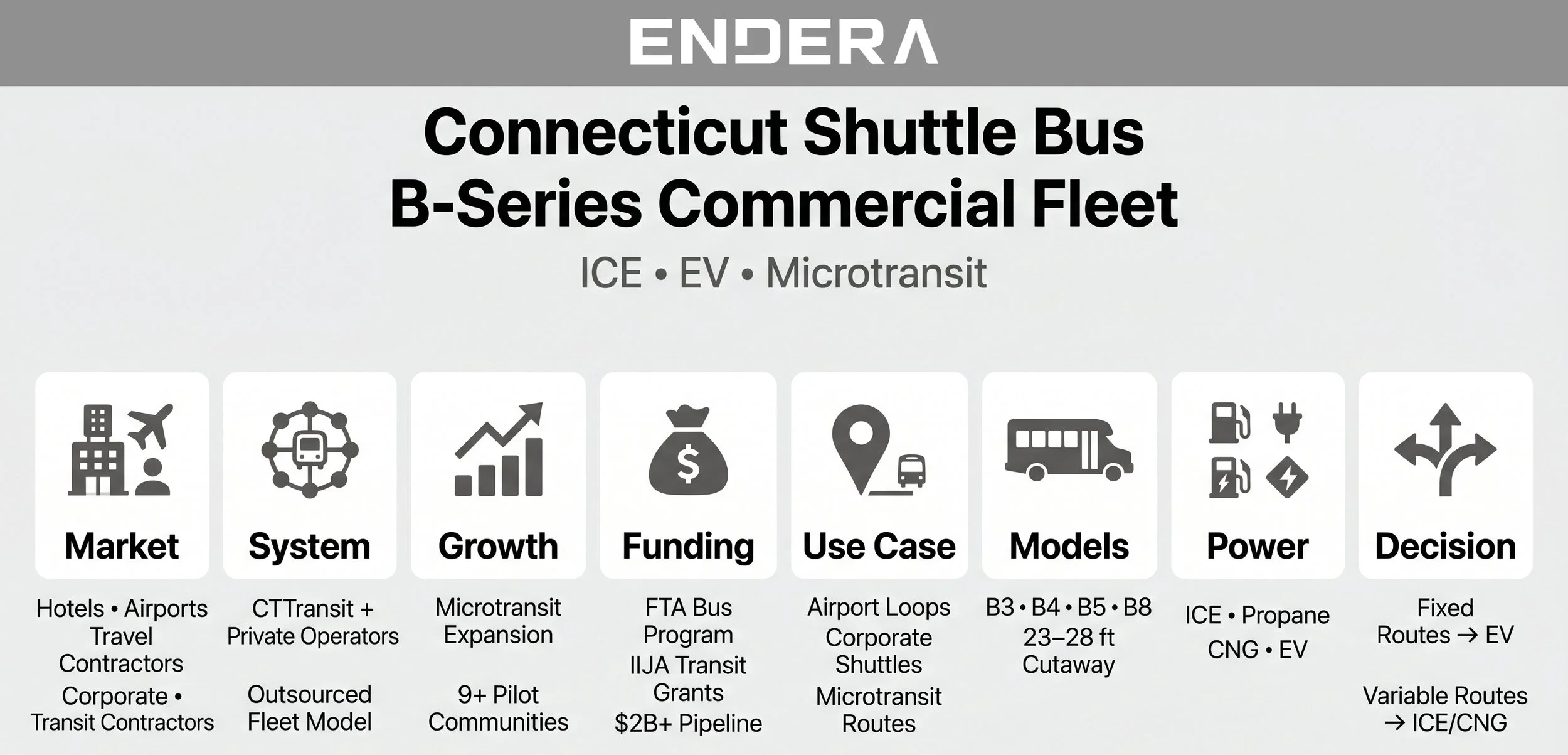
Connecticut's commercial shuttle market operates across a wider range of buyers than most states its size. CTTransit runs statewide service through multiple divisions and contracted private operators — meaning a significant portion of Connecticut's transit capacity is delivered by commercial fleet companies, not public agencies directly. That outsourcing model creates consistent demand for commercially built shuttle buses from private contractors, corporate transport providers, and institutional operators who need vehicles that meet professional-grade standards from day one.
Endera manufactures Class 4 B-Series commercial shuttles in ICE, propane, CNG, and full-electric configurations on Ford E450 and Chevrolet Express cutaway chassis. For Connecticut operators — whether running hotel loops, employee shuttles, or contracted transit routes — the B-Series is purpose-built for the daily cycle counts that van conversions can't sustain over a full service life.
Connecticut's contracted transit market has standards your shuttle needs to meet from day one — connect with an Endera fleet specialist today to find the right B-Series configuration for your operation.
Why Shuttle Bus Demand Is Growing in Connecticut
Connecticut's transit system covers 600-plus buses statewide, with approximately 60 buses procured annually through replacement cycling alone. That baseline procurement volume doesn't account for growth-driven purchases — and Connecticut's transit footprint is actively expanding.
The state has invested in microtransit pilot programs across more than nine communities, deploying smaller on-demand vehicles designed to close first-mile and last-mile transit gaps that fixed-route buses don't serve well. That use case maps directly to the B-Series format — vehicles sized for 8 to 25 passengers, dispatched on flexible or semi-fixed routes, with real-time tracking built in. Microtransit is expanding the market for mid-size commercial shuttles beyond traditional hotel and airport applications into a transit segment that's growing by design.
How Connecticut Fleets Pay for Shuttle Buses
Federal transit funding supports shuttle and cutaway bus purchases directly. The FTA Bus and Bus Facilities Program has distributed over $2 billion in recent funding rounds for bus acquisition and upgrades — covering cutaway buses, vans, and paratransit vehicles alongside full-size transit buses. Connecticut transit agencies and their contracted operators have consistently accessed this funding pipeline.
In 2025, the Connecticut Department of Transportation announced a $35.7 million federal grant for fleet and facility upgrades in the Windham region — one example of the ongoing capital investment flowing through Connecticut's transit system. Private operators holding transit contracts can often align fleet purchases with their agency partners' funding cycles, reducing net acquisition cost. Endera's financing and grant navigation services help commercial operators identify which federal and state programs apply to their ownership structure.
Connecticut Use Cases: Where the B-Series Fits
Connecticut's geography concentrates commercial shuttle demand around several distinct markets. Hartford's corporate corridor, New Haven's university cluster, and the I-95 hospitality corridor between Greenwich and Stamford each generate consistent shuttle demand across different buyer profiles.
Airports, Hotels, and Tourism
Bradley International Airport and the surrounding hospitality market anchor the largest segment of Connecticut's commercial shuttle use. The B4 (24 ft) covers airport parking loops and hotel transfers efficiently — enough capacity to reduce per-trip cost without the operational burden of a full transit bus. Electric B4 models are well-suited here: fixed routes and overnight depot charging make the daily operational math straightforward.
Corporate Campuses and Employee Transport
Financial services, insurance, and pharmaceutical operations in Hartford, Stamford, and New Haven generate ongoing demand for employee shuttle service. The B5 (25 ft) handles larger employee circuits with the same platform flexibility that makes it suitable for hotel operations — seating, ADA access, and configuration can be specified to the route rather than defaulted. Endera's Endera Dispatch software provides AI-powered routing and real-time GPS tracking built specifically for this type of multi-stop corporate operation.
Microtransit and Contracted Transit Routes
Contracted operators serving Connecticut's microtransit programs and demand-response routes need vehicles with commercial-grade durability, real-time tracking capability, and configurations that comply with state and federal transit standards. The B-Series is FTA-eligible and Buy America compliant — meeting the documentation requirements attached to federally funded contract vehicles without additional certification steps.
ICE vs. Electric: What Connecticut Shuttle Operators Are Choosing
Connecticut's transit fleet is approximately 10% electric as of recent reporting, with supply constraints and long delivery timelines slowing broader adoption. That ratio means ICE and hybrid shuttle buses remain the operational standard for most Connecticut commercial fleets — but the direction of procurement is clearly toward electrification for operators with the infrastructure to support it.
When Electric Makes Sense
Hotel and corporate shuttle operators running fixed daily routes with overnight depot access are the strongest candidates for electric B4 and B5 models. Connecticut's compact geography keeps most commercial routes well within daily range, and Endera's turnkey charging solutions — site assessments, DC fast charger procurement, metering installation — handle the infrastructure side without requiring operators to source those services separately.
When ICE Remains the Right Call
Operators with multiple depot locations, irregular daily routes, or procurement timelines that don't align with a charging buildout should consider ICE or CNG configurations as a current-cycle solution. All B-Series models share the same platform — standardizing on Endera now doesn't foreclose an EV transition on the next procurement cycle.
Connecticut Licensing and Compliance Requirements
Commercial passenger transport operators in Connecticut must meet state and federal licensing requirements. Drivers transporting passengers for compensation typically require a CDL with a passenger (P) endorsement. Operations running as motor bus carriers may require state certification from the Connecticut Department of Transportation in addition to standard vehicle registration and commercial liability coverage.
Endera's B-Series vehicles meet federal Motor Vehicle Safety Standards and are available in ADA-compliant configurations for operators serving accessible transport routes. For operators pursuing FTA-funded transit contracts, vehicles are Buy America compliant and carry the documentation required for federally funded procurement submissions.
The B-Series Lineup for Connecticut Operators
| Model | Length | Fuel Options | Best Fit |
|---|---|---|---|
| B3 | 23 ft | ICE | Hotel loops, small urban routes, microtransit |
| B4 | 24 ft | ICE & EV | Airport shuttles, campus loops, corporate transport |
| B5 | 25 ft | ICE & EV | Employee shuttles, contracted transit routes |
| B8 | 28 ft | ICE | High-demand municipal and group transport |
All models are built on Ford E450 and Chevrolet Express cutaway chassis, with body assembly and powertrain installation handled at Endera's Ottawa, Ohio manufacturing facility. Buyers receive a single warranty document — not split coverage from a chassis supplier and a separate body upfitter.
Ready to Spec a Shuttle for Your Connecticut Fleet?
Several 2026 B-Series units are available for immediate delivery through Endera Stock, including flat-floor ADA-configured models and standard passenger layouts. For operators working within formal procurement processes or contract bid requirements, Endera provides full specification documentation and compliance materials.
Connecticut's contracted transit market has no patience for vehicles that fall short on day one. Contact Endera's sales team today to discuss fleet configuration, powertrain options, or financing for your operation.
Frequently Asked Questions
What shuttle bus sizes work best for Connecticut commercial operators?
The B4 (24 ft) is the most broadly applicable model for Connecticut's common use cases — airport loops, hotel transfers, and corporate routes. Operators needing higher capacity can step up to the B5 (25 ft) without significantly increasing operational footprint. The B3 (23 ft) suits tighter urban routes and microtransit applications where maneuverability matters more than passenger count.
Are there federal funding programs available for commercial shuttle bus purchases in Connecticut?
The FTA Bus and Bus Facilities Program funds cutaway and shuttle bus purchases for transit agencies and their contracted operators — covering vehicles, facilities, and related infrastructure. Private commercial operators outside transit contracts typically don't access FTA funding directly, but IIJA clean vehicle incentives and state programs are available for EV shuttle purchases. Endera's grant navigation services help identify the applicable pathway for a given operator's structure.
Does Connecticut's 2035 zero-emission school bus mandate affect commercial shuttle buyers?
The 2035 alternative fuel mandate and 2040 zero-emission requirement apply specifically to school buses — not commercial shuttle fleets. Commercial shuttle operators are not subject to those deadlines, though Connecticut's broader clean transportation policy direction makes EV readiness a prudent long-term planning consideration for operators with fixed routes and depot infrastructure.
What is microtransit and why does it matter for shuttle bus buyers in Connecticut?
Microtransit refers to on-demand or flexible-route transit service using smaller vehicles — typically 8 to 20 passengers — that fill gaps fixed-route buses don't serve efficiently. Connecticut has deployed microtransit pilots across more than nine communities, using contracted operators with commercially built shuttle vehicles. The B-Series format is well-matched to microtransit applications given its size, dispatch software compatibility, and FTA eligibility for contracted service.
Do B-Series shuttle buses require a CDL to operate in Connecticut?
Drivers transporting passengers for compensation in Connecticut typically require a CDL with a passenger (P) endorsement. The specific licensing requirement depends on the vehicle's GVWR, the number of passengers, and whether the operation is classified as a for-hire carrier under Connecticut DOT regulations. Operators should confirm requirements with the Connecticut DMV and DOT based on their specific operational structure.
How does Endera's Dispatch software benefit Connecticut shuttle operators specifically?
Endera Dispatch includes AI-powered routing, real-time GPS tracking, geofence management, and state-of-charge monitoring for EV units. For Connecticut microtransit and contracted transit operators, the geofence and routing tools align with the service area management requirements that transit contracts typically specify. Custom reporting dashboards are included at no additional cost — useful for operators reporting vehicle performance to transit agency partners.
What is the service life of a B-Series shuttle bus under Connecticut commercial use?
Purpose-built commercial shuttle buses on medium-duty cutaway chassis typically operate for 10 to 12 years under daily commercial use. That lifespan depends on route intensity, maintenance adherence, and cycle counts per day. Connecticut hotel and airport operators running 8 to 12 daily cycles can reasonably expect a full-term service life from a B-Series vehicle — versus van-based alternatives that accumulate structural fatigue faster under equivalent use.