
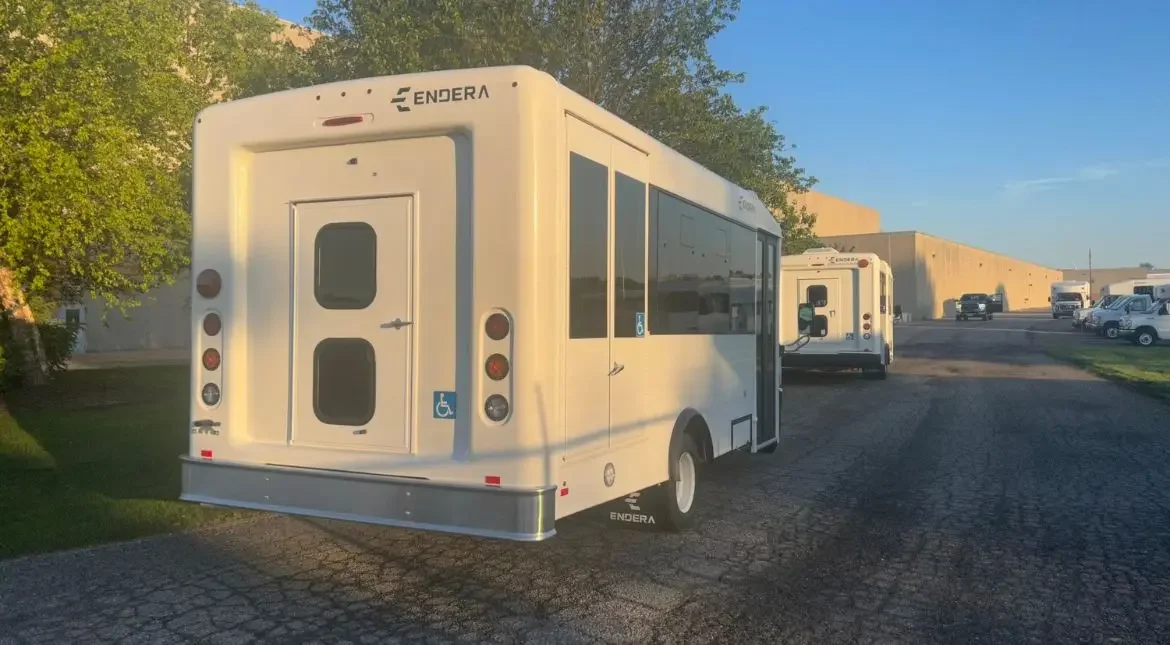
Missouri's shuttle market ranges from major metro operations in Kansas City and St. Louis to seasonal tourism routes in Branson and the Lake of the Ozarks. The state also has strong CNG and propane infrastructure, supported by the Missouri Alternative Fuels Commission, making alternative fuels a practical option for operators not yet ready to go fully electric.
Endera's B-Series — the B3, B4, B5, and B8, ranging from 23 to 28 feet — is built for exactly this range. ICE, propane, CNG, and full electric configurations are available on Ford E450 and Chevrolet Express cutaway chassis, manufactured at Endera's Ottawa, Ohio facility. Missouri's infrastructure already supports alternative fuels — your shuttle should too.
Talk to an Endera specialist today to match the right fuel type and model to your Missouri operation.
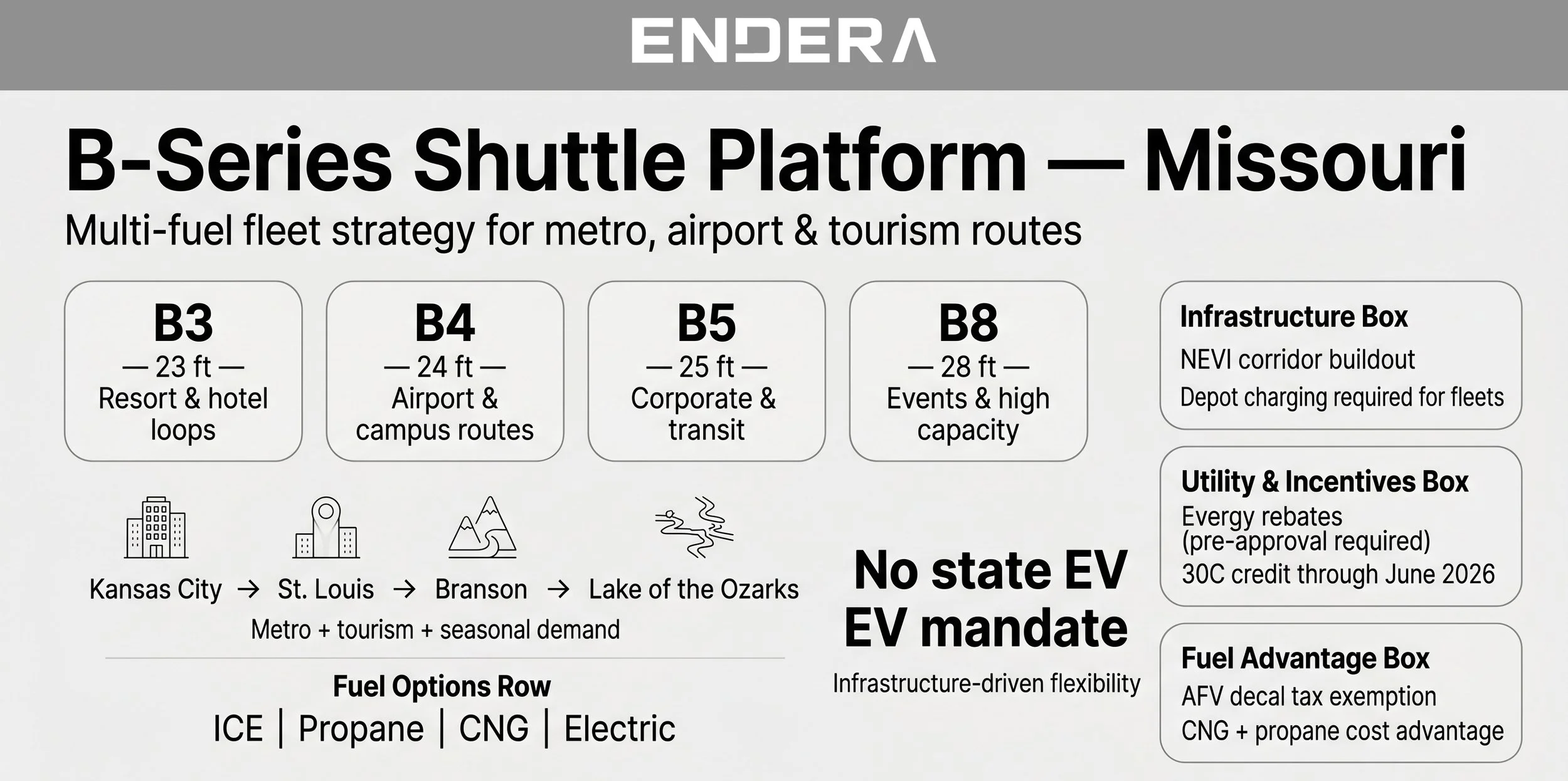
Missouri's Fleet Landscape: No Mandate, Practical Flexibility
Alternative Fuels Are Part of the Policy Fabric
Missouri has no statewide EV mandate for commercial vehicle fleets and no state-level vehicle purchase rebate. What the state does have is an active alternative fuel infrastructure — the Missouri Alternative Fuels Commission promotes CNG, propane, and electric vehicles as equivalent clean transportation tools, and state agency fleets are required to have 50% of new vehicle purchases be alternative fuel vehicles, with 30% of fuel used annually coming from alternative sources.
Missouri's motor fuel tax also does not apply to vehicles running on CNG, propane, or electricity that obtain an AFV decal — a practical operating cost advantage for commercial shuttle operators running alternative fuel configurations.
The Charging Infrastructure Picture in Missouri
Missouri has over 1,300 public EV chargers, mostly in Kansas City, St. Louis, and Springfield. Utilities like Evergy offer strong incentives, including $25,000–$65,000 rebates for fleet charging, while programs from Liberty Utilities support fleet and school bus electrification.
Outside major metros, charging is more limited, making depot-based charging essential for reliable EV operations.
The B-Series Lineup for Missouri Operations
Four Models for Missouri's Diverse Shuttle Markets
The B3 (23 ft) is a compact ICE model suited for resort loops, hotel shuttles, and tight urban routes. The B4 (24 ft) and B5 (25 ft) offer more capacity with ICE and electric options, ideal for university transit, airport transport, and corporate shuttles. The B8 (28 ft) is built for high-volume use like peak-season resorts, events, and busy municipal routes.
Chassis Coverage Across Missouri's Markets
All B-Series models are available on Ford E450 or Chevrolet Express cutaway chassis — platforms with broad dealer networks across Missouri, including smaller markets well outside the KC and St. Louis metros. For operators running routes in Branson, Springfield, or the Lake of the Ozarks area where a specialized bus service center isn't nearby, chassis serviceability through a regional Ford or GM dealer is a practical operational advantage.
Fleet Decision Framework: Missouri Routes and the Right Configuration
Matching the Vehicle to Missouri's Operating Environments
| Use Case | Recommended Model | Fuel Type | Why |
|---|---|---|---|
| Branson / Lake of the Ozarks resort loop | B3 / B4 | ICE or Propane | Seasonal, variable demand, cost-efficient |
| Airport ground transport (MCI, STL) | B4 / B5 | EV or ICE | Defined cycles; EV viable with depot charging |
| University transit (Mizzou, WashU, UMKC) | B4 / B5 | EV or CNG | Predictable schedules, campus infrastructure |
| Corporate campus (KC, St. Louis) | B4 / B5 | EV or ICE | Short defined routes, employer charging access |
| High-volume event / municipal | B8 | ICE / CNG | Maximum capacity, longer routes |
For Missouri operators at Kansas City International (MCI) or St. Louis Lambert (STL) running defined parking loop cycles, the electric B4 and B5 offer compelling long-term operating economics. Operators at San Diego International Airport, a comparable high-frequency deployment, have forecasted nearly $20,000 in annual savings per vehicle annually versus LPG or CNG. That figure scales meaningfully across a multi-vehicle Missouri airport fleet over a full service cycle.
Public Charging in Missouri vs. What Shuttle Fleets Actually Need
Corridor Coverage Doesn't Equal Depot Operations
Missouri's $98.9 million NEVI allocation is deploying charging infrastructure along designated alternative fuel corridors — primarily interstates — before expanding into local and community locations. That buildout supports long-distance travel reliability, but it doesn't address the operational requirements of shuttle fleets running fixed daily loops. NEVI stations are designed for transient use; shuttle fleets need consistent, controlled depot charging that aligns with dispatch schedules and doesn't depend on a public charger's availability or uptime on a given morning.
Depot Charging Is the Operational Foundation
For Missouri shuttle operators, reliable EV operations depend on depot-based charging, not public infrastructure. Even in major metros, public chargers can be inconsistent and disrupt service.
Endera’s turnkey depot charging services provide a controlled, reliable setup, while incentives like Evergy rebates (up to $65,000 per site) and the federal 30C credit can significantly reduce installation costs.
Why Missouri Fleets Miss EV Charging Rebates — And How to Actually Secure Them
Pre-Approval Is the Step Most Operators Skip
Evergy's fleet charging rebates — up to $65,000 per site — are often presented as straightforward cost savings. In practice, many Missouri operators fail to capture that value because the program is a structured process with strict sequencing, not a post-install reimbursement. The most common failure point is timing:
Evergy explicitly requires fleets to apply and receive pre-approval before installation begins. Any project that moves forward without that approval risks full disqualification, regardless of equipment quality or total spend. Even with pre-approval in hand, incentives only apply to qualified equipment configurations and metering setups — typically separately metered charging systems tied to specific rate plans — and the rebate is capped, not guaranteed.
Execution Complexity Is Where Projects Break Down
Fleet operators must manage a structured process—design, pre-approval, installation, verification, and payout—to secure incentives. Missing steps, using non-approved equipment, or changing scope can delay or cancel rebates. Costs like electrical upgrades and trenching are often not covered and must be planned upfront.
For Missouri operators, programs like Evergy’s require active project management, not passive savings. Endera’s team helps coordinate approvals, equipment, and installation to keep projects compliant and maximize rebate capture.
True Cost vs. Cash Flow Reality for Missouri Operators
Federal Programs After the 2025 Changes
The 45W commercial clean vehicle credit was eliminated for vehicles acquired after September 30, 2025. The 30C charging equipment credit — up to $100,000 per installed charging port — remains available through June 30, 2026 and is the most actionable near-term federal tool for Missouri operators planning depot charging installations. Equipment must be physically placed in service by that date, not just purchased or permitted.
For Missouri operators in the Kansas City and St. Louis metros who qualify for Evergy's fleet charging rebate, stacking that rebate with the 30C credit before the deadline represents a meaningful combined infrastructure cost reduction.
Where CNG and Propane Make Sense in Missouri
For Missouri operators running longer routes, seasonal operations in Branson or the Lake of the Ozarks, or fleets without centralized depot charging infrastructure, CNG and propane remain practical and policy-supported choices.
The state's motor fuel tax exemption for AFV decal holders directly reduces operating costs. CNG in particular is accessible in Missouri's major markets and benefits from the Alternative Fuels Commission's ongoing promotion of natural gas as a bridge fuel. Endera's financing team can model the full lifecycle cost across fuel types for Missouri operators given their specific route profiles, seasonal demand patterns, and infrastructure access.
Manufactured in Ohio, Serving Missouri's Central Markets
Domestic Supply Chain, Predictable Lead Times
Every B-Series shuttle is manufactured at Endera's 250,000-square-foot Ottawa, Ohio facility, with approximately 65% of components sourced from within Ohio. Missouri's central location in the country means delivery from Endera's Ohio facility is among the most geographically straightforward of any state in this article series — a practical lead time advantage for operators working within defined seasonal or budget-cycle deployment windows. The domestic supply chain also supports Buy America compliance for Missouri operators accessing federal transit funding.
Fleet Software for Missouri's Operating Environments
Every Endera commercial shuttle comes available with Endera Dispatch for real-time vehicle tracking, route performance data, and EV state-of-charge monitoring, alongside Endera Go for passenger-facing shuttle location and ETA updates. For Missouri hospitality operators managing high-frequency seasonal routes at Branson resort properties, and for airport and corporate operators where on-time performance directly affects guest and employee experience, that operational visibility removes guesswork from daily fleet management.
The Right Shuttle for Missouri, Built Without Compromise
Missouri fleet operators need vehicles that handle the state's range of operating environments — from Branson resort loops to Kansas City corporate campuses — and come from a manufacturer that supports every fuel path rather than pushing a single technology decision. The B-Series delivers across four models, four fuel types, and two chassis options, with fleet software, financing support, and grant coordination to back every purchase.
Missouri routes don't all look the same — your fleet configuration shouldn't either. Talk to an Endera specialist today to find the right B-Series configuration for your operation.
FAQs
Which B-Series models are available for Missouri operators?
All four models — B3 (23 ft), B4 (24 ft), B5 (25 ft), and B8 (28 ft) — are available in Missouri in ICE, propane, CNG, and electric configurations depending on model. Contact Endera's sales team for current availability and lead times.
Does Missouri have state EV incentives for fleet purchases?
Missouri has no state-level vehicle purchase rebate. The most significant financial tools are Evergy's fleet charging rebates (up to $65,000 per site, pre-approval required), the federal 30C charging equipment credit (through June 2026), and the AFV decal motor fuel tax exemption for CNG, propane, and electric vehicles.
Does Missouri's AFV decal program apply to electric shuttle buses?
Yes. Missouri's motor fuel tax does not apply to vehicles operating on alternative fuels — including electricity, CNG, and propane — that obtain an AFV decal. This reduces operating costs for operators running alternative fuel configurations.
What chassis options are available in Missouri?
All B-Series models are available on Ford E450 and Chevrolet Express cutaway chassis, serviced through dealer networks across Missouri including smaller markets outside KC and St. Louis.
Do Endera shuttles comply with Buy America requirements?
Yes. With approximately 65% of components sourced domestically, Endera's manufacturing supports Buy America compliance for federally funded Missouri procurement contracts.
Can I get an in-stock 2026 shuttle for fast delivery in Missouri?
Yes. Endera Stock lists ready-to-deliver 2026 models available for rapid deployment without a custom build lead time.
How do I get pricing or a spec sheet for Missouri fleet purchases?
Spec sheets and floor plans are available on Endera's shuttle bus page. For pricing and configuration discussions, contact Endera at hello@enderacorp.com or call +1 (419) 523-3593.