
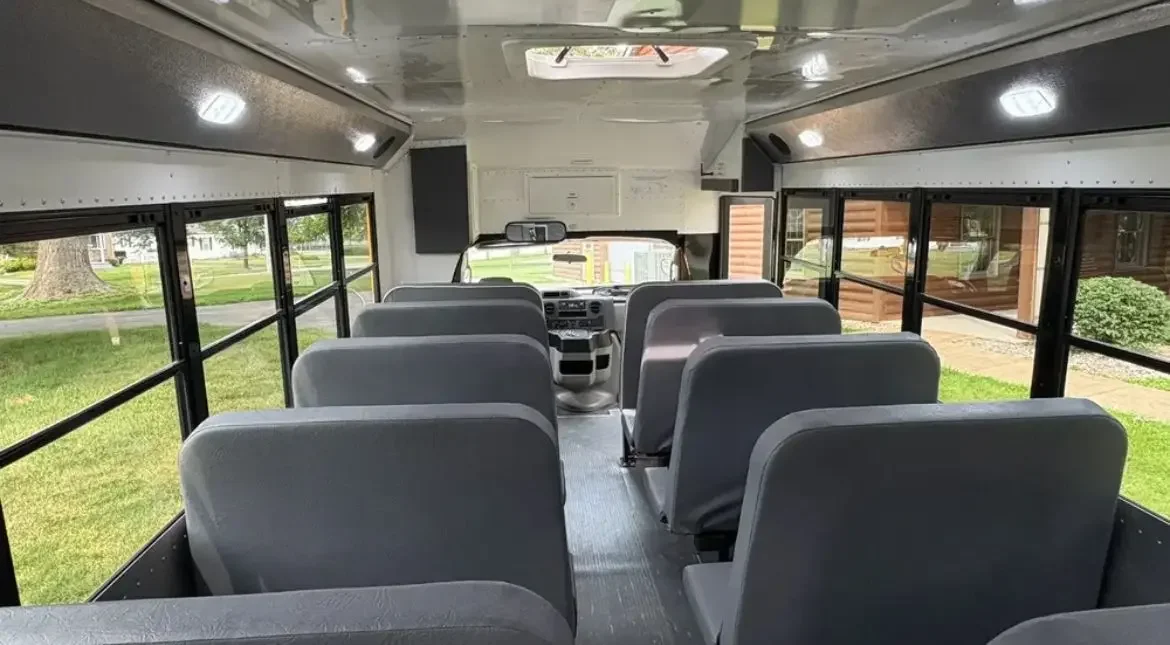
If you need a small school bus that fits your routes without the waste of running a half-empty full-size, Endera's Type A lineup was built for exactly that. The Endera 4, 5, and 6 seat 14 to 30 passengers, come in gas, propane, CNG, or full electric configurations, and are manufactured start-to-finish in Ottawa, Ohio on Ford and Chevrolet cutaway chassis.
Every model is available in 4- to 6-section floor plans, so seating, wheelchair accessibility, and storage can be configured to match your district's specific needs.
Ready to find the right fit? Contact Endera's sales team today to confirm availability and walk through configuration options.
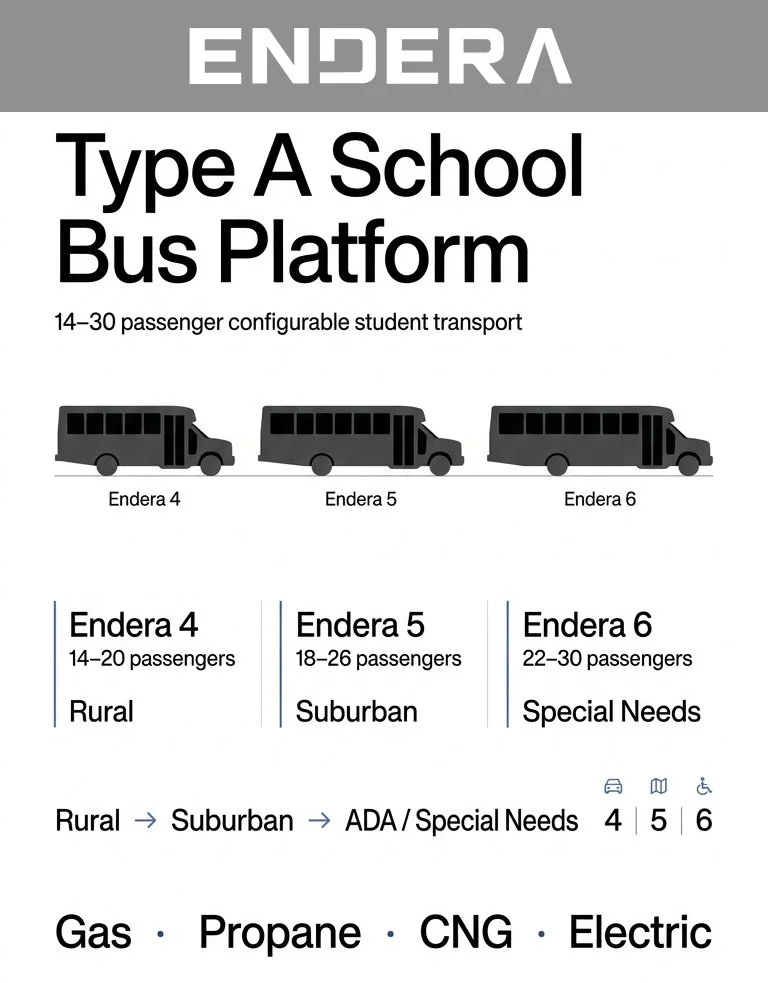
Fleet Decision Framework: Matching the Bus to the Route
Start With the Route, Not the Vehicle
Most short school bus pages lead with passenger counts and floor plans. But research on student transportation efficiency shows that the best fleet decisions are driven by ridership demand, route geography, and accessibility requirements — not vehicle size alone. Route length, stop frequency, and the specific needs of the student population are the key variables when selecting vehicle type and technology. A bus that's too large for a rural spur route wastes fuel and budget; one that's too small creates service gaps and overcrowding.
Three Models, One Goal: The Right Bus for Your Route
Choosing a short school bus starts with your route, not a spec sheet. The number of students you're moving, the roads you're covering, and whether you need ADA-accessible layouts should drive the decision. Here's how Endera's three Type A models map to common use cases:
| Use Case | Recommended Model | Fuel Type | Why |
|---|---|---|---|
| Rural low-ridership routes | Endera 4 | ICE / Propane | Smaller capacity, flexible fuel, lower operating cost |
| Suburban mixed routes | Endera 5 | ICE or EV | Mid-range capacity with full accessibility options |
| Special needs / ADA routes | Endera 6 | EV / CNG | Maximum configuration flexibility and zero-emission comfort |
Low-ridership rural routes benefit from smaller, fuel-flexible configurations that avoid unnecessary capital cost and keep operating expenses lean.
Mixed suburban routes are well served by the mid-range Endera 5, which balances capacity with ADA accessibility options and multi-fuel availability.
Special needs and dedicated ADA routes demand maximum configurability and the quietest, cleanest ride possible — where electric powertrains deliver the greatest benefit for vulnerable student populations.
Compare configurations → https://www.enderamotors.com/contact-departments
The Endera Type A Lineup: Three Models, Total Customization
Built for the Students Who Need It Most
The Endera 4, 5, and 6 are Type A school buses — the category designed for specialized student transport, smaller districts, and routes where a full-size bus simply isn't the right tool. Each model is available in 4 to 6 section configurations, meaning districts can tailor seating capacity, storage layout, and accessibility features to match the exact demands of their routes. This isn't a one-size-fits-all product with cosmetic variations — it's genuine configurability built into the manufacturing process.
Safety That Exceeds Industry Standards
Every Endera Type A is engineered to exceed the highest industry safety standards for structural integrity and student protection. The vertical integration at Endera's Ottawa facility means that safety engineering isn't an afterthought applied at a separate body-building shop — it's baked into the design from the first weld. From reinforced body structure to high-visibility design elements, these buses are built around the premise that the students riding them are the most important cargo on the road.
ICE, Propane, CNG, or Electric — Every District Is Different
No Mandate, No Pressure — Just Options
Endera offers all four fuel types across the Type A lineup: gasoline (ICE), propane, compressed natural gas (CNG), and full electric.
That flexibility reflects the reality of school district procurement — not every district has EV charging infrastructure in place, and not every state has grant programs mature enough to offset the upfront cost of electrification today. Districts can start with propane or CNG as a cleaner bridge fuel and add electric buses as funding and infrastructure allow.
Why Electric School Buses Are Worth the Conversation
The case for electric school buses goes beyond fuel savings. Diesel exhaust is a classified carcinogen, and students sitting near the tailpipe during loading and unloading face repeated low-level exposure every school day. Electric buses eliminate that exposure entirely — and with federal programs like the EPA Clean School Bus Program offering significant grant funding, the total cost of ownership for an electric Type A is increasingly competitive with traditional ICE alternatives.
Total Cost of Ownership: What Your Bus Really Costs Over 10+ Years
The Purchase Price Is Only the Beginning
When evaluating a short school bus, sticker price is only part of the equation. What matters more is total cost of ownership (TCO) — the combined cost of buying, fueling, maintaining, and operating the vehicle over its full lifecycle. According to the World Resources Institute, TCO analysis is essential for school districts because upfront costs alone often misrepresent long-term financial impact. The cheapest bus at purchase is rarely the cheapest bus over time.
Electric Wins the Long Game
A simplified comparison makes the tradeoffs clear:
| Factor | ICE | Propane | CNG | Electric |
|---|---|---|---|---|
| Upfront cost | Low | Medium | Medium | High |
| Fuel cost | High | Lower | Lower | Lowest |
| Maintenance | Medium | Lower | Medium | Lowest |
| 10-year TCO | — | — | — | Often lowest |
The Electric School Bus Initiative notes that electricity is cheaper and more stable than diesel, and maintenance costs are significantly reduced thanks to fewer moving parts and no oil changes or exhaust systems to service. Research also shows that regenerative braking — standard in electric buses — reduces brake wear and lowers maintenance expenses over time, with lifecycle analyses finding electric buses can deliver hundreds of thousands of dollars in reduced total ownership cost compared to diesel over a typical service life. Importantly, smaller Type A buses are particularly well-suited for electrification: their lighter weight and shorter routes require smaller battery packs, improving efficiency and accelerating return on investment.
Built in Ohio, Backed by American Manufacturing
A Domestic Supply Chain That Delivers
Every Endera Type A is produced at the company's 250,000-square-foot Ottawa, Ohio facility, with approximately 65% of components sourced from within the state. That domestic manufacturing base matters for school districts in a very practical way: it supports compliance with Buy America requirements that govern many state and federal transit funding programs, and it means shorter lead times and more reliable parts availability than vehicles assembled from international supply chains.
Software, Grants, and Everything That Comes After the Sale
Fleet Management Built for School Transportation
Every Endera school bus comes available with access to Endera's fleet management platform. Endera Dispatch gives transportation directors real-time visibility into vehicle location, performance data, and — for EV operators — state-of-charge monitoring that ensures no bus runs short on a route. The software is purpose-built for transportation operators, not adapted from a generic commercial telematics tool, which means the data it surfaces is actually useful for the decisions school transportation teams make every day.
Navigating the Grant Landscape So You Don't Have To
Federal and state funding for electric school buses has expanded significantly in recent years, but the application process can be a barrier for smaller districts without dedicated grant staff. Endera's financing and advisory team helps districts identify and secure funding from programs including the EPA Clean School Bus Program, HVIP, and a range of state-level incentives — tapping into more than $20 billion in available EV subsidies. From direct financing to capital leasing to grant management, the goal is to make the path to a new fleet as straightforward as the buses themselves.
The Short School Bus Your District Has Been Looking For
The right Type A school bus isn't the cheapest one in the catalog or the one with the longest spec sheet. It's the one that fits your routes, serves your students safely, and comes from a manufacturer with the depth to support it for the long haul. The Endera 4, 5, and 6 are built to be exactly that — configurable, safe, fuel-flexible, and backed by a team that treats the sale as the beginning of the relationship, not the end.
Contact Endera's sales team to find the right Type A configuration for your district.
FAQs
What is a Type A school bus?
A Type A school bus is a smaller, conversion-style bus built on a cutaway van chassis — typically used for special needs transport, rural low-ridership routes, and smaller school districts. Endera's Type A lineup includes the Endera 4, 5, and 6, available in both ICE and electric configurations.
How many passengers do Endera Type A buses carry?
The Endera 4, 5, and 6 support 14 to 30 passengers depending on configuration. Each model offers 4 to 6 section options for seating, accessibility features, and storage — allowing districts to match capacity precisely to their ridership.
Are Endera school buses ADA compliant?
Yes. Endera Type A buses can be configured with ADA-compliant wheelchair lifts and accessible seating layouts, making them well suited for special needs and mobility-impaired student transport.
What chassis do Endera Type A buses use?
The Endera 4, 5, and 6 are available on both Ford and Chevrolet cutaway chassis, giving districts flexibility in their procurement and service preferences.
Does Endera offer electric school buses?
Yes. All three Type A models — the Endera 4, 5, and 6 — are available in full electric variants. Electric school buses eliminate diesel exhaust exposure for students and qualify for significant federal and state grant funding through programs like the EPA Clean School Bus Program.
How does Endera help with school bus grant funding?
Endera's financing team assists districts in identifying and applying for federal, state, and local EV incentives. This includes EPA grants, California's HVIP, and other programs — handling the paperwork so districts can focus on students, not bureaucracy.
Where are Endera school buses manufactured?
All Endera Type A school buses are manufactured at the company's facility in Ottawa, Ohio — supporting Buy America compliance and a domestic supply chain that ensures consistent parts availability and shorter lead times.