
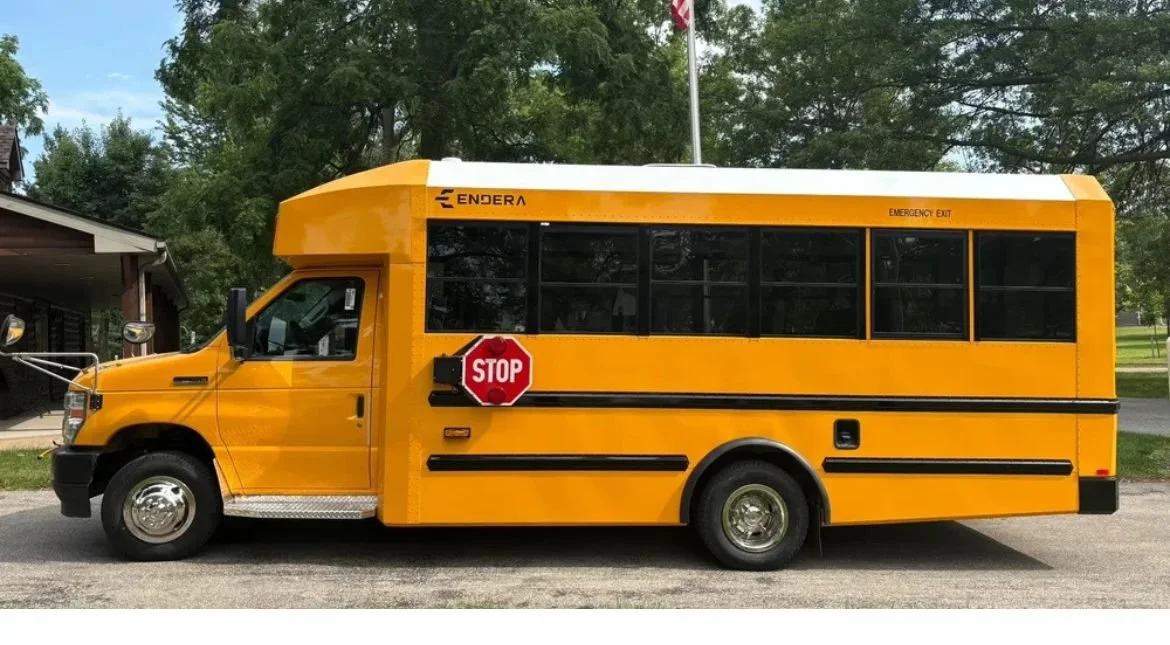
School bus procurement decisions rarely get made in a vacuum. Districts, private schools, churches, and transportation contractors are weighing purchase price against lead time, fuel costs against grant eligibility, and long-term maintenance against the risk of buying from a manufacturer with no service presence nearby. The difference between a sound procurement and a regrettable one usually comes down to who built the bus, where, and whether they'll still be around when something needs fixing.
Endera manufactures 2026 Type A school buses factory-direct from a 250,000-square-foot facility in Ottawa, Ohio — the only American vertically integrated OEM building both EV and ICE school buses under one roof. Their Type A school bus lineup covers gasoline, propane, CNG, and electric configurations, with ADA-compliant customization available across all models.
Ready to move on your next procurement? Contact Endera's sales team today to discuss specs, lead times, and available funding.
What Is a Type A School Bus?
A Type A school bus is defined under federal classification as a vehicle with a gross vehicle weight rating (GVWR) of up to 14,500 lbs (Type A-1) or between 14,501 and 21,500 lbs (Type A-2), built on a cutaway van or forward-control chassis and designed to carry more than 10 passengers. According to the Head Start transportation guidelines published by HHS, Type A buses are distinct from Type B, C, and D classifications based on this chassis architecture and weight range — not simply passenger count.
In practice, the Type A classification covers the compact, maneuverable end of the school bus market. These vehicles run narrower urban streets, shorter suburban routes, and specialized transport assignments where a full-size Type C or D bus would be impractical. They're the standard choice for special education programs, daycare centers, assisted living facilities, and smaller districts running routes with lower ridership.
2026 Endera Type A School Bus Models
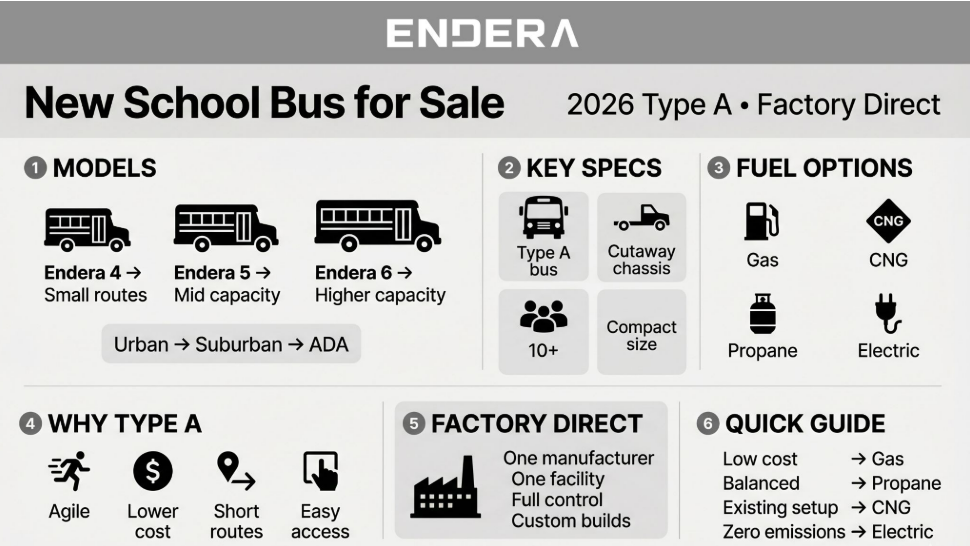
Endera produces three Type A school bus configurations — the Endera 4, 5, and 6 — built on Ford E450 and Chevrolet Express cutaway chassis. Each model is available with 4 to 6 section configurations, covering seating layouts, ADA-compliant lift options, and storage. Powertrain choices span gasoline, propane, CNG, and full electric across the lineup.
The Endera 4 suits smaller rosters and tighter routes. The 5 and 6 scale up for higher capacity without crossing into Type B or C territory. All three are engineered to exceed federal structural integrity standards — specifically the rollover protection thresholds outlined under FMVSS 220 and the compartmentalized seating requirements of FMVSS 222. For districts submitting to state bid processes, Endera builds to comply with procurement spec requirements across multiple states, including those with stricter brake, lighting, and structural mandates.
Gas vs. Propane vs. CNG vs. Electric: Which Fuel Type Is Right?
The fuel type decision shapes not just operating costs but procurement eligibility, maintenance complexity, and long-term fleet strategy. Here's how each option stacks up for Type A buyers.
Gasoline
Gasoline carries the lowest upfront cost and requires no infrastructure changes. It's the straightforward choice for organizations running lower annual mileage or operating in areas without access to alternative fuel infrastructure. Parts availability is universal, and driver training requirements are minimal.
Propane (Autogas)
Propane reduces fuel costs by roughly 30–40% compared to gasoline in most markets, with lower tailpipe emissions and a mature fueling infrastructure across rural and suburban areas. Type A propane buses are popular with private schools and church fleets that run consistent routes but aren't ready for full electrification.
CNG (Compressed Natural Gas)
CNG delivers the lowest per-mile fuel cost of the combustion options in most fleet scenarios. The tradeoff is infrastructure: CNG requires on-site fueling stations or proximity to a public CNG network, which makes it best suited for districts or operators who already run CNG vehicles. Maintenance intervals are comparable to gasoline, with longer engine life in many documented fleet cases.
Electric
Electric carries the highest purchase price but the lowest total cost of ownership over a standard 10–12 year service life. The U.S. EPA allocated $5 billion under the Clean School Bus Program (2022–2026) specifically for electric school bus adoption — and Endera assists buyers in navigating those grants directly through their financing and grant navigation services.
SP+, the parking partner at San Diego International Airport, forecasts nearly $20,000 in annual savings per Endera EV compared to LPG/CNG equivalents. School districts operating on similar route patterns can expect comparable returns.
What Factory-Direct Actually Means for Buyers
"Factory-direct" is used loosely in the bus industry. In Endera's case, it means the entire manufacturing process — powertrain integration, body assembly, and software installation — happens at their Ottawa, Ohio facility. There is no separate upfitter involved. The chassis arrives from Ford or GM, and every subsequent step, including the proprietary all-electric powertrain on EV models, is performed in-house.
For buyers, this distinction matters in three ways. First, warranty responsibility is consolidated — there's no finger-pointing between a body builder and a powertrain supplier when something goes wrong. Second, lead-time visibility is more predictable because production isn't split across multiple facilities. Third, custom configurations — seating layouts, lift specifications, fuel type — can be adjusted earlier in the build process without the delays that come with multi-stage assembly. Buyers can reach the sales team directly at (419) 796-6080 to discuss configuration timelines.
CDL Requirements and Operational Fit
Under federal guidelines, a CDL is required to operate any bus designed to carry 16 or more passengers (including the driver), or any vehicle with a GVWR above 26,001 lbs. Most Type A-1 school buses fall below both thresholds, meaning many operators — including private schools, churches, and smaller transit contractors — can legally operate them with a standard driver's license, provided their state does not impose stricter requirements.
This is one of the practical advantages that makes Type A buses attractive for organizations that aren't running a full fleet operation. However, any vehicle transporting school-age children under a district contract will typically require a commercial driver's license regardless of vehicle weight under state school bus endorsement rules. Buyers should confirm their state's specific requirements with their DMV or state education transportation office before assuming CDL exemptions apply.
Ready to Buy? Here's How to Order
Endera in-stock vehicles are available for immediate delivery. Current stock includes 2026 Ford E450-based units (GVWR 14,500 lbs, gasoline) in 12+2 and 8+4 passenger flat-floor configurations with 800 lb Braun ADA lifts, plus a 14-passenger rear-luggage configuration. All units feature face-forward seating, non-slip flooring, and 70,000 BTU A/C.
For custom builds — including propane, CNG, or electric configurations — production lead times vary by specification and volume. Contact the Endera sales team to discuss configuration options, delivery windows, and available grant programs that may reduce net acquisition cost.
Frequently Asked Questions
How much does a new Type A school bus cost in 2026?
New Type A school bus pricing in 2026 ranges from approximately $45,000–$70,000 for gasoline and propane configurations, with electric models running higher before grant offsets are applied. Endera does not publish fixed pricing online due to the range of configuration options — contact their sales team at (419) 796-6080 for a quote based on your specific requirements. Federal and state incentives, including EPA Clean School Bus Program funding, can reduce the net cost of electric models substantially.
What is the difference between a Type A-1 and Type A-2 school bus?
A Type A-1 bus has a GVWR of up to 14,500 lbs; a Type A-2 falls between 14,501 and 21,500 lbs. Both are built on cutaway van or forward-control chassis, which distinguishes them from the larger Type B, C, and D classifications. Most Endera Type A models are in the A-1 range, built on the Ford E450 with a 14,500 lb GVWR.
Are there federal grants available for new school bus purchases?
Yes — the EPA's Clean School Bus Program allocated $5 billion from 2022 to 2026 specifically for replacing older diesel school buses with clean or zero-emission alternatives. Additional state-level incentives, including California's HVIP program, provide further rebates for electric school buses. Endera's financing team assists buyers in identifying and applying for eligible programs as part of the purchasing process.
Do Type A school buses require a CDL to drive?
Federal law requires a CDL for vehicles designed to carry 16 or more passengers or with a GVWR above 26,001 lbs. Many Type A-1 buses fall below both thresholds. However, state school bus endorsement rules frequently require a CDL regardless of vehicle size when transporting school-age children under a district contract. Buyers should verify state-specific requirements before relying on a CDL exemption.
What safety standards do 2026 Type A school buses meet?
Federal Motor Vehicle Safety Standards applicable to school buses include FMVSS 220 (rollover protection), FMVSS 222 (compartmentalized seating and crash protection), and more than 37 additional standards covering lighting, mirrors, emergency exits, and body structure. Endera engineers its Type A school buses to meet or exceed these federal standards, and builds to state procurement spec requirements for districts submitting competitive bids.
How long does it take to receive a custom-built Type A school bus from Endera?
Lead times for custom-built units depend on configuration complexity, powertrain type, and current production volume. In-stock gasoline models are available for immediate delivery. For propane, CNG, or electric custom builds, buyers should contact Endera's sales team early in the procurement cycle — particularly if purchase timing is tied to a district bid calendar or grant disbursement window.
What is the typical service life of a new Type A school bus?
Type A school buses in regular fleet service typically last 10–12 years before reaching end-of-life thresholds under Federal Transit Administration guidelines. Electric models may extend this range due to fewer moving parts in the drivetrain and lower mechanical wear. Endera's vertically integrated manufacturing means warranty coverage — available at enderamotors.com/warranty — spans the vehicle, powertrain, and associated systems under a single document rather than multiple overlapping claims.