
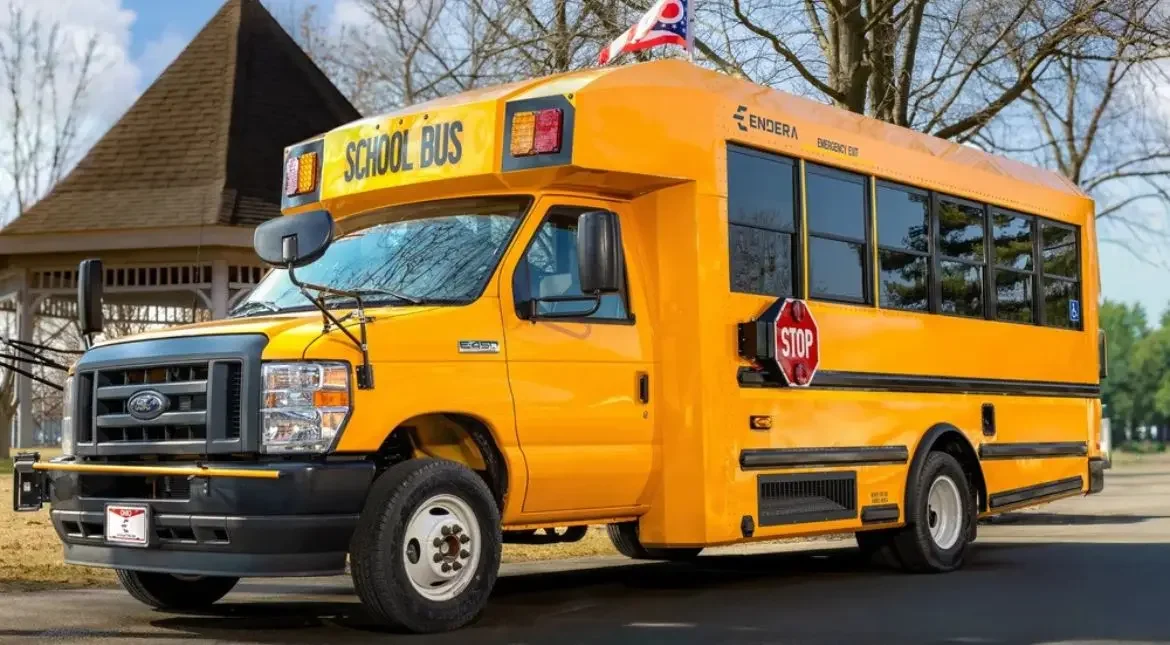
Choosing the wrong fuel type for a school bus purchase doesn't just affect emissions — it affects a district's budget, infrastructure readiness, and long-term replacement cycle. Type A school buses are the workhorses of small-district and special needs transport, and the powertrain decision carries consequences that outlast any single budget cycle.
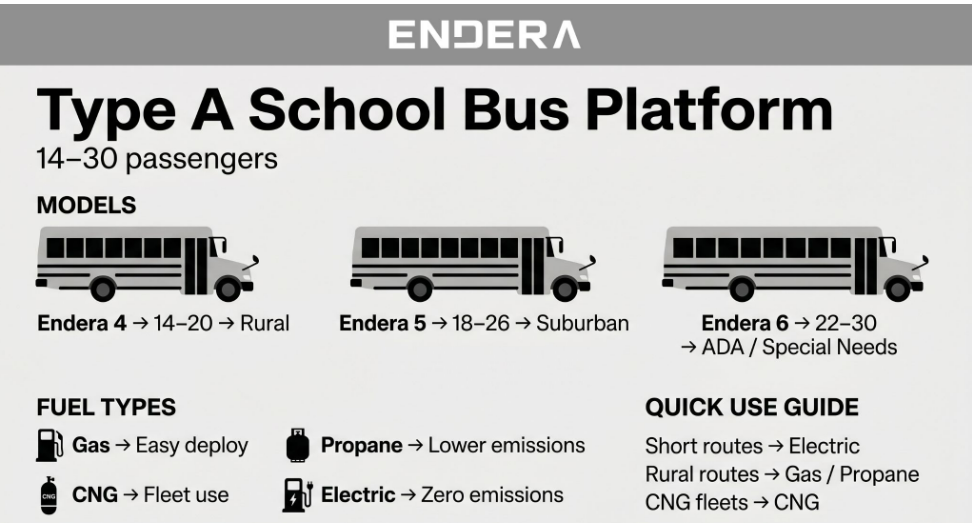
Endera manufactures Type A school buses in gasoline, propane, CNG, and electric configurations from a single vertically integrated facility in Ottawa, Ohio — the only American OEM doing so under one roof. For districts evaluating a purchase or fleet refresh, Endera's school bus lineup includes the Endera 4, 5, and 6 models in 4–6 section configurations, with ADA-compliant lift options and seating customized to route requirements.
Ready to optimize your routes? Contact Endera’s fleet specialists today to design a custom configuration blueprint for your district.
What Is a Type A School Bus?
A Type A school bus is built on a cutaway van chassis — typically a Ford E450 or Chevrolet Express — and is designed for routes where a full-size bus is impractical. According to Nevada's minimum school bus standards, Type A buses are divided into two weight classes: A-1 models at or below 10,000 lbs GVWR, and A-2 models above that threshold.
These buses typically seat between 16 and 36 passengers, making them the standard choice for special needs transport, rural routes, and smaller districts where a Type C or D bus would run underloaded. They cost less to operate per route than larger buses and are considerably easier to maneuver on narrow roads or tight school parking configurations.
How Type A Differs from Type C and Type D
Type C and D buses are built on full-size truck or transit chassis, designed for 40–90 passengers on longer, higher-volume routes. Type A buses serve the opposite end of the spectrum — shorter distances, smaller headcounts, and routes that require more vehicle agility than capacity.
For districts running mixed fleets, the distinction matters for procurement: Type A units qualify for separate federal funding streams and are subject to different FMVSS compliance requirements than their larger counterparts.
Fuel Type Comparison: Gas, Propane, CNG, and Electric
The four powertrain options Endera offers are not interchangeable — each carries distinct emissions profiles, infrastructure requirements, and lifetime cost structures. According to emissions analysis from the Electric School Bus Initiative, the differences between fuel types are significant enough to materially affect both health outcomes and operating budgets.
| Fuel Type | Tailpipe Emissions | Infrastructure Needed | Best For |
|---|---|---|---|
| Gasoline | Moderate NOx, CO₂ | Standard fueling | Easy deployment, rural districts |
| Propane | Lower NOx vs gas | Propane fueling station | Moderate emissions reduction |
| CNG | Lower NOx, higher VOC/CO | CNG fueling infrastructure | Fleets with existing CNG setup |
| Electric | Zero tailpipe | Depot DC fast charging | Short routes, sustainability mandates |
One detail most vendors don't disclose: propane and CNG are not zero-emission options. Propane produces lower NOx than gasoline but still emits CO and volatile organic compounds. CNG follows a similar pattern — reduced NOx but elevated VOC and CO in certain operating conditions. Electric is the only configuration that eliminates tailpipe emissions entirely, which matters most for student health on vehicles where passengers sit directly behind the engine compartment.
The Health Case for Electric
Diesel and gasoline exhaust exposure has been linked to measurable cognitive and respiratory impacts in children, according to research from the World Resources Institute's Electric School Bus Initiative. Electric buses eliminate tailpipe exposure on the vehicle entirely — a factor that is increasingly influencing purchasing decisions in districts under state air quality mandates.
For districts not yet ready to go fully electric, propane remains the most practical intermediate step: lower NOx than gasoline, widely available fueling infrastructure, and a lower upfront cost than EV configurations.
Which Fuel Type Is Right for Your District?
The right powertrain depends on three variables: route length, existing infrastructure, and budget structure. Research from the National Renewable Energy Laboratory found that the average school bus route covers roughly 25 miles daily, and that over 90% of U.S. fleets could be fully electrified with current battery technology without range limitations.
That said, electric is not the right answer for every situation. Districts without depot charging infrastructure, or those operating in areas without reliable grid access, may find propane or gasoline a more practical bridge. Endera's dual-track production — offering ICE and EV on the same platform — is designed specifically to meet districts where they are in that transition rather than forcing a premature commitment.
Decision Framework by Route and Fleet Type
Short urban or campus routes → Electric. Predictable mileage and depot charging make range a non-issue, and zero tailpipe emissions align with urban district sustainability requirements.
Rural or variable routes → Gasoline or propane. Easier refueling access and no charging infrastructure dependency.
Fleets with existing CNG infrastructure → CNG remains cost-effective if fueling stations are already in place, though it carries higher VOC output than propane.
Districts under electrification mandates → Electric is the only compliant path forward in states like California and New York, where zero-emission school bus requirements are already in effect.
Endera's Type A School Bus Configurations
Endera's school bus models — the Endera 4, 5, and 6 — are built on Ford E450 and Chevrolet Express cutaway chassis and are available across all four fuel types. Each model supports 4–6 section configurations, allowing districts to specify seating count, ADA-compliant lift placement, and storage layout at the factory level.
Because Endera designs, engineers, and assembles its buses at the Ottawa manufacturing facility rather than outsourcing body work to a third-party upfitter, customization is handled during production. This eliminates the specification drift that commonly occurs in multi-stage assembly and reduces post-delivery rework.
Powertrain and Charging Infrastructure
Endera's proprietary all-electric powertrain positions battery packs and high-voltage components within the frame rails, lowering the center of gravity and protecting cells in a collision. DC fast charging is standard on every EV unit. For districts new to fleet electrification, Endera also provides turnkey charging solutions including site assessments, standalone DC fast charger procurement, and metering system installation — without requiring costly grid upgrades.
Total Cost of Ownership and Available Funding
Purchase price is one line in a multi-year cost equation. Electric buses carry fewer moving parts than ICE vehicles, reducing maintenance costs over time, and depot charging rates run significantly lower than per-gallon gasoline or propane pricing per mile. Over a 10-year lifecycle, the operating savings often close — or reverse — the upfront cost gap.
The more consequential variable for most districts is grant access. Endera's grant navigation and financing services help districts tap over $20 billion in available federal, state, and local EV subsidies — including EPA Clean School Bus Program funding, California HVIP rebates, direct financing, and capital leasing. For many districts, that coverage eliminates the cost premium of electric over gasoline entirely.
Safety and Compliance
Every Type A school bus sold in the U.S. must meet Federal Motor Vehicle Safety Standards regardless of fuel type. Key standards include FMVSS 571.222, which governs passenger seating and crash protection, and FMVSS 571.217, which covers emergency exit requirements. Alternative fuel variants — propane, CNG, and electric — carry additional compliance requirements including fuel system crash integrity standards and, where applicable, fire suppression protocols.
Endera's Type A models are engineered to exceed industry structural integrity standards across all powertrain configurations. The company's Buy America compliance and FTA-eligible manufacturing status also simplify the procurement paperwork for districts accessing federal transit funding.
Get Your Fleet Spec'd
Districts evaluating Type A school buses can contact Endera's sales team to discuss powertrain selection, configuration options, and applicable grant programs. For districts on an accelerated timeline, in-stock vehicles are available for immediate delivery on 2026 Ford E450 chassis.
Frequently Asked Questions
What is a Type A school bus and who is it designed for?
A Type A school bus is built on a cutaway van chassis and seats between 16 and 36 passengers, divided into A-1 (≤10,000 lbs GVWR) and A-2 (>10,000 lbs GVWR) weight classes. It is designed for special needs transport, rural routes, and smaller school districts where full-size Type C or D buses would be impractical.
Is electric actually viable for most school bus routes?
Research from the National Renewable Energy Laboratory found that the average school bus route covers approximately 25 miles daily, and over 90% of U.S. fleets fall within the range capabilities of current electric bus technology. For districts with depot charging, range is rarely a practical limitation.
What's the real difference between propane, CNG, and electric emissions?
Propane and CNG both reduce NOx compared to gasoline but produce CO and volatile organic compounds during combustion — neither qualifies as zero-emission. Electric buses eliminate tailpipe emissions entirely, making them the only option that removes student exhaust exposure on the vehicle.
What federal funding is available for electric school buses?
The EPA Clean School Bus Program has directed billions toward replacing diesel and gasoline buses with zero-emission alternatives, and state programs like California's HVIP provide additional per-vehicle rebates. Endera's grant navigation services assist districts in identifying and applying for applicable funding across federal, state, and local sources.
Can Endera configure a bus to our district's exact specifications?
Endera's Type A models support 4–6 section configurations with options for seating count, ADA-compliant lift placement, and storage layout — all determined at the factory level. Because Endera assembles bodies in-house rather than using a third-party upfitter, custom builds don't carry the lead time penalties common in multi-stage assembly.
What are the FMVSS standards a Type A school bus must meet?
All Type A school buses must comply with FMVSS 571.222 for passenger seating and crash protection, and FMVSS 571.217 for emergency exit requirements. Propane, CNG, and electric variants carry additional fuel system crash integrity and fire suppression requirements specific to their powertrain.
Does Endera offer financing for school bus purchases?
Yes. Endera offers direct financing, capital leasing, and full grant management support for qualifying districts. The company helps clients navigate over $20 billion in available EV subsidies at the federal, state, and local level — including EPA and HVIP programs — reducing or in some cases eliminating the upfront cost difference between electric and ICE configurations.