
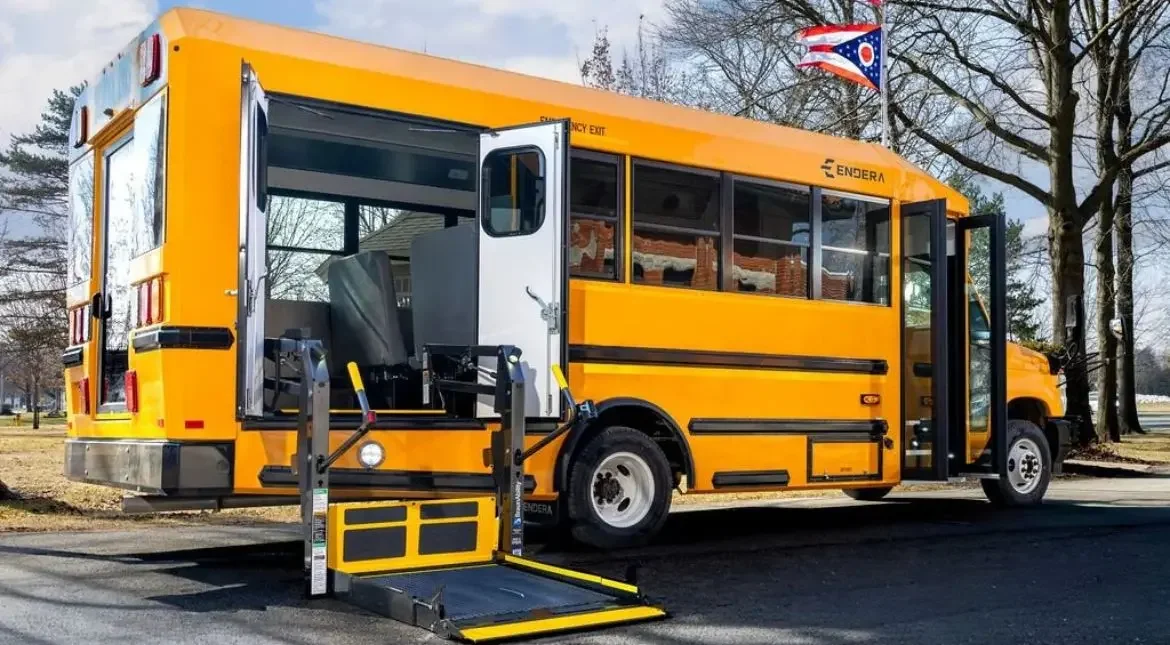
Florida school districts operate under a procurement framework that's more prescriptive than most buyers realize. The state governs what buses are built from, how they're certified for sale, and what equipment must be standard before a student boards. Buying the wrong bus isn't just a budget problem — it's a compliance failure.
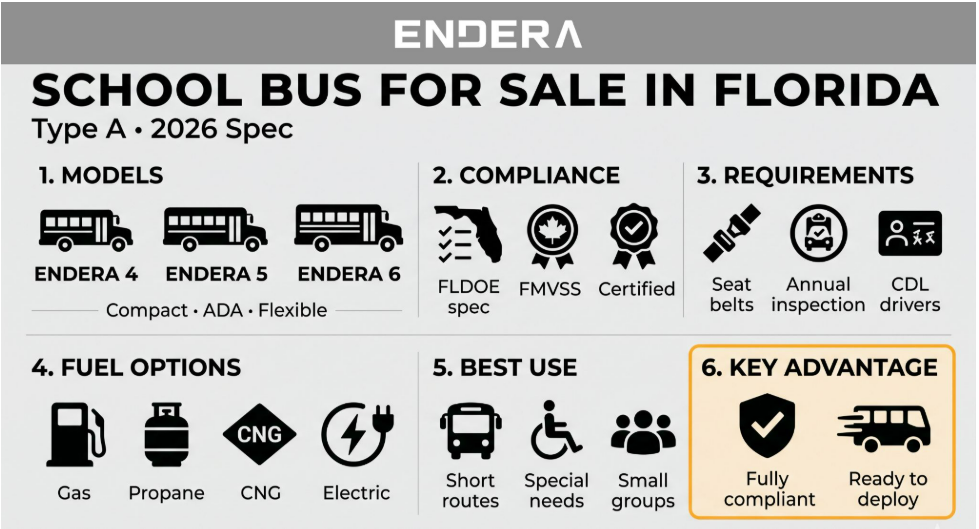
Endera manufactures Type A school buses in gasoline, propane, CNG, and electric configurations, engineered to meet the structural, safety, and equipment requirements set by the Florida Department of Education's 2026 school bus specifications. Their school bus lineup is available in multiple section configurations with ADA-compliant lift options across all powertrain types.
Ready to verify compliance before your next RFP? Contact Endera's sales team today to request spec documentation and confirm lead times.
What Florida's 2026 School Bus Specifications Require
Florida's school bus standards are among the most detailed in the country. Under Rule 6A-3.003, F.A.C., every school bus purchased by a public school board or charter school in Florida must meet three simultaneous requirements: the state's own 2026 specifications, all applicable Federal Motor Vehicle Safety Standards (FMVSS), and the 2025 National School Transportation Specifications — with Florida's rules taking precedence in any conflict.
For Type A buses specifically, the 2026 specs require a minimum 130-amp alternator, with higher capacity mandated when wheelchair lifts or air conditioning are installed. Florida builds upward from federal minimums, not alongside them — which means a bus compliant with FMVSS alone may still fall short of what's required for sale to a Florida district.
Who Can Sell a School Bus to a Florida School District
Not every manufacturer can simply sell into Florida's public school market. Under the certification requirement codified in Rule 6A-3.003, every school bus chassis and body manufacturer must certify in writing to the Florida Commissioner of Education that all vehicles offered for sale to public school systems meet or exceed all state standards and specifications.
This pre-sale certification requirement exists independently of any individual purchase order. A manufacturer that hasn't completed the certification process cannot legally sell new buses to Florida public school boards or charter schools — regardless of whether the vehicle is federally compliant. Buyers should confirm manufacturer certification status as a standard step in the RFP or procurement process.
Who Florida Law Requires to Be Transported
Understanding why Florida districts need buses — and what kinds — starts with the statute. Under Florida Statute §1006.21, school boards are required to provide transportation for elementary students living more than two miles from school, students on hazardous routes regardless of distance, and students in specific programs including special education and vocational placements.
That mandate creates consistent demand for Type A buses specifically. Special education routes, shorter-distance elementary runs, and smaller program-specific transport needs all align with the Type A's capacity range and maneuverability — particularly in Florida's mix of dense suburban corridors, coastal urban areas, and lower-density rural counties.
Seat Belt Requirements on Florida School Buses
Florida law is explicit on restraint systems. Under Florida Statute §316.6145, every school bus purchased new after December 31, 2000 must be equipped with safety belts or a federally approved restraint system in sufficient quantity for each student. Passengers on equipped buses are required to use them at all times while the vehicle is in operation.
The statute also establishes a priority allocation rule: school districts must prioritize routing seat belt-equipped buses to elementary schools first. For districts managing fleet replacements, this means newer purchases — including 2026 models — carry mandatory restraint equipment that affects route assignment, not just safety compliance.
Florida School Bus Safety and Inspection Standards
Florida requires annual safety inspections for all school buses operating in the state, conducted in accordance with FLDOE inspection standards and overseen through the FLDOE School Transportation office. Buses that fail inspection must be removed from service immediately — there is no provisional operation period while deficiencies are corrected.
For fleet procurement teams, this creates a practical argument for buying new rather than used. A used bus with deferred maintenance or out-of-spec equipment may pass a surface-level review but fail state inspection once placed in service — an outcome that disrupts routes with no easy short-term remedy.
Driver Certification in Florida
Florida school bus drivers must meet training, physical fitness, and certification requirements under Florida Statute §1012.45, including a valid Florida CDL with school bus and passenger endorsements. Districts are responsible for ensuring their drivers meet ongoing certification and recertification requirements.
These requirements apply regardless of vehicle size or powertrain type. An electric Type A bus and a gasoline Type C bus carry the same driver certification standard — which simplifies fleet transitions for districts that already have certified drivers in service.
New vs. Used School Buses in Florida: The Compliance Factor
The used school bus market in Florida is governed by a specific rule: used buses purchased by public school boards or charter schools must meet all federal and state requirements that were in effect on the date the vehicle was manufactured. This creates a moving target — older buses may have been compliant when built, but they predate Florida's 2000 seat belt mandate, the 2026 specifications, or updated FMVSS requirements.
New 2026 models eliminate that ambiguity entirely. Endera's in-stock vehicles are built to current Florida and federal spec, with seat belt systems, ADA-compliant lifts, and equipment configurations that meet 2026 standards out of the factory. For districts replacing aging units under procurement deadlines, that compliance certainty is often worth more than the upfront price difference between new and used.
Powertrain Options and Florida's Fleet Reality
Florida does not currently have a state-mandated EV transition timeline for school buses, which means districts are making powertrain decisions based on total cost, infrastructure readiness, and operational fit rather than regulatory deadline pressure. Gasoline remains the lowest-barrier entry point, and for districts running diverse route types across varying mileage profiles, it's often the practical default.
Propane and CNG offer meaningful per-mile fuel cost reductions where infrastructure is available, and Florida's warm climate removes the cold-weather range concerns that affect both battery and CNG performance in northern states. Electric models suit urban districts with consistent short routes and charging access. Endera's financing and grant navigation services include federal EPA Clean School Bus Program assistance for districts pursuing electric options.
Built for Florida Routes
Florida's geographic diversity — from Miami-Dade's dense urban grid to the rural route miles of the Panhandle — means no single bus configuration fits every district. Endera's Type A lineup covers the Endera 4, 5, and 6 in 4–6 section configurations, with ADA lift options, seating customization, and powertrain flexibility built into the same production platform. A district can spec a gasoline Endera 4 for a rural special ed route and an electric Endera 6 for an urban elementary run without changing manufacturers, service relationships, or warranty structures.
For procurement teams building RFP specifications or evaluating configurations against the 2026 Florida specs, contact Endera's sales team to request documentation and spec sheets.
Frequently Asked Questions
Does Florida require manufacturers to certify their buses before selling to school districts?
Yes. Under Rule 6A-3.003, F.A.C., every school bus chassis and body manufacturer must certify in writing to the Florida Commissioner of Education that all vehicles offered for sale to Florida public school systems meet or exceed all applicable state standards and specifications. This certification must be completed before any sale — it is not a post-purchase process. Procurement teams should request proof of certification as a standard step in any Florida school bus RFP.
What does Florida's 2026 school bus specification add beyond federal FMVSS requirements?
Florida's 2026 specs incorporate the 2025 National School Transportation Specifications as a baseline and then layer additional state-specific requirements on top. For Type A buses, this includes a minimum 130-amp alternator requirement, with mandatory upgrades when ADA lifts or air conditioning are installed. Where Florida's rules conflict with national specs, the state requirements prevail — making Florida standards effectively stricter than the federal floor in several equipment categories.
Are seat belts required on all school buses in Florida?
Under Florida Statute §316.6145, all school buses purchased new after December 31, 2000 must be equipped with safety belts or a federally approved restraint system for every student. Passengers on equipped buses are required to use them while the vehicle is in operation. Districts must also prioritize routing seat belt-equipped buses to elementary schools first, which affects how new purchases are integrated into existing fleet assignments.
Does Florida have any EV incentives or mandates for school buses?
Florida does not currently have a state-mandated zero-emission timeline for school bus fleets, unlike California's 2035 deadline. Incentives are available at the federal level — the EPA's Clean School Bus Program has allocated $5 billion nationally for electric school bus replacements, with Florida districts eligible to apply. Endera's grant navigation team assists Florida buyers in assessing federal program eligibility as part of the purchasing process.
What happens if a used school bus fails Florida's annual inspection?
Buses that fail Florida's annual safety inspection must be removed from service immediately. There is no provisional operation window while deficiencies are addressed. For districts managing tight routing schedules, a failed inspection on a recently purchased used bus can cause immediate service disruption — which is one of the primary operational arguments for purchasing new vehicles built to current specifications.
Can private schools in Florida purchase and operate Type A school buses?
Yes, with conditions. Under Florida Statute §316.615, certain capacity school buses owned, operated, or leased by nonpublic schools are required to meet the state specifications prescribed by the FLDOE. Private schools operating buses that meet the size threshold for "school bus" classification under Florida law must comply with the same construction and equipment standards as public district buses, including the seat belt requirements under §316.6145.
How does Florida's route mandate affect which bus size a district should buy?
Florida Statute §1006.21 requires transportation for elementary students beyond two miles, hazardous route students regardless of distance, and students in special programs. Many of these populations — particularly special education and smaller program placements — are transported in groups that fit within Type A capacity ranges. Districts building or expanding fleets for these specific statutory obligations often find Type A models more cost-efficient than larger buses that run under capacity on the same routes.