

Airport ground transportation is one of the most demanding operating environments a shuttle bus will face. Vehicles run continuous loops around the clock, seven days a week, with no tolerance for downtime and passengers who are already stressed before they board. Finding an airport shuttle bus for sale that holds up under those conditions — reliably, year after year — is a different challenge than buying for a hotel loop or university campus.
Endera's B-Series was built with this operating profile in mind. The B4 and B5 are proven in live airport deployments — including at San Diego International Airport, where SP+'s electric fleet has forecasted nearly $20,000 in annual savings per vehicle compared to LPG or CNG models.
Ready to spec a shuttle built for airport demands? Contact Endera's fleet specialists today to discuss configuration and deployment timelines.
Fleet Decision Framework: Matching the Shuttle to the Airport Mission
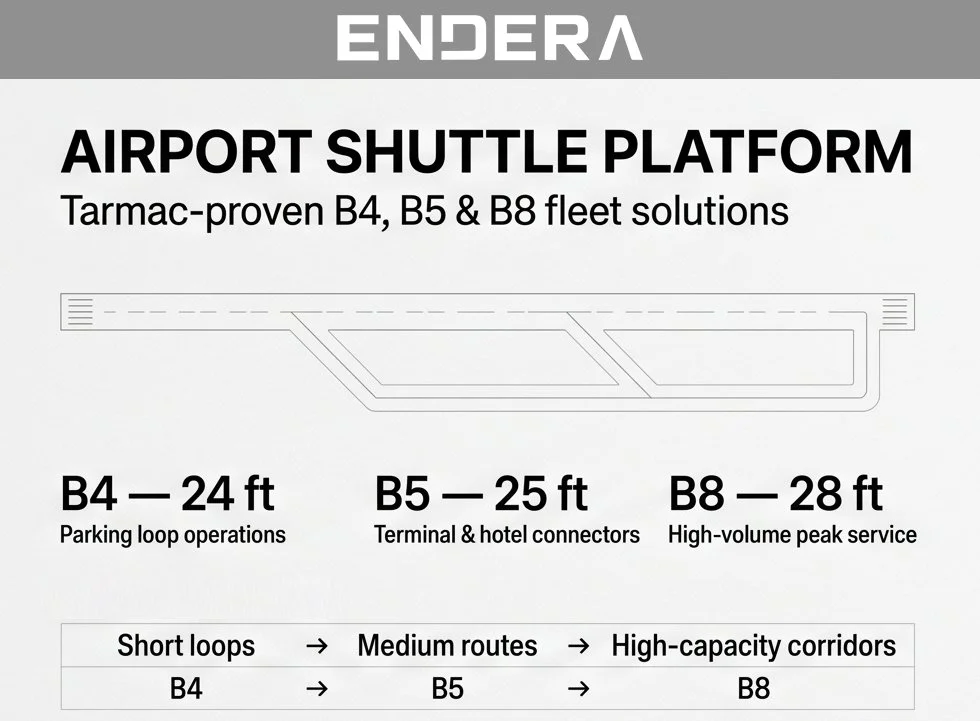
Airport Routes Are Not All the Same
A rental car facility shuttle running 400-meter loops all day has almost nothing in common with a hotel connector covering three miles of surface roads through airport traffic. Research on high-frequency transit operations consistently shows that vehicle selection should be driven by route length, cycle time, passenger volume, and utilization rate — not simply vehicle size or fuel type. Getting this match wrong means either overspending on capacity you don't need or running a vehicle into the ground trying to meet demand it wasn't sized for.
A Practical Framework for Airport Fleet Buyers
Instead of asking "What airport shuttle should I buy?", the better question is: "What vehicle best fits my route cycle, passenger load, and utilization profile?" That reframe turns a complex purchasing decision into a structured, data-driven one — and prevents the kind of costly mismatch that shows up six months into operation when you're already locked into a contract.
| Use Case | Recommended Model | Fuel Type | Why |
|---|---|---|---|
| Parking lot / rental car loops | B4 (24 ft) | Electric | Short cycles maximize EV efficiency and savings |
| Hotel & off-site connector | B5 (25 ft) | Electric or ICE | Higher capacity for varied passenger loads |
| High-volume terminal transfer | B8 (28 ft) | ICE / CNG | Maximum capacity for peak-hour surges |
| Mixed or transitional fleet | B4 + B5 combo | EV + ICE | Flexibility across route types during EV transition |
Short, high-frequency loops are the ideal use case for electrification — consistent utilization and predictable distances mean smaller battery packs work harder and return on investment accelerates faster.
Off-site connectors covering longer distances benefit from the B5's higher capacity and the option to choose ICE or EV depending on charging infrastructure availability at remote pickup locations.
High-volume terminal routes at major hubs may require the B8's 28-foot capacity to maintain service levels during peak travel windows without running vehicles over capacity.
The B-Series Airport Lineup: Proven Where It Counts
The B4 — The Workhorse of Airport Parking Operations
The B4 is a 24-foot shuttle available in both ICE and full electric configurations, built on the Ford E450 and Chevrolet Express cutaway chassis. It's the model that earned a score of 90.1 on the rigorous Altoona Bus Research and Testing Program — the highest in its class — providing the kind of third-party durability certification that airport procurement teams and their insurance carriers need to see before committing to a fleet. For parking operators running tight loops under constant use, this is the validated choice.
The B5 — Capacity and Comfort for Longer Airport Routes
The B5 steps up to 25 feet and is available in both ICE and EV variants, making it the right fit for airport hotel connectors, off-site parking facilities, and employee transportation networks that cover more ground and carry varied passenger loads. Six B5 shuttles are already running at Illumina's corporate headquarters, demonstrating the model's ability to handle high-frequency, multi-stop routes in a professional environment — directly comparable to the demands of airport ground transportation.
Total Cost of Ownership: What Your Airport Fleet Really Costs
High Utilization Makes the EV Math Compelling
Airport shuttle operations run at much higher utilization than typical transit, which actually strengthens the case for electrification. Research shows that heavily used vehicles recoup electric investment faster because fuel and maintenance savings scale with operating hours. At San Diego International Airport, SP+ operations demonstrate this clearly, with nearly $20,000 in annual savings per vehicle compared to LPG or CNG alternatives.
| Factor | ICE | CNG | Propane | Electric |
|---|---|---|---|---|
| Upfront cost | Low | Medium | Medium | High |
| Fuel cost | High | Lower | Lower | Lowest |
| Maintenance | Medium | Medium | Lower | Lowest |
| 10-year TCO | — | — | — | Often lowest |
The Electric School Bus Initiative — whose findings apply equally to commercial EV fleets — notes that electricity is cheaper and more price-stable than fossil fuels, and that maintenance costs drop significantly with fewer moving parts and no oil, exhaust, or transmission systems to service. Regenerative braking, standard on Endera's EV models, further reduces brake wear — a meaningful saving on vehicles that stop dozens of times per hour on airport loops.
The Passenger Experience Is Part of the Product
Real-Time Visibility for Travelers Who Are Already Stressed
An airport passenger who just landed after a six-hour flight and can't find the parking shuttle is not a happy customer. Endera Go, the rider-facing component of Endera's software platform, gives passengers real-time shuttle location, ETA updates, and occupancy data directly on their phones. For airports and parking operators, that level of transparency meaningfully reduces wait-time anxiety, improves perceived service quality, and cuts down on the volume of calls to the operations center asking where the bus is.
Dispatch Tools That Keep Operations Running Smoothly
Endera Dispatch gives fleet managers real-time visibility into vehicle location, performance, and—critically for EV fleets—state-of-charge monitoring to prevent mid-route failures. Built specifically for transportation operators, it delivers data tailored to airport ground teams’ daily decisions. In high-frequency operations where one vehicle going offline can disrupt service, this proactive oversight is essential.
Procurement Timeline Reality: How Long Airport Shuttle Buying Actually Takes
Private vs. Public — Two Completely Different Processes
One of the biggest gaps in the airport shuttle market isn’t product information, but process clarity. Private operators can often complete procurement in 30–90 days, with 3–9 months for delivery and deployment. Public airport authorities, however, follow a far more complex, regulated, multi-phase process with extensive oversight, making private procurement seem relatively simple.
What Public Airport Procurement Actually Looks Like
According to guidance on airport capital project delivery methods, public-sector buyers must align procurement methods with statutory constraints and project complexity — directly impacting how long every phase takes. The planning and pre-award phases alone involve specification development, pricing validation, and supplier selection strategy before a single RFP is issued. In practice, the full timeline typically breaks down as follows:
| Phase | Estimated Timeline |
|---|---|
| Vendor research | 2–3 months |
| Pilot or demo phase | Often required |
| RFP process | 6–12 months |
| Contract award | Up to 12–18 months |
| Delivery and deployment | 6–18 months |
Large infrastructure procurement schedules commonly span 12–18 months or more before implementation even begins. The takeaway is simple: buying an airport shuttle isn't just a vehicle decision — it's a timeline decision. Understanding that upfront allows operators to plan fleet transitions, budget cycles, and infrastructure readiness in advance, rather than scrambling to close gaps after a contract is finally signed. Engaging Endera's team early in the process — even before an RFP is issued — gives public airport buyers a manufacturer who can support specification development, demo coordination, and pricing validation from day one.
Charging Infrastructure and Operational Readiness
DC Fast Charging as a Standard Feature
One of the most common concerns airport operators raise about electric shuttles is charging logistics — specifically, whether EVs can keep up with the demands of a 24-hour operation. Endera addresses this directly: DC fast charging comes standard on all EV variants of the B4 and B5, enabling rapid turnaround times between cycles. For parking operators with dedicated staging areas, a well-designed charging layout means vehicles can top up between loops without meaningfully interrupting service frequency.
Turnkey Infrastructure Support From Day One
Endera's platform services extend beyond the vehicle itself to include site assessments, charging station procurement, and turnkey installation of metering systems. For airports and parking operators that haven't yet built out EV infrastructure, this removes a major barrier to electrification — you don't need a separate electrical contractor, a separate equipment vendor, and a separate installation team. Endera handles the full scope, which is the same vertically integrated approach that defines how they build the buses in the first place.
Built for the Demands of Airport Ground Transportation
An airport shuttle bus doesn't get days off. It needs to perform on the first loop of the morning and the last loop of the night, every day, in all weather, with no margin for unreliability. The Endera B-Series is built to meet that standard — with third-party durability certification, real-world airport deployments, integrated software, and the manufacturing depth to back it up.
Contact Endera's sales team to discuss the right airport shuttle configuration for your operation.
Which Endera model is best for airport parking shuttle operations?
The B4 (24 ft) is the most commonly deployed model for airport parking loops, available in both ICE and full electric configurations. It earned a 90.1 score on the Altoona durability test — the highest in its class — making it a validated choice for high-frequency operations.
Are Endera airport shuttles available in electric?
Yes. The B4 and B5 are both available in full electric variants, powered by a 150 kWh battery pack and Cascadia iM225 motor with DC fast charging standard. The B8 is currently ICE-only. CNG and propane options are also available across the lineup.
How does Endera's software improve airport shuttle operations?
Endera Dispatch provides fleet managers with real-time vehicle tracking, performance data, and EV state-of-charge monitoring. Endera Go gives passengers live shuttle location and ETA updates — improving the rider experience and reducing operational inquiry volume.
Does Endera help with charging infrastructure at airports?
Yes. Endera's platform services include site assessments, charging station procurement, and full turnkey installation of metering systems — handling the complete infrastructure scope alongside the vehicle purchase.
What real-world savings have airport operators seen with Endera EVs?
SP+, Endera's parking operator partner at San Diego International Airport, has forecasted nearly $20,000 in annual savings per vehicle compared to LPG or CNG models — a figure that compounds significantly across a multi-vehicle fleet over a 10-year operating cycle.
What chassis do Endera airport shuttles use?
All B-Series models are built on Ford E450 and Chevrolet Express cutaway chassis — two of the most proven and widely serviced platforms in commercial ground transportation.
Can Endera support a mixed EV and ICE airport fleet?
Absolutely. The shared platform architecture across the B-Series means parts, maintenance procedures, and service networks are consistent whether you're running ICE, CNG, propane, or electric models — making mixed-fleet management during an EV transition significantly simpler.