
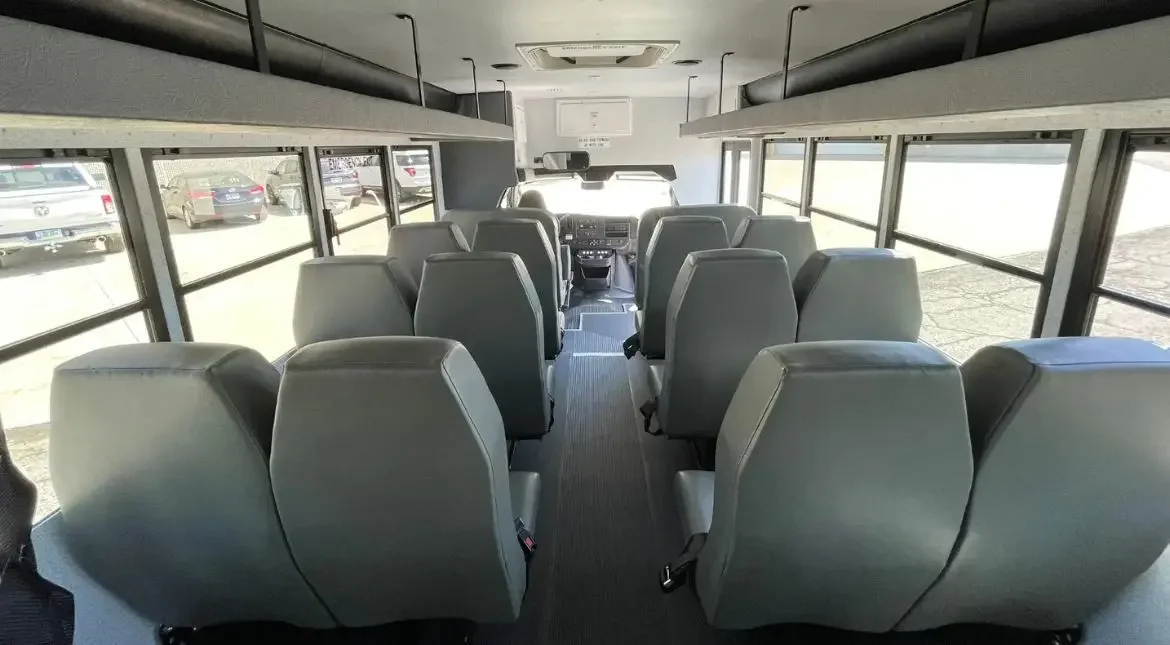
The 15-passenger capacity range sits at a practical crossroads for fleet buyers — large enough to move meaningful groups efficiently, small enough to stay maneuverable in parking lots, hotel driveways, and urban streets. It eliminates the wasted capacity of a full-size bus on lower-ridership routes while outperforming what a standard van can legally and safely carry.
Endera builds mid-capacity shuttles across the B-Series lineup in gasoline, propane, CNG, and electric configurations, with ADA-compliant lift options and flexible interior layouts. These are purpose-built commercial vehicles engineered to the structural and safety standards that institutional buyers require.
Ready to find the right mid-capacity fit? Contact Endera's sales team today to compare B-Series models and confirm current availability.
Is a 15-Passenger Vehicle a Bus or a Van? The Legal Distinction
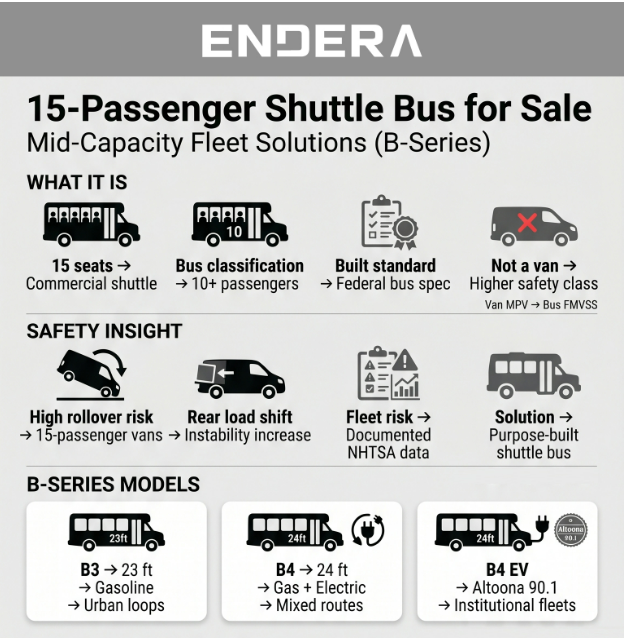
Under federal classification, a vehicle designed to carry 10 or more passengers is legally defined as a bus — not a multipurpose passenger vehicle. This distinction, established through NHTSA interpretations of Federal Motor Vehicle Safety Standards, determines which structural, braking, and occupant protection requirements apply to the vehicle before it ever leaves the factory.
A 15-passenger van is built to MPV standards. A 15-passenger shuttle bus is built to bus standards — which include higher structural integrity thresholds, more rigorous crash protection requirements, and different seating and restraint specifications. For buyers transporting employees, guests, or students, that difference has direct liability and insurance implications that a purchase price comparison alone won't capture.
Why 15-Passenger Vans Carry Documented Safety Risks
NHTSA research has consistently shown that 15-passenger vans carry a significantly elevated rollover risk when loaded near capacity. Specifically, vans with 10 or more occupants had a rollover rate in single-vehicle crashes nearly three times higher than those carrying fewer than five passengers. The primary driver is weight distribution — as rear seats fill, the center of gravity shifts rearward and upward, reducing stability in lane changes and evasive maneuvers.
Purpose-built shuttle buses address this structurally. Endera's proprietary all-electric powertrain on EV models places battery packs within the frame rails, lowering the center of gravity by design rather than managing it as an afterthought. ICE models built on the Ford E450 cutaway chassis are purpose-engineered for the weight distributions of full passenger loads — not retrofitted van platforms.
B-Series Models in the Mid-Capacity Range
Endera's B-Series covers the 23–28 foot range, with the B3 and B4 being the most relevant configurations for buyers in the 12–16 passenger range. Both are built on the Ford E450 cutaway chassis with face-forward seating, 70,000 BTU A/C, non-slip flooring, and available 800 lb Braun ADA lifts.
| Model | Length | Fuel Options | Best For |
|---|---|---|---|
| B3 | 23 ft | Gasoline | Small hotel loops, tight urban routes |
| B4 | 24 ft | Gasoline & Electric | Airport parking, university circuits, hotel shuttles |
The B4 is the primary choice where capacity and maneuverability need to balance. Its electric variant holds an Altoona durability test score of 90.1 — the highest in its class — providing a documented third-party reliability baseline that matters in institutional procurement and total cost of ownership comparisons.
Shuttle Bus vs. 15-Passenger Van: The Operator's Calculation
The van vs. shuttle bus decision often comes down to upfront price — vans are cheaper to acquire. The calculation changes when liability exposure, maintenance cycles, and operational fit are added. Schools and institutions are explicitly restricted under federal guidance from purchasing new 15-passenger vans for student transport unless the vehicle meets additional stability and safety requirements. For many institutional buyers, a compliant shuttle bus is not a preference but a regulatory requirement.
For commercial operators — hotels, corporate campuses, and tour operators — the case is operational. Shuttle buses carry structured ADA compliance, better passenger ingress and egress, and more durable interiors built for repeat-cycle commercial use. A van interior degrades under the loading patterns of a commercial route in ways that a purpose-built shuttle body does not.
ADA Compliance and Accessibility
Under DOT ADA regulations for transportation providers, fixed-route shuttle operators are required to accommodate passengers with disabilities, including wheelchair securement systems and accessible boarding. Endera's B-Series shuttles are available with the Braun 800 lb lift and compliant securement points — making ADA readiness a standard configuration option rather than a custom add-on.
Electric vs. Gas in the Mid-Capacity Range
For operators running hotel loops, airport parking circuits, and campus routes — typically under 80 miles per operating shift — electric is consistently the stronger long-term option. Lower per-mile fuel costs and reduced brake wear from regenerative braking translate to measurable savings over an 8–10 year vehicle life. SP+ at San Diego International Airport, operating Endera electric shuttles, projects nearly $20,000 in annual savings per vehicle versus LPG/CNG equivalents.
Gasoline remains the practical default for operators with variable route mileage, no charging infrastructure, or a fleet composition that makes unified charging impractical. Propane is the mid-point: meaningful fuel cost savings versus gasoline without the infrastructure commitment of a full EV transition. Endera's financing options cover all three powertrain types, and the grant navigation team can assess whether an electric purchase qualifies for federal or state incentive programs that close the price gap.
Ready to Configure Your Fleet
Mid-capacity shuttle procurement decisions are rarely one-size-fits-all. Route length, passenger load consistency, charging access, and budget cycle all shape which B-Series model and powertrain makes operational sense. Endera's in-stock vehicles include ready-to-deliver gasoline configurations for buyers with immediate timelines. Custom builds — electric, propane, CNG, or alternate seating layouts — are available with lead times that vary by specification.
Contact the Endera sales team to discuss configuration, compare model specs, or get documentation on the B4's Altoona test certification for procurement files.
Frequently Asked Questions
Do I need a CDL to drive a 15-passenger shuttle bus?
Federal CDL requirements apply to vehicles designed to carry 16 or more passengers (including the driver) or with a GVWR above 26,001 lbs. A 14-passenger shuttle with the driver — 15 total — falls just at the federal threshold, meaning CDL requirements can apply depending on exact configuration and state law. The Endera B3 and B4 in standard configurations have a GVWR of 14,500 lbs, which is below the weight-based CDL trigger, but buyers should confirm state-specific passenger count rules with their DMV before assuming an exemption.
Why does NHTSA consider 15-passenger vans a safety concern?
NHTSA research found that fully loaded 15-passenger vans have a rollover rate in single-vehicle crashes nearly three times higher than lightly loaded ones. The risk is structural — as rear seats fill, weight shifts rearward and upward, reducing stability. This is why NHTSA has issued repeated consumer advisories about 15-passenger van use, particularly for institutional operators like schools and church groups. Purpose-built shuttle buses address this through chassis-level engineering rather than driver precautions alone.
What is the difference between the B3 and B4 for mid-capacity routes?
The B3 is a 23-foot model available in gasoline only, suited for smaller hotel shuttles and tight urban loops. The B4 is a 24-foot model available in both gasoline and electric, with higher daily mileage capacity and the Altoona durability certification that matters in municipal and institutional procurement. For buyers weighing the two, the B4 is the stronger choice when electrification or procurement documentation is a factor; the B3 suits straightforward gasoline fleet needs at slightly lower operating cost.
Can a 15-passenger shuttle bus be used for student transport?
Any vehicle regularly used to transport school-age students must meet school bus FMVSS requirements — regardless of how it's labeled. B-Series shuttles are not certified for student transport under those standards. Buyers with student transport needs should look at Endera's Type A school bus lineup, which is purpose-built to meet those requirements.
How does the Altoona durability test affect a purchasing decision?
The Altoona Bus Research and Testing Center runs a standardized 12-year, 500,000-mile durability simulation that is required for FTA-funded transit vehicle procurement. Endera's B4 electric passed with a score of 90.1 — the highest in its class — which provides documented third-party evidence of long-term reliability. For buyers using federal or municipal funding, Altoona certification is often a procurement requirement. For commercial buyers, it provides a verifiable reliability baseline that manufacturer specifications alone cannot.
What interior configurations are available in the B-Series mid-capacity range?
Standard configurations include face-forward seating with non-slip flooring, 70,000 BTU A/C, and available 800 lb Braun ADA lifts. Luggage options vary by model — the B3 can be configured without luggage compartments for flat-floor layouts, while the B4 accommodates luggage configurations for airport and hotel use. Seating count and arrangement, lift placement, and ADA securement points can be customized within the build spec. Contact Endera's sales team directly for a full configuration worksheet.
Are Endera shuttles covered under a single warranty regardless of powertrain?
Endera provides separate warranty documents for electric vehicles and commercial buses, both available at enderamotors.com/warranty. Because Endera is vertically integrated — building the body, powertrain, and software in-house — warranty responsibility isn't split between a chassis supplier and a body builder. For operators managing a mixed ICE and EV fleet, that consolidated warranty structure simplifies claims handling compared to multi-manufacturer arrangements.