
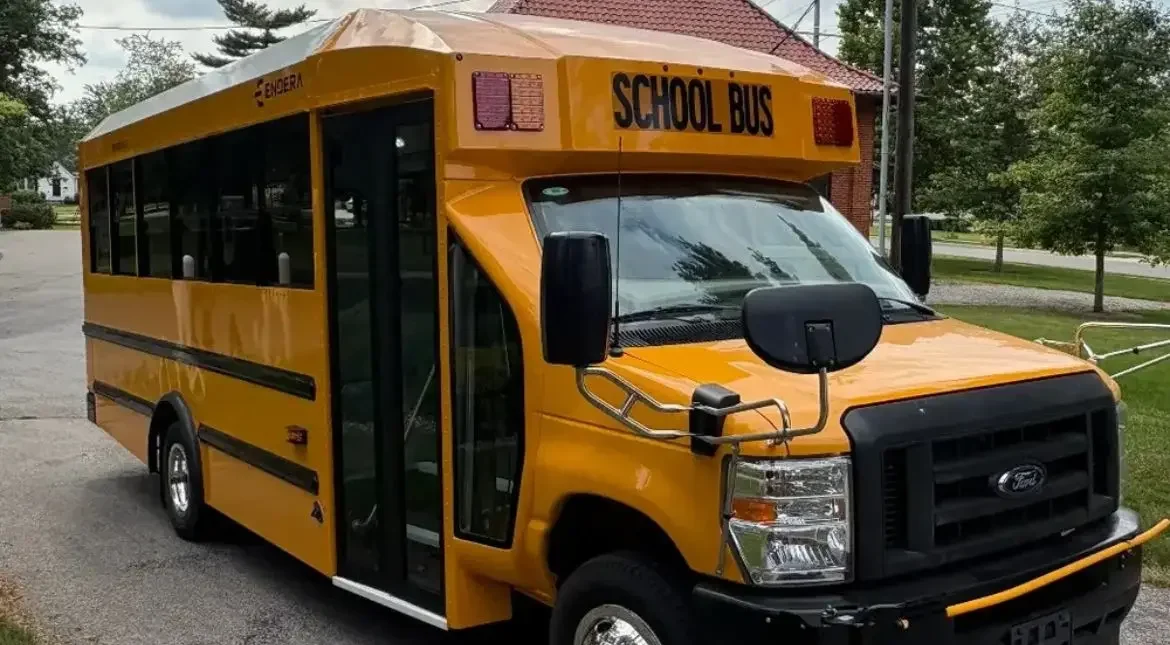
Fleet managers who need smaller buses aren't just buying down in size — they're buying into a different operational model entirely. Compact Type A school buses handle routes, environments, and passenger loads that full-size buses genuinely can't serve efficiently, and the procurement decision involves different specs, compliance thresholds, and cost structures than most buyers expect going in.
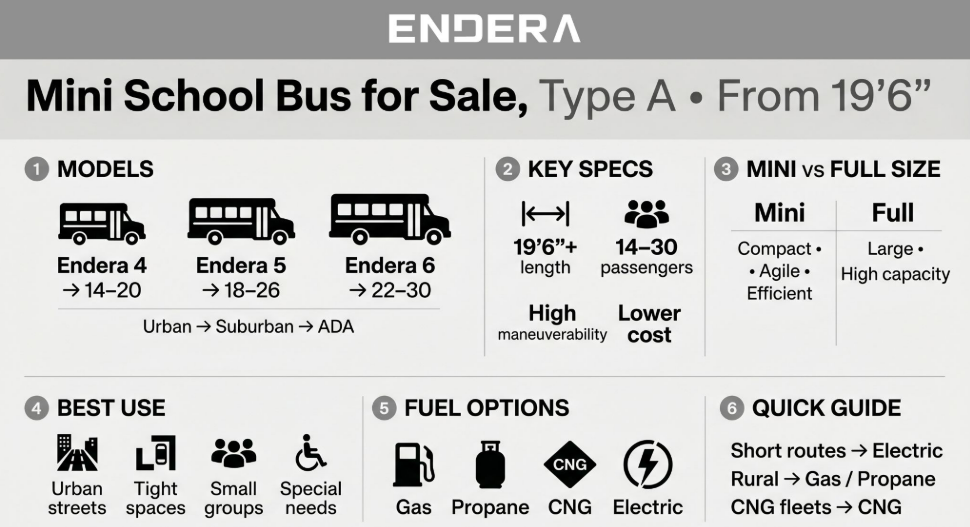
Endera manufactures compact Type A school buses starting at 19'6" on Ford E450 and Chevrolet Express cutaway chassis, available in gasoline, propane, CNG, and electric configurations. Endera's school bus models — the Endera 4, 5, and 6 — support 4–6 section configurations with ADA-compliant lift options, customizable seating, and storage layouts determined at the factory level.
Need help matching a configuration to your routes? Contact Endera's sales team today to get the right spec from the start.
What Is a Mini School Bus?
A mini school bus is a Type A bus — built on a cutaway van chassis with the driver's door retained from the original vehicle platform. Under classifications used across multiple U.S. state transportation standards, Type A buses fall into two GVWR categories: A-1 at or below 14,500 lbs, and A-2 between 14,500 and 21,500 lbs. Both are significantly lighter than Type C or D full-size buses, which typically range from 25,000 to 36,000 lbs GVWR.
Per NHTSA's school bus regulations, any vehicle designed to carry 11 or more passengers to or from school must meet Federal Motor Vehicle Safety Standards — regardless of size. Compact does not mean exempt. Mini school buses must comply with the same federal safety framework as full-size buses, including FMVSS 571.222 for passenger seating and crash protection and FMVSS 571.217 for emergency exits.
Passenger Capacity at 19'6"
A compact Type A bus at 19'6" typically seats between 14 and 30 passengers, depending on configuration. Adding an ADA-compliant wheelchair lift or rear storage reduces usable seating, so districts should spec capacity based on the actual route population — not the maximum listed figure. Endera's 4–6 section build options allow that tradeoff to be resolved at the factory rather than through post-delivery modifications.
What 19'6" Means in Real-World Operation
Most buyers focus on passenger count, but the length of a bus has direct consequences for where it can actually operate. At 19'6", a compact Type A bus has a meaningfully shorter turning radius than a Type C or D full-size bus, which can stretch to 35–45 feet. That difference determines whether a bus can navigate urban side streets, enter tight school drop-off zones, or turn around in a standard suburban cul-de-sac without a multi-point maneuver.
Full-size buses struggle in environments built for passenger vehicles — dense urban grids, private school campuses with constrained access lanes, and residential routes with limited turnaround space. A 19'6" bus operates cleanly in all of these. For districts running multiple short routes through varied environments, compact sizing often eliminates operational bottlenecks that don't show up on a spec sheet.
Where Compact Buses Perform Best
The strongest use cases for a 19'6" Type A bus are urban school districts with tight street infrastructure, special education and ADA-configured routes, private schools and academies with smaller daily headcounts, and shuttle-style transport for sports teams, after-school programs, or church groups. These are routes where a full-size bus wastes capacity, burns excess fuel, and creates logistics problems that compound daily.
Mini Bus vs Full-Size Bus: Key Differences
| Feature | Compact Type A (19'6"+) | Full-Size Type C/D |
|---|---|---|
| Length | ~19–25 ft | 35–45 ft |
| GVWR | 10,000–21,500 lbs | 25,000–36,000 lbs |
| Capacity | 14–36 passengers | 65–90 passengers |
| Maneuverability | High | Low |
| Fuel consumption | Lower | Higher |
| CDL requirement | May not apply | Required |
| Upfront cost | Lower | Higher |
The CDL threshold is a detail many buyers overlook. Under FMCSA regulations, a Commercial Driver's License is required when a vehicle carries 16 or more passengers or exceeds 26,001 lbs GVWR. Depending on configuration, certain compact Type A buses may fall below both thresholds — which reduces staffing costs and expands the driver pool available to smaller districts and private operators.
Fuel Options for Compact Type A Buses
Shorter routes make compact buses strong candidates for electrification. Research from the National Renewable Energy Laboratory found that the average school bus route covers approximately 25 miles daily — well within the operating range of current electric Type A technology. For districts running predictable urban loops, the case for electric is stronger at the compact end of the fleet than anywhere else.
Endera offers all four fuel configurations on its compact Type A models. Gasoline remains the easiest deployment path for rural districts without fueling infrastructure investment. Propane reduces NOx output compared to gasoline and is widely available, making it the most practical step-down for districts not yet ready for full electrification.
CNG suits fleets that already have fueling infrastructure in place. Electric, per emissions data from the Electric School Bus Initiative, is the only option that eliminates tailpipe emissions entirely — a factor that carries added weight on routes where students board and ride in close proximity to the engine compartment.
Operational Savings at the Compact Scale
Lower GVWR translates directly into lower operating costs. Compact buses consume less fuel per mile than full-size alternatives, put less load on brakes and tires, and — in the case of electric — benefit from the same reduced drivetrain maintenance advantage as larger EV buses. For fleets running multiple short routes, those savings multiply across every vehicle in the rotation.
Total Cost of Ownership and Available Funding
Compact Type A buses carry a lower upfront cost than full-size alternatives, but the more significant financial variable for most districts is grant access. Endera's grant navigation and financing services help districts access over $20 billion in available federal, state, and local EV subsidies — including EPA Clean School Bus Program funding, California HVIP rebates, direct financing, and capital leasing options. For many districts, that coverage reduces or eliminates the cost premium of electric over gasoline at the point of purchase.
Districts on an accelerated timeline can also review Endera's in-stock vehicles for ready-to-deliver 2026 units on Ford E450 chassis. For custom configurations, Endera's sales team can be reached at (419) 796-6080 or sales@enderacorp.com.
Is a 19'6" Bus the Right Size for Your Fleet?
A compact Type A bus at 19'6" is well-suited for routes carrying up to 30 passengers through urban or space-constrained environments. It is not the right fit for high-capacity routes, long-distance rural transport, or districts that need to consolidate passenger loads across fewer vehicles. The honest answer for most small districts and private operators is that a compact bus handles the actual daily route more efficiently than a larger vehicle that runs underloaded — and the cost structure reflects that.
For districts managing a mix of route types, Endera's proprietary all-electric powertrain and dual-track ICE/EV production make it possible to configure compact and standard-size buses on the same platform, simplifying parts management and service across a mixed fleet. Districts unsure which configuration fits their routes can contact Endera's sales team to work through the specs.
Frequently Asked Questions
What classifies a bus as a "mini" or Type A school bus?
A mini school bus is technically a Type A school bus — built on a cutaway van chassis and classified by GVWR into A-1 (≤14,500 lbs) and A-2 (14,500–21,500 lbs) categories. These classifications are used across multiple U.S. state transportation standards and determine which federal safety requirements apply.
How many students can a 19'6" mini school bus carry?
A 19'6" Type A bus typically seats between 14 and 30 passengers, depending on configuration. Adding an ADA-compliant wheelchair lift or rear storage reduces available seating, so capacity should be calculated based on the specific build rather than the listed maximum.
Do mini school buses require a CDL to drive?
CDL requirements depend on passenger count and GVWR. Under FMCSA regulations, a CDL is required for vehicles carrying 16 or more passengers or exceeding 26,001 lbs GVWR. Certain compact Type A configurations may fall below both thresholds, which can lower staffing costs for smaller districts and private operators.
Are mini school buses subject to the same safety standards as full-size buses?
Yes. Per NHTSA regulations, any vehicle designed to carry 11 or more passengers to or from school must meet Federal Motor Vehicle Safety Standards — including FMVSS 571.222 for seating and crash protection and FMVSS 571.217 for emergency exits. Compact size does not reduce compliance obligations.
Is electric a practical option for a compact school bus?
For most short-route operations, yes. The National Renewable Energy Laboratory found that the average school bus route covers roughly 25 miles daily, well within the operating range of current electric Type A buses. Compact buses running predictable urban loops are among the strongest candidates for electrification in any district fleet.
What's the advantage of a 19'6" bus over a full-size Type C or D bus?
Compact Type A buses offer a shorter turning radius, lower fuel consumption, reduced maintenance costs, and lower upfront pricing compared to full-size alternatives. They are specifically better suited for urban environments, special needs routes, and lower-density passenger loads where a full-size bus would run significantly underloaded.
Can Endera configure a compact bus for ADA and special needs transport?
Yes. Endera's Type A models support 4–6 section configurations with ADA-compliant lift placement, wheelchair tie-downs, and custom seating layouts — all determined at the factory level. Because Endera assembles bodies in-house, these configurations are built into production rather than added as post-delivery modifications.