
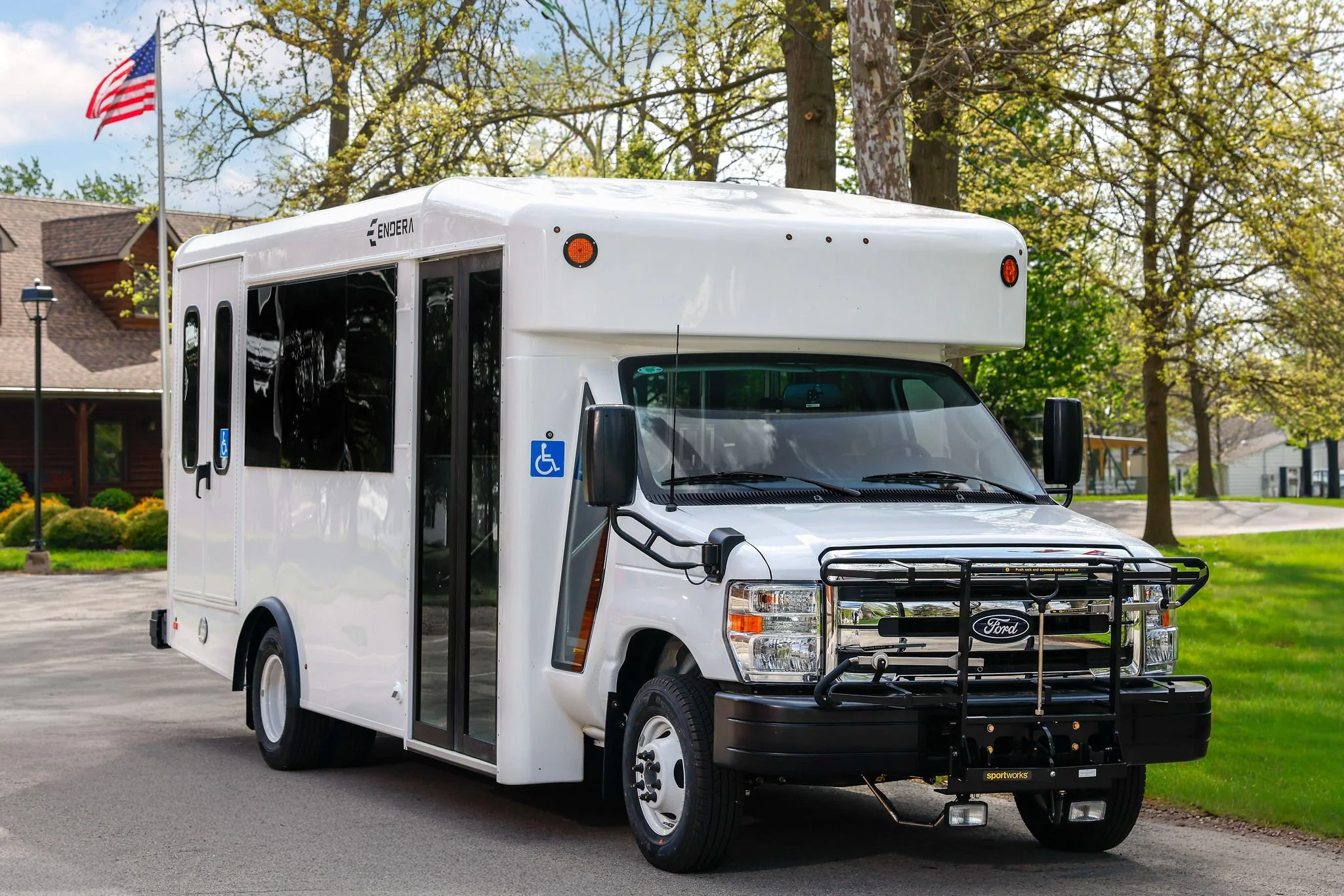
Wisconsin's shuttle market runs across more industries than most people expect. Milwaukee's healthcare corridor and convention center traffic, Madison's dense university campus system, Green Bay's growing corporate and logistics base, and a tourism economy built around the Dells, Door County, and lakefront properties all generate consistent shuttle demand. These aren't markets with identical needs — and a single-spec vehicle from a generic upfitter rarely serves all of them well.
Endera assembles the B-Series shuttle from the ground up — chassis integration, powertrain, body, and software — at its 250,000-square-foot facility in Ottawa, Ohio, just a few hours from Wisconsin's eastern border. One manufacturer, one warranty, one team accountable for the full vehicle. For Wisconsin operators evaluating a new shuttle or fleet refresh, Endera's B-Series lineup spans the B3, B4, B5, and B8 in 23–28 foot configurations, with ICE and full-electric powertrains available and route-specific customization handled at the factory level.
Ready to spec your fleet? Contact Endera's fleet specialists today to design a custom configuration blueprint for your operation.
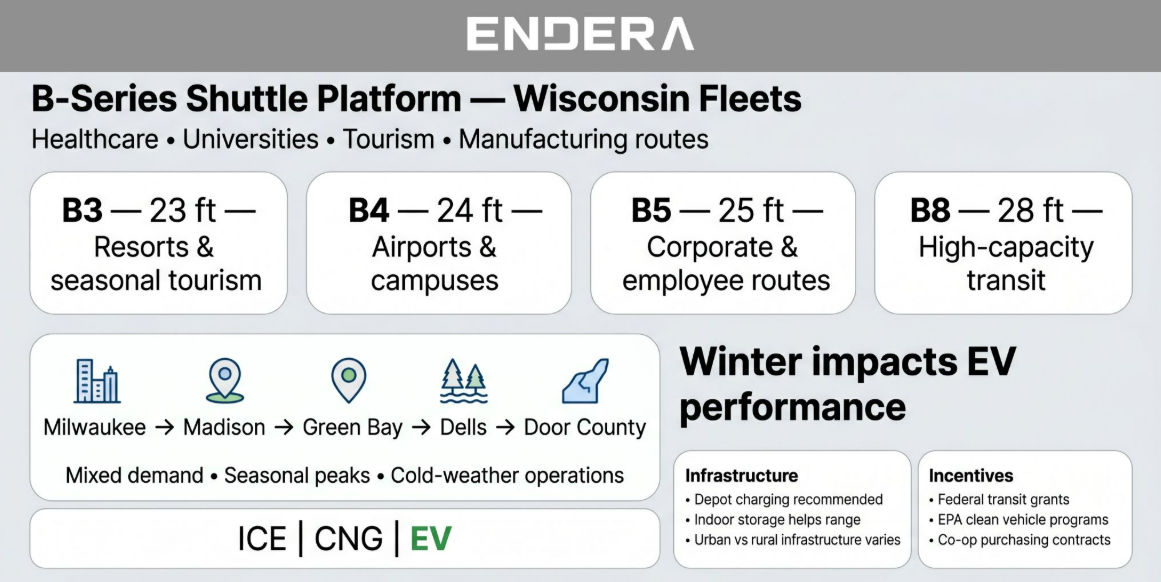
The Endera B-Series Lineup for Wisconsin Fleets
Four Models, Configured for What You Actually Run
The B-Series spans 23 to 28 feet across four models, covering everything from compact hotel loops in downtown Milwaukee to high-capacity employee shuttles on corporate campuses in the Fox Cities. Every model is built on Ford E450 or Chevrolet Express cutaway chassis — platforms Wisconsin service networks are already set up to support.
Matching the Model to the Route
The B3 (23 ft) handles compact urban routes and smaller hotel operations. The B4 (24 ft) and B5 (25 ft) are available in both ICE and full-electric configurations, covering airport ground transport, university circulators, and corporate fleets. The B8 (28 ft) handles higher-capacity municipal and group transport where ridership demands more room.
Electric or ICE — What Wisconsin Operators Need to Know
Wisconsin Winters Are a Real Variable
Wisconsin's winters are genuinely severe — not a caveat to bury in fine print. For fleet operators considering electric models, cold temperatures reduce usable battery range through battery chemistry changes and the energy required for cabin heating, with effects most noticeable on early morning routes. The operators who run EVs successfully through Wisconsin winters aren't ignoring this — they're planning around it.
Strategies That Work
Pre-conditioning while plugged in shifts cabin heating energy off the battery and onto the grid, protecting morning range on cold days. Keeping vehicles connected during dwell time between runs maintains battery temperature and reduces the energy draw at the start of each route. Indoor or covered depot storage makes a measurable difference in overnight energy retention — an advantage worth factoring into infrastructure planning from the start.
Where ICE and CNG Make More Sense
For longer intercity routes, rural corridors without reliable depot access, or operations that run high daily mileage across variable conditions, ICE and CNG configurations are the practical near-term choice. Endera's dual-track production means Wisconsin operators can mix powertrains across a fleet without switching manufacturers — deploying electric where the duty cycle fits and ICE where it doesn't.
Which B-Series Model Fits Your Wisconsin Route?
Milwaukee and Southeast Wisconsin
Milwaukee's shuttle market is anchored by healthcare — Froedtert, Aurora, Children's Wisconsin — along with Fiserv Forum event traffic, Mitchell International Airport ground transport, and a growing convention and hospitality sector. The B4 and B5 are the standard fit for most of these applications. Airport and hotel routes are structured and depot-charged, making electric configurations viable for operators ready to invest in charging infrastructure.
Madison and the University Corridor
Madison runs one of the most active university shuttle systems in the Midwest. UW-Madison's campus transport operations, State Capitol area hotel and hospitality fleets, and a growing biotech and life sciences campus sector all generate consistent demand. The B4 and B5 — electric or ICE depending on route profile — cover the majority of these applications, with Endera Dispatch's route optimization particularly useful for the stop-heavy, schedule-driven patterns that define campus transit.
Green Bay, Appleton, and the Fox Cities
The Fox Cities corridor has a distinct shuttle profile driven by manufacturing, logistics, and healthcare rather than hospitality or higher education. Employee shuttles connecting facilities, shift transport for distribution operations, and medical campus circulators are the primary use cases. ICE and CNG configurations handle the longer and less predictable routes in this corridor well, while structured campus or medical routes are candidates for phased electrification.
Tourism and Seasonal Operations
For the Wisconsin Dells, Door County, Lake Geneva, and the Northwoods resort corridor, shuttle demand spikes sharply in summer and drops significantly in winter. The B3 and B4 cover most seasonal hospitality applications, and Endera's capital leasing option is worth considering for operators who want to match their fleet investment to actual seasonal utilization rather than carrying full ownership costs year-round.
How Wisconsin Fleets Procure Shuttle Buses
Public Sector Procurement
Wisconsin public agencies procure vehicles through competitive processes governed by the Wisconsin Department of Administration, which manages statewide procurement policy and centralized contract vehicles available to state agencies, municipalities, and qualifying public institutions. Agencies using federal transit funding must also comply with FTA procurement requirements, including Buy America certification for rolling stock.
Cooperative Purchasing
Many Wisconsin public operators — transit authorities, municipalities, universities — access vehicle contracts through the Wisconsin Cooperative Purchasing Service (Co-op) or national frameworks like NASPO ValuePoint and Sourcewell. Pre-competed contracts reduce administrative burden significantly for smaller agencies without dedicated procurement staff, and keep the purchase fully compliant without running a full RFP cycle.
Who Actually Signs Off
Approval authority in Wisconsin varies by operator type. For the Milwaukee County Transit System and Madison Metro Transit, fleet decisions move through transportation planning departments and comply with FTA competitive procurement rules. University of Wisconsin system shuttles operate through campus transportation offices tied to internal capital budgets. For private operators — hotels, resorts, healthcare systems, corporate campuses — procurement decisions are made internally with considerably more flexibility and shorter timelines.
Who Actually Buys Shuttle Buses in Wisconsin
Shuttle bus purchasing in Wisconsin is rarely a single-person decision. It moves through several internal roles — each responsible for a different piece of approval, compliance, and long-term operational risk — and understanding that structure is what separates a smooth procurement from one that stalls halfway through.
At the operational level, the transportation director or fleet manager defines route needs, vehicle sizing, and duty cycles. In state agencies and university systems, this role works within formal fleet governance structures administered by the Wisconsin Department of Administration, which oversees vehicle procurement policy, lifecycle planning, and the state fleet management system that governs how agencies request and replace vehicles. At UW-Madison, for example, all vehicle procurement flows through the Fleet Program Officer in coordination with DOA — departments cannot initiate purchases independently.
Grants and Financing for Wisconsin Fleets
Federal Funding Is Accessible
Many Endera EV models qualify for EPA clean transportation programs and FTA formula grants available to Wisconsin public transit agencies and qualifying private operators. Wisconsin also participates in regional clean vehicle programs, and operators in Milwaukee and Madison metro areas may have access to air quality improvement incentives tied to emissions reduction priorities in those corridors. Endera's team helps Wisconsin operators identify applicable programs and manages the application process directly.
Flexible Financing for Every Operator Type
Endera offers direct vehicle financing and capital leasing. For Wisconsin's seasonal tourism operators, leasing preserves operating capital during off-peak months — a practical consideration for resort and attraction shuttle operations that carry significant downtime between November and April.
Software and Infrastructure Included
Fleet Management From Day One
Every Endera B-Series shuttle comes available with Endera Dispatch — built in-house and integrated directly with the vehicle. Wisconsin fleet managers get real-time vehicle tracking, route analytics, and maintenance scheduling without a separate telematics vendor.
The Passenger Experience
Endera Go gives riders real-time shuttle tracking and ETA updates. For Milwaukee's airport and convention operations and Madison's campus circulators, that visibility is a practical service improvement — particularly during peak periods when shuttle frequency and wait times are most visible to passengers.
Charging Infrastructure for EV Buyers
For Wisconsin operators selecting electric models, Endera provides full turnkey charging support — site assessment, charger procurement, and installation. One vendor handles the vehicle and the charging setup, which matters for operators who don't have dedicated facilities staff to manage a separate infrastructure project.
Wisconsin Fleets Deserve a Shuttle That Holds Up
From Milwaukee's healthcare corridor to Madison's university campuses and Door County's seasonal resort operations, Wisconsin shuttle fleets run across a wide range of environments and duty cycles. Endera's B-Series is built as a complete system — engineered and assembled under one roof, backed by real software, and close enough to Wisconsin that delivery timelines and service response are both realistic.
Districts and operators evaluating the B-Series can contact Endera's fleet specialists to discuss model selection, powertrain options, applicable grant programs, and financing. For operations on an accelerated timeline, in-stock vehicles are available for immediate delivery.
FAQs
Does Endera sell shuttle buses in Wisconsin?
Yes. Endera sells new B-Series shuttle buses to fleet operators throughout Wisconsin, including airport operations, hospitals and medical campuses, universities, hotels and resorts, corporate campuses, and municipal operators. The sales team can walk through configurations, financing, and applicable grant funding for your operation.
What B-Series models are available for Wisconsin operators?
Wisconsin operators can choose from the B3 (23 ft, ICE), B4 (24 ft, ICE or EV), B5 (25 ft, ICE or EV), and B8 (28 ft, ICE). The right model depends on route length, ridership, and depot infrastructure.
How do Wisconsin winters affect electric shuttle performance?
Cold temperatures reduce usable EV range through battery chemistry changes and cabin heating energy demands. Pre-conditioning while plugged in, maintaining dwell-time connections between runs, and indoor depot storage are the primary mitigation strategies. For most structured Wisconsin routes — airport loops, campus circulators, medical campus shuttles — EV operation through winter is manageable with proper planning. Longer rural routes in winter are better served by ICE configurations in the near term.
Are Endera shuttles eligible for federal or Wisconsin-specific grant funding?
Yes. Many Endera EV models qualify for EPA clean transportation programs and FTA grants. Endera's team helps Wisconsin operators identify applicable funding and manages the application process directly.
How does Wisconsin public procurement work for shuttle buses?
Public agencies procure through Wisconsin Department of Administration-governed processes. Many use the Wisconsin Cooperative Purchasing Service or national frameworks like NASPO ValuePoint and Sourcewell to access pre-competed contracts. Agencies using federal funding must comply with FTA requirements including Buy America provisions.
Does Endera provide charging infrastructure for Wisconsin EV buyers?
Yes. Endera provides full turnkey charging infrastructure — site assessment, charger procurement, and installation. Wisconsin operators work with one vendor for both the vehicle and the charging setup.
What software comes with an Endera shuttle bus?
Every Endera B-Series shuttle comes available with Endera Go (real-time passenger tracking and ETA) and Endera Dispatch (fleet management, routing, and vehicle health analytics), both built in-house and integrated directly with the vehicle's hardware.