
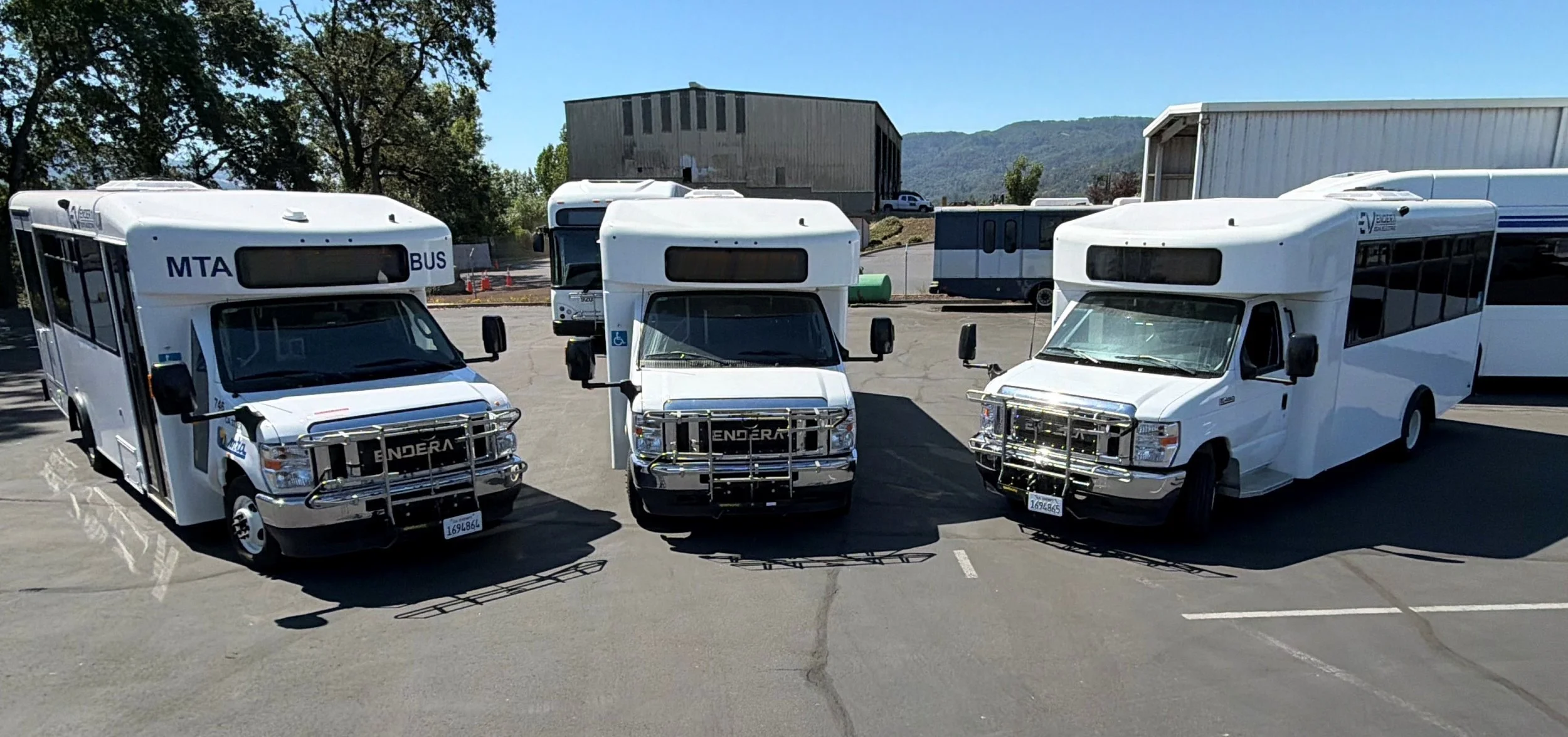
Oregon's commercial shuttle market is shaped by a combination of forces that few other states share: strong sustainability mandates driving fleet electrification, active federal transit funding flowing to agencies across the state, a tourism economy that includes coastal, wine country, and outdoor recreation demand, and a university and healthcare infrastructure that generates year-round institutional shuttle requirements.
Endera manufactures Class 4 B-Series commercial shuttles in ICE, propane, CNG, and full-electric configurations on Ford E450 and Chevrolet Express cutaway chassis. The B-Series is FTA-eligible and Buy America compliant — meeting the federal procurement requirements that Oregon transit agencies and municipalities need for federally funded fleet purchases. For Oregon operators evaluating a new shuttle or fleet refresh, Endera's B-Series lineup spans the B3, B4, B5, and B8 in 23–28 foot configurations, with ADA-accessible flat-floor models and route-specific customization handled at the factory level.
Ready to spec your fleet? Contact Endera's fleet specialists today to design a custom configuration blueprint for your operation.
Why Oregon Fleets Choose the B-Series
Oregon's transportation environment rewards operational flexibility. Urban operators in Portland, Eugene, and Salem need reliable fixed-route vehicles for employee transport, campus loops, and healthcare shuttles. Rural and coastal operators face longer inter-community distances with limited service infrastructure and seasonal tourism demand that spikes significantly in summer months.
The B-Series is built on medium-duty Ford E450 and Chevrolet Express cutaway chassis — commercial platforms engineered for sustained daily use. Endera is the only American vertically integrated OEM for Class 4 electric shuttles, with body assembly and powertrain installation handled at a single Ohio facility. Oregon operators receive one warranty document and one point of service accountability rather than split coverage from a chassis supplier and a separate body upfitter.
The B-Series Lineup for Oregon Fleets
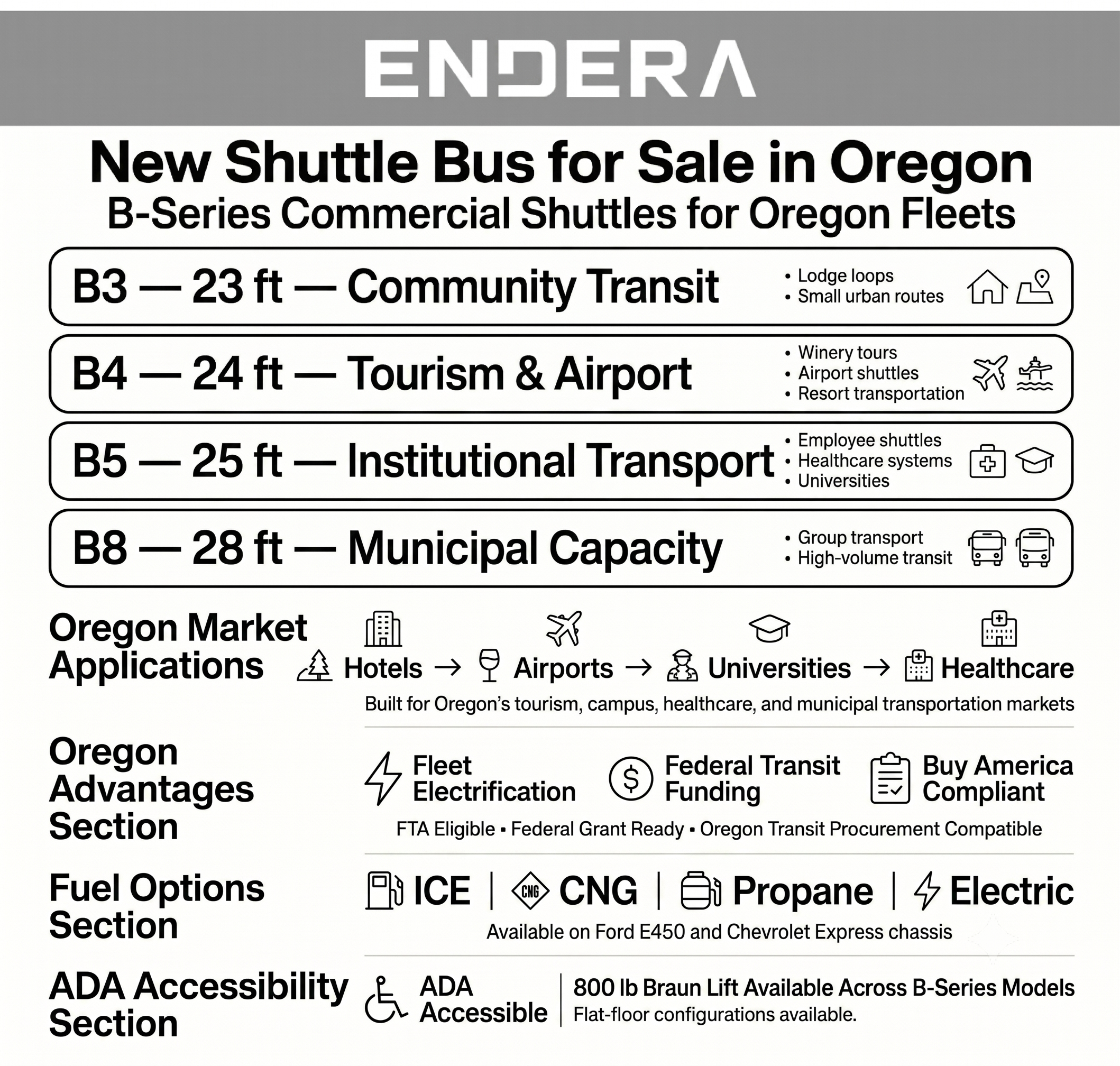
| Model | Length | Fuel Options | Best Fit |
|---|---|---|---|
| B3 | 23 ft | ICE | Lodge loops, community transit, small urban routes |
| B4 | 24 ft | ICE & EV | Airport shuttles, campus loops, winery and resort transport |
| B5 | 25 ft | ICE & EV | Employee transport, healthcare, higher-capacity routes |
| B8 | 28 ft | ICE | High-volume municipal and group transport |
ADA-configured flat-floor models with 800 lb Braun lifts are available across the lineup, meeting ADA accessible transportation requirements and FTA Part 37 transportation service regulations as delivered.
Oregon Shuttle Use Cases: Where the B-Series Fits
Oregon's shuttle demand spans several distinct markets with different operational requirements. The 2022 National Household Travel Survey documents growing multimodal transportation demand and shifting commuter behavior nationally — trends that are especially pronounced in Oregon, where public transit ridership, employer-sponsored commuter programs, and tourism-linked shuttle demand have all expanded in recent years.
Tourism, Wineries, and Coastal Transportation
A North Coast visitor transportation feasibility study identified consistent shuttle demand gaps along Oregon's coastal tourism corridor — gaps that mid-size commercial shuttles are well-positioned to fill. Oregon's Willamette Valley wine country generates seasonal visitor transport demand for winery tours, resort circuits, and event transportation.
The B4 handles these fixed, predictable routes efficiently, and its electric configuration suits the sustainability positioning that Oregon tourism operators increasingly favor.
Universities, Healthcare, and Employee Transport
University of Oregon, Oregon State, and Portland State operate campus circulation and off-campus transport programs requiring ADA configurations and real-time dispatch. Oregon Health & Science University and the state's major health systems run patient transport and campus shuttle programs with similar requirements. Major Oregon employers — Nike, Intel, and the growing tech corridor around Hillsboro — generate employee shuttle demand that the B5's higher capacity handles well.
Endera's Endera Dispatch software provides AI-powered routing and GPS tracking suited to multi-stop institutional operations.
Airports and Municipal Transit
Portland International and regional Oregon airports support parking and hotel shuttle operations requiring high-frequency fixed-route vehicles. Oregon's tribal transit systems and rural transit operators access federal funding through ODOT procurement channels — the B-Series's Buy America compliance and FTA eligibility satisfy the documentation requirements attached to federally funded contract vehicles.
Oregon's Fleet Electrification Leadership
Oregon is among the more active states in the country on fleet electrification. The Oregon DOT transit fleet electrification program provides lifecycle cost analysis resources and planning guidance for transit agencies evaluating the transition from ICE to electric fleets. Corvallis Transit System has already secured federal funding for electric buses and charging infrastructure — real-world proof that Oregon transit agencies are actively executing EV procurement, not just evaluating it.
Oregon's sustainability mandate creates a procurement environment where electric fleets are increasingly the expected standard rather than the premium option. Oregon DOT transit grant and bus procurement funding supports fleet replacement, transit modernization, and EV transition for qualifying agencies across the state.
Federal Funding for Oregon Fleet Operators
The FTA Bus and Low-No Emission Grant program provides federal funding for electric and clean-fuel bus purchases — Oregon agencies have been consistent recipients. The Biden-Harris administration's $15 billion federal transportation funding announcement outlines the broader federal investment pipeline that Oregon transit operators can access for fleet modernization. Buy America requirements apply to all federally funded transit vehicle purchases — Endera's domestic manufacturing satisfies this requirement.
Endera's grant navigation and financing services help Oregon operators identify applicable programs, confirm Buy America compliance documentation, and manage applications alongside procurement.
EV vs. ICE: The Oregon Fleet Decision
Oregon's mild coastal and valley climate removes most cold-weather EV concerns — wet conditions and moderate temperatures are where electric shuttles operate reliably. The DOE Alternative Fuels Data Center provides route-specific charging cost modeling that Oregon operators can use to calculate per-mile energy cost against existing fuel spend. The U.S. Energy Information Administration publishes current Oregon electricity rates for fleet-level operating cost modeling.
When Electric Makes Sense
Fixed-route operations with predictable daily mileage and overnight depot charging are strong EV candidates. Airport loops, campus circuits, winery tours, and employee shuttles all fit this profile. The Electrification Coalition identifies shuttle and transit operations among the highest-ROI EV deployment environments — and Oregon's active grant funding makes acquisition cost reduction realistic for qualifying operators.
When ICE or Propane Bridges the Gap
Rural operators in Eastern Oregon or coastal areas without charging infrastructure, or those with irregular long-distance routes, should consider ICE or propane as a current-cycle solution. All B-Series configurations share the same platform — standardizing on Endera now doesn't foreclose an EV transition on the next procurement cycle as Oregon's charging infrastructure expands.
Ready to Spec a Shuttle for Your Oregon Fleet?
Several 2026 B-Series units are available for immediate delivery through Endera Stock, including ADA-configured flat-floor models and standard passenger layouts. For operators working within Oregon's formal procurement process or FTA grant-aligned purchasing cycles, Endera provides full specification documentation, Buy America compliance materials, and grant application support.
Operators evaluating the B-Series can contact Endera's fleet specialists to discuss fleet configuration, EV range estimates for Oregon routes, or financing options.
FAQs
Are electric shuttle buses practical in Oregon's wet climate?
Yes — Oregon's mild, wet climate is well-suited to electric operation. Battery performance is more stable in moderate temperatures than in extreme cold, and wet conditions don't meaningfully affect electric shuttle operation. Fixed-route airport, campus, and tourism circuits with overnight depot charging are the strongest candidates. Oregon DOT's fleet electrification resources provide lifecycle cost analysis for operators evaluating the transition.
What B-Series configuration works best for Oregon winery and tourism operations?
The B4 (24 ft) handles winery tours, coastal resort loops, and Oregon tourism circuits efficiently — predictable routes, right-sized capacity, and electric configuration that aligns with Oregon's sustainability positioning. Operators running longer or higher-capacity circuits, such as Crater Lake or Columbia Gorge tourism routes, may find the B5 (25 ft) better matched to passenger volume.
Are Endera B-Series shuttles FTA-eligible for Oregon transit procurement?
Yes. Endera's B-Series shuttles are Buy America compliant and FTA-eligible, meeting the federal procurement requirements attached to FTA-funded vehicle purchases. Oregon transit agencies accessing FTA Bus and Low-No Emission grants can specify Endera vehicles with confidence that Buy America documentation requirements are satisfied.
What federal funding is available for Oregon shuttle fleet electrification?
Oregon transit agencies have consistently received FTA Bus and Low-No Emission grant funding for electric bus purchases. The broader federal transportation funding pipeline includes $15 billion announced for fleet modernization. Oregon DOT transit grant programs provide additional state-level support. Endera's grant navigation services help Oregon operators identify applicable programs based on their ownership structure and fleet profile.
What ADA accessibility options are available for Oregon fleet operators?
Flat-floor B-Series configurations include 800 lb Braun ADA lifts installed at the manufacturing stage, meeting FTA Part 37 accessibility requirements. For Oregon healthcare systems, senior living communities, and tribal transit operators, OEM-installed lift systems provide unified warranty coverage and cleaner compliance documentation than aftermarket modifications.
How does Oregon's transit funding environment affect shuttle bus procurement decisions?
Oregon's active federal and state transit funding creates a procurement environment where new vehicles — particularly electric models — are financially accessible to agencies that apply. The Corvallis Transit System's recent federal grant for electric buses and charging infrastructure demonstrates that even smaller Oregon transit operators can successfully access fleet modernization funding. Operators who approach procurement with grant applications in parallel move faster and pay less net.
What fleet management software does Endera provide for Oregon operators?
Every B-Series shuttle is compatible with Endera Dispatch, which includes AI-powered routing, real-time GPS tracking, geofence management, state-of-charge monitoring for EV units, and custom reporting dashboards at no additional cost. The Endera Go rider app provides passengers with live vehicle location and ETA — useful for Oregon tourism operators and campus fleets where passenger wait-time visibility affects service experience.