
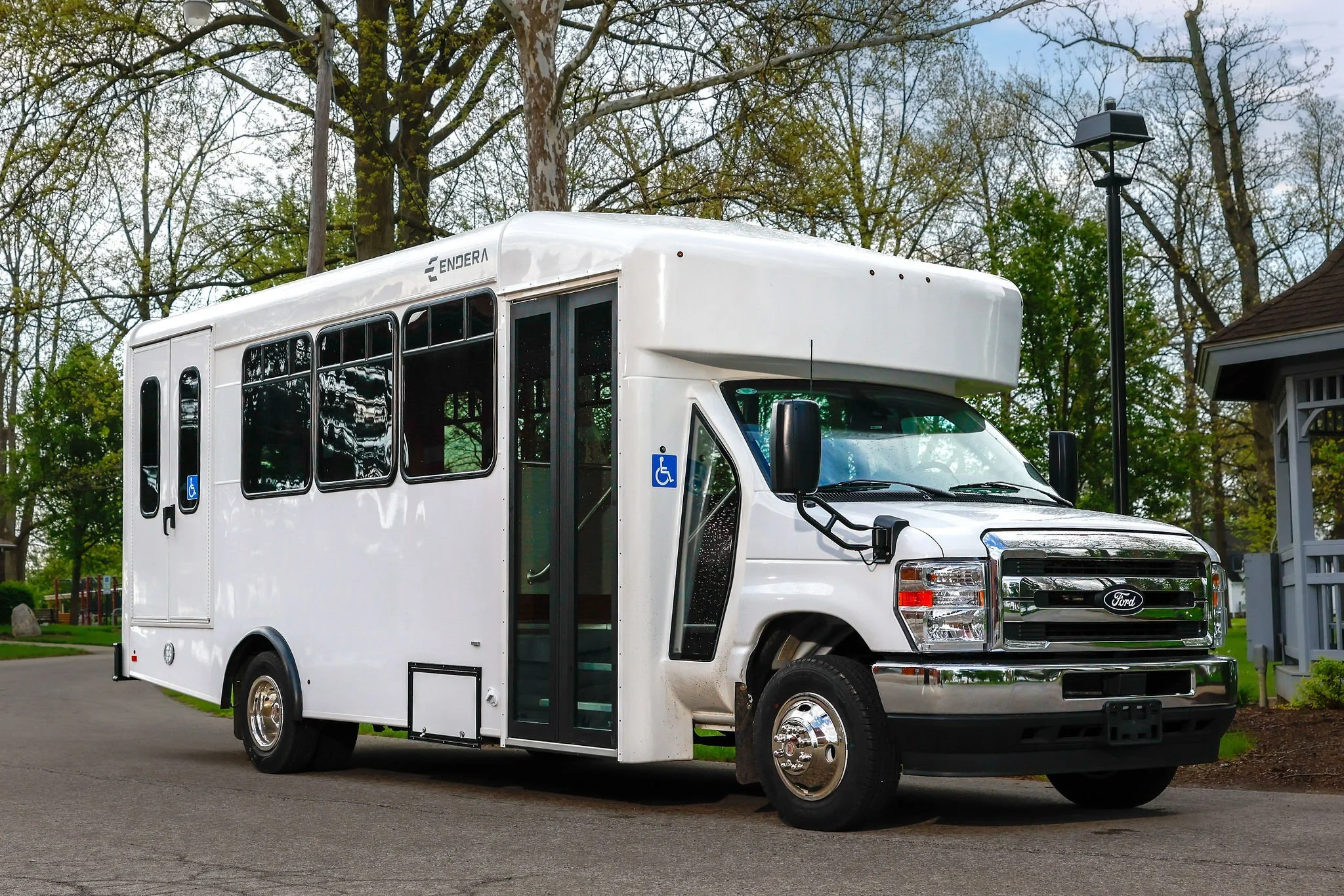
Arkansas's commercial shuttle market draws from a wider range of industries than its population size suggests. Northwest Arkansas's rapid corporate growth around Walmart, Tyson, and J.B. Hunt has created substantial employee shuttle demand. Little Rock's airport and hospitality corridor runs consistent ground transportation operations. The state's casino, tourism, and university sectors add further fleet requirements across both urban and rural corridors.
Endera manufactures Class 4 B-Series commercial shuttles in ICE, propane, CNG, and full-electric configurations on Ford E450 and Chevrolet Express cutaway chassis. For Arkansas hotels, airports, healthcare systems, corporate campuses, and transit operators, the B-Series is purpose-built for the daily cycle counts and passenger volumes that van-based alternatives can't sustain long-term.
Ready to optimize your routes? Contact Endera's fleet specialists today to design a custom configuration blueprint for your Arkansas operation.
Why Arkansas Fleets Choose the B-Series
Arkansas's geography creates genuinely different operational requirements across the state. Northwest Arkansas corporate operators need reliable daily employee shuttles on tight schedules. Rural transit operators in the Arkansas Delta face long inter-community distances with limited service infrastructure.
The Arkansas Department of Transportation oversees a network that reflects both realities — dense enough in Fayetteville and Little Rock to support fixed-route shuttle operations, and spread enough elsewhere that vehicle reliability and parts accessibility become the primary procurement criteria.
Built for Commercial Use, Not Converted From It
The B-Series is built on medium-duty Ford E450 and Chevrolet Express cutaway chassis — commercial platforms engineered for sustained daily use, not adapted from light-duty personal vehicles. Endera is the only American vertically integrated OEM for Class 4 electric shuttles, with body assembly and powertrain installation handled at a single Ohio facility.
Arkansas operators receive one warranty document and one point of service accountability rather than split coverage from a chassis supplier and a separate body upfitter. For fleet managers in markets where service options are limited — rural Delta communities, remote resort areas — that consolidation reduces downtime risk and simplifies the maintenance relationship considerably.
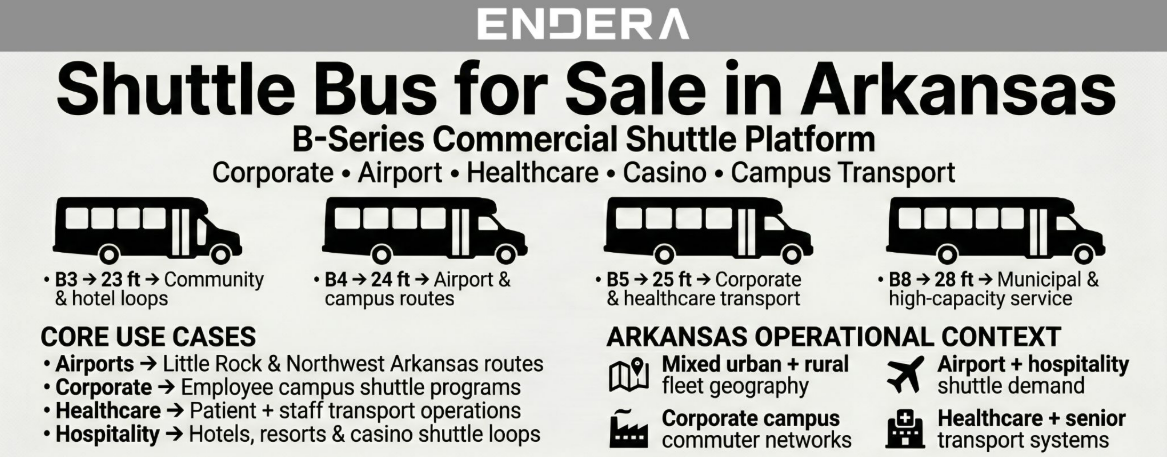
The B-Series Lineup for Arkansas Fleets
ADA-configured flat-floor models with 800 lb Braun lifts are available across the lineup, meeting ADA accessible transportation requirements and FTA Part 37 transportation service regulations as delivered.
Arkansas Shuttle Use Cases: Where the B-Series Fits
Arkansas's shuttle demand concentrates across several distinct markets with different operational profiles.
Airports, Hotels, and Hospitality
Bill and Hillary Clinton National Airport in Little Rock and Northwest Arkansas National Airport in Bentonville support parking and hotel shuttle operations requiring high-frequency fixed-route vehicles. The B4's fixed-route efficiency handles these circuits well — and the electric B4 is well-suited here, with predictable daily mileage and overnight depot charging aligning with airport ground transportation operations.
Corporate Campuses and Employee Transport
Northwest Arkansas's concentration of Fortune 500 headquarters and supplier operations generates consistent employee shuttle demand between transit hubs, parking facilities, and corporate campuses. The B5's higher capacity handles larger employee circuits; Endera Dispatch provides AI-powered routing and real-time GPS tracking suited to multi-stop corporate operations.
Healthcare, Senior Living, and Casinos
Arkansas's major health systems — including CHI St. Vincent, Baptist Health, and UAMS — operate patient transport and campus shuttle programs. Senior living communities across central and northwest Arkansas run resident transport requiring accessible configurations. The state's casino properties along the Oklahoma border and in Hot Springs generate hospitality shuttle demand with similar high-cycle operational characteristics to hotel fleets.
Electric vs. ICE: The Arkansas Fleet Decision
Arkansas's warm climate removes the cold-weather range concerns that complicate EV adoption in northern states — a practical advantage for operators evaluating electric B4 and B5 models. Predictable urban and suburban routes in Fayetteville, Little Rock, and Fort Smith are strong candidates for electrification.
Why Shuttle Fleets Are Strong EV Candidates
Shuttle operations fit electric adoption well because they return to base daily, run predictable routes, and have scheduled downtime for overnight charging. The Electrification Coalition identifies shuttle and transit operations among the highest-ROI EV deployment environments.
According to Atlas Public Policy's transportation electrification research, the South and Southeast are seeing accelerating commercial fleet EV adoption as infrastructure expands and operating economics improve. The International Council on Clean Transportation tracks commercial fleet EV economics confirming that the maintenance cost advantage of electric compounds meaningfully over a full service lifecycle.
Funding and Incentives for Arkansas EV Fleets
The FTA Low or No Emission Vehicle Program provides federal funding for electric shuttle purchases by qualifying transit operators. The Arkansas Energy Office oversees statewide clean energy and electrification initiatives relevant to commercial fleet operators, including VW Settlement-funded EV charging infrastructure programs. The Arkansas DEQ Clean Fuels Funding Assistance Program offers competitive grants for projects that replace eligible medium-duty and heavy-duty vehicles with alternative-fuel or all-electric options — open to public, private, and nonprofit entities. Endera's grant navigation services help Arkansas operators identify applicable programs and structure purchases accordingly.
When ICE or Propane Is the Better Call
Operators with rural routes, multiple unconnected depot locations, or procurement timelines that don't align with a charging buildout should consider ICE or propane as a current-cycle solution. Propane reduces fuel costs 30–40% versus gasoline per DOE Alternative Fuels Data Center data and qualifies for clean fuel programs that diesel replacements typically cannot access.
All B-Series configurations share the same platform — standardizing on Endera now doesn't foreclose an EV transition on the next procurement cycle.
Total Cost of Ownership for Arkansas Fleet Operators
Electric drivetrains reduce maintenance spend 30–40% versus diesel — fewer moving parts, no oil changes, and regenerative braking extending pad life on high-cycle routes. The U.S. Energy Information Administration publishes current Arkansas electricity rates for operators modeling per-mile energy cost against existing diesel or propane spend.
For Arkansas operators running five or more vehicles on fixed daily routes, the combination of lower operating costs and federal funding that offsets acquisition cost changes the fleet financing conversation considerably. The DOE Alternative Fuels Data Center provides fleet-specific operating cost modeling tools for commercial operators working through the economics before deployment.
Get Your Fleet Spec'd
Several 2026 B-Series units are available for immediate delivery through Endera Stock, including ADA-configured flat-floor models and standard passenger layouts. For operators working within formal procurement or grant-aligned purchasing cycles, Endera provides full specification documentation and compliance materials.
To discuss fleet configuration, EV range estimates for Arkansas routes, or financing options, contact Endera's sales team.
FAQs
What B-Series configuration works best for Arkansas airport and hotel operations?
The B4 (24 ft) handles Little Rock and Northwest Arkansas airport parking loops and hotel transfers efficiently. Electric B4 models suit these fixed-route applications well given predictable daily mileage and overnight depot charging availability. Operators with higher passenger volumes or longer resort circuits can step up to the B5 (25 ft).
Are electric shuttle buses practical in Arkansas?
Yes — Arkansas's warm climate removes the cold-weather range concerns that affect EV adoption in northern states. Fixed-route hotel, airport, and campus operations with overnight depot charging are straightforward EV applications. Stop-and-go urban routing further improves electric efficiency through regenerative braking, making Northwest Arkansas corporate and Little Rock airport circuits strong candidates.
Do B-Series shuttle buses require a CDL in Arkansas?
Most B-Series configurations fall below the federal CDL threshold — under 26,001 lbs GVWR and fewer than 16 passengers including the driver. Arkansas operators running for-hire commercial transport should confirm state-specific licensing requirements, as for-hire passenger carrier rules may add licensing layers beyond the standard CDL threshold.
What ADA accessibility options are available for Arkansas fleet operators?
Flat-floor B-Series configurations include 800 lb Braun ADA lifts installed at the manufacturing stage, meeting FTA Part 37 accessibility requirements. For senior living communities, healthcare transport, and casino accessibility programs, OEM-installed lift systems provide unified warranty coverage and cleaner compliance documentation than aftermarket modifications.
Are there funding programs for Arkansas shuttle fleet electrification?
Yes. The FTA Low or No Emission Vehicle Program funds electric shuttle purchases for qualifying transit operators. The Arkansas DEQ Clean Fuels Funding Assistance Program offers grants for medium- and heavy-duty vehicle replacement with alternative-fuel or all-electric options for public, private, and nonprofit entities. The Arkansas Energy Office also administers VW Settlement-funded charging infrastructure programs. Endera's grant navigation services help Arkansas operators identify applicable pathways based on their ownership structure and fleet profile.
How does the B-Series handle Arkansas's rural and long-distance routes?
ICE and propane B-Series configurations are well-suited to Arkansas's rural corridors — straightforward fueling access, broad parts availability, and no infrastructure dependency. For operators running routes between Northwest Arkansas communities, the Delta region, or resort areas in the Ozarks, ICE or propane provides the range flexibility that fixed-depot electric charging can't yet match.
What fleet management software does Endera provide for Arkansas operators?
Every B-Series shuttle is compatible with Endera Dispatch, which includes AI-powered routing, real-time GPS tracking, geofence management, state-of-charge monitoring for EV units, and custom reporting dashboards at no additional cost. The Endera Go rider app provides passengers with live vehicle location and ETA — useful for Arkansas corporate shuttle and campus operations where passenger wait-time visibility affects service perception.