
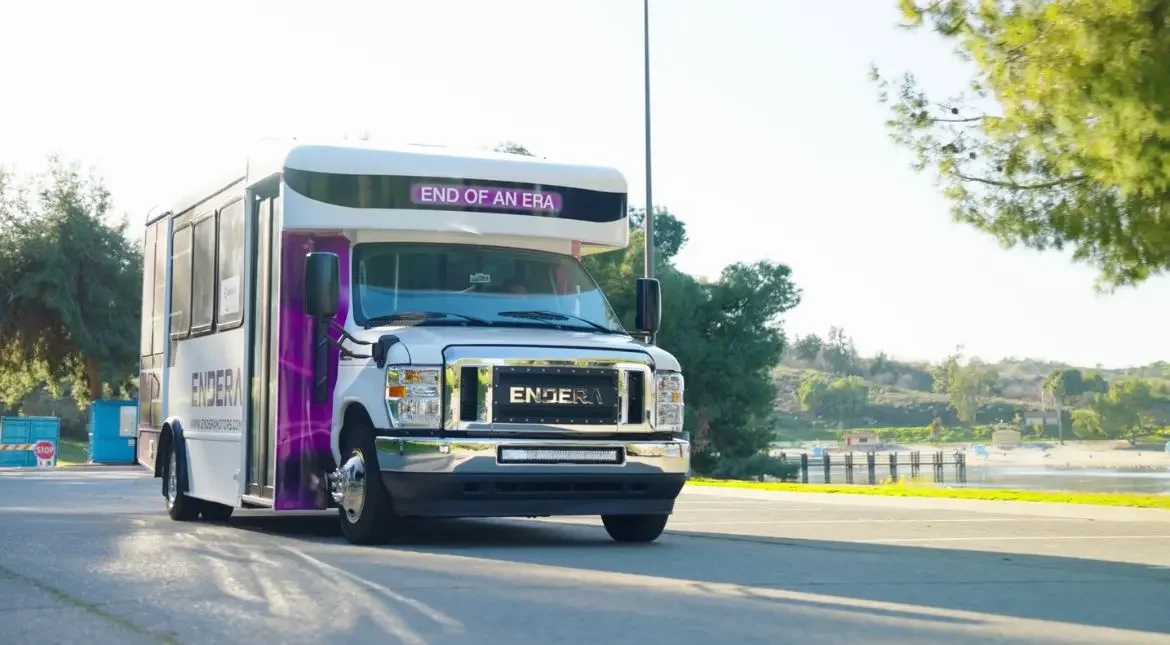
Washington is one of the most EV-supportive states in the U.S., shaping its shuttle market accordingly. It follows California's Advanced Clean Trucks standards, offers business EV incentives, and is expanding charging infrastructure through the NEVI program. For operators in Seattle, university campuses, and SEA airport transport, both policy and funding are actively supporting electrification.
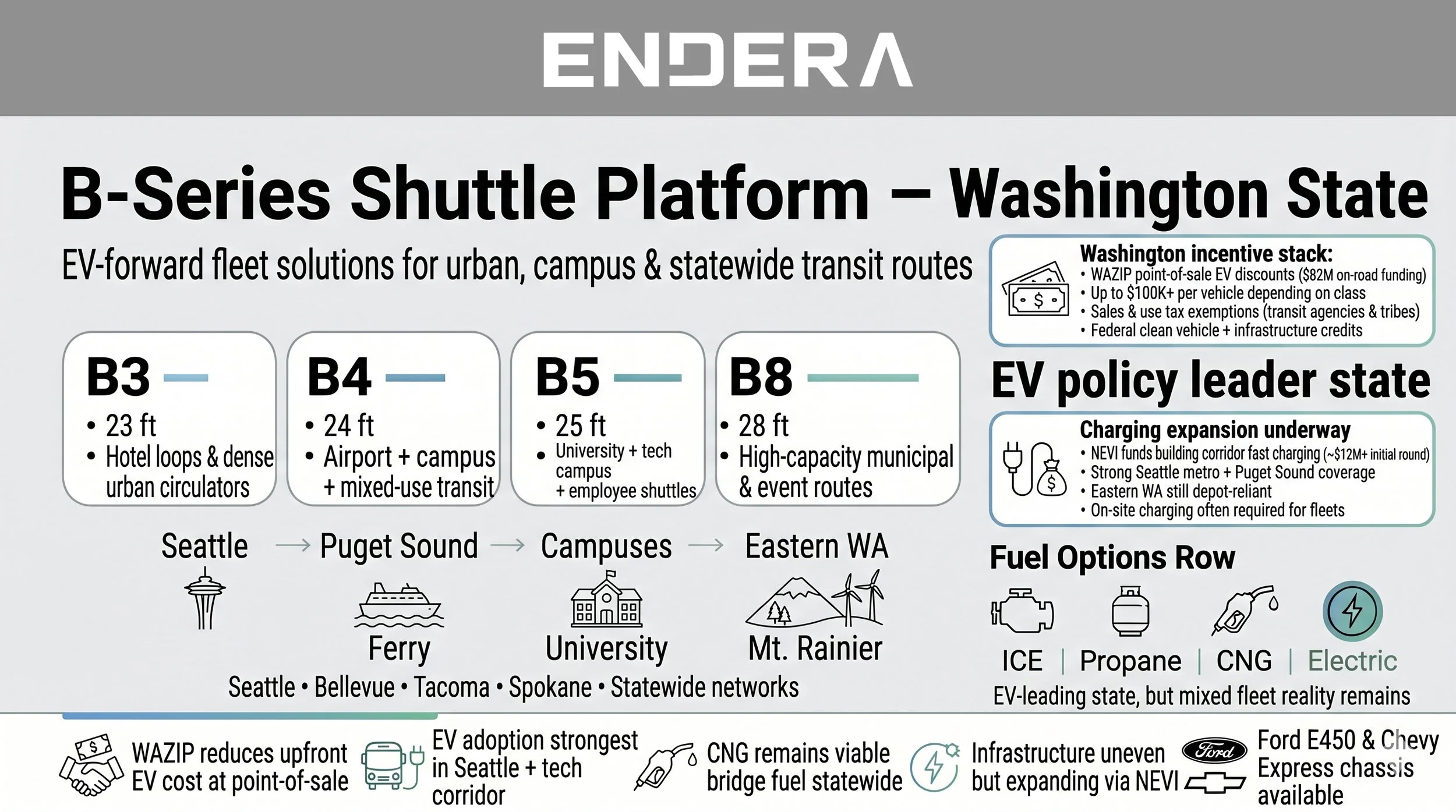
Endera's B-Series — the B3, B4, B5, and B8, ranging from 23 to 28 feet — is available in ICE, propane, CNG, and full electric configurations, built on Ford E450 and Chevrolet Express cutaway chassis. For Washington operators ready to move on electric now, the funding picture is favorable. For those not yet set up for EV charging, ICE and propane configurations remain available without compromise.
Washington's incentive windows don't stay open forever — connect with an Endera fleet specialist today to find the right configuration before the funding picture shifts.
Washington's EV Landscape: What Fleet Operators Actually Need to Know
Mandates, Incentives, and What They Mean for Shuttle Fleets
Washington has adopted California's Advanced Clean Trucks requirements, requiring manufacturers to sell an increasing percentage of zero-emission vehicles starting with model year 2025 — a policy that directly affects vehicle availability and manufacturer prioritization in the Washington market.
On the incentive side, the state's Washington Zero-Emission Incentive Program (WAZIP) provides point-of-sale discounts for qualifying commercial EV purchases, with $112 million available — $82 million for on-road vehicles. The discount is applied at the time of purchase, not as a post-purchase rebate, which meaningfully reduces the cash flow pressure of going electric. Transit agencies and federally recognized tribes purchasing zero-emission buses also qualify for a sales and use tax exemption under Washington law.
A Charging Infrastructure That's Growing — Unevenly
Washington’s NEVI program is already rolling out, with $12.16 million in Round 1 funding for 14 DC fast-charging stations along key corridors like I-90 and US 97. However, the focus is on interstate travel rather than local shuttle operations. While Seattle and other urban areas gain usable public charging, rural and eastern Washington still rely on depot charging. Endera’s turnkey infrastructure services support operators with on-site charging alongside vehicle deployment.
The B-Series Lineup for Washington Operations
Four Models Covering Washington's Range of Shuttle Markets
The B3 (23 ft) is the compact ICE model — best suited for hotel loops, small campus circulators, and urban pickup operations in Seattle and other dense markets where maneuverability matters.
The B4 (24 ft) and B5 (25 ft) are the workhorses — available in both ICE and full electric configurations, the right fit for airport ground transportation at SEA, campus transit at UW, WSU, or Seattle University, and corporate employee shuttles across the Puget Sound tech corridor. The B8 (28 ft) handles high-volume routes where passenger capacity is the primary demand.
Built for Washington's Multi-Season Operating Environment
Washington's climate varies more than most states its size — mild and wet west of the Cascades, colder and drier to the east.
For EV operators, that matters. Cold temperatures increase energy consumption as heating systems draw battery power, and wet weather affects vehicle longevity differently than dry climates. All B-Series shuttles are built at Endera's Ottawa, Ohio facility on Ford E450 and Chevrolet Express cutaway chassis — platforms with proven durability across variable climate conditions and broad service network coverage throughout Washington.
Fleet Decision Framework: Matching the Shuttle to the WA Route
Washington Route Types and the Right Configuration
| Use Case | Recommended Model | Fuel Type | Why |
|---|---|---|---|
| Seattle hotel / urban loop | B3 / B4 | EV or ICE | Dense routes, strong charging infrastructure |
| Airport ground transport (SEA) | B4 / B5 | EV | High utilization maximizes EV economics |
| University transit (UW, WSU) | B4 / B5 | EV or CNG | Campus charging infrastructure often available |
| Tech campus / corporate (Bellevue, Redmond) | B5 | EV | Predictable routes, employer charging access |
| Eastern WA / rural operations | B4 / B5 | ICE or CNG | Infrastructure gaps require fuel flexibility |
For Washington operators at Seattle-Tacoma International Airport (SEA) or running corporate campus routes in the Bellevue and Redmond tech corridor — where Microsoft, Amazon, and other major employers have existing EV charging infrastructure — the electric B4 and B5 deliver the strongest operating economics. Operators at San Diego International Airport, a comparable high-frequency airport deployment, have forecasted nearly $20,000 in annual savings per vehicle versus LPG or CNG alternatives.
Washington Incentives: What Actually Lands on the Balance Sheet
WAZIP, Tax Exemptions, and Federal Credits — Stacked
Washington operators have access to a more layered incentive stack than most states. WAZIP provides point-of-sale discounts on qualifying commercial EV purchases from its $82 million on-road vehicle fund — with the discount applied at time of purchase rather than as a delayed rebate. Transit agencies and tribes qualify for a sales and use tax exemption on zero-emission bus purchases.
The IRS commercial clean vehicle credit adds a federal layer on top of state programs, and businesses installing EV charging infrastructure may qualify for the 30C tax credit — up to $100,000 per installed port through June 2026.
Timing Still Matters — First-Come, First-Served
WAZIP funding operates on a first-come, first-served basis — when the allocation is exhausted, it's gone until additional funding is appropriated. Washington operators who qualify should engage the process sooner rather than waiting for a more convenient procurement window.
Endera's financing and grant advisory team helps Washington operators identify which programs apply to their specific operation, structure the purchase to maximize available incentives, and navigate the application process without absorbing that administrative burden internally.
What WAZIP Actually Does to Shuttle Bus Pricing
A Point-of-Sale Discount, Not a Delayed Rebate
Most discussions of Washington's WAZIP program stop at "incentives are available." What actually matters for operators is how those incentives translate into purchase price on the day of the transaction. WAZIP is structured as a point-of-sale voucher — the discount is applied immediately at purchase, not months later as a rebate.
That distinction removes one of the biggest practical barriers to EV adoption: the need to carry the full upfront cost while waiting for reimbursement. For shuttle buses falling into Class 3–6 vehicle categories, voucher amounts range from approximately $45,000 to $100,000+ per vehicle depending on weight class and eligibility for enhanced funding.
What the Numbers Look Like in Practice
| Scenario | Typical Cost |
|---|---|
| ICE shuttle (baseline) | $90K–$120K |
| Electric shuttle (pre-incentive) | $140K–$180K |
| Electric shuttle after WAZIP | $60K–$120K (effective) |
The result is a meaningful shift in how operators should think about the purchase. The upfront price gap between ICE and electric can shrink dramatically — or disappear entirely depending on configuration and eligibility. In some cases,
Washington operators reach near price parity on day one, rather than waiting years to recover costs through fuel and maintenance savings. That reframes the core question for WA fleets from affordability to operational fit — which is exactly where the real decision should be made. Endera's financing and grant advisory team helps Washington operators confirm eligibility, time the purchase correctly within WAZIP's first-come, first-served funding structure, and stack additional federal credits where applicable.
True Cost vs. Cash Flow Reality
The Remaining Gap and How to Manage It
Even with WAZIP applied, electric shuttles may carry a higher effective upfront cost than ICE in some configurations — and the savings from lower fuel and maintenance costs still accrue over time rather than landing immediately. Battery replacement — estimated in the tens of thousands of dollars — remains a mid-cycle planning consideration that operators should factor into their 10-year ownership model alongside the operating savings.
The honest picture: Washington's incentive stack compresses the early-year financial pressure more than almost any other state, but it doesn't eliminate the need for thoughtful purchase structure.
Financing Options That Work With the Incentive Stack
Endera's financing team structures purchases with the full lifecycle in mind — direct financing, capital leasing, and grant-stacked purchase structures based on each operator's cash flow and ownership timeline. For Washington operators who qualify for WAZIP, the 30C charging credit, and federal commercial vehicle credits simultaneously, coordinating those programs correctly at the time of purchase requires the kind of planning that's hard to do alone under procurement deadline pressure.
Built for Washington's Direction of Travel
Washington is moving toward electrification faster than most states — the mandates are in place, the incentive programs are funded, and the infrastructure is being built. For shuttle operators in the state, that's not a distant trend to monitor. It's the environment you're already operating in. The B-Series gives Washington fleets the vehicle and fuel flexibility to move at the pace that fits their routes, budget, and infrastructure — with a manufacturer that handles the whole package.
Washington's window for early-mover incentives won't stay open indefinitely. Talk to an Endera specialist today to find the right B-Series configuration for your Washington fleet.
FAQs
Which B-Series models are available for Washington operators?
All four models — B3 (23 ft), B4 (24 ft), B5 (25 ft), and B8 (28 ft) — are available in Washington in ICE, propane, CNG, and electric configurations depending on model. Contact Endera's sales team for current availability and lead times.
Does Washington's WAZIP program apply to Endera shuttle purchases?
Qualifying commercial EV purchases may be eligible for WAZIP point-of-sale discounts from Washington's $82 million on-road vehicle allocation. Endera's financing team can help determine eligibility and coordinate timing with the purchase process.
Are there sales tax exemptions for zero-emission shuttle buses in Washington?
Yes. Transit agencies and federally recognized tribes purchasing zero-emission buses qualify for a sales and use tax exemption under Washington law, subject to the program's cumulative benefit cap.
How does Washington's charging infrastructure affect EV shuttle deployment?
The Seattle metro and major Puget Sound corridors have relatively strong public charging availability. Eastern Washington and rural areas have more limited local charging coverage despite NEVI corridor buildout. Endera's turnkey infrastructure services provide on-site depot charging for operators who can't rely on public infrastructure.
Do Endera shuttles comply with Buy America requirements?
Yes. With approximately 65% of components sourced domestically, Endera's manufacturing supports Buy America compliance for federally funded Washington procurement contracts.
Can I get an in-stock 2026 shuttle for fast delivery in Washington?
Yes. Endera Stock lists ready-to-deliver 2026 models available for rapid deployment without a custom build lead time.
How do I start the purchasing process for a Washington fleet?
Contact Endera's sales team to discuss configuration, incentive eligibility, and timeline. Given WAZIP's first-come, first-served funding structure, earlier engagement preserves more options.