
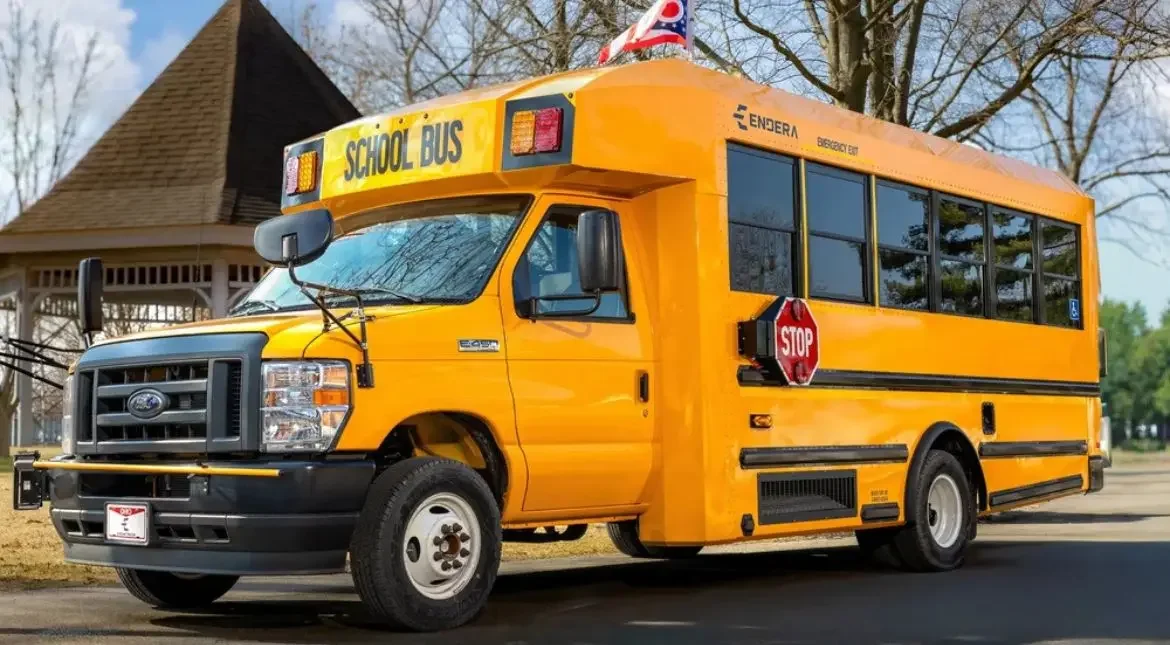
Vermont school districts are small by national standards — most serve tight-knit rural communities where every procurement dollar is visible and every vendor relationship matters. That context shapes how districts approach school bus purchases: carefully, with documentation in order, and with a close eye on whether federal funding is available to offset cost. For districts that qualify, Buy America compliance is the prerequisite that makes funding possible.
Endera manufactures Type A school buses in gasoline, propane, CNG, and electric configurations from its Buy America compliant facility in Ottawa, Ohio. All models are engineered to meet applicable Federal Motor Vehicle Safety Standards and Vermont's school bus identification and equipment requirements under 23 V.S.A. §1283.
Every procurement dollar matters in Vermont — contact Endera's sales team today to confirm Buy America documentation and assess federal funding eligibility before your next bid cycle.
What Buy America Requires for Vermont Purchases
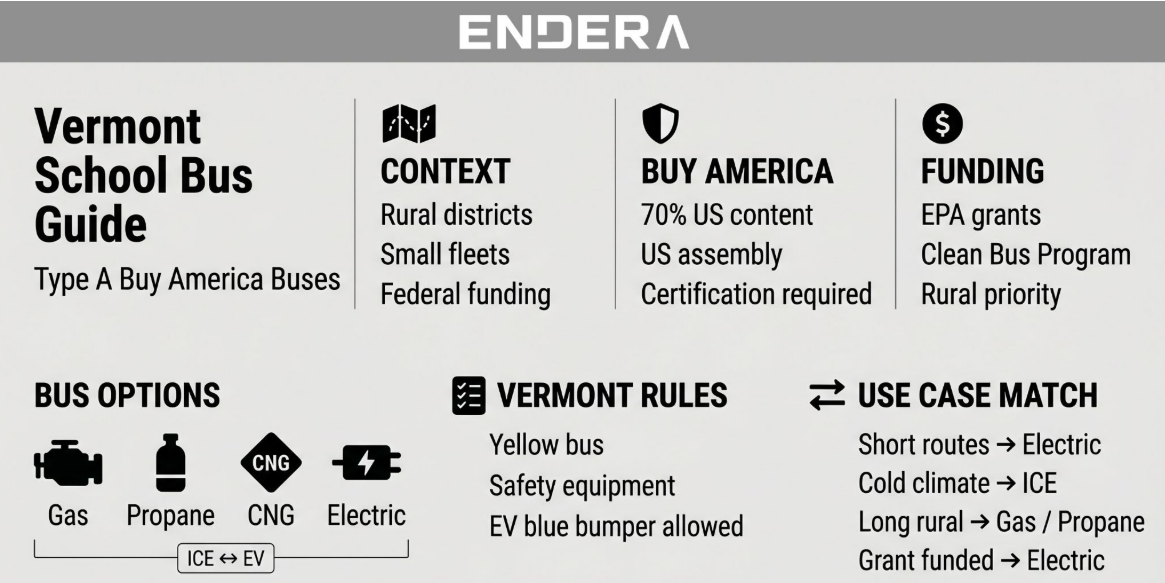
The Federal Transit Administration's Buy America program requires that transit vehicles purchased using federal funds — including EPA Clean School Bus Program rebates and FTA grants — contain more than 70% domestic component content and be finally assembled in the United States. This threshold has applied to bus procurements since FY2020.
The requirement is enforced through documentation. Before a federally funded purchase can be finalized, the manufacturer must provide a pre-award Buy America certification confirming the vehicle meets the domestic content and assembly requirements. Vermont districts using any federal transportation funding must have this certification on file. Endera's Ottawa, Ohio manufacturing facility — drawing 65% of its supply chain from within Ohio — meets and documents these requirements as a standard part of the sales process.
Federal Funding Vermont Districts Have Already Accessed
Vermont has been an active recipient of EPA Clean School Bus Program funding across multiple rounds. In October 2022, four Vermont school districts received $4.345 million to purchase 11 clean school buses. In the 2023 rebate round, six Vermont school districts received awards: Arlington School District, River Valley Unified School District #73, Sandgate School District, South Burlington School District, Vernon School District, and Champlain Valley Unified School District.
Vermont's rural, low-income, and small-district profile aligns well with the EPA program's priority criteria — the program specifically prioritizes rural and underserved communities, which describes the majority of Vermont's school systems. Districts that haven't yet applied remain eligible for future funding cycles. Endera's grant navigation services assist Vermont districts in identifying eligibility, preparing applications, and coordinating the compliance documentation that award finalization requires.
Vermont's School Bus Identification and Equipment Requirements
Vermont law under 23 V.S.A. §1283 specifies the identification and equipment requirements for all school buses operating in the state. Buses must be painted National School Bus Glossy Yellow, identified with "School Bus" lettering not less than eight inches high between the warning signal lamps, and equipped with a stop arm, flashing warning lights, and a mirror system providing specific sightline coverage from the driver's seated position.
Vermont includes a notable electric-specific provision: plug-in electric school buses may have blue bumpers instead of the standard glossy black. This is a small but meaningful detail that identifies EV buses distinctly in the field and reflects Vermont's accommodation of its growing electric fleet. All school buses — including electric models — must also comply with Federal Motor Vehicle Safety Standards as of the date of manufacture, as required by 23 V.S.A. §1283(a)(6).
Vermont's No-Van Rule for Student Transport
Vermont's approach to student transportation is more restrictive than most states on one specific point: 11–15 passenger vans cannot legally be used to transport school children. The Vermont Department of Motor Vehicles has confirmed that any 11–15 passenger vehicle used to transport school children must be a certified school bus — not a converted van, rental vehicle, or passenger vehicle.
This means the decision for Vermont districts in the mid-capacity range isn't van vs. bus — it's which bus. Type A school buses are the direct fit for routes and student populations where a full-size Type I bus would run under capacity. For Vermont's many small and rural districts, a properly sized Type A running a special education placement or a low-ridership rural route is the operationally and legally correct answer.
Electric vs. ICE for Vermont's Rural Districts
Vermont has no state mandate requiring zero-emission school bus purchases, but the state's environmental priorities and rural district profile make the evaluation worth doing carefully.
| Scenario | Better Fit |
|---|---|
| Short suburban/town routes under 80 miles/day | Electric |
| Rural routes with limited charging access | ICE (gas or propane) |
| District pursuing EPA grant funding | Electric |
| Cold-weather operation, long daily mileage | ICE or EV with conservative range planning |
| First-time buyer, tight procurement budget | Gasoline |
Vermont's cold winters are the central range variable for electric evaluation. Heating systems can reduce effective battery range by up to 50% in sustained sub-freezing conditions — meaning a 150-mile rated battery should be planned for 75–100 miles in Vermont's harshest months.
For districts with predictable short routes and overnight charging access, electric is viable year-round with appropriate planning. For longer rural routes in the Northeast Kingdom or higher-elevation areas, gasoline or propane remains the more operationally reliable choice.
Vermont Driver Requirements for School Bus Operations
Vermont requires school bus drivers to hold a CDL with a school bus endorsement, with separate knowledge tests for Type I (large) and Type II (small) school buses. The endorsement examination uses the Vermont School Bus Manual and the Vermont Commercial Driver License Manual, with a passing score of 80% or better required. A road test in a school bus representative of the type the driver will operate is also required.
Vermont sets the minimum age for school bus drivers at 21 and requires a background check, medical examination, and completion of a formal training program covering safe driving, student management, emergency procedures, and state-specific regulations. These requirements apply uniformly across gasoline, propane, CNG, and electric bus types.
Documentation Vermont Districts Need at Purchase
Vermont school bus procurement requires more than a price quote. Federally funded purchases need a Buy America pre-award certification, FMVSS compliance documentation, and warranty terms on file before the award can be finalized. Districts conducting formal competitive procurement also need specification documentation confirming the vehicle meets Vermont's identification and equipment requirements.
Don't let missing documentation delay a funded purchase. Contact Endera's sales team today to request a full procurement documentation package, confirm grant eligibility, and review in-stock and custom-build availability for Type A models.
Frequently Asked Questions
Which Vermont school districts have received EPA Clean School Bus funding?
In the 2022 round, four Vermont school districts received a combined $4.345 million for 11 clean school buses. In the 2023 rebate round, six Vermont districts received awards: Arlington School District, River Valley Unified School District #73, Sandgate School District, South Burlington School District, Vernon School District, and Champlain Valley Unified School District. Vermont districts that haven't yet applied remain eligible for future EPA program cycles.
Can Vermont school districts use 15-passenger vans for student transport?
No. Vermont law and the Vermont DMV have confirmed that any 11–15 passenger vehicle used to transport school children must be a certified school bus — not a passenger van. Vehicles cannot be retrofitted to meet school bus specifications after manufacture. Districts in this capacity range must use a Type I or Type II school bus compliant with FMVSS school bus standards.
What are Vermont's school bus color and identification requirements?
Under 23 V.S.A. §1283, Vermont school buses must be painted National School Bus Glossy Yellow with "School Bus" lettering at least eight inches high between the warning signal lamps. Electric school buses have one specific exception: they may have blue bumpers instead of the standard glossy black. All buses must comply with FMVSS as of their date of manufacture.
How does cold weather affect electric school bus performance in Vermont?
Heating systems draw significantly from the traction battery in cold weather, with extreme cold potentially reducing range by up to 50%. A bus rated at 150 miles should be route-planned for 75–100 miles in Vermont's coldest months. DC fast charging, standard on Endera's electric units, allows mid-shift top-ups when weather conditions require it. Districts in higher-elevation or Northeast Kingdom locations with longer routes should evaluate range carefully before committing to electric.
Does Buy America compliance affect which school bus brands Vermont districts can purchase?
Yes, for federally funded purchases. Districts using EPA Clean School Bus Program funds or FTA grants must purchase from manufacturers that provide a pre-award Buy America certification confirming more than 70% domestic component content and U.S. final assembly. Endera's domestic manufacturing footprint meets this threshold and provides the certification documentation as a standard part of the procurement process.
What is the minimum age to drive a school bus in Vermont?
Vermont requires school bus drivers to be at least 21 years old, hold a CDL with a school bus endorsement, pass written knowledge tests with a score of 80% or better, complete a road test in a representative bus, pass a medical examination, and complete a formal driver training program. These requirements apply to all bus types and powertrain configurations.
How long does it take to receive a custom-built Type A school bus from Endera?
In-stock gasoline models can typically be delivered within 1–2 weeks from Endera's Ohio facility. Custom builds — electric, propane, CNG, or alternate seating configurations — run 60–120 days depending on specification and current production volume. Vermont districts with procurement timelines tied to the school year or a grant award window should begin the custom-build conversation 3–6 months in advance.