
New Mexico school districts are buying new buses under two very different financial realities depending on whether they're pursuing federal funding. For districts that qualify for EPA Clean School Bus Program awards, the upfront cost gap between electric and ICE narrows dramatically — in some cases disappearing entirely. For districts purchasing outside of federal funding, ICE remains the lower-barrier entry point in a state where rural route mileage, charging infrastructure gaps, and tight operational budgets all factor into the decision.
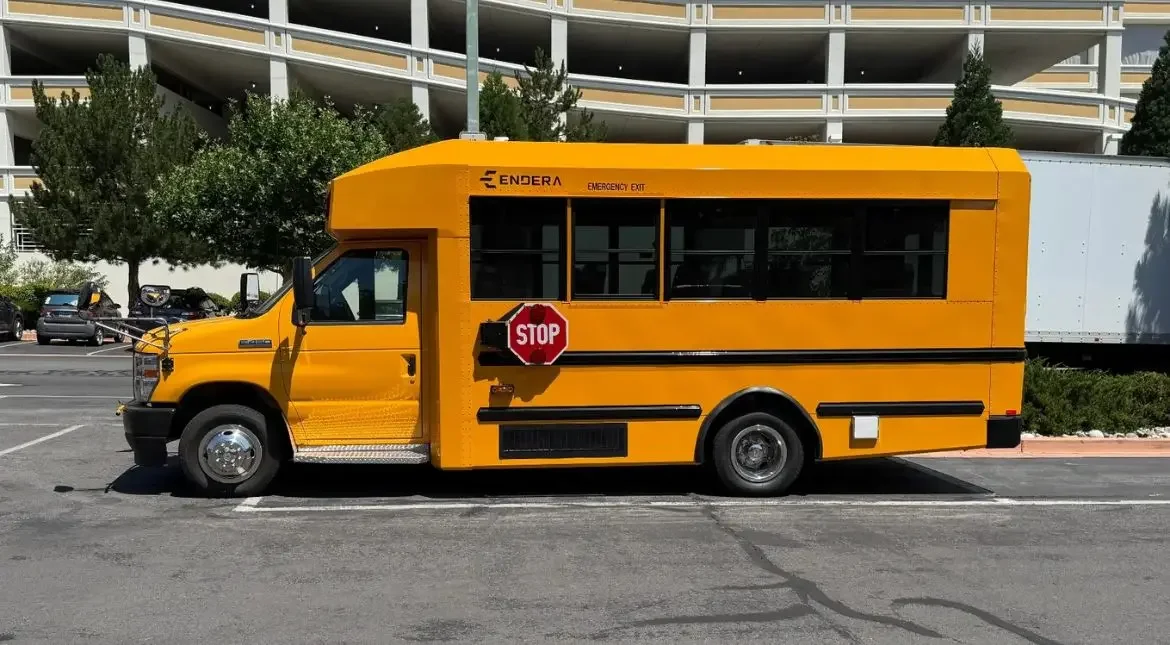
Endera manufactures Type A school buses in gasoline, propane, CNG, and electric configurations from its Buy America compliant facility in Ottawa, Ohio. All models are engineered to meet applicable Federal Motor Vehicle Safety Standards and New Mexico's school bus construction and equipment requirements under 6 NMAC 40.2.
Not sure which financial path makes sense for your district? Contact Endera's sales team today to model the real cost difference with and without federal funding applied.
Federal Funding New Mexico Districts Have Already Accessed
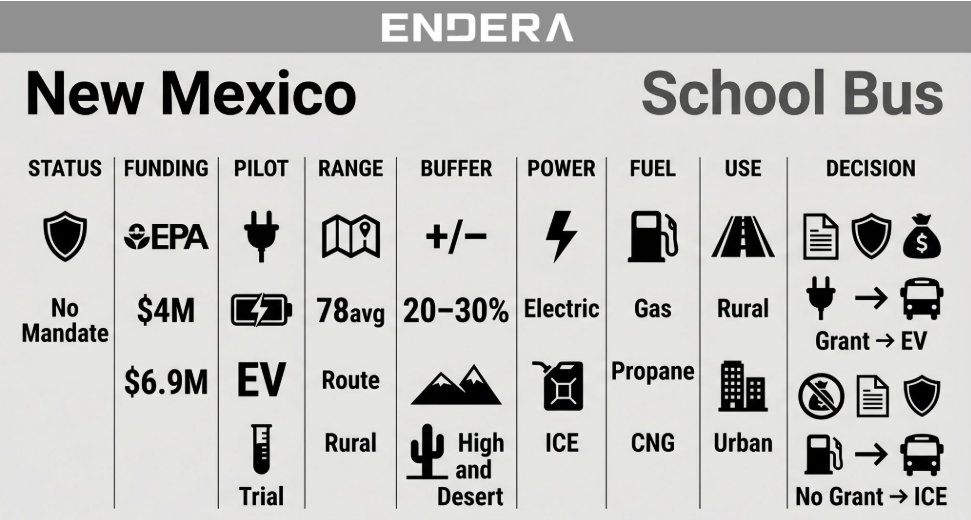
New Mexico has received meaningful federal investment across multiple EPA Clean School Bus Program rounds. In 2022, New Mexico school districts received $4 million for clean bus replacements. In the 2023 round, Albuquerque Public Schools received $6.9 million — the only New Mexico district selected in that cycle — to purchase 20 electric buses replacing older diesel models.
The EPA's Clean School Bus Program has funded over 8,500 buses nationally across more than 1,200 districts. New Mexico districts that haven't yet applied remain eligible for future rounds. Endera's grant navigation services help districts identify eligibility, prepare applications, and coordinate the compliance documentation required for award finalization.
New Mexico's Electric School Bus Pilot: What the State Is Learning
New Mexico launched a two-year statewide electric school bus pilot program beginning in the 2025-26 school year, deploying Type A and Type D electric buses across multiple districts in rotating six-week rounds. The pilot tracks range performance, charging infrastructure needs, driver and community acceptance, and operational savings — with a full report delivered to the state at the end of each school year.
This pilot matters for procurement decisions because it generates real-world New Mexico performance data: how electric buses perform in high-altitude, high-desert conditions, how charging infrastructure integrates with existing facilities, and what maintenance and training requirements look like for districts making a first-time electric transition. Districts evaluating electric purchases can reference pilot findings as they become available rather than relying solely on manufacturer spec sheets or data from other climates.
Is EV Range Enough for New Mexico Routes?
New Mexico's bus route geography is the central range concern for districts evaluating electric. The state's lower-density rural areas run longer routes than urban and suburban counterparts, and high-desert altitude and temperature extremes both affect battery performance. The honest planning framework: districts should calculate expected daily mileage, add a 20–30% buffer for weather variability, and compare that figure against the bus's rated range.
For most New Mexico districts, the math works. Legislative transportation studies show the average bus route in the state runs well under 78 miles — well within the operating range of a 105–150 mile electric Type A on a single overnight charge. The exceptions are the longest rural routes in low-density counties, where ICE remains the more operationally straightforward choice until charging infrastructure expands to those areas.
New Mexico School Bus Compliance: What the State Requires
New Mexico's school bus standards are administered by the Public Education Department's Transportation Bureau. Under 6 NMAC 41.4, all school buses used to transport students must meet the state's construction standards and the school bus maintenance and safety audit inspection guide. Required equipment includes driver seat belts, IEP-required student restraints, a UL-approved fire extinguisher rated 2A10BC or greater, three triangular warning reflectors, a first aid kit, and a body fluid clean-up kit.
New Mexico's construction standards under 6 NMAC 40.2 require the state transportation director to maintain bus construction standards consistent with national design recommendations, covering both body and chassis specifications — including standards for transporting students with disabilities. Any new technology or component applied to a school bus in New Mexico must have Public Education Department approval before use, which means vendors introducing new configurations should work with the state on compliance verification.
ICE vs. Electric: The New Mexico Decision Matrix
New Mexico has no state mandate requiring zero-emission bus purchases. Districts have full flexibility, making the decision a practical one based on routes, budget, and infrastructure readiness.
| Scenario | Better Fit |
|---|---|
| Rural routes over 100 miles/day | ICE (gas, propane, or CNG) |
| No charging infrastructure at depot | ICE |
| District pursuing EPA grant funding | Electric |
| Urban/suburban routes under 80 miles/day | Electric |
| First-time EV transition with pilot support | Electric (with planning support) |
| Tight budget, no grant funding available | ICE |
Endera builds the same Ford E450-based platform in all four powertrain options — meaning a district can procure gasoline now and transition to electric in a future cycle without changing manufacturers, service relationships, or the VDOE specification compliance documentation on file.
Type A Buses Across New Mexico's District Geography
New Mexico's 89 school districts range from Albuquerque Public Schools — one of the largest urban districts in the Southwest — to small rural districts in the Navajo Nation and southeastern plains counties where daily ridership on individual routes may be minimal. Type A buses serve both ends of that spectrum: urban districts use them for special education and smaller program placements; rural districts use them as the right-size vehicle for routes that don't justify a full-size bus.
Endera's Type A lineup — the Endera 4, 5, and 6 — covers 4–6 section configurations with ADA-compliant lift options across all powertrain types. For districts managing mixed fleets, the same manufacturer relationship and vehicle warranty covers both ICE and electric purchases.
Starting the Procurement Conversation
New Mexico school bus procurement typically follows a competitive bidding process consistent with state public purchasing requirements. Endera can provide specification compliance documentation, Buy America certification for federally funded purchases, and grant eligibility assessment as part of the pre-bid engagement.
Get your documentation in order before the bid window opens. Contact Endera's sales team today to discuss route-specific configuration options, confirm EPA funding eligibility, and review in-stock and custom-build availability for Type A models.
Frequently Asked Questions
Has New Mexico received EPA Clean School Bus Program funding?
Yes. New Mexico school districts received $4 million in the 2022 EPA Clean School Bus Program round. In the 2023 round, Albuquerque Public Schools received $6.9 million — the only New Mexico district selected — to purchase 20 electric buses replacing older diesel models. Districts that didn't apply or weren't selected in prior rounds remain eligible for future funding cycles.
What are New Mexico's school bus equipment requirements?
Under 6 NMAC 41.4, all New Mexico school buses must carry a UL-approved fire extinguisher rated 2A10BC or greater, three triangular warning reflectors, a first aid kit, a body fluid clean-up kit, and an operable driver seat belt. Student restraint systems are required for any student whose IEP specifies them. All buses must also meet the state's construction standards under 6 NMAC 40.2 and pass the state's maintenance and safety audit inspection.
Does New Mexico have an electric school bus mandate?
No. New Mexico has not enacted a state-level zero-emission school bus mandate. Districts have full flexibility to purchase ICE or electric models. The state is running a two-year electric school bus pilot beginning in 2025-26 that will generate real-world performance data for districts evaluating electric options.
Is electric range sufficient for New Mexico's rural routes?
For most routes, yes. State transportation data shows the average New Mexico bus route runs well under 78 miles — within the operating range of a 105–150 mile electric Type A on a single overnight charge. Long rural routes in the state's lowest-density counties may exceed practical EV range, particularly in winter when heating draws from the battery. Districts should calculate expected daily mileage plus a 20–30% weather buffer before committing to an electric configuration.
What is New Mexico's electric school bus pilot program?
New Mexico's Economic Development Department launched a two-year pilot in 2025-26 deploying Type A and Type D electric buses across multiple districts in rotating six-week rounds statewide. The pilot tracks range, charging infrastructure needs, driver acceptance, and operational savings, with a full report submitted to the state at year's end. Districts evaluating electric purchases can reference pilot findings as data becomes available.
Does Endera's manufacturing qualify as Buy America compliant for federal purchases?
Yes. Endera manufactures its vehicles domestically at its Ottawa, Ohio facility, sourcing 65% of its supply chain from within Ohio. This meets the FTA's Buy America threshold of more than 70% domestic content for transit vehicle procurements. Districts using EPA Clean School Bus Program funds or FTA grants must purchase from manufacturers with a pre-award Buy America certification — Endera can provide this documentation on request.
Can New Mexico districts purchase used school buses instead of new?
Yes. New Mexico law permits school districts to purchase used school buses, provided the vehicle meets construction and design standards in effect on its date of manufacture and passes the state's inspection requirements. Used buses are not eligible for EPA Clean School Bus Program funding, which requires model year 2023 or newer vehicles. For districts prioritizing funding eligibility, new purchases are the only qualifying path.