
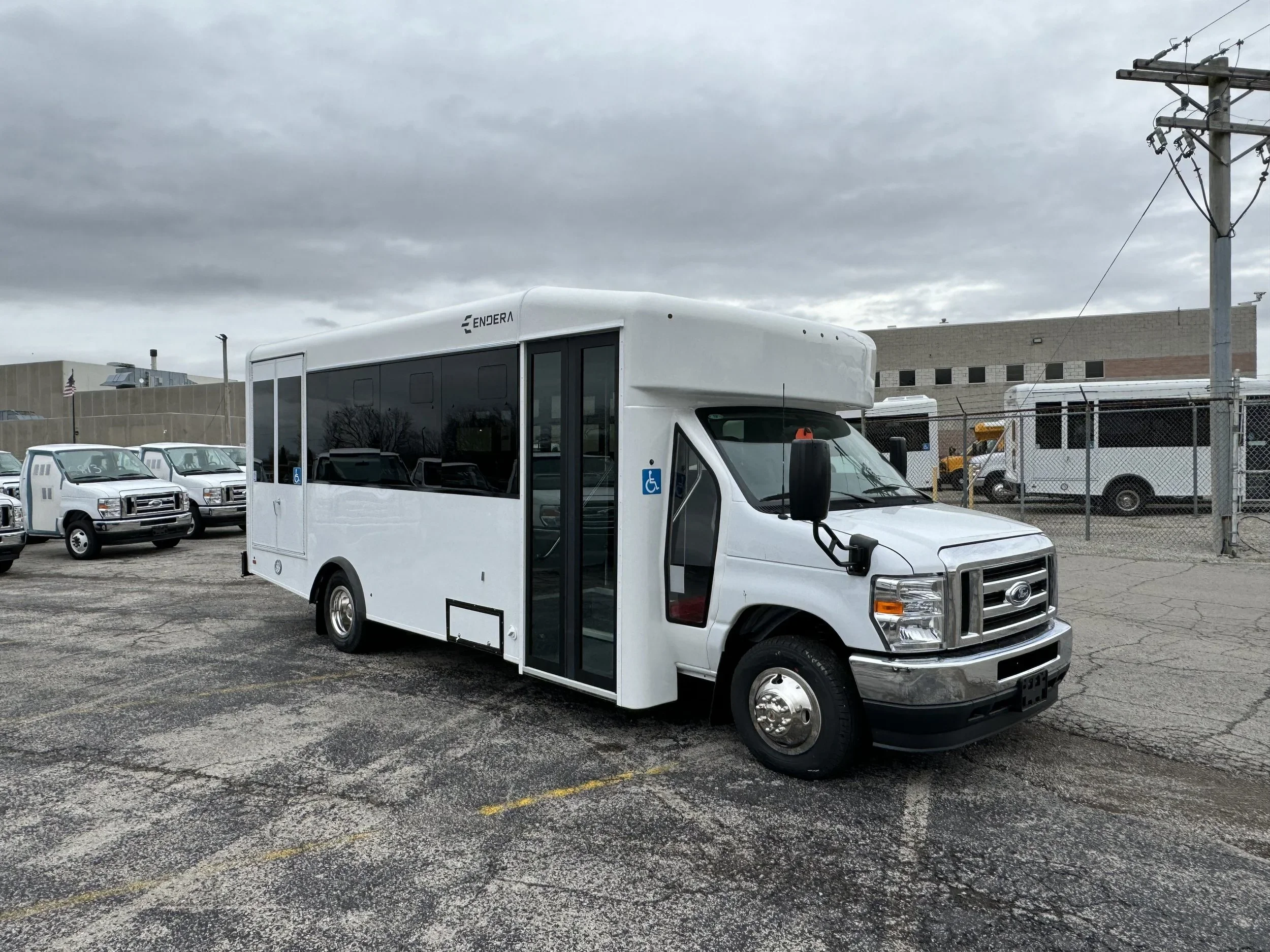
Texas is the second-largest state by population and one of the most geographically spread markets in the country. Dallas-Fort Worth, Houston, San Antonio, and Austin each anchor shuttle markets that would be significant on their own — and together they represent a volume and variety of transportation demand that few states can match. Endera builds the B-Series commercial shuttle as a complete system — vehicle, powertrain, software, and charging infrastructure — assembled under one roof so that operators from DFW airport ground transport to Austin campus transit are working with a manufacturer accountable for the entire vehicle, not a patchwork of vendors.
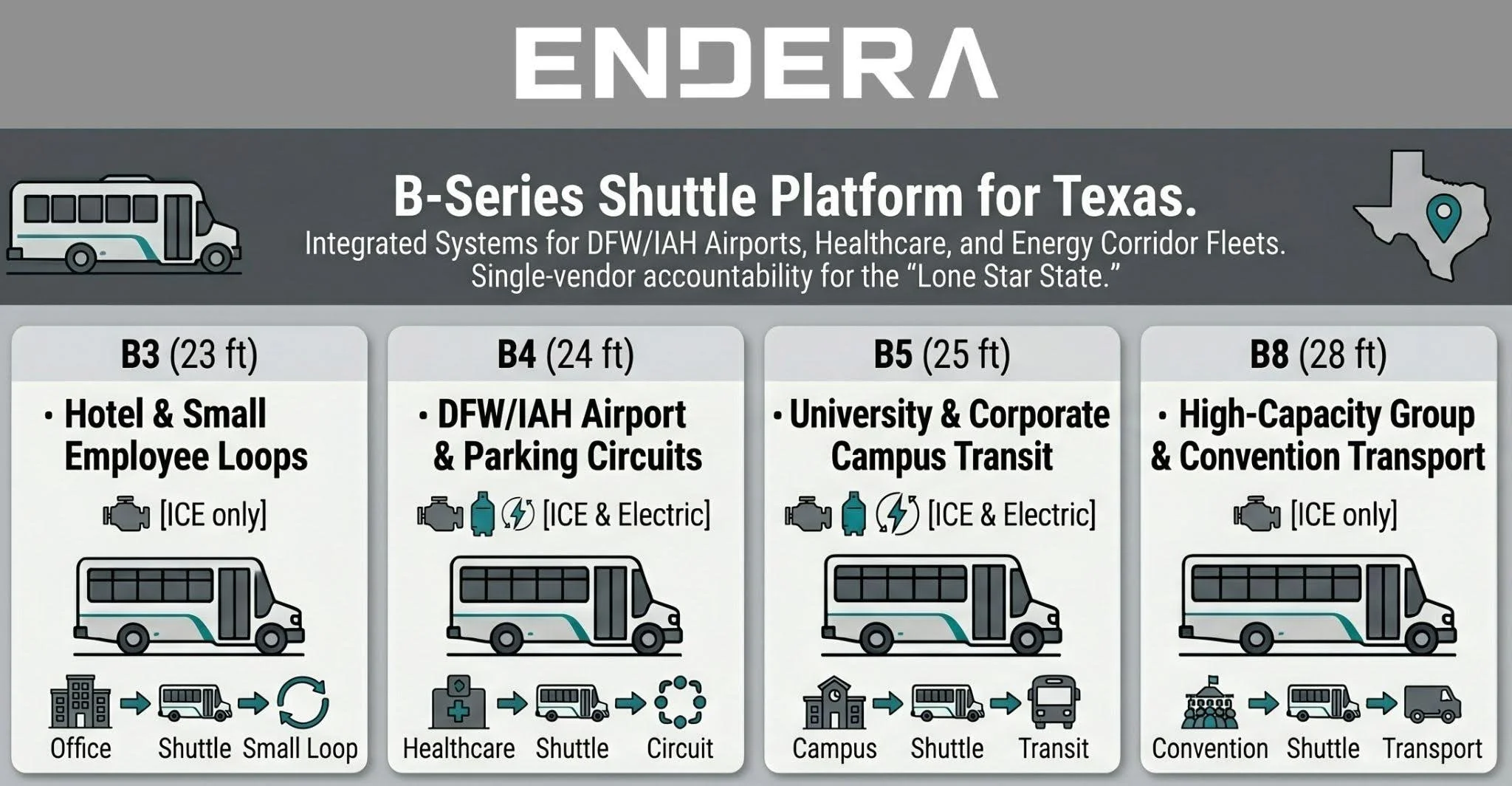
What a hotel shuttle operator in San Antonio needs from a vehicle is different from what a corporate campus shuttle program in Houston's Energy Corridor requires, and both are different from the high-frequency airport parking shuttles running at DFW or IAH. For Texas operators evaluating a new shuttle or fleet refresh, Endera's B-Series lineup spans the B3, B4, B5, and B8 in 23–28 foot configurations, with ICE and full-electric powertrains available and route-specific customization handled at the factory level.
Ready to spec your fleet? Contact Endera's fleet specialists today to design a custom configuration blueprint for your operation.
The B-Series Lineup and What Each Model Is Built For
Four Models, Multiple Fuel Options
Endera's B-Series runs from 23 to 28 feet, built on the Ford E450 and Chevrolet Express cutaway chassis — platforms with an extensive dealer and service network across Texas. The B3 at 23 feet handles smaller hotel loops and employee shuttles. The B4 and B5 — available in both ICE and electric — cover the mid-size range used most often by airports, corporate campuses, and university transit. The B8 at 28 feet handles high-volume convention and group transport where passenger capacity drives the decision.
ICE or Electric: Honest Guidance for Texas Operators
Texas's climate is warm most of the year, which supports consistent EV battery performance on shorter, predictable routes — airport parking loops, resort property shuttles, and university campus transit are all good candidates for the electric B4 and B5. DC fast charging comes standard, which matters for operations running tight turnaround schedules. For operators covering longer inter-city corridors, rural routes across west Texas, or operations where depot charging infrastructure isn't yet in place, the ICE variants remain the more practical choice. Endera builds both, which means operators aren't pushed toward a fuel type before their operation is actually ready for it.
What 274 Million Annual Passenger Trips Mean for Shuttle Utilization in Texas
A Transit Market That Sets the Operational Baseline
Texas transit operates at a scale that directly shapes how shuttle fleets are deployed and sized. According to the Texas Comptroller of Public Accounts, public transportation systems across the state delivered approximately 274 million passenger trips in a single fiscal year — a figure drawn from TxDOT reporting that reflects the combined demand of the state's metropolitan transit authorities, urbanized transit districts, and rural networks. That level of volume isn't an abstraction for fleet operators. In major corridors — airport loops at DFW or IAH, corporate campuses, and university transit systems — shuttle buses are rarely sitting idle.
What High-Volume Utilization Means for Vehicle Selection
In high-demand corridors, many Texas shuttle vehicles function as continuous-duty assets, cycling passengers throughout the day to absorb overflow demand and serve first- and last-mile connections that larger transit systems don't cover. Fleet sizing reflects that pressure — operators in dense metro environments typically deploy multiple vehicles to maintain frequency and redundancy rather than relying on a small number of high-capacity units.
In contrast, lower-density rural Texas operations may run fewer vehicles, but each one covers longer distances and operates for extended periods per shift. For buyers evaluating shuttle bus options in Texas, vehicle selection isn't just about seating capacity — it's about how often the vehicle runs, how reliably it handles sustained utilization, and whether the manufacturer behind it can support the fleet when something needs attention.
Who Makes the Shuttle Purchase Decision in Texas Organizations
The Operational Side of the Table
In Texas shuttle operations — whether that's a corporate mobility program, an airport ground transport contractor, or a university transportation department — the transportation director or fleet manager defines what the vehicle needs to do. They know the routes, the duty cycles, the maintenance patterns, and where the current fleet is falling short. That operational knowledge is what drives specifications. But the purchase authority usually sits with someone else.
The Approval Side of the Table
For public-sector buyers — UT System, Texas A&M, DART, Capital Metro, or state agency fleets — procurement runs through the Texas Comptroller's Statewide Procurement Division, with formal solicitations posted through the Electronic State Business Daily and statewide contracts available through TxSmartBuy. When federal transit funding is involved, FTA procurement compliance standards apply. For private operators like energy companies, hospitality groups, or logistics firms, the approval chain typically runs through a CFO or operations VP weighing total cost of ownership alongside capital availability. Endera's financing options — direct financing, capital leasing, and grant navigation — are structured for both types of buyers.
How B-Series Compares to Other Texas-Available Shuttle Buses
The Shared Platform Reality
In Texas, most shuttle buses share the same underlying Ford E450 or GM cutaway chassis, and the differences between manufacturers come down to integration, configuration flexibility, and who's accountable when something goes wrong. For public-sector buyers using federal transit funding, compliance is a real constraint. Any shuttle purchased with federal dollars must meet FTA Buy America requirements, including domestic content thresholds and U.S. final assembly standards — which narrows the field to manufacturers that can certify compliance and support pre-award and post-delivery audit requirements.
Where Endera Differs — and Where It Doesn't
Competing manufacturers like Starcraft, Turtle Top, and ElDorado operate as body builders on shared chassis, which is a reasonable fit for operators who prioritize low upfront cost, rapid availability, or compatibility with an existing service relationship. Where Endera's B-Series differs is in being a fully integrated platform — vehicle, powertrain, software, and charging infrastructure — from a single manufacturer. For high-volume Texas operators where downtime directly impacts revenue, that single-vendor accountability reduces friction across procurement, service, and long-term fleet management in ways that a multi-vendor configuration doesn't.
What the Procurement Difference Looks Like in Practice
Body-builder configurations often require third-party telematics, separate charging vendors for EV units, and more coordination during procurement and ongoing service. Under federal procurement rules, public agencies must verify compliance certifications before contract award — a process that becomes more complex when multiple vendors are involved. In practice, the decision comes down to operational priorities: single-vendor accountability and integrated software favor the B-Series; lowest initial cost or existing dealer compatibility may favor traditional manufacturers.
Endera's Software Stack: What It Does for Texas Fleet Managers
Real-Time Visibility for Passengers and Operators
Every Endera B-Series shuttle comes available with two integrated software tools built in-house. Endera Go gives passengers real-time vehicle location, ETA updates, and occupancy data — directly useful for airport shuttle services, convention transport, and corporate campus programs where wait time affects the passenger experience and operational throughput. Endera Dispatch handles the fleet management side: routing optimization, vehicle health analytics, and for EV operators, state-of-charge monitoring that lets managers plan routes around battery availability.
No Third-Party Integration Required
Both tools are integrated directly with the vehicle's hardware — no separate telematics license, no integration project, no data gap between what the vehicle is doing and what the software is reporting. For Texas operators managing fleets across multiple locations or routes, that visibility is operationally useful day to day. For operators building the internal case for electrification, the cost-per-mile and utilization data Dispatch generates is exactly what a CFO or procurement officer needs to evaluate ROI.
Texas Shuttle Operations Need a Vehicle Built for the Scale
From DFW airport loops and Houston Energy Corridor campus shuttles to San Antonio hospitality transport and Austin university transit, Texas shuttle operations span more ground and more variety than almost any other state. Endera's B-Series is built as a complete system — vehicle, powertrain, software, and charging infrastructure — by one manufacturer accountable for the whole thing, with the fuel flexibility to meet operators wherever they are in the transition to clean energy.
Contact Endera's fleet specialists to explore configurations, check current availability, and find out what funding your Texas operation may qualify for.
FAQs
1. What B-Series models are available for Texas buyers?
The B-Series runs from the B3 (23 feet) through the B8 (28 feet). The B4 and B5 are available in both ICE and electric configurations. The B3 and B8 are currently ICE only. Endera's sales team can confirm current in-stock availability and lead times for Texas delivery.
2. Can Texas shuttle operators access TCEQ grant funding?
Yes, depending on operator type. Public entities operating fleets of more than 15 vehicles may qualify through TCEQ's GAFF program. Operators replacing older diesel vehicles should also review the TxVEMP program. Endera's team navigates applicable funding as part of the sales process.
3. Does Endera provide charging infrastructure for Texas EV buyers?
Yes. Endera provides full turnkey charging infrastructure — site assessment, charger sourcing, and installation — as part of its EV offering. Texas operators work with one vendor for both the vehicle and the charging setup.
4. How does Texas public procurement work for shuttle buses?
Public agencies in Texas procure through the Texas Comptroller's Statewide Procurement Division, with statewide contracts available through TxSmartBuy. Federal transit funding purchases are subject to FTA requirements. Endera's sales team can support documentation across procurement pathways.
5. Is the B-Series right for west Texas or rural operations?
For long rural corridors and operations without depot charging infrastructure, the ICE variants are the more practical choice. The propane and CNG options available on Endera's school bus line are also worth considering for operators managing mixed fleet types. Endera's team works through route and depot conditions before recommending a configuration.
6. What software comes with a B-Series shuttle?
Every B-Series shuttle comes available with Endera Go and Endera Dispatch — real-time passenger tracking, fleet management, routing, and vehicle health analytics — both built in-house and integrated directly with the vehicle's hardware.
7. Does Endera offer financing for Texas buyers?
Yes. Endera offers direct vehicle financing and capital leasing through its financing platform. Capital leasing preserves working capital and aligns vehicle costs with revenue cycles. Endera also assists with grant identification and application for buyers pursuing public funding.