
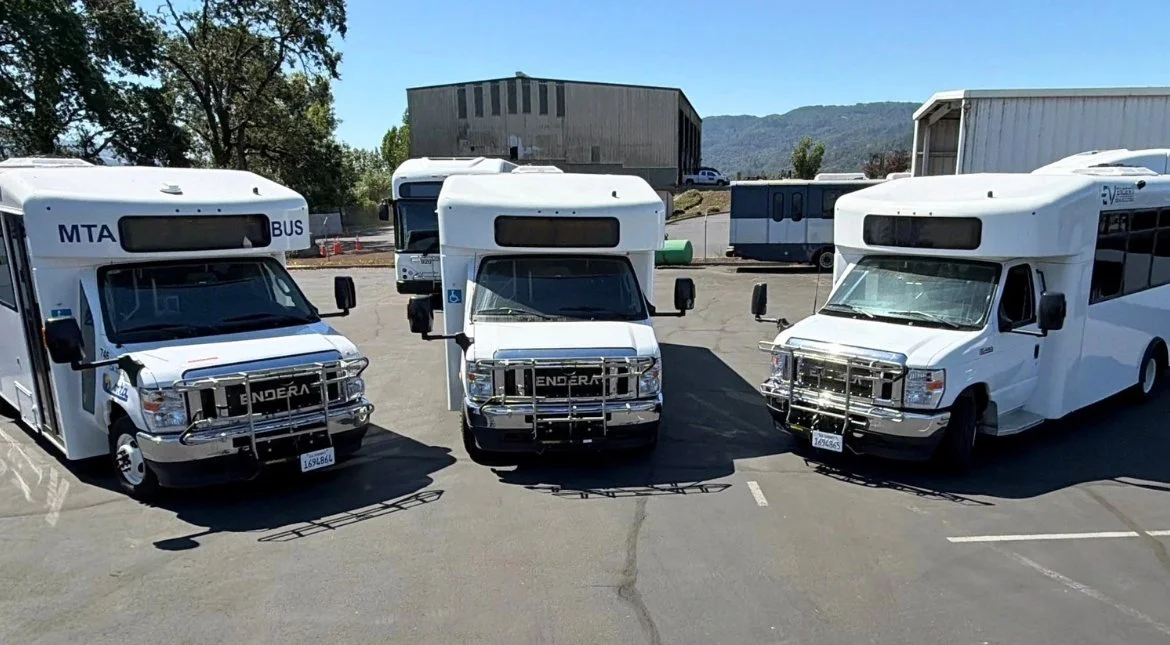
Michigan brings a specific set of expectations to fleet procurement that other states don't — automotive manufacturing culture means buyers understand engineering quality, cold winters mean vehicle reliability is tested in ways the national average doesn't capture, and an active EV ecosystem means operators are evaluating electric readiness alongside traditional powertrain options. For Michigan fleet buyers, the shuttle bus decision is a technical and operational decision, not just a capacity decision.
Endera manufactures Class 4 B-Series commercial shuttles in ICE, propane, CNG, and full-electric configurations on Ford E450 and Chevrolet Express cutaway chassis. Endera is the only American vertically integrated OEM for Class 4 electric shuttles — body assembly and powertrain installation handled at the same Ottawa, Ohio facility. For Michigan transit agencies, universities, manufacturing campuses, and healthcare systems, the B-Series is FTA-eligible and Buy America compliant. For Michigan operators evaluating a new shuttle or fleet refresh, Endera's B-Series lineup spans the B3, B4, B5, and B8 in 23–28 foot configurations, with ADA-accessible flat-floor models and route-specific customization handled at the factory level.
Ready to spec your fleet? Contact Endera's fleet specialists today to design a custom configuration blueprint for your operation.
Michigan's Fleet Modernization and EV Leadership
Michigan's Office of Future Mobility and Electrification is driving statewide investment in electrified transportation and smart mobility systems — a policy environment that shapes fleet procurement decisions across both public and private operators. The Michigan Business Mobility Funding Platform supports mobility innovation and infrastructure development aligned with the state's transportation modernization goals.
The Michigan Department of Environment, Great Lakes, and Energy EV program oversees clean transportation initiatives and EV infrastructure investment statewide. The Michigan Clean Cities Coalition supports alternative fuel and electric fleet adoption across municipal, commercial, and institutional operators — providing a support network for Michigan fleet managers navigating the transition from diesel to cleaner powertrains.
Electric Shuttle Bus Performance in Michigan Winters
Cold-weather EV performance is the primary question Michigan fleet buyers ask before specifying electric. NREL's electric bus cold-weather performance research documents battery range reduction, regenerative braking efficiency, and thermal management performance under winter operating conditions — findings directly applicable to Michigan fleets running through January and February.
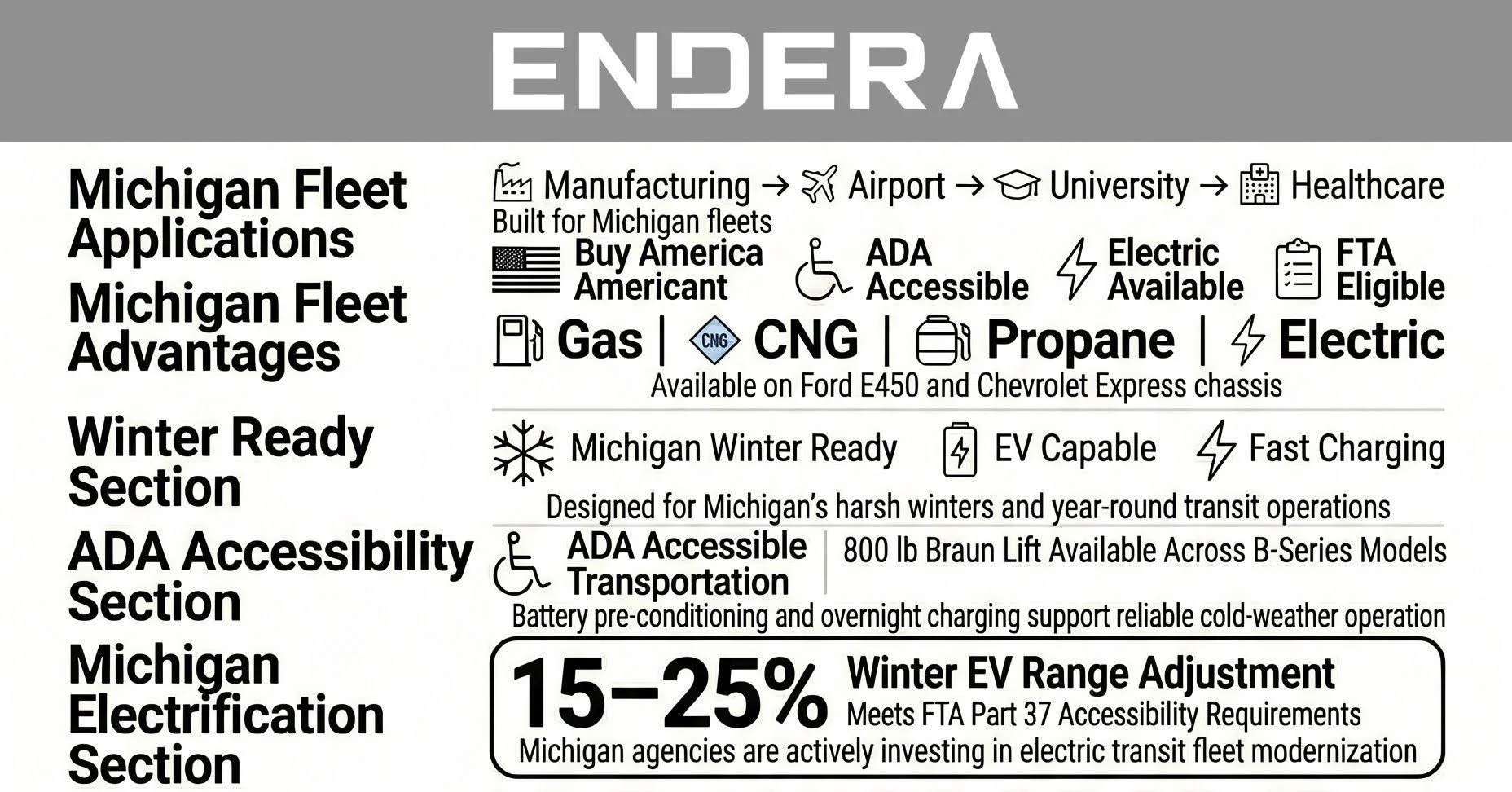
Battery range typically drops 15–25% in sub-freezing conditions. Pre-conditioning the battery while still plugged in before departure mitigates range loss. Regenerative braking remains effective even in cold weather, recovering energy on every deceleration cycle — a meaningful advantage for high-cycle Detroit and Grand Rapids urban routes with frequent stops. DC fast charging is standard on every Endera EV unit, enabling rapid recharge between shifts during high-demand cold weather periods.
The B-Series Lineup for Michigan Fleets
| Model | Length | Fuel | Best Fit |
|---|---|---|---|
| B3 B4 B5 |
23 ft 24 ft 25 ft |
ICE ICE & EV ICE & EV |
Hotel loops, community transit, small urban routes Airport shuttles, campus loops, manufacturing transport Employee transport, healthcare, higher-capacity routes |
| B8 | 28 ft | ICE | High-volume municipal and group transport |
ADA-configured flat-floor models with 800 lb Braun lifts are available across the lineup, meeting ADA accessible transportation requirements and FTA Part 37 transportation service regulations as delivered.
Michigan Shuttle Use Cases: Where the B-Series Fits
Michigan's shuttle demand spans a wide range of institutional and commercial buyers with distinct operational profiles. Michigan's automotive manufacturing heritage shapes buyer expectations in ways that matter for fleet procurement — operators here understand drivetrain engineering, evaluate total cost of ownership methodically, and expect vehicles that perform under real commercial load rather than light-duty conditions.
Detroit, Grand Rapids, and Airport Transportation
Detroit Metro Airport and Gerald R. Ford International in Grand Rapids support high-frequency parking and hotel shuttle operations requiring durable fixed-route vehicles. Detroit's convention and hospitality corridor generates event and hotel shuttle demand that the B4 handles efficiently. Manufacturing campuses across southeastern Michigan — Ford, GM, Stellantis, and their supplier networks — operate employee shuttle programs where daily reliability and ADA accessibility are non-negotiable.
For these operators, the vertically integrated manufacturing model matters: one warranty, one service contact, and consistent quality control across every vehicle in the fleet rather than the accountability gaps that upfitter-assembled alternatives create.
Universities and Campus Transportation
The Ride in Ann Arbor serves University of Michigan's dense urban transit environment — ADA-accessible, high-frequency, and sustainability-oriented. Michigan State University Transportation Services operates campus and off-campus transportation connecting students and staff across a large residential campus.
Both represent the institutional shuttle profile that the B4 and B5 are designed for — compact, ADA-configured, and compatible with Endera Dispatch for route optimization and real-time GPS tracking.
Rural and Community Transit
The Michigan Public Transit Association represents community transit operators across the state — many managing demand-response and paratransit services in areas without fixed-route infrastructure. The National Rural Transit Assistance Program supports these smaller agencies with training, technical assistance, and procurement guidance.
For rural Michigan operators, ICE and propane B-Series configurations serve demand-response routes well — broad parts availability, no charging infrastructure dependency, and the operational flexibility that dispersed rural routing requires. Michigan's rural counties, particularly in the Upper Peninsula and northern Lower Peninsula, often have no alternative transport options — making vehicle reliability and long service life the most important procurement criteria, ahead of powertrain type or passenger capacity.
Michigan Fleet Funding and Procurement
The FTA Low or No Emission Vehicle Program provides federal funding for electric shuttle purchases by transit agencies and qualifying contracted operators. Michigan transit agencies have benefited from active federal fleet modernization investment — and operators moving toward electric now are better positioned in competitive grant cycles than those approaching applications reactively.
Michigan's VW Environmental Mitigation Trust allocation directed funding toward transit bus and shuttle fleet emissions reduction — a program that qualifying Michigan commercial operators accessed for cleaner fleet purchases. Endera's grant navigation services help Michigan operators identify applicable federal and state programs and structure purchases accordingly.
Phased Electrification for Michigan Fleets
Many Michigan operators are running mixed ICE and electric fleets during the transition — deploying electric on fixed urban routes where charging infrastructure exists while maintaining ICE or propane on rural circuits or routes with variable daily mileage. Endera's platform supports this directly: all B-Series configurations are compatible with Endera Dispatch, providing unified GPS tracking, routing, and state-of-charge monitoring across both ICE and EV units from a single dashboard.
That operational continuity — same manufacturer, same software, same service network — reduces the administrative complexity of managing a mixed fleet. Standardizing on Endera now doesn't foreclose an EV transition on the next procurement cycle as Michigan's charging infrastructure continues to expand under state and federal investment programs.
Ready to Spec a Shuttle for Your Michigan Fleet?
Several 2026 B-Series units are available for immediate delivery through Endera Stock, including ADA-configured flat-floor models and standard passenger layouts. For agencies working within Michigan's formal procurement or FTA grant-aligned purchasing cycles, Endera provides full specification documentation, Buy America compliance materials, and grant application support.
Contact Endera's fleet specialists to discuss fleet configuration, cold-weather EV performance, or financing for your Michigan operation.
FAQs
How do electric shuttle buses perform in Michigan's winter conditions?
Battery range drops 15–25% in sub-freezing temperatures. NREL's cold-weather electric bus research confirms that overnight charging combined with battery pre-conditioning before departure are the primary mitigation strategies. Regenerative braking remains effective in cold weather, and DC fast charging on every Endera EV unit enables rapid recharge between shifts during high-demand winter periods.
Are Endera B-Series shuttles FTA-eligible for Michigan transit procurement?
Yes. Endera's B-Series shuttles are Buy America compliant and FTA-eligible, meeting the federal procurement requirements attached to FTA-funded vehicle purchases. Full Buy America compliance documentation is provided at the point of sale — a requirement for Michigan transit agencies and municipalities accessing federal fleet modernization grants.
What funding programs support Michigan shuttle fleet electrification?
The FTA Low or No Emission Vehicle Program funds electric shuttle purchases for qualifying transit operators. Michigan EGLE's EV programs and the Michigan Clean Cities Coalition provide additional support for clean fleet adoption. Michigan's VW Environmental Mitigation Trust directed funding toward transit and shuttle fleet emissions reduction for qualifying operators. Endera's grant navigation services identify applicable programs based on ownership structure and fleet profile.
What ADA accessibility options are available for Michigan transit operators?
Flat-floor B-Series configurations include 800 lb Braun ADA lifts installed at the manufacturing stage, meeting FTA Part 37 accessibility requirements. For Michigan NEMT operators, paratransit contractors, and senior living communities, OEM-installed equipment provides unified warranty coverage and stronger compliance standing than post-sale retrofits.
How does the B-Series serve Michigan's manufacturing employee shuttle needs?
The B4 and B5 handle manufacturing campus employee transport well — ADA-configured, high-cycle durable, and available in electric for campuses aligned with sustainability commitments. Michigan's major automotive manufacturers and their supplier networks operate employee shuttle programs that require reliable daily performance and accessible configurations for diverse workforce populations.
Can Michigan fleets run mixed ICE and electric B-Series shuttles from the same platform?
Yes. All B-Series configurations are compatible with Endera Dispatch, providing unified GPS tracking, routing, and state-of-charge monitoring across both ICE and EV units. Michigan operators transitioning gradually can deploy electric on fixed urban routes while maintaining ICE on rural or variable-mileage circuits — without managing separate telematics systems for different vehicle types.
Do B-Series shuttle buses require a CDL in Michigan?
Most B-Series configurations fall below the federal CDL threshold — under 26,001 lbs GVWR and fewer than 16 passengers, including the driver. Michigan operators running for-hire commercial transport should confirm state-specific licensing requirements, as Michigan for-hire passenger carrier rules may add licensing layers beyond the standard federal CDL threshold.