
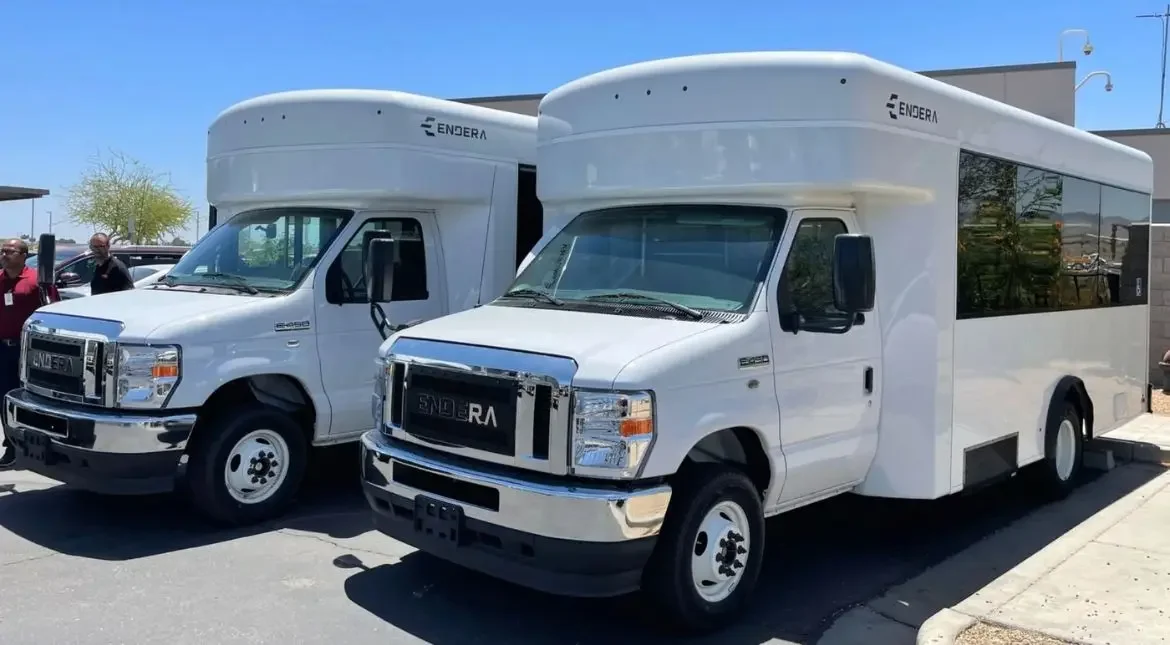
South Carolina's shuttle market is diverse, from high-frequency coastal tourism loops in Charleston, Myrtle Beach, and Hilton Head to inland corporate, university, and medical campus routes. Across the state, operators are increasingly considering electrification, but often without a clear implementation roadmap.
Endera's B-Series — the B3, B4, B5, and B8, ranging from 23 to 28 feet — covers all of it. ICE, propane, CNG, and full electric configurations are available, built on Ford E450 and Chevrolet Express cutaway chassis and manufactured at Endera's Ottawa, Ohio facility with domestic supply chain credentials that support federally funded procurement.
Ready to build a fleet that fits South Carolina's range of routes? Talk to an Endera specialist today to find the right configuration for your operation.
South Carolina Fleet Conditions: What Actually Drives the Decision
A Coastal Tourism Economy With Real Operational Demands
The Charleston and Myrtle Beach markets run shuttle operations that look more like airport ground transportation than typical hotel shuttles — high frequency, heavy passenger volume during peak season, and guests who have zero tolerance for delays or uncomfortable rides. Heat and humidity compound those demands: South Carolina summers are persistent, and HVAC performance matters as much to fleet longevity as it does to passenger experience. Vehicles running in these conditions need to be reliable at high utilization, not just on paper.
Inland and Institutional Markets Have Different Priorities
Away from the coast, South Carolina's corporate campuses, universities like Clemson and USC, and major healthcare systems run shuttle operations that prioritize schedule reliability and configurability over raw capacity. These are often lower-frequency routes with more predictable ridership — environments where the right-sized vehicle and fuel type can deliver meaningful operating cost advantages over a generic fleet choice. The B-Series lineup is built to serve both ends of this spectrum without requiring operators to compromise on either.
The B-Series Lineup for South Carolina Operations
Four Models, Full Range of SC Applications
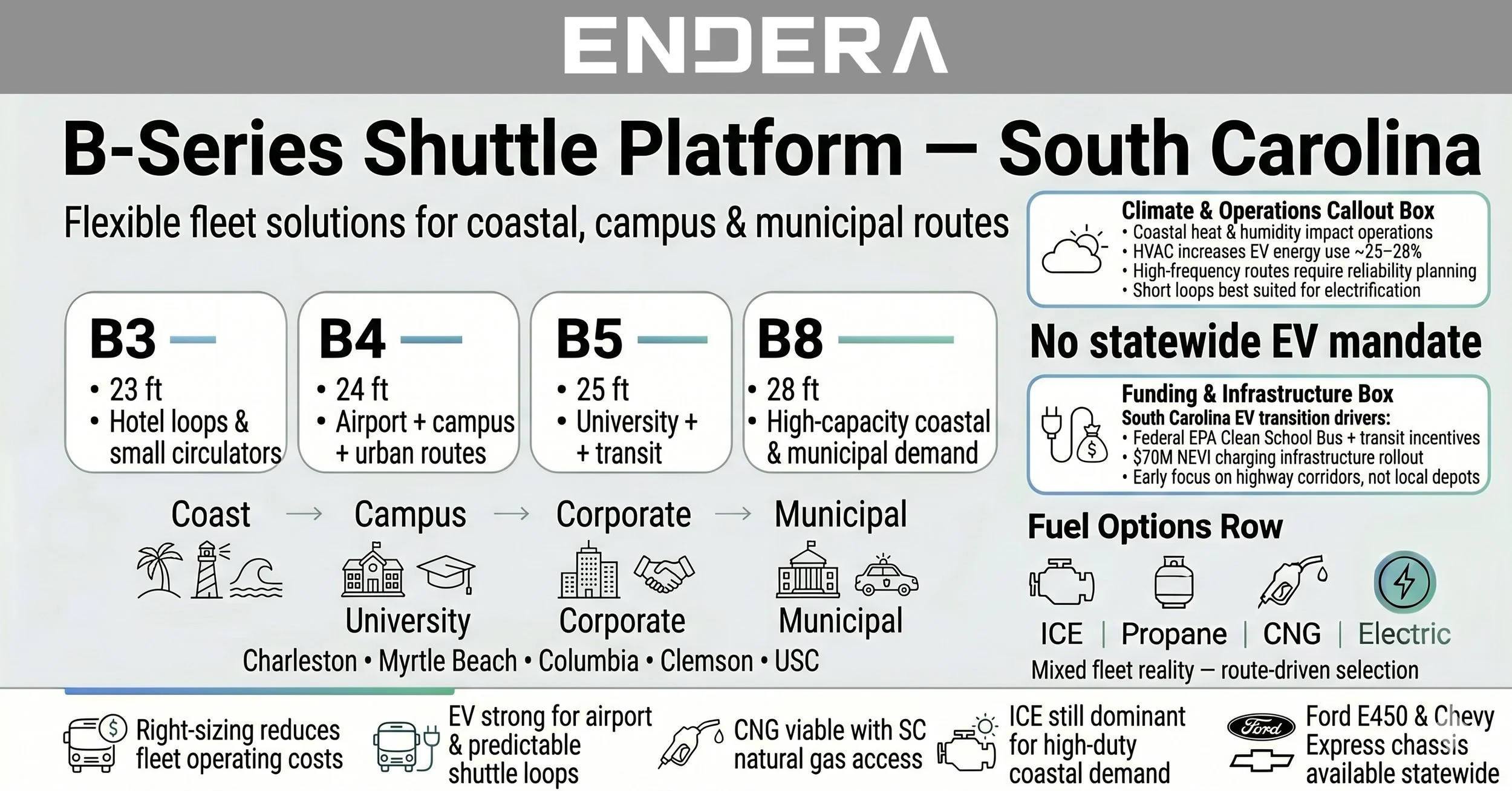
The B3 (23 ft) is the compact ICE model — right for hotel loops, small campus circulators, and urban pickup operations where maneuverability matters more than capacity. The B4 (24 ft) and B5 (25 ft) step up in capacity and unlock both ICE and full electric configurations — the workhorses for airport operations, university transit, and higher-frequency corporate routes. The B8 (28 ft) is the high-capacity ICE model for maximum passenger volume on busy coastal or municipal routes.
Built on Proven Chassis, Serviced Across South Carolina
All B-Series models are available on Ford E450 or Chevrolet Express cutaway chassis — two of the most widely serviced commercial platforms in the country, with dealer networks that extend across South Carolina including markets outside Charleston and Columbia. For operators in smaller coastal communities or inland cities without specialized bus service centers, that breadth of chassis support is a practical operational advantage that reduces downtime risk.
Fleet Decision Framework: Matching the Shuttle to the SC Route
Route Type and Utilization Define the Right Configuration
The right B-Series model and fuel type for a South Carolina operator depends on what the route actually demands. Research on demand-responsive transit consistently shows that matching vehicle capacity to actual ridership volume — rather than buying to a theoretical peak — is one of the most effective ways to control operating costs across a fleet's service life.
| Use Case | Recommended Model | Fuel Type | Why |
|---|---|---|---|
| Coastal hotel / resort loop | B3 / B4 | ICE or Propane | Flexible fuel, tight routes, high seasonal volume |
| Airport shuttle (CHS, MYR) | B4 / B5 | EV or ICE | High utilization favors EV economics |
| University transit | B4 / B5 | EV or CNG | Predictable schedules, campus infrastructure |
| Corporate / medical campus | B5 | EV or ICE | Higher capacity, defined route cycles |
| High-volume municipal / event | B8 | ICE / CNG | Maximum capacity for peak demand |
For South Carolina operators at Charleston International (CHS) or Myrtle Beach International (MYR) with defined parking loop cycles, the electric B4 and B5 offer the strongest long-term operating economics. Operators at San Diego International Airport — a comparable high-frequency deployment — have forecasted nearly $20,000 in annual savings per vehicle versus LPG or CNG, a figure that compounds across a multi-vehicle fleet over a full service cycle.
Heat, Humidity, and What SC Summer Does to EV Performance
HVAC Load Is the Variable Most Operators Underestimate
South Carolina's summer heat and humidity create real EV performance considerations. Research published in Applied Energy shows that extreme heat increases EV energy consumption by roughly 25–28%, driven primarily by HVAC demand and thermal management. In a coastal South Carolina summer — where temperatures regularly exceed 95°F with high humidity — keeping passengers comfortable draws significant battery power. Studies on EV thermal systems confirm that cooling loads are among the largest energy consumers outside propulsion under these conditions.
Short, Defined Routes Absorb It — Longer Ones Require Planning
For short, predictable routes like hotel loops and airport parking circuits, that range reduction is manageable — particularly with DC fast charging available between cycles. For longer or more variable routes, operators should build in range buffers and use state-of-charge monitoring to catch issues before they affect service. Endera Dispatch provides that real-time visibility across the fleet, giving South Carolina operators the data to manage heat-driven performance variability in operation rather than discovering it mid-route.
EV Infrastructure Reality in South Carolina
$70 Million Coming — But Not Evenly Distributed
South Carolina is actively investing in EV infrastructure through the federally backed NEVI program, which will bring nearly $70 million to the state for charging network buildout. For shuttle operators, though, the practical picture is more nuanced than "EV infrastructure is coming." The state's NEVI plan focuses initial investment on designated alternative fuel corridors — primarily major interstates — before expanding into local and community charging networks. These corridor stations must meet strict federal requirements including DC fast charging capability and placement roughly every 50 miles. The local and community infrastructure where shuttle fleets actually operate comes later.
What That Means for SC Fleet Deployment Today
Infrastructure in South Carolina varies by region. Coastal areas like Charleston, Myrtle Beach, and Hilton Head are more likely to see earlier charging availability, while inland campuses and corporate fleets typically need on-site charging. Rural markets face the most limited coverage. For operators, the key question isn’t whether infrastructure is coming, but whether routes can be reliably supported in the required timeframe. Endera’s turnkey services—site assessments, charger procurement, and installation—help bridge that gap.
True Cost vs. Cash Flow Reality
Long-Term Savings Are Real — Early-Year Pressure Is Too
Electric shuttles deliver genuine savings over a full ownership cycle. Lower fuel costs, reduced maintenance, and no oil or exhaust system to service the compound meaningfully over 10 years. The honest challenge is that those savings accrue slowly while the higher upfront cost of an EV lands immediately. Lenders often view electric vehicles as higher-risk assets, which can mean tighter financing terms and higher monthly payments in early ownership years — making cash flow harder to manage even when long-term ROI is positive.
Incentives Help, but Timing Matters
Programs like the IRS commercial clean vehicle credit and EPA fleet incentives can reduce net purchase cost significantly — but they don't always offset the upfront expense at the moment of transaction, and that gap has to be managed operationally. Endera's financing and grant advisory team works with South Carolina operators to structure purchases in a way that manages early-year cash flow while capturing the long-term benefit — through direct financing, capital leasing, and grant application support.
Manufactured in Ohio, Ready for South Carolina
Domestic Supply Chain, Predictable Timelines
Every B-Series shuttle is built at Endera's 250,000-square-foot Ottawa, Ohio facility, with approximately 65% of components sourced from within Ohio. That domestic manufacturing supports compliance with Buy America standards for South Carolina operators accessing federal transit funding — including municipal operators, university transit systems, and publicly funded airport ground transportation. Lead times are more predictable than vehicles assembled from international supply chains, which matters for operators working within defined seasonal or budget-cycle deployment windows.
Software and Support That Travel With the Vehicle
Every Endera commercial shuttle comes available with Endera Dispatch for real-time fleet tracking, route performance data, and EV state-of-charge monitoring, alongside Endera Go for passenger-facing shuttle location and ETA updates. For South Carolina operators managing high-frequency coastal routes where a vehicle going offline creates immediate service gaps, that operational visibility is worth more than it appears on a feature list.
The Right Shuttle for South Carolina, Built to Perform
South Carolina's fleet operators need vehicles that hold up under coastal heat and humidity, serve high-frequency routes reliably, and come from a manufacturer that stays accountable after the sale. The B-Series delivers across four models, four fuel types, and two chassis options — with the fleet software, financing support, and grant advisory capacity to back every purchase.
Your operation deserves a shuttle that shows up every day. Connect with an Endera fleet specialist today to find the right B-Series configuration for your South Carolina fleet.
FAQs
Which B-Series models are available for South Carolina operators?
All four models — B3 (23 ft), B4 (24 ft), B5 (25 ft), and B8 (28 ft) — are available for South Carolina operators in ICE, propane, CNG, and electric configurations depending on model. Contact Endera's sales team for current availability and lead times.
Are electric shuttles practical for South Carolina's climate?
Yes, with route-level planning. South Carolina's heat increases EV energy consumption by roughly 25–28% in peak summer months. Short, defined routes like airport loops and hotel circuits absorb that reduction well. Longer variable routes require range buffer planning. Endera's Dispatch platform provides real-time state-of-charge monitoring to support that planning.
What chassis options are available in South Carolina?
All B-Series models are available on Ford E450 and Chevrolet Express cutaway chassis, both broadly serviced through dealer networks across South Carolina including smaller coastal and inland markets.
Does Endera help South Carolina operators access EV incentives?
Yes. Endera's financing and grant advisory team assists operators in identifying and applying for federal programs including the IRS commercial clean vehicle credit and EPA DERA incentives, as well as direct financing and capital leasing options.
Do Endera shuttles comply with Buy America requirements?
Yes. With approximately 65% of components sourced domestically, Endera's manufacturing model supports Buy America compliance for federally funded South Carolina procurement contracts.
Can I get an in-stock 2026 shuttle for fast delivery in South Carolina?
Yes. Endera Stock lists ready-to-deliver 2026 models built on the Ford E450 chassis, available for rapid deployment without a custom build lead time.
How do I get pricing or a spec sheet for South Carolina fleet purchases?
Spec sheets and floor plans are available on Endera's shuttle bus page. For pricing and configuration discussions, contact Endera at hello@enderacorp.com or call +1 (419) 523-3593.