
The range question is where most electric school bus evaluations start — and where many stall. Districts worry that 105–150 miles sounds promising until the first cold morning, the first route with hills, or the first day the A/C runs continuously. Those concerns are legitimate, and the honest answer requires more than a spec sheet number.
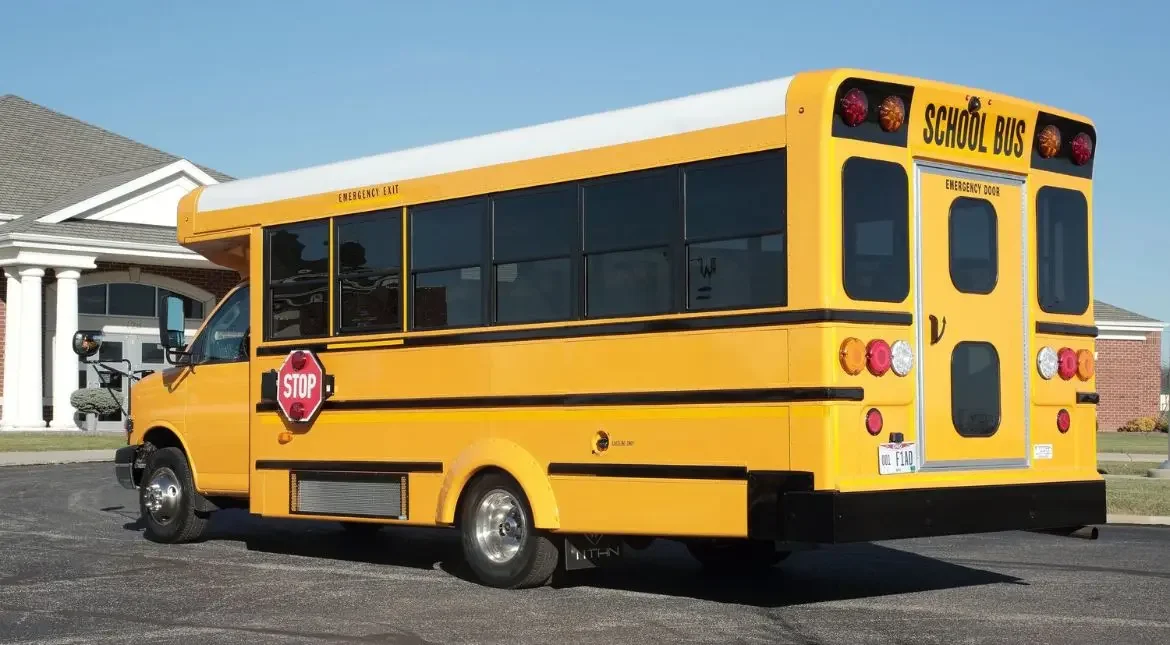
Endera manufactures zero-emission Type A electric school buses with a 150 kWh battery pack and DC fast charging standard on every unit. Built at its vertically integrated facility in Ottawa, Ohio, Endera's electric Type A lineup covers the Endera 4, 5, and 6 models with ADA-compliant configurations, custom section options, and Buy America compliant manufacturing that qualifies purchases for federal funding.
Get the real range picture for your routes — connect with an Endera fleet specialist today to model performance against your district's actual daily mileage.
Is 105–150 Miles Actually Enough for Your Routes?
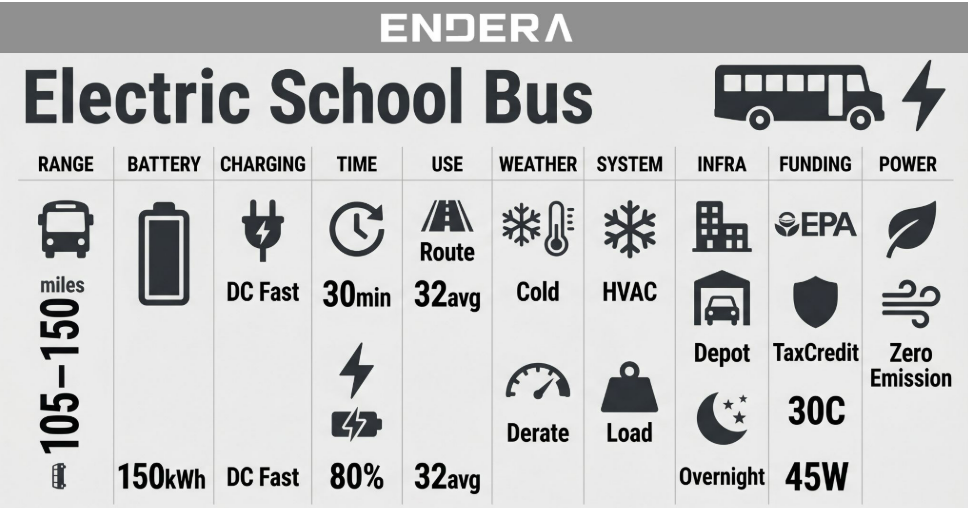
The range question becomes less daunting when measured against real operational data. According to research published by the Electric School Bus Initiative, the average school bus route length is just 32 miles — and in a multi-state study of existing routes, no single route exceeded 127 miles. A 105-mile electric Type A bus comfortably handles the vast majority of real-world district routes on a single overnight charge.
The practical planning rule that fleet managers use: size your charging buffer at 20–30% above expected daily mileage to account for accessory loads and weather variability. A district running 80-mile daily routes should plan for a bus rated at 105+ miles — which puts Endera's 150 kWh battery squarely in operational range for most Type A use cases.
What Actually Reduces Range (And What Doesn't)
Range figures from manufacturers are calculated under ideal conditions. Real-world range varies based on four primary factors, and understanding each helps districts plan charging schedules accurately rather than guessing.
Climate and HVAC
Climate and HVAC is the biggest variable. According to the Alternative Fuels Data Center's electric school bus planning guide, heating needs in extremely cold weather can reduce range by up to 50%. Air conditioning draws significantly less power than heating, making cold-climate operations the more challenging planning scenario. Districts in northern states should plan conservative range buffers for winter months.
Terrain
Terrain affects range through both hill-climbing load and regenerative braking recovery. Hilly routes consume more energy on climbs but recover a portion on descents through regenerative braking — which simultaneously reduces brake wear. The net effect on range is route-specific but generally modest compared to climate impact.
Payload
Payload adds weight that the motor must move. A fully loaded bus uses more energy per mile than a partially loaded one — a meaningful consideration for routes with consistent maximum ridership versus variable loads.
ADA Lifts
ADA lifts do not reduce traction battery range. Per the Electric School Bus Initiative, wheelchair lifts and ramps draw from a separate 12-volt battery rather than the high-voltage traction pack. ADA-configured buses carry no range penalty for the lift system itself.
Charging: What Setup Electric School Bus Buyers Actually Need
Most electric school bus operations use overnight Level 2 charging at a central depot — a practical setup that aligns with the natural gap between afternoon drop-off and morning pick-up. For a 150 kWh battery, Level 2 charging typically completes a full charge in 6–10 hours, fitting within the standard overnight window without requiring mid-shift interruption.
DC fast charging, standard on every Endera electric unit, provides an additional operational tool. Reaching 80% charge in approximately 30 minutes, DC fast charging supports staggered start-time schedules, midday route extensions, and situations where a bus needs to be service-ready faster than overnight charging allows. Endera's turnkey EV platform covers site assessment, charging station procurement, metering installation, and demand-based schedule optimization through Endera Dispatch — so charging infrastructure is handled as part of the vehicle purchase rather than as a separate project.
Federal Funding That Makes the Numbers Work
The upfront cost of an electric school bus — typically $100,000–$200,000 more than a gasoline equivalent before incentives — is the primary obstacle for most districts. Federal funding programs address this directly. The EPA's Clean School Bus Program has funded over 8,500 electric school buses nationally, with awards covering the full purchase cost for priority applicants.
The 45W Qualified Commercial Clean Vehicle tax credit provides additional savings of up to $40,000 per electric bus for eligible purchasers, and the 30C tax credit covers up to $100,000 in charging infrastructure costs in qualifying areas. These programs can stack — reducing or eliminating the net cost premium of an electric bus versus its ICE equivalent. Endera's financing and grant navigation services identify which programs apply to a specific district's profile and assist with application preparation.
Zero-Emission: What It Means in Practice for Schools
Zero-emission means no tailpipe emissions — no diesel particulate matter, no nitrogen oxides, no carbon monoxide in loading zones where students wait and board. The health case is direct: diesel exhaust exposure has documented links to respiratory conditions, and school bus loading zones concentrate that exposure at the worst possible moment — when children are stationary and engines are idling at close range.
Electric buses also eliminate engine noise, which reduces driver fatigue on long routes and improves the passenger environment for students with sensory sensitivities — a practical benefit that is increasingly cited by special education transportation coordinators as a meaningful operational advantage alongside the emissions reduction.
Endera's Electric Type A: Built From the Ground Up
Endera's electric Type A school buses use a proprietary all-electric powertrain engineered specifically for the Type A body dimensions and weight distribution — not adapted from a larger vehicle class or converted from an ICE platform. Battery packs are placed within the frame rails, lowering the center of gravity and protecting high-voltage components within the structural frame rather than mounting them externally.
The 150 kWh pack powers a Cascadia iM225 electric motor, with DC fast charging capable of reaching 80% in approximately 30 minutes. All configurations are available with 4–6 section seating layouts, ADA-compliant 800 lb Braun lift options, and the same Buy America manufacturing compliance that makes every Endera electric purchase eligible for federal grant funding.
The Right Bus for the Right Route
Electric Type A school buses are the strongest operational fit for short-to-medium daily routes — special education placements, urban and suburban elementary runs, and program-specific transport where daily mileage is predictable and charging at a central depot is feasible. They are not the right fit for districts running long rural routes in extreme cold climates without charging infrastructure — and no responsible manufacturer should suggest otherwise.
For districts with routes that fit the profile, the financial case is compelling when federal funding is in play. Contact Endera's sales team today to review route mileage against battery specs, assess grant eligibility, and confirm build timelines for electric Type A configurations.
Frequently Asked Questions
How does cold weather affect electric school bus range?
Heating systems are the biggest range draw in cold weather — the Alternative Fuels Data Center notes that extreme cold can reduce range by up to 50%. A bus rated at 150 miles should be route-planned for 75–100 miles in sustained sub-freezing conditions. DC fast charging capability allows mid-shift top-ups when weather demands it.
Do ADA wheelchair lifts reduce electric school bus range?
No. Lifts and ramps draw from a separate 12-volt auxiliary battery, not the high-voltage traction pack. ADA-configured electric buses carry no range penalty for the lift system — confirmed by Electric School Bus Initiative research across Type A, C, and D models.
What is the average daily mileage of a school bus route?
Electric School Bus Initiative data puts the average route at approximately 32 miles. In a multi-state study, no single route exceeded 127 miles. Most Type A electric buses rated at 105+ miles cover typical routes on a single overnight charge without midday recharging.
Can charging infrastructure costs be covered by federal funding?
Yes. The 30C tax credit covers up to $100,000 in charging infrastructure costs in qualifying areas, and some EPA Clean School Bus grants include infrastructure as an eligible expense. Endera's grant navigation team can identify which programs apply to a specific district's location.
What powertrain does Endera use in its electric school buses?
Endera's electric Type A uses a 150 kWh battery pack and Cascadia iM225 motor, with battery packs placed within the frame rails for a lower center of gravity and structural protection. DC fast charging is standard, reaching 80% charge in approximately 30 minutes.
How is Endera's electric Type A different from a converted school bus?
Endera designs and builds its powertrain in-house — battery integration, motor placement, and charging are engineered from the ground up for the Type A body. Converted buses apply a third-party drivetrain to an existing ICE platform, which can create weight distribution issues and split warranty responsibility between two manufacturers.
Which states have mandates requiring electric school bus purchases?
California requires zero-emission purchases by 2035 (rural districts by 2045). Maryland requires districts to prioritize zero-emission buses beginning in FY2025 with exceptions. New York mandates zero-emission purchases starting in 2027. Most other states have no active mandate but offer incentive programs that make electric the financially preferred choice when grant funding is available.