
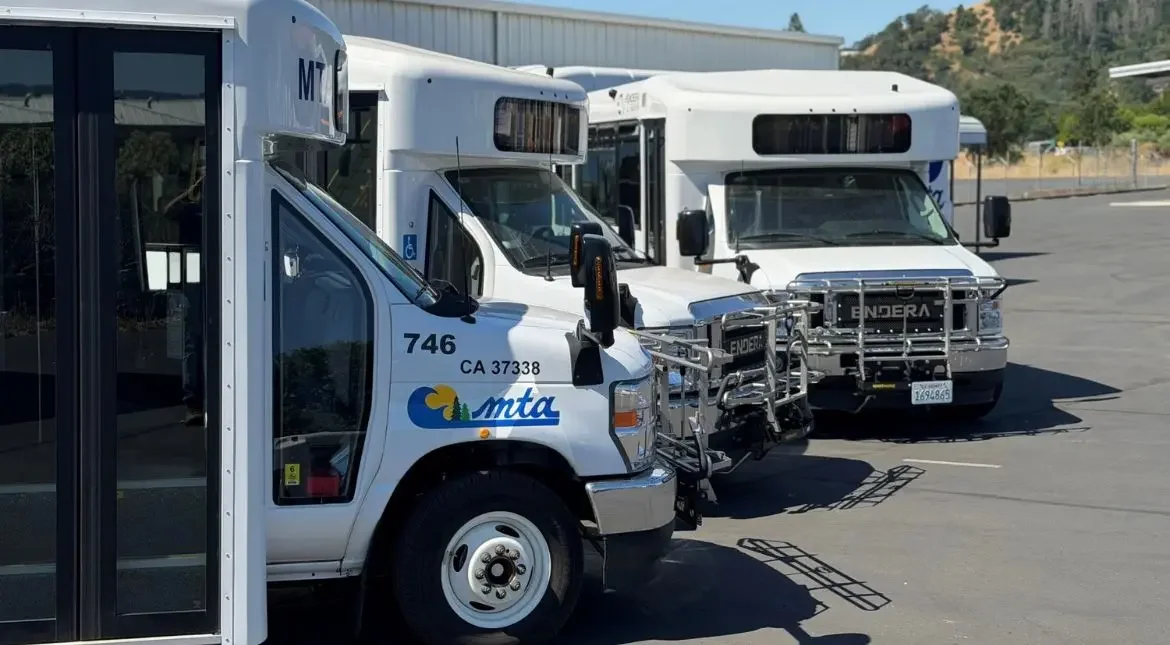
Rhode Island's compact geography makes it one of the more practical markets for shuttle bus operations — short routes, dense population, and consistent daily ridership across hotels, universities, healthcare facilities, and municipal transit. The challenge for smaller fleet operators isn't finding passengers; it's justifying the capital outlay on the right vehicle for a market where oversized equipment creates more operational friction than it solves.
Endera manufactures Class 4 B-Series commercial shuttles in lengths from 23 to 28 feet, available in ICE, propane, CNG, and full-electric configurations. For Rhode Island operators running tight urban routes or campus loops, the B-Series is built to the scale that actually fits the work — not adapted from transit bus platforms designed for larger markets.
Right-size your fleet from the start — connect with an Endera specialist today to find the configuration that fits your Rhode Island operation.
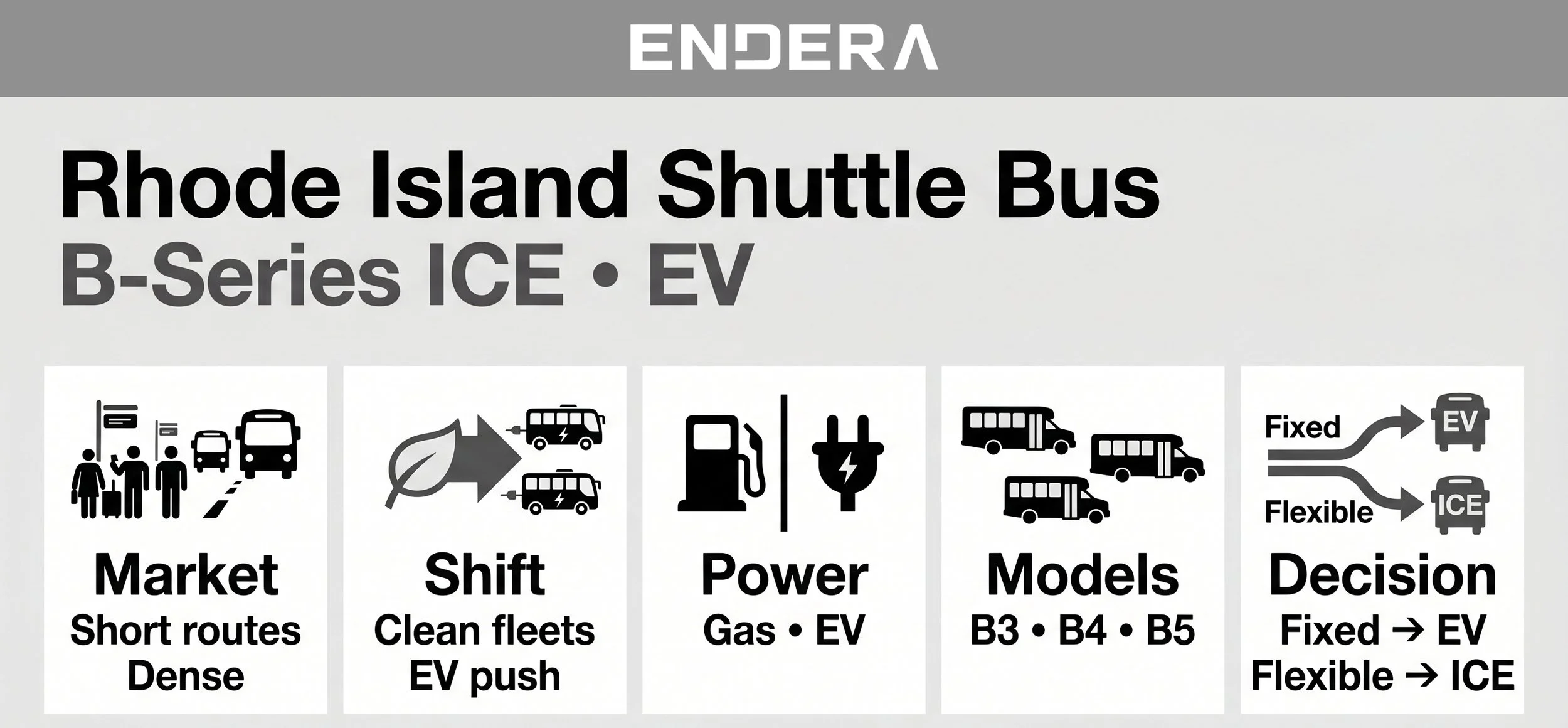
Why Rhode Island Fleets Are Moving Toward Cleaner Vehicles
Transportation is the largest source of greenhouse gas emissions in the Northeast region, and Rhode Island's policy environment reflects that reality. According to an Acadia Center clean transportation report, the state has been under sustained pressure to decarbonize its vehicle fleets — a push that has since translated into real procurement activity and infrastructure investment.
The Rhode Island Public Transit Authority has committed roughly $10 million to electric bus adoption, including real-world pilot testing and route validation across the state's network. RIPTA operates 229 buses and shuttle-style vehicles serving 37 of Rhode Island's 39 municipalities — and that footprint is expanding. In 2023, RIPTA received $25 million in federal funding to add up to 25 additional buses to its fleet, accelerating a procurement cycle that private operators can align with.
Rhode Island Use Cases: Where the B-Series Fits
Rhode Island's density is an operational advantage for shuttle fleets. Routes are short, turnaround times are fast, and passenger counts are consistent enough to justify dedicated vehicles over ride-share alternatives. The state's road network — dense, urban, and in places genuinely narrow — also puts a premium on vehicles that don't require wide turns or oversized parking accommodations.
The B-Series lineup maps directly to Rhode Island's most common commercial transport applications. At 23 to 25 feet, the B3, B4, and B5 handle the operational realities of Providence and surrounding municipalities without the compromises that come with scaling up to full-size transit equipment.
Hotels, Airports, and Tourism
Providence's T.F. Green International Airport and the surrounding hospitality corridor generate steady demand for airport and hotel shuttle service. The B4 (24 ft) handles this workload efficiently — enough passenger capacity to keep per-trip costs manageable without the footprint of a full transit bus.
Electric B4 models are particularly well-suited here. Fixed-route operations with predictable daily mileage allow operators to charge overnight and run full days without range concerns, while eliminating the fuel and maintenance costs associated with high-cycle gasoline or propane vehicles.
Senior, Healthcare, and Campus Transport
Medical transport providers, assisted living facilities, and university operators in Rhode Island typically need ADA-compliant configurations with lift access and flat-floor interiors. The 23 ft B3 and 24 ft B4 navigate tight institutional drop-off areas without the maneuvering challenges of larger vehicles.
Brown University, Providence College, and RISD together represent a meaningful campus transport market within a few square miles — exactly the kind of dense, short-route environment the B-Series was designed for. Flat-floor configurations with 800 lb Braun ADA lifts are available as standard equipment across these models.
Electric vs. ICE: Making the Right Call for a Rhode Island Fleet
Electric B4 and B5 models make financial sense for operators running predictable daily routes with overnight depot charging available. A VEIC fleet electrification case study tracking utility-supported fleet transitions found that replacing 443 vehicles generated approximately $2.5 million in lifetime savings. Lower fuel spend is the most visible line item, but reduced brake wear, fewer oil changes, and simplified drivetrain servicing contribute meaningfully to total cost of ownership across a 10-to-12-year vehicle lifespan.
For operators not yet ready for a full electric transition, propane and CNG configurations offer a practical middle path — cleaner than gasoline, with a lower infrastructure commitment than EV. Rhode Island's statewide EV charging expansion plan is improving depot readiness over time, but for fleets with irregular routes or no existing charging setup, bridge fuel options keep operations moving while the broader infrastructure matures.
Turnkey Charging for Operators Ready to Go Electric
Depot readiness remains the primary barrier for most first-time EV buyers. Endera addresses this at the point of sale through turnkey charging solutions — site assessments, DC fast charger procurement, and metering system installation handled as a single engagement.
Endera Dispatch, the company's fleet management software, also includes demand-based charging schedule optimization that reduces energy costs by avoiding peak-rate charging windows. For a Rhode Island operator running a small electric fleet out of a single depot, that scheduling layer can meaningfully offset electricity costs over time.
The B-Series Lineup: Specs and Configuration Options
Each B-Series model serves a distinct capacity and operational profile. All are built on Ford E450 and Chevrolet Express cutaway chassis, with body assembly and powertrain installation handled at Endera's Ottawa, Ohio manufacturing facility:
B3 (23 ft): ICE only. The most maneuverable option — well-suited for Providence-area streets, hotel loops, and smaller healthcare routes.
B4 (24 ft): ICE and EV. The most broadly applicable model for Rhode Island, covering airport shuttles, campus loops, and mid-size hospitality operations.
B5 (25 ft): ICE and EV. Higher passenger capacity for corporate campuses, employee transport, or larger university circuits.
B8 (28 ft): ICE only. Municipal transit and high-demand group transport where volume outweighs maneuverability considerations.
Because Endera manufactures the body and installs the powertrain at the same facility, buyers receive a single warranty document — not a chassis warranty from Ford layered over a separate body warranty from an upfitter.
Stock Availability and How to Buy
Several 2026 B-Series units are available for immediate delivery through Endera Stock. Current inventory includes 12+2 passenger flat-floor configurations with 800 lb Braun ADA lifts, 8+4 passenger flat-floor units, and 14-passenger models with rear luggage compartments — all on 2026 Ford E450 chassis with a 14,500 lb GVWR.
Rhode Island operators don't need to navigate a build-to-order backlog to get a production-ready vehicle. Contact Endera's sales team today for fleet pricing, powertrain recommendations, or questions about available financing and grant options.
Frequently Asked Questions
What shuttle bus size works best for Rhode Island operations?
For most Rhode Island use cases — hotel loops, airport runs, campus transport — the B3 (23 ft) and B4 (24 ft) are the strongest fits. Their dimensions handle dense urban streets and tight institutional drop-off areas without the maneuverability tradeoffs of larger vehicles. Operators running higher-volume fixed routes can step up to the B5 without significantly increasing the operational footprint.
Are there state or federal funding programs available for shuttle bus purchases in Rhode Island?
Rhode Island operators can access federal funding through programs like the EPA's Clean School Bus Program and FTA transit grants, as well as state-level incentives tied to clean vehicle adoption. RIPTA's recent $25 million federal award for fleet expansion signals active procurement funding at the state level. Endera's grant navigation services help operators identify applicable programs and manage the application process.
How does Endera's vertical integration affect the warranty on a B-Series shuttle?
Because Endera manufactures both the vehicle body and the electric powertrain at a single facility in Ottawa, Ohio, buyers receive unified warranty coverage rather than separate documents from a chassis supplier and a body upfitter. When a warranty claim arises, there's one point of contact rather than two manufacturers deferring to each other. Warranty details for commercial vehicles are available on Endera's warranty page.
What is the range of Endera's electric shuttle buses?
Endera's electric B-Series models use a 150 kWh battery pack with DC fast charging standard on every unit. Exact range depends on passenger load, climate, and route profile. For Rhode Island's typical short-to-mid-distance commercial routes, most operators will find daily range more than sufficient with overnight depot charging. Endera provides route-specific estimates during the sales process.
Can the B-Series handle ADA-compliant transport in Rhode Island?
Yes. Flat-floor B-Series configurations are available with 800 lb Braun ADA lifts as standard equipment, making them appropriate for senior transport, healthcare shuttle, and any application requiring accessible passenger loading. ADA compliance requirements for commercial passenger vehicles in Rhode Island align with federal standards, and the B-Series meets those specifications without aftermarket modification.
Does Rhode Island's size make electric shuttle buses more practical than in larger states?
It does, in several respects. Shorter average route distances mean less daily energy draw, which reduces battery wear and makes overnight charging more reliable as the primary recharge method. The state's concentrated geography also means depot locations are rarely far from the operational service area — a practical advantage for smaller operators without the infrastructure resources of large transit authorities.
What ongoing software tools does Endera provide for fleet operators?
Every B-Series commercial shuttle is compatible with Endera Dispatch, the company's fleet management platform. It includes AI-powered routing, real-time GPS tracking, geofence management, and state-of-charge monitoring for electric units. The rider-facing component, Endera Go, provides passengers with real-time vehicle location and ETA data — both tools built in-house and supported directly through Endera.