
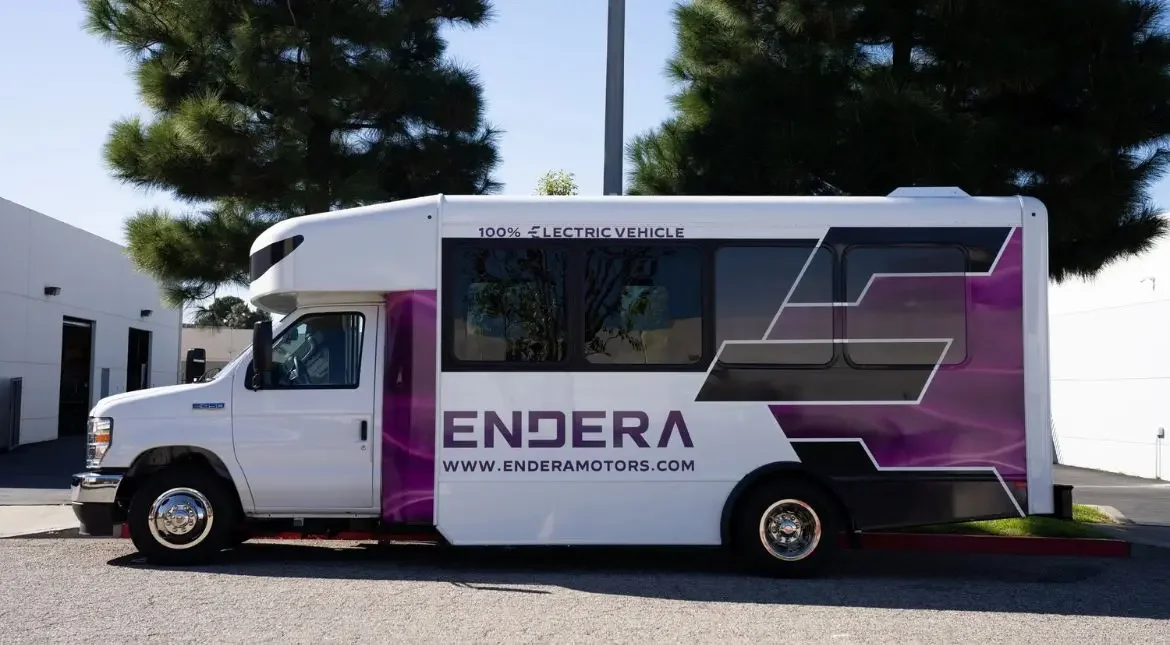
Virginia's shuttle market is highly diverse, from the dense, fast-paced Northern Virginia corridor with major airports and tech hubs to university, military, and tourism-driven demand in cities like Richmond and Hampton Roads. Recent shifts in EV policy have also created a more uncertain regulatory environment for fleet operators.
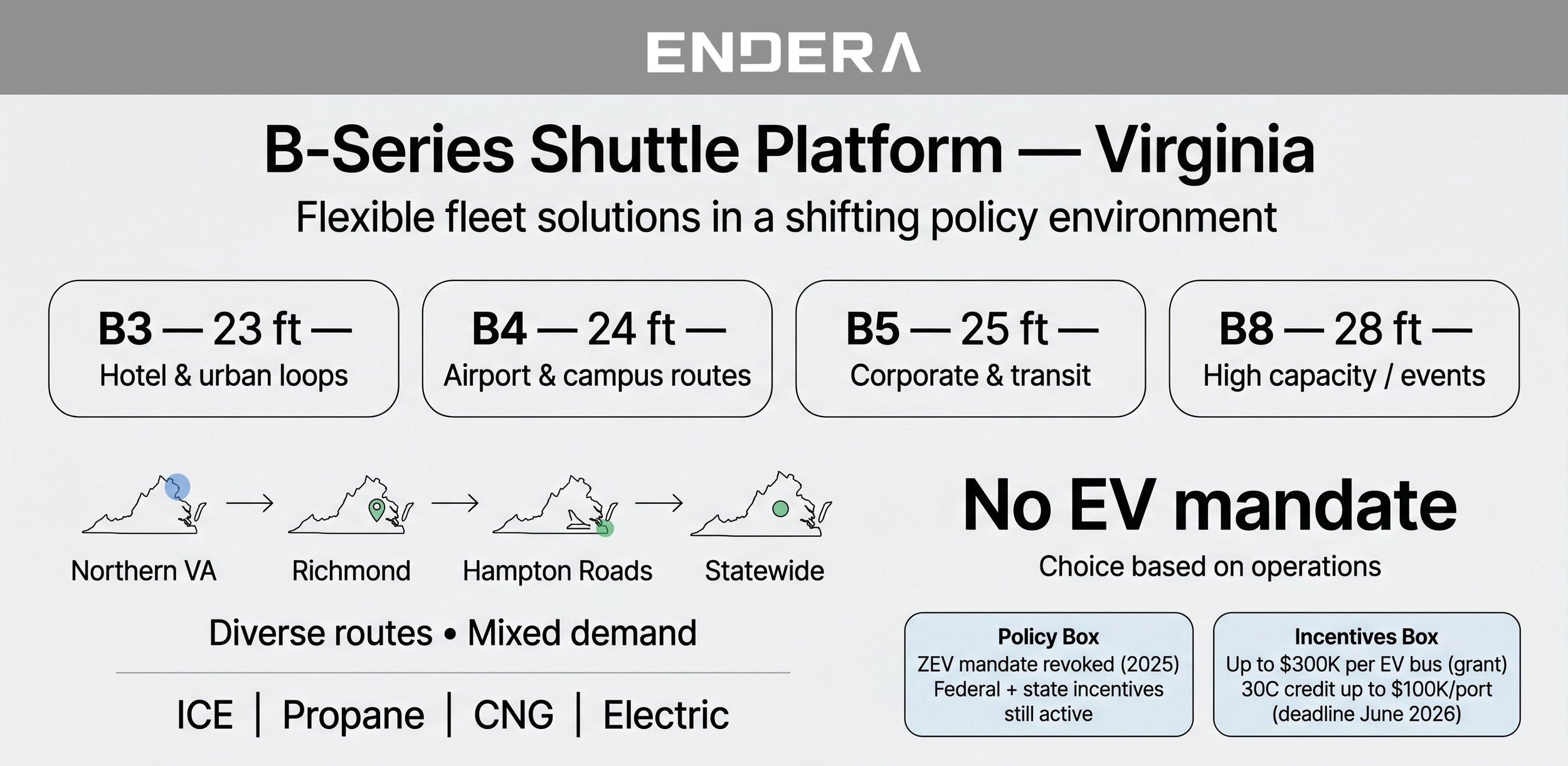
Endera's B-Series — the B3, B4, B5, and B8, ranging from 23 to 28 feet — is built to serve all of it. ICE, propane, CNG, and full electric configurations are available on Ford E450 and Chevrolet Express cutaway chassis, manufactured at Endera's Ottawa, Ohio facility. For Virginia operators, the multi-fuel flexibility is as relevant as the vehicle itself.
Don't let policy uncertainty stall your fleet decisions — talk to an Endera specialist today to find the right configuration for your Virginia operation.
Virginia's EV Policy Landscape: What Fleet Operators Actually Need to Know
The ZEV Mandate That Was — and Isn't
Virginia adopted California's Advanced Clean Cars II standards in January 2024, which would have required 100% of new passenger vehicles sold in the state to be zero-emission by 2035. In June 2024, Governor Youngkin announced Virginia would not comply with the ZEV mandate.
That position was codified in June 2025 when House Joint Resolution 88 was signed into law, revoking Virginia's participation in the Advanced Clean Cars II ZEV requirement. For commercial fleet operators who had been planning around an assumed compliance deadline, that shift changes the calculus — there is no state mandate driving a forced EV transition timeline for Virginia fleets as of 2026.
What That Means in Practice
The absence of a mandate doesn't eliminate the case for electrification — it just returns the decision to operational and financial merit. Virginia still has $100 million in NEVI funding being deployed over five years for public charging infrastructure, more than 1,800 public charging stations including 354 DC fast chargers, and a set of federal and state programs that make electric vehicles financially attractive for the right operation.
For Virginia fleet operators, the question now is straightforward: does the vehicle, the route, and the funding make sense — without a policy deadline forcing the answer.
The B-Series Lineup for Virginia Operations
Four Models Covering Virginia's Shuttle Markets
The B3 (23 ft) is a compact ICE model ideal for hotel loops, campus routes, and tight urban operations. The B4 (24 ft) and B5 (25 ft) offer more capacity with ICE and electric options, suited for airport transport, corporate shuttles, and university transit. The B8 (28 ft) is built for high-volume routes like events, military bases, and busy regional operations.
Built on Chassis Serviced Across Virginia
All B-Series models are available on Ford E450 or Chevrolet Express cutaway chassis — platforms with broad dealer networks across Virginia, from Northern Virginia's suburban corridors to smaller markets in the Shenandoah Valley and southwest Virginia. For operators running routes across multiple regions of the state, chassis serviceability through regional dealers matters when a vehicle needs attention away from a central depot.
Fleet Decision Framework: Virginia Routes and the Right Configuration
Matching the Vehicle to Virginia's Operating Environments
| Use Case | Recommended Model | Fuel Type | Why |
|---|---|---|---|
| Northern VA tech campus (Tysons, Reston) | B4 / B5 | EV | Short defined routes, employer charging access |
| Airport ground transport (DCA, IAD) | B4 / B5 | EV or ICE | High utilization; EV economics strong with depot charging |
| University transit (UVA, VT, GMU) | B4 / B5 | EV or CNG | Predictable schedules, campus infrastructure |
| Richmond hotel / downtown loop | B3 / B4 | ICE or Propane | Lower volume, urban maneuverability |
| Hampton Roads / military shuttle | B5 / B8 | ICE or CNG | Higher capacity, longer routes, fuel flexibility |
For Virginia operators at Reagan National or Dulles with defined parking loop cycles, the electric B4 and B5 offer compelling long-term operating economics. Operators at San Diego International Airport, a comparable high-frequency deployment, have forecasted nearly $20,000 in annual savings per vehicle annually versus LPG or CNG — a figure that compounds significantly across a multi-vehicle Northern Virginia fleet over a full service cycle.
NEVI ≠ Depot Reality: Why Virginia's EV Infrastructure Doesn't Power Fleet Decisions
What NEVI Actually Builds — and What It Doesn't
Virginia’s $100M NEVI program is expanding public fast charging along key highways like I-95, I-64, and I-81, focused on long-distance travel and corridor access. However, it doesn’t build depot charging for shuttle fleets, which need centralized, high-throughput overnight charging and operate on a very different infrastructure model.
The Question Virginia Fleet Operators Should Actually Be Asking
Airport, campus, hotel, and corporate shuttles in Virginia operate under very different conditions than highway travel, with fixed schedules, predictable dwell times, and the need for guaranteed charging at a central depot. Public corridor chargers like those on I-95 are designed for convenience between trips, not for fleets that must be fully charged and ready on strict timelines like early morning departures.
For fleet operators, the key question isn’t whether charging exists in the state, but whether it can support reliable daily operations. That shifts EV planning toward depot readiness, utility coordination, and route-based energy needs, with turnkey depot charging solutions filling that gap before vehicles are deployed.
Virginia Incentives: What Fleet Operators Can Access
Transit Emissions Reduction Grants — Up to $300K Per Electric Bus
One of Virginia's most significant fleet incentive mechanisms is the Transit Emissions Reduction Grant program, funded through Virginia's portion of the Volkswagen environmental settlement. Awards are capped at $300,000 per electric bus including charging infrastructure, and $15,000 per propane bus.
For eligible transit operators and fleet managers in Virginia, this is a meaningful program — one of the higher per-vehicle award levels available at the state level nationally — and it applies to commercial shuttle operations, not just traditional transit agencies. Eligibility and application requirements should be confirmed with Virginia program administrators, as funding availability is competitive and subject to change.
Federal Programs and the 30C Deadline
Federal tools remain the most broadly accessible for Virginia commercial fleet operators. The IRS commercial clean vehicle credit (45W) applies to qualifying commercial EV purchases, and the 30C charging equipment tax credit — worth up to $100,000 per installed charging port — expires June 30, 2026. That deadline was moved up from 2032 by legislation signed in 2025, making it a time-sensitive consideration for Virginia operators planning depot charging installations.
Equipment must be physically placed in service by June 30 to qualify — not just purchased or permitted. Endera's financing and grant advisory team helps Virginia operators coordinate the purchase and installation timeline to avoid missing that window.
True Cost vs. Cash Flow Reality
Where Virginia's Incentive Stack Changes the Equation
Virginia offers a strong incentive stack through federal credits and the Transit Emissions Reduction Grant. When the 45W vehicle credit, 30C charging credit, and VW settlement funds are combined, upfront costs for EV shuttle deployments can drop significantly, even before operating savings.
However, eligibility varies, the 30C deadline is fixed, and most fuel and maintenance savings accumulate over time rather than upfront.
When ICE, Propane, or CNG Makes More Sense in Virginia
For Virginia operators on longer or rural routes—especially in western Virginia and the Shenandoah Valley—ICE and propane remain practical options in 2026 due to limited charging coverage. The state also supports CNG and propane conversions for eligible public fleets through its Alternative Fuels Fleet Vehicle Incentive, with up to $10,000 in reimbursements.
Endera’s financing team can help model total lifecycle costs across fuel types based on specific routes and infrastructure access.
Manufactured in Ohio, Delivered to Virginia
Domestic Supply Chain Supporting Virginia's Federal Procurement Requirements
The B-Series shuttles are built at Endera’s 250,000-square-foot facility in Ottawa, Ohio, with about 65% U.S.-sourced components, supporting Buy America compliance. This is especially relevant for Virginia’s federal, military, and government-linked operators.
Domestic production also helps ensure more predictable lead times, which is useful for deployments tied to contracts, airport operations, or academic schedules.
Fleet Software for Virginia's Demanding Operating Environments
Every Endera commercial shuttle comes available with Endera Dispatch for real-time vehicle tracking, route performance data, and EV state-of-charge monitoring, alongside Endera Go for passenger-facing shuttle location and ETA updates. For Northern Virginia operators where on-time performance directly affects federal contractor employee productivity, and for airport operators where a delayed shuttle affects guest experience, that operational visibility is a functional requirement, not a feature extra.
Built for Virginia's Varied Fleet Markets
Virginia fleet operators are making decisions in a state where the policy environment has shifted, the federal incentive window is closing on a key deadline, and the right vehicle choice depends heavily on the specific route and operating context. The B-Series gives Virginia operators the model range, fuel flexibility, and manufacturer support to navigate all of it — without being pushed toward a technology choice that doesn't fit the operation.
Virginia's policy landscape is moving. Make sure your fleet is positioned ahead of it. Talk to an Endera specialist today to find the right B-Series configuration for your Virginia operation.
FAQs
Is there a ZEV mandate for commercial shuttles in Virginia?
No. Virginia's participation in the Advanced Clean Cars II ZEV mandate was revoked by House Joint Resolution 88, signed in June 2025. There is no state mandate requiring commercial fleet electrification in Virginia as of 2026. Fleet operators can choose ICE, propane, CNG, or electric based on operational fit and financial planning.
What state incentives are available for EV shuttle purchases in Virginia?
The Transit Emissions Reduction Grant program offers up to $300,000 per electric bus including charging infrastructure for eligible operators, funded through Virginia's VW environmental settlement allocation. The Alternative Fuels Fleet Vehicle Incentive covers CNG and propane for government and local fleet vehicles up to $10,000.
What is the 30C charging credit deadline for Virginia operators?
The 30C tax credit — up to $100,000 per installed charging port — expires June 30, 2026. Equipment must be physically placed in service by that date. Virginia operators planning depot charging installations should engage Endera's team early to ensure the timeline is achievable.
Which B-Series models are available for Virginia operators?
All four models — B3, B4, B5, and B8 — are available in Virginia in ICE, propane, CNG, and electric configurations depending on model. Contact Endera's sales team for current availability and lead times.
Do Endera shuttles comply with Buy America requirements?
Yes. With approximately 65% of components sourced domestically, Endera's manufacturing supports Buy America compliance for Virginia federal and federally funded procurement contracts.
What chassis options are available in Virginia?
All B-Series models are available on Ford E450 and Chevrolet Express cutaway chassis, serviced through dealer networks across Virginia including Northern Virginia, Richmond, Hampton Roads, and smaller regional markets.
Can I get an in-stock 2026 shuttle for fast delivery in Virginia?
Yes. Endera Stock lists ready-to-deliver 2026 models available for rapid deployment without a custom build lead time.