
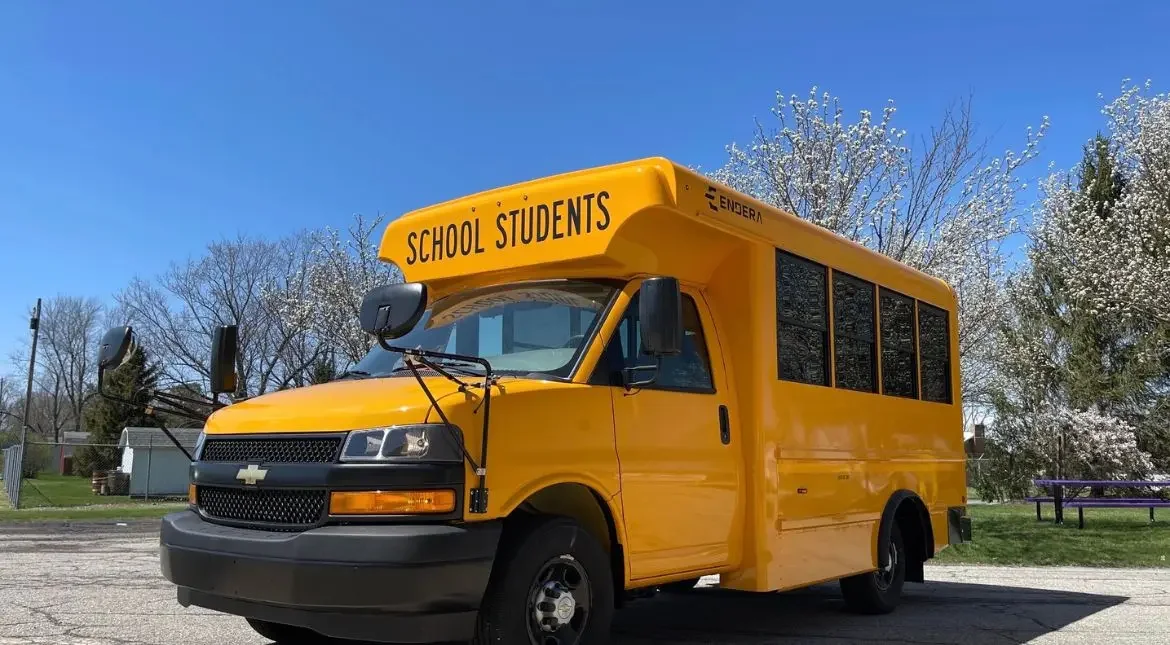
The skoolie movement — converting retired school buses into mobile homes and campers — has been growing for years. More recently, electric Type A school buses have become an appealing option for conversions, offering a smaller, lighter, and cleaner platform than traditional diesel buses. They also reduce common issues like fuel costs, engine noise, and the maintenance demands of diesel engines.
Endera's Type A school buses — the Endera 4, 5, and 6 — are purpose-built commercial vehicles, not conversion kits. But their construction quality, proprietary EV powertrain, and configurable floor plans make them one of the more serious starting points for anyone exploring what a purpose-built electric camper bus could look like.
Curious whether an Endera Type A fits your conversion plans? Talk to the sales team today to discuss platform specs and configuration options.

Electric Skoolie vs. Diesel: What Actually Changes
The Ownership Model Shifts Entirely
Most skoolie content still treats electric buses as experimental — something to watch, not something to build with today. That framing is outdated. While electric school buses still represent a small share of the roughly 450,000 U.S. school buses in operation, adoption is accelerating rapidly, with thousands of units already deployed or on order nationwide. A diesel skoolie is fundamentally a mechanical system — oil changes, fuel systems, belts, filters, and the long-term unpredictability of an aging engine.
An electric platform removes most of that complexity. No combustion, no exhaust system, far fewer moving parts. The routine maintenance profile changes dramatically, and the driving experience changes with it: electric buses are significantly quieter, eliminating the engine noise and vibration that defines long highway drives and overnight stays in a diesel build.
Maintenance Doesn't Disappear — It Changes Form
Maintenance doesn’t disappear with electric skoolies—it just shifts. Instead of focusing on fuel and engine upkeep, the main concerns become charging, range, and energy planning.
While EVs generally have lower long-term maintenance costs, they require a different mindset, with more emphasis on managing energy use rather than mechanical servicing.
Why Type A? The Case for Going Smaller
Maneuverability and Scale That Actually Works
Full-size Type C and D school buses are popular for skoolie builds but are often impractical due to size, limited campground access, and CDL requirements in many states.
Type A buses, at 20–25 feet, are much more manageable—they fit in standard parking spaces, handle narrow roads more easily, and can usually be driven with a regular license. This makes them far more practical for everyday use and travel.
The Electric Advantage on a Conversion Platform
Diesel skoolies require ongoing maintenance like fuel systems, oil changes, filters, and exhaust components. Switching to an electric drivetrain greatly reduces this, since electric motors have far fewer moving parts and no combustion-related systems to maintain.
For converted vehicles that may sit for long periods, this lower-maintenance setup is a major advantage. The main tradeoff is range, which builders address with larger battery systems, solar, and careful trip planning.
The Endera Type A Platform: What You're Starting With
A Commercially Built Foundation
Endera's Type A school buses are manufactured at the company's 250,000-square-foot Ottawa, Ohio facility, where the EV powertrain integration and body construction happen under the same roof. The battery pack is housed within the structural frame rails — lowering the center of gravity and providing structural protection that a field-converted bus simply can't replicate.
The Endera 4, 5, and 6 are available in 4 to 6 section configurations on Ford and Chevrolet cutaway chassis, with floor plans configurable for seating, storage, and accessibility layouts. That configurability — a direct result of vertical integration — is what makes these buses interesting as a conversion starting point: the interior isn't locked into a fixed template.
Proprietary EV Powertrain and What It Means for Range
Endera's electric Type A buses use a 150 kWh battery pack and Cascadia iM225 electric motor with DC fast charging standard. In commercial school bus operations, that powertrain is optimized for predictable short-to-medium routes — the kind of daily mileage that most converted camper bus owners actually cover.
Federal guidance from the U.S. Department of Energy notes that most school buses average well under 100 miles per day, a range profile that aligns closely with typical weekend camper trip distances. The honest caveat: a loaded camper conversion adds weight beyond the vehicle's commercial configuration, and HVAC loads for full-time living are higher than a school route — both factors that compress effective range and should be modeled into any serious conversion plan.
Conversion Considerations: What Changes on a Type A EV
Weight, Payload, and What Actually Fits
Type A school buses are designed for passenger use, not heavy residential conversions with cabinets, water systems, and batteries. With a GVWR typically around 11,000–14,500 lbs, they have strict limits on how much additional weight can be added.For electric Type A builds, the weight of the existing battery pack also needs to be factored in from the beginning to stay within legal payload limits.
A thoughtful, lightweight build using aluminum framing, composites, and efficient appliances can stay well within limits; a heavy residential-style interior can push past them quickly. Research on EV energy consumption also shows that added weight and HVAC load have a material impact on range — every pound of conversion build reduces effective operating distance.
Solar Integration and the Dual-Battery Question
One of the most discussed topics in the electric skoolie conversion space is how to integrate solar and auxiliary house batteries alongside the vehicle's primary traction pack. In a commercial EV like an Endera Type A, the traction battery is a closed, managed system — it is not designed to be tapped for residential loads the way a dedicated house bank would be.
Converters working on electric Type A platforms typically install a separate 12V or 48V house battery system charged by rooftop solar, keeping residential loads entirely separate from the vehicle's propulsion system. This is cleaner from an electrical standpoint and protects the traction battery warranty, but it adds system complexity and requires careful energy budgeting for off-grid use.
What "Camper Ready" Actually Means on an Electric Bus
Configuration Options That Support Conversion
Endera's Type A floor plans — available in multiple layout configurations across the Endera 4, 5, and 6 — can be specified with features that align well with conversion use: open floor plans without fixed seating obstacles, accessible entry configurations, and storage sections that provide usable space from day one. The ADA-accessible layout options, which include wider door configurations and flat floor sections, are particularly useful for converters who want a more livable interior without structural modifications.
None of this makes an Endera Type A a purpose-built RV — but it does mean the starting point is a higher-quality, better-engineered platform than a retired fleet bus purchased at auction.
The Honest Tradeoff: Commercial vs. Residential Use
A commercially built Type A EV is engineered for a specific operating profile — defined routes, depot charging, and predictable daily mileage. Camper conversion changes that profile significantly: irregular routes, charging from campground pedestals or solar rather than DC fast chargers, variable loads, and potentially long periods of inactivity.
Endera's vehicles come with Endera Dispatch fleet management software optimized for commercial operations — state-of-charge monitoring, route performance analytics, maintenance tracking. For a converted camper application, much of that software infrastructure becomes less relevant, though the real-time vehicle health monitoring remains genuinely useful for an owner-operator who doesn't have a fleet maintenance team behind them.
A Serious Platform for a Serious Conversion
Electric Type A school buses represent a genuinely interesting conversion opportunity — not because any manufacturer is selling a finished camper product, but because the platform combines commercial build quality, a modern EV drivetrain, and configurable interiors in a size that actually makes sense for real-world use. Endera's Type A lineup is the most thoroughly engineered version of that platform available from a domestic manufacturer.
For converters thinking seriously about what comes next in the electric skoolie space, the platform is worth understanding before the build begins. Contact Endera's sales team today to learn more about the Type A lineup and discuss commercial purchase options.
FAQs
Does Endera sell a purpose-built RV or camper bus?
No. Endera's Type A school buses — the Endera 4, 5, and 6 — are commercially built vehicles for student transport, special education routes, and institutional transit. They are not sold as RVs or conversion-ready camper platforms. Converters interested in the platform should contact Endera's sales team to discuss commercial purchase options.
What makes a Type A school bus a good conversion base?
Type A buses offer better maneuverability than full-size school buses, a smaller footprint compatible with most campgrounds and roads, and — in electric variants — a dramatically lower-maintenance powertrain. The Endera Type A's configurable floor plans and structural build quality provide a stronger starting point than a high-mileage fleet auction unit.
How does the electric powertrain affect range in a converted camper?
A loaded camper conversion adds weight and residential HVAC loads beyond the vehicle's commercial configuration — both of which reduce effective range. Converters should model their specific build weight and energy use against the vehicle's rated range, accounting for seasonal temperature impacts on battery performance.
Can I charge an Endera electric Type A at a campground pedestal?
Endera's Type A EVs support DC fast charging as standard. Most campground pedestals provide 30A or 50A AC service — Level 2 charging compatible but at a much lower rate than DC fast charging. Charging time from a campground pedestal would be significantly longer than from a commercial DC fast charger. Converters should plan their power management strategy around this reality.
What is the GVWR for Endera's Type A school buses?
GVWR varies by chassis configuration — typically in the 11,000 to 14,500 lb range for cutaway Type A platforms. Conversion weight must be factored against the GVWR from the start of any build plan.
Where are Endera Type A buses manufactured?
All Endera Type A school buses are built at the company's Ottawa, Ohio facility — a 250,000-square-foot plant where EV system integration and body construction happen under one roof.
How do I learn more about purchasing an Endera Type A?
Contact Endera's sales team directly to discuss commercial purchase options, floor plan configurations, and specifications. Endera sells to commercial operators, fleet managers, and institutional buyers.