
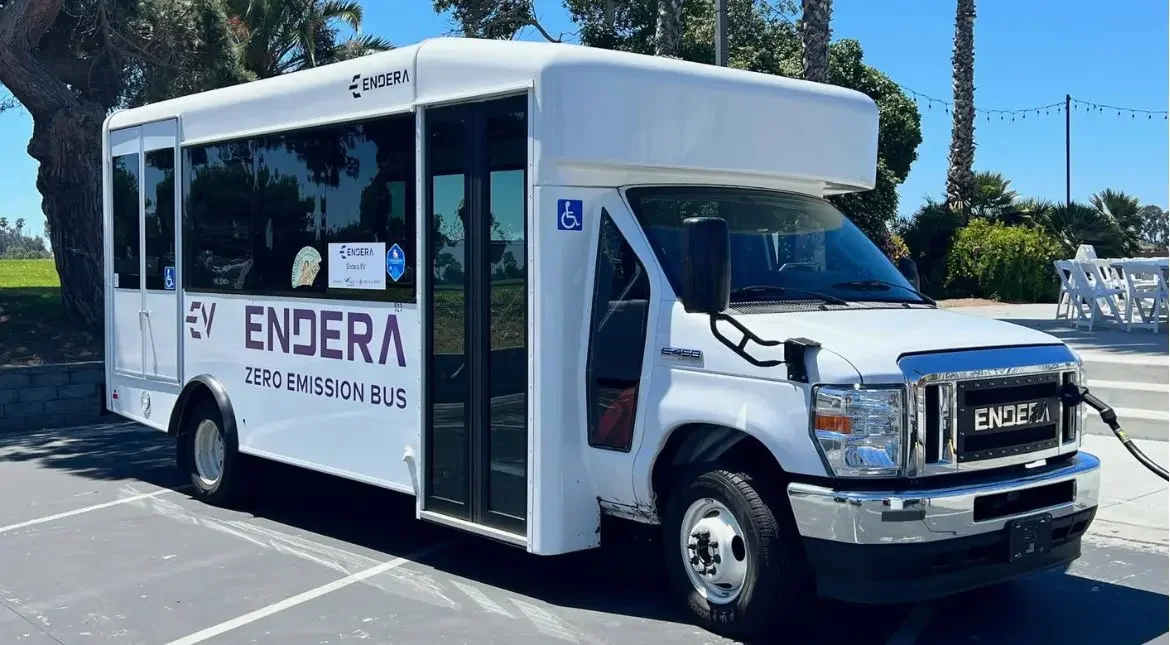
Oklahoma has 39 federally recognized tribes, many operating active, federally funded transit systems that are often overlooked in national coverage. The Cherokee, Choctaw, Chickasaw, Muscogee (Creek), Comanche, Cheyenne & Arapaho, and Seminole Nations all run services ranging from medical transport to rural transit across large service areas. These programs serve thousands of riders and are supported by dedicated federal funding streams.
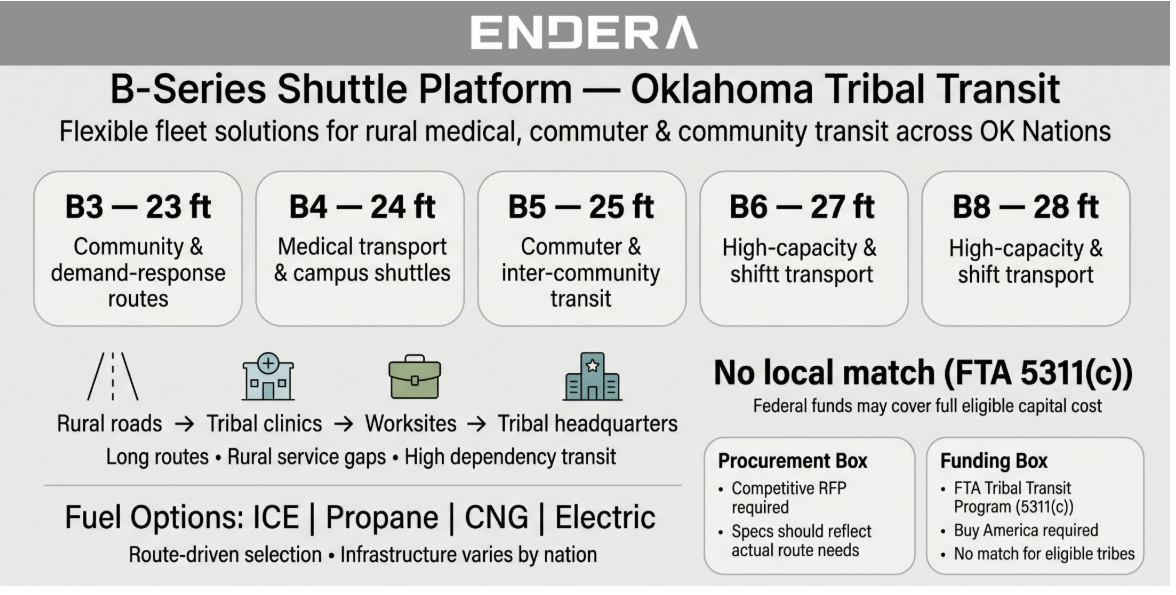
Endera's B-Series — the B3, B4, B5, and B8, ranging from 23 to 28 feet — is available in ICE, propane, CNG, and full electric configurations on Ford E450 and Chevrolet Express cutaway chassis, manufactured at Endera's Ottawa, Ohio facility with domestic supply chain credentials that support Buy America compliance. For Oklahoma tribal transit programs, the vehicle decision starts with the route — medical transport, employee commuter circuits, demand-responsive community service — and the funding framework that supports procurement.
Ready to optimize your routes? Contact Endera's fleet specialists today to design a custom configuration blueprint for your tribal transit program.
Oklahoma's Tribal Transit Landscape: Scale and Structure
Oklahoma's tribal transit programs collectively represent one of the largest concentrations of tribally operated public transportation in the country. The Oklahoma Faces of Transit catalog lists Cherokee Nation Transit, Choctaw Nation Tribal Transit, Chickasaw Nation Transit, Muscogee (Creek) Nation, Comanche Nation Transit, Cheyenne & Arapaho Tribal Transit, Seminole Nation Transit, and White Eagle Transit — alongside nineteen rural public transportation systems operating across all 77 Oklahoma counties.
Many of these programs serve overlapping geographies, and tribal transit often fills the transportation gap in rural southeastern and southwestern Oklahoma where no other public transit exists.
The Cherokee Nation's 2022 Tribal Transportation Self-Governance Compact with USDOT — the first of its kind — gives the tribe the ability to plan and oversee road construction and transit projects using federal funds without seeking federal permission for each decision. The Cherokee Nation has already demonstrated EV commitment by building solar canopy charging at its headquarters in Tahlequah for electric fleet vehicles. For a tribal transit program operating at this level of infrastructure maturity, the conversation about fleet electrification is already well underway — the vehicle needs to meet the funding requirements and the operating profile, not the other way around.
Federal Funding for Tribal Transit: How It Works
The FTA Tribal Transit Program — authorized under Section 5311(c) of federal public transportation law — is a set-aside from the Formula Grants for Rural Areas program totaling approximately $45 million nationally in formula and competitive grants.
Critically, there is no local match required for federally recognized tribes under the formula program — a significant distinction from standard Section 5311 rural transit funding, which requires a local match. Eligible activities include capital purchases (vehicles), operations, planning, and administrative expenses. All activities eligible under the broader Section 5311 rural program are also eligible under the Tribal Transit Program.
For Oklahoma tribal transit programs accessing Section 5311(c) formula funds, the absence of a local match requirement means the federal government covers 100% of eligible capital costs for qualifying vehicle purchases. That's a fundamentally different financial equation than most state or local transit procurement, where a 20% local match is standard.
For a tribal transit program purchasing B-Series shuttles as capital assets, this funding structure can cover the full vehicle cost for qualifying purchases — provided the vehicles meet Buy America requirements and the procurement follows federal guidelines. Endera's domestic manufacturing credentials — approximately 65% Ohio-sourced components — are directly relevant here.
The B-Series Lineup for Oklahoma Tribal Transit
Oklahoma tribal transit programs serve three distinct operational profiles, each with different vehicle requirements:
Medical transport — the Choctaw Nation Tribal Transit's primary mission — runs patients to non-emergency medical appointments across a 10½-county service area in southeastern Oklahoma. Routes are demand-responsive rather than fixed-schedule, covering significant daily mileage across rural terrain. The B4 (24 ft) and B5 (25 ft) in ICE or propane configurations offer the reliability and range that medical transport in rural Oklahoma demands without the range planning complexity of electric in areas without depot charging infrastructure.
Employee commuter transit — Cherokee Nation Transit runs defined commuter routes from rural communities to employment centers with predictable daily mileage. This makes B4 and B5 electric or CNG models a strong fit, supported by centralized depot charging. The tribe's EV work in Tahlequah further strengthens the case for electrification compared to other rural Oklahoma routes.
Demand-responsive community transit — serving general tribal members for employment, services, and daily mobility — covers the widest range of routes and distances. For this use case, the B3 (23 ft) compact model or B4 offers maneuverability and right-sized capacity for variable ridership patterns across communities where a larger vehicle would run consistently underutilized.
Fleet Lifecycle Reality: When Oklahoma Tribal Transit Vehicles Are Actually Replaced
A key factor in tribal transit procurement is FTA's useful life requirement, which sets minimum age and mileage thresholds before vehicles can be replaced using federal funds. These range from 4 years/100,000 miles for smaller buses to 12 years/500,000 miles for larger ones. Oklahoma tribal transit programs under the FTA Tribal Transit Program must follow these rules, meaning replacement timing depends on federal eligibility — not just operational preference.
Oklahoma tribal transit fleets typically replace vehicles on a 7–12 year cycle, driven by federal funding rules, maintenance costs, and downtime risk. Medical transport fleets often see faster wear due to high mileage and rural routing, reaching replacement around 120,000–250,000+ miles, while commuter systems like Cherokee Nation transit can extend service life with more predictable routes. These differences make durability and serviceability key factors in procurement, along with understanding where vehicles sit in their FTA useful life cycle.
Buy America, Procurement Compliance, and What It Means in Practice
Tribal transit programs accessing Section 5311(c) funds for capital vehicle purchases must follow Buy America requirements — the same standards that apply to all FTA-funded capital projects. This means final assembly in the United States and a domestic content threshold for components. Endera's manufacturing model — with final assembly at the Ottawa, Ohio facility and approximately 65% of components sourced from within Ohio — is designed to support Buy America compliance. For Oklahoma tribal transit procurement officers, confirming Buy America compliance before issuing a vehicle RFP is standard practice, and Endera can provide the documentation needed to support that certification.
Tribal transit programs using federal funds must follow competitive procurement processes like RFPs or IFBs before selecting a vendor. While this can feel complex, engaging Endera early helps staff understand vehicle specs, fuel options, and pricing in advance, so RFPs are written with accurate requirements instead of generic specs that lead to mismatched bids.
Heat, Routes, and Oklahoma's Operating Realities for Tribal Transit
Oklahoma's summer heat increases EV energy use by about 25–28% due to higher HVAC demand. For rural medical transport with long, variable routes and limited charging, ICE and propane remain more reliable short-term options. However, electric shuttles are viable for structured commuter routes with depot charging, aligning with tribal sustainability goals.
Oklahoma tribal transit serves some of the most geographically challenging routes in the state. The 10½-county Choctaw Nation service area covers mountainous southeastern Oklahoma terrain. Cherokee Nation routes connect rural communities in the Ozark foothills to Tahlequah. These aren't urban loop routes — they're rural connectors with longer daily mileage, fewer backup vehicles, and limited commercial service access if a vehicle goes down. Chassis reliability and serviceability through regional Ford and GM dealer networks matters practically in these environments in ways that don't apply to urban shuttle operations.
Get Your Fleet Spec'd
Oklahoma's tribal transit programs move people to medical appointments, connect employees to tribal campuses, and provide mobility in rural communities where no other transportation exists. That mission deserves a vehicle and a manufacturer that understands the operating environment — rural terrain, extreme heat, federal procurement requirements, and the service reliability that vulnerable populations depend on. The B-Series is built for exactly that combination.
To discuss fleet configuration, powertrain options, or tribal transit procurement requirements, contact Endera's fleet specialists.
FAQs
Can Oklahoma tribal transit programs use federal funds to purchase Endera shuttles?
Yes. The FTA Tribal Transit Program (Section 5311(c)) funds capital vehicle purchases for federally recognized tribes with no local match required under the formula program. Endera's manufacturing supports Buy America compliance for FTA-funded purchases.
What B-Series models are best suited for tribal transit use cases?
Medical transport on rural routes: B4/B5 in ICE or propane for reliability and range. Employee commuter transit at tribal headquarters: B4/B5 in EV or CNG where depot charging is available. Demand-responsive community transit: B3 or B4 for right-sized capacity on variable ridership routes.
Do federal procurement rules apply to tribal transit vehicle purchases?
Yes. Tribes using Section 5311(c) funds for capital purchases must follow competitive procurement procedures. Engaging Endera's team before the RFP is issued helps ensure technical specifications accurately reflect operational needs.
How does Oklahoma's heat affect electric configurations for tribal transit?
Extreme heat increases EV energy consumption by roughly 25–28% due to HVAC demand. For rural medical transport routes with high daily mileage and limited charging access, ICE and propane are more operationally reliable. For defined commuter routes at tribal campuses with depot charging, electric configurations are viable.
Does Endera's manufacturing meet Buy America requirements?
Yes. With approximately 65% of components sourced from Ohio and final assembly at Endera's Ottawa, Ohio facility, Endera's vehicles are designed to support Buy America compliance documentation for FTA-funded tribal transit procurement.
What chassis options are available for tribal transit programs?
All B-Series models are available on Ford E450 and Chevrolet Express cutaway chassis — both broadly serviced through dealer networks across Oklahoma including in rural southeastern and southwestern Oklahoma markets.
How do tribal transit programs engage Endera for procurement?
Contact Endera's sales team before issuing your RFP. Early engagement allows specifications to reflect actual operational requirements — fuel type, accessibility features, chassis preference, and service territory — before the competitive process formally begins.