
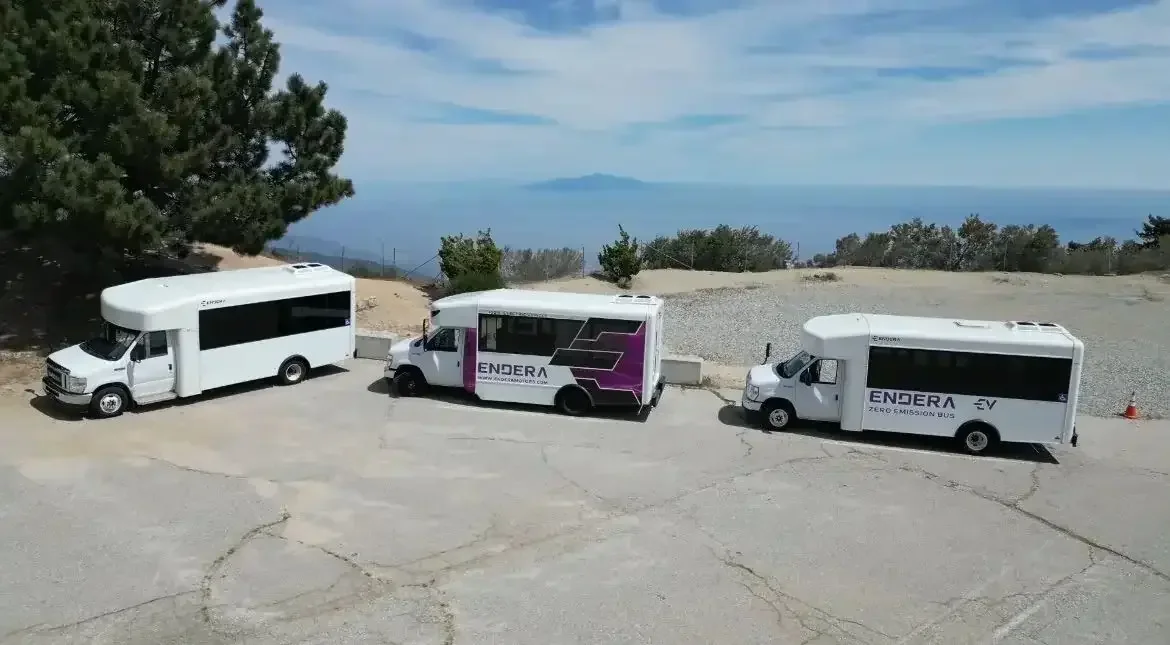
Nebraska has no EV mandate or purchase rebates and charges a $150 annual EV registration fee. However, very low electricity rates (~$0.10/kWh) make long-term EV operating costs attractive once infrastructure is in place. Key shuttle markets include Omaha hospitality, Lincoln university and corporate transit, casino resorts, agriculture and food processing sites, and healthcare systems.
Endera's B-Series — the B3, B4, B5, and B8, ranging from 23 to 28 feet — covers Nebraska's range of commercial shuttle applications. ICE, propane, CNG, and full electric configurations are available on Ford E450 and Chevrolet Express cutaway chassis, manufactured at Endera's Ottawa, Ohio facility. For Nebraska operators, the decision comes down to what the route demands, what the infrastructure supports, and what the numbers actually say once Nebraska's uniquely favorable electricity rates are factored in.
Ready to optimize your routes? Contact Endera's fleet specialists today to design a custom configuration blueprint for your Nebraska operation.
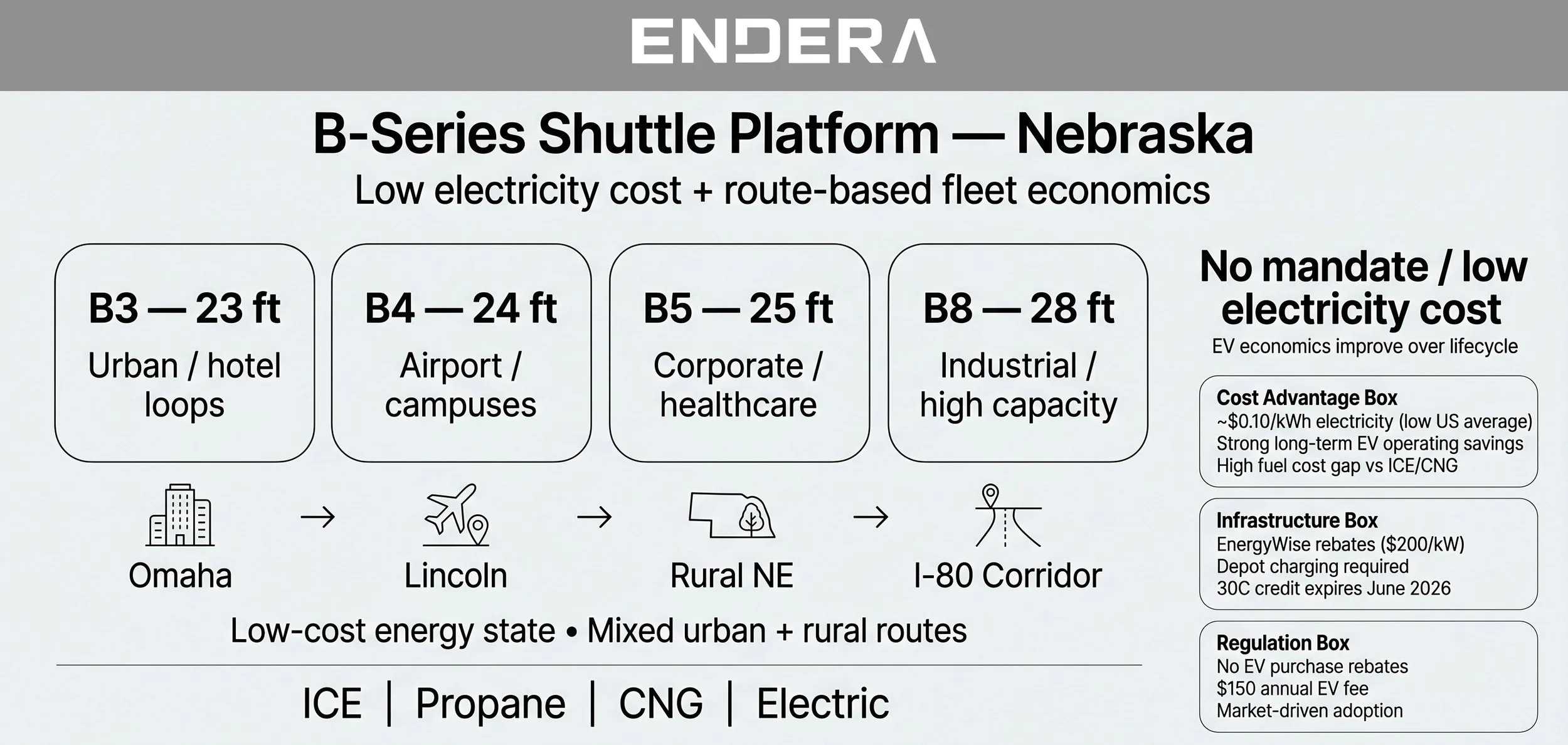
Nebraska's Fleet Landscape: Practical Conditions, Low Electricity Costs
No Mandate, No Rebate — But a Hidden EV Advantage
Nebraska has no EV mandate or purchase rebates and charges a $150 annual EV registration fee. However, its low commercial electricity rate (~$0.10/kWh) is among the lowest in the US, improving long-term operating economics for shuttle fleets with depot charging. While it doesn't offset upfront costs, it strengthens lifecycle savings compared to higher-cost states.
Utility Charging Incentives Through EnergyWise Nebraska
Multiple Nebraska utilities participate in the EnergyWise Nebraska program, offering commercial charging infrastructure rebates. The Nebraska Public Power District (NPPD) offers $200 per kW of charging capacity for Level 2 and DC fast charger installations, with conduit reimbursement at $15 per foot up to $2,000. The cost cap is 50% of the total project cost for most commercial applicants — and nonprofits can qualify for up to 90% coverage.
Multiple other Nebraska utilities offer equivalent $200/kW commercial rebates through the same framework. The federal 30C charging equipment credit — up to $100,000 per installed port — stacks on top of utility rebates through June 30, 2026. That combination makes depot charging installation more affordable in Nebraska than the thin state incentive picture suggests on the surface.
The B-Series Lineup for Nebraska Operations
Four Models for Nebraska's Diverse Shuttle Markets
The B3 (23 ft) is a compact ICE model suited for downtown Omaha hotel loops, small campus routes at UNL or Creighton, and tight urban pickups. The B4 (24 ft) and B5 (25 ft) offer higher capacity and both ICE and electric options, ideal for Omaha airport, Lincoln corporate campuses, casino resorts, and healthcare systems like Nebraska Medicine and CHI Health. The B8 (28 ft) is built for high-volume needs such as casino circuits, events, and manufacturing shift transport.
Chassis Coverage Across Nebraska's Markets
All B-Series models are available on Ford E450 or Chevrolet Express cutaway chassis — platforms with strong dealer networks across Nebraska, including in smaller markets well outside Omaha and Lincoln. For operators in Grand Island, Kearney, Norfolk, or along Nebraska's agricultural corridor, regional chassis serviceability through Ford and GM dealers matters practically when a vehicle needs attention away from a major service center.
Fleet Decision Framework: Nebraska Routes and the Right Configuration
Matching the Vehicle to Nebraska's Operating Environments
| Use Case | Recommended Model | Fuel Type | Why |
|---|---|---|---|
| Omaha hotel / downtown loop | B3 / B4 | EV or ICE | Urban; short routes; low electricity cost |
| Airport ground transport (OMA) | B4 / B5 | EV or ICE | Defined cycles; depot charging viable |
| Casino resort shuttle | B4 / B5 | ICE or EV | Variable demand; growing market |
| University transit (UNL, Creighton) | B4 / B5 | EV or CNG | Predictable schedules; campus infrastructure |
| Agricultural / industrial campus | B5 / B8 | ICE or CNG | Longer routes, shift schedules, fuel flexibility |
For Omaha and Lincoln operators running defined urban and campus routes with depot charging, the electric B4 and B5 are operationally viable — and Nebraska's low electricity rates make the long-term operating savings case stronger than in most states. Operators at San Diego International Airport, a comparable high-frequency EV deployment, have forecasted nearly $20,000 in annual savings per vehicle versus LPG or CNG. In Nebraska, with electricity costs at roughly half the national commercial average in some utility territories, those per-vehicle savings may be higher.
Nebraska Winters and Cold-Weather EV Considerations
Cold Weather Is a Planning Variable, Not a Dealbreaker
Nebraska's winters vary significantly across the state — western and central Nebraska see more severe cold than Omaha and Lincoln, which sit in the milder eastern tier. Research on EV thermal systems shows cold temperatures reduce effective range through heating load and reduced battery performance.
For Nebraska shuttle operators, the winter range consideration matters more for routes in the northern Panhandle or on routes that run through January blizzard conditions than for Omaha hotel loops or indoor corporate campus circulators. Short, depot-based routes in Lincoln and Omaha absorb cold-weather range reduction well with overnight charging. Longer routes across the state's agricultural interior or casino resort circuits in the western Sandhills require more conservative range planning in winter months.
Nebraska's Favorable Electricity Rate Changes the Winter Math
Nebraska's cold-weather EV impact is softened by its low electricity rates (~$0.10/kWh). While heating still reduces range, the added energy cost is relatively low compared to higher-rate states. This makes winter EV operation more cost-efficient than many national comparisons suggest.
Route-Based Cost Reality: Nebraska Shuttle Economics by Duty Cycle
What the Numbers Actually Look Like in Nebraska
Understanding whether electric shuttles pencil out in Nebraska requires moving beyond generic fuel savings claims and into route-specific cost modeling based on actual duty cycles. At Nebraska's average commercial electricity rate of roughly $0.09–$0.10/kWh — among the lowest in the country — electric shuttle operating costs typically land in the $0.18–$0.28 per mile range, depending on vehicle efficiency, HVAC load, and driving conditions. By contrast, diesel and CNG shuttle fleets commonly operate in the $0.45–$0.75 per mile range when fuel, idle time, and stop-and-go duty cycles are fully accounted for, based on EIA transportation energy cost benchmarks. That gap isn't theoretical — it compounds across every mile a vehicle runs.
How Nebraska's Three Main Shuttle Profiles Compare
| Route Profile | Daily Mileage | EV Payback Profile |
|---|---|---|
| Omaha hotel shuttle | 80–120 miles/day | Strong — short defined loops, low idle |
| Lincoln university loop | 60–100 miles/day | Strong — predictable schedule, depot charging |
| Casino resort shuttle | 120–180 miles/day | Fastest — high utilization accelerates payback |
Across Nebraska shuttle routes, EVs typically deliver 30–60% fuel savings versus diesel or CNG, along with lower maintenance from fewer moving parts and regenerative braking. High-mileage routes like casino and airport shuttles see the fastest payback due to higher utilization. Endera's financing team can model route-specific TCO using Nebraska's real duty cycles and electricity rates instead of national averages.
Public Charging vs. Depot Operations in Nebraska
NEVI Builds the I-80 Corridor — Not Fleet Infrastructure
Nebraska is receiving approximately $30 million in NEVI funds, with the 2025 plan focused on installing 30–35 DC fast charging sites along the I-80 corridor and other designated alternative fuel routes. That buildout supports long-distance travel — it doesn't address the operational requirements of shuttle fleets running fixed daily routes in Omaha or Lincoln. Public corridor charging and depot fleet charging are different infrastructure problems, and operators who plan around public availability are taking on the reliability risk documented consistently in real-world fleet deployments: variable uptime, queuing, and pricing unpredictability that public chargers introduce.
Depot Charging Is the Operational Foundation
For Nebraska commercial shuttle operators, reliable daily operations depend on depot-based charging — vehicles charging overnight at a controlled facility, dispatched fully charged each morning.
Endera's turnkey depot charging services handle site assessment, equipment procurement, and full installation, giving Nebraska operators a controlled charging environment that the NEVI corridor network doesn't provide. Combined with the EnergyWise utility rebates and the 30C credit before its June 30, 2026 expiration, the depot charging infrastructure cost for Nebraska operators is more manageable than the absence of a state vehicle rebate might suggest.
True Cost vs. Cash Flow for Nebraska Operators
The Financial Case With Nebraska's Electricity Rate Applied
Electric shuttles reduce total operating costs through lower fuel and maintenance, and Nebraska's low electricity rates further improve long-term savings over a 10-year cycle. The main barrier remains upfront cost, with no state purchase rebate and limited federal support, though the 30C credit and utility incentives help offset infrastructure costs. Financing is key to managing the vehicle cost gap.
Financing Options for Nebraska Operators
Endera's financing team offers direct financing and capital leasing options for Nebraska operators who want to deploy electric configurations without waiting for grant timing. The capital leasing structure — where operators use vehicles while preserving capital — is particularly relevant in a state where the operational savings case is strong but the upfront cost gap isn't offset by state grants.
Get Your Fleet Spec'd
Nebraska fleet operators make good vehicle decisions without mandate pressure — and the operating cost case for electrification is genuinely strong in a state with some of the lowest electricity rates in the country. The B-Series covers the full range of Nebraska applications across four models, four fuel types, and two chassis options, with fleet software, financing, and infrastructure support to make every configuration operationally sound.
To discuss fleet configuration, powertrain options, or Nebraska procurement requirements, contact Endera's fleet specialists.
FAQs
Which B-Series models are available for Nebraska operators?
All four models — B3 (23 ft), B4 (24 ft), B5 (25 ft), and B8 (28 ft) — are available in Nebraska in ICE, propane, CNG, and electric configurations depending on model. Contact Endera's sales team for current availability and lead times.
What incentives are available for Nebraska fleet operators installing EV charging?
Nebraska utilities participating in the EnergyWise program — including NPPD and others — offer $200/kW commercial rebates for Level 2 and DC fast charging, capped at 50% of project cost (90% for nonprofits). The federal 30C charging equipment credit — up to $100,000 per port — stacks on top through June 30, 2026.
Does Nebraska charge a registration fee for EVs?
Yes. Nebraska charges a $150 annual registration fee for EVs in addition to standard registration costs. CNG, LNG, and propane vehicles are not subject to this fee.
How does Nebraska's electricity rate affect the EV operating cost case?
Nebraska's average commercial electricity rate of roughly $0.10/kWh is among the lowest in the country per EIA data. That rate advantage compresses the per-mile fuel cost of electric shuttles meaningfully compared to higher-electricity-cost states, improving the long-term operating economics even without a strong upfront incentive stack.
What chassis options are available in Nebraska?
All B-Series models are available on Ford E450 and Chevrolet Express cutaway chassis, serviced through dealer networks across Nebraska including smaller markets outside Omaha and Lincoln.
Do Endera shuttles comply with Buy America requirements?
Yes. With approximately 65% of components sourced domestically, Endera's manufacturing supports Buy America compliance for federally funded Nebraska procurement contracts.
Can I get an in-stock 2026 shuttle for fast delivery in Nebraska?
Yes. Endera Stock lists ready-to-deliver 2026 models available for rapid deployment without a custom build lead time.