
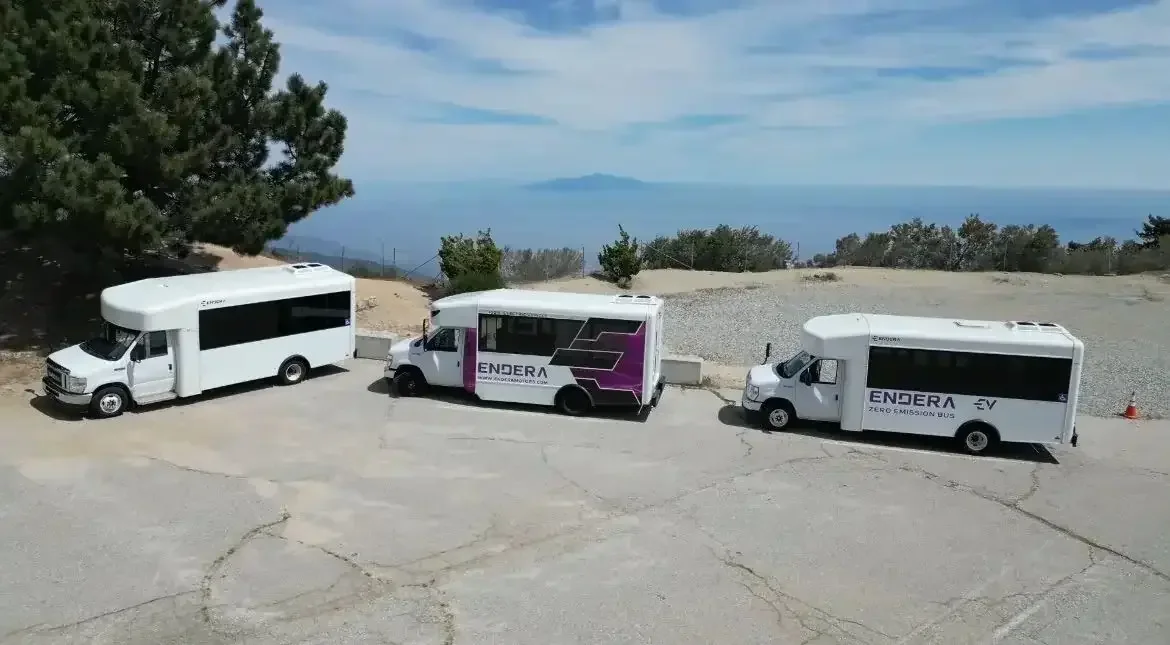
Missouri's shuttle market ranges from major metro operations in Kansas City and St. Louis to seasonal tourism routes in Branson and the Lake of the Ozarks. The state also has strong CNG and propane infrastructure, supported by the Missouri Alternative Fuels Commission, making alternative fuels a practical option for operators not yet ready to go fully electric.
Endera's B-Series — the B3, B4, B5, and B8, ranging from 23 to 28 feet — is built for exactly this range. ICE, propane, CNG, and full electric configurations are available on Ford E450 and Chevrolet Express cutaway chassis, manufactured at Endera's Ottawa, Ohio facility. Missouri's infrastructure already supports alternative fuels — your shuttle should too.
Talk to an Endera specialist today to match the right fuel type and model to your Missouri operation.
How North Carolina Transit Agencies Pay for Shuttle Buses
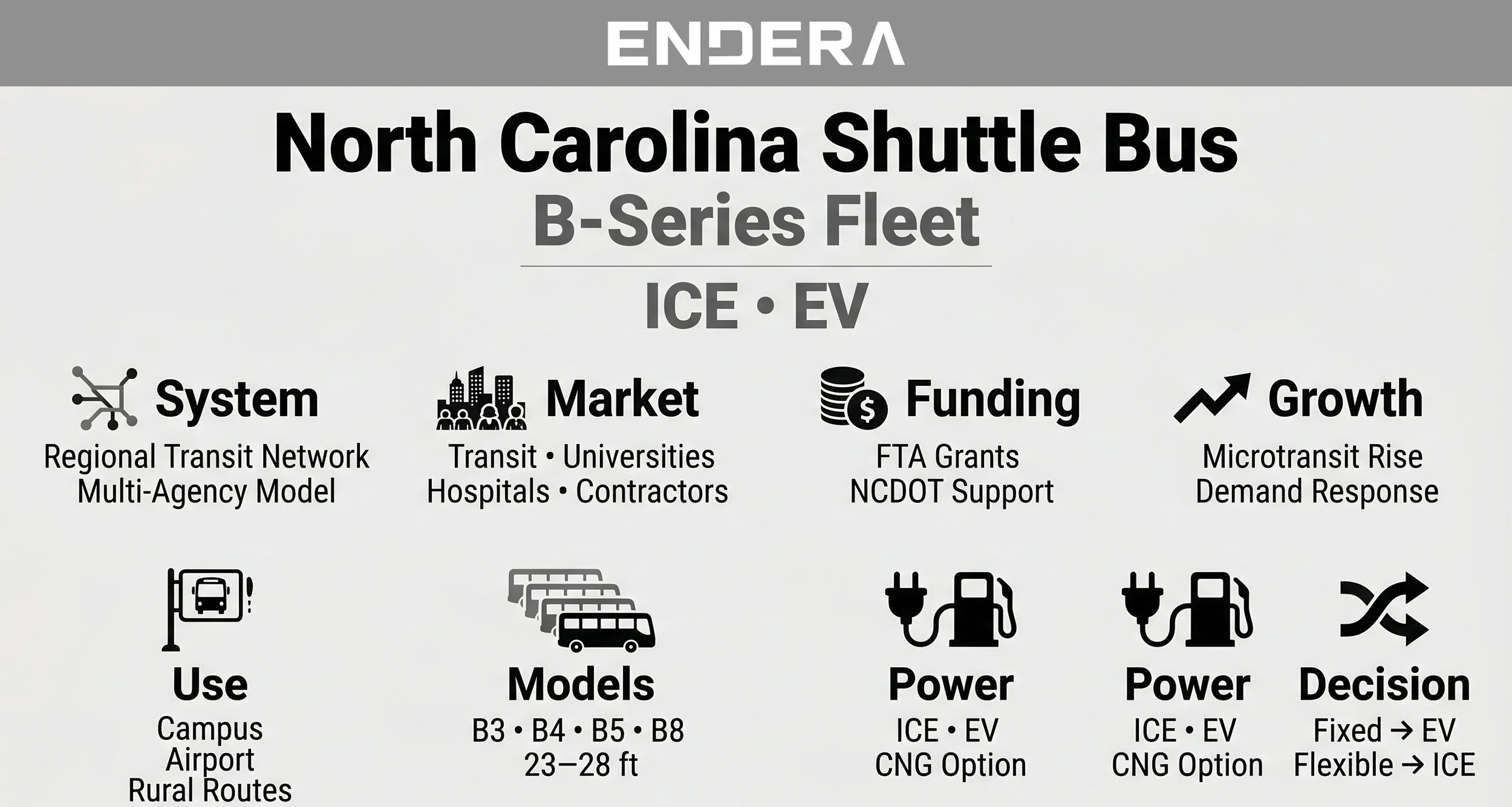
North Carolina's transit funding flows through NCDOT's Transit Discretionary Grant program, which has delivered over $5.8 million in recent rounds to transit systems across the state for fleet replacement and modernization. Federal funding layers on top — North Carolina agencies have received approximately $6.1 million in FTA awards to purchase new American-made buses, with individual city-level grants adding further capacity.
Even smaller systems are active in this pipeline. A recent Fayetteville transit grant of approximately $463,000 was used specifically for new bus vehicle purchases — demonstrating that mid-size and smaller NC cities consistently participate in federal procurement funding, not just the Triangle and Charlotte metros.
At the national level, the FTA's 2025–2026 investment round allocated $2.4 billion across 199 projects for bus, shuttle, and facility upgrades. Endera's grant navigation services help North Carolina operators identify applicable programs and build procurement documentation aligned with FTA and NCDOT requirements.
Why Shuttle Bus Demand Is Growing in North Carolina
North Carolina's transit growth isn't happening only in full-size bus corridors. NCDOT's Transit Discretionary Grant program specifically funds on-demand microtransit systems — smaller vehicles deployed for first-mile and last-mile connections that fixed-route buses don't serve. That funding category has been growing steadily, and it maps directly to the B-Series format: vehicles in the 8-to-25-passenger range, capable of flexible routing, with real-time tracking built in.
Demand-response and paratransit fleets reinforce this further. Systems like CK Rider in Cabarrus County operate mixed fleets of buses, demand-response vans, and shuttle vehicles — a structure that requires commercially built, ADA-configurable mid-size vehicles. The B-Series serves that need without the operational overhead of a full-size transit bus. As more NC counties launch demand-response programs to serve aging populations and rural residents without fixed-route access, mid-size shuttle procurement is set to grow alongside that expansion.
Who Buys Shuttle Buses in North Carolina?
North Carolina's shuttle bus market spans a wider buyer profile than most transit-focused markets. Public transit agencies represent the core procurement channel, but institutional and private operators account for a significant share of total fleet demand:
Regional transit agencies — GoTriangle, GoRaleigh, GoDurham, and county-level systems procuring through FTA-funded cycles
Universities and colleges — UNC Charlotte's CATS fleet operates shuttles, paratransit vans, and ADA-configured vehicles for campus and off-campus transport
Hospitals and healthcare systems — non-emergency medical transport and patient shuttle operations across the state's major health systems
Municipal and rural operators — smaller cities and counties running demand-response and on-demand service, often supported by NCDOT discretionary grants
Private contractors — companies holding transit service contracts who need FTA-eligible, Buy America compliant vehicles for publicly funded routes
Each buyer profile has different procurement structures and timelines — but all require commercially built vehicles that meet federal standards and carry proper documentation for funding compliance.
ICE vs. Electric: What NC Transit Operators Are Choosing
North Carolina's transit operators are expanding electric fleet capacity, with grants and utility programs helping fund both vehicles and charging infrastructure. The transition is active but uneven — urban agencies with fixed routes and established facilities are further along than rural operators managing dispersed service areas.
When Electric Makes Sense
Transit agencies running fixed urban or campus routes are the strongest candidates for electric B4 and B5 models. Predictable daily mileage, overnight depot charging, and access to FTA Low-No Emission program funding make electric operationally and financially viable for these applications. Endera's turnkey charging platform handles site assessment, DC fast charger procurement, and metering installation as a single engagement — removing the infrastructure coordination burden from transit operators managing multiple projects simultaneously.
When ICE or Bridge Fuels Cover the Gap
Rural operators running demand-response routes across dispersed geographies, or agencies with no existing charging infrastructure, should consider ICE or CNG as a current-cycle solution. Propane and CNG satisfy the direction North Carolina's fleet policy is heading — cleaner than diesel, with lower infrastructure commitment than full electric. All B-Series configurations share the same platform, so operators can standardize on Endera now and add electric units on subsequent procurement cycles without switching manufacturers.
The B-Series for North Carolina Transit Fleets
| Model | Length | Fuel Options | Transit Fit |
|---|---|---|---|
| B3 | 23 ft | ICE | Demand-response, rural on-demand, microtransit |
| B4 | 24 ft | ICE & EV | Fixed urban routes, campus loops, airport shuttles |
| B5 | 25 ft | ICE & EV | Regional employee transport, higher-capacity fixed routes |
| B8 | 28 ft | ICE | High-demand municipal and group transport |
All models are built on Ford E450 and Chevrolet Express cutaway chassis, with body and powertrain assembled at Endera's Ottawa, Ohio facility. The B4 electric shuttle holds the highest Altoona durability test score in its class at 90.1 — a certification that matters for FTA-funded procurement, where quantitative durability proof is often required in the bid process.
Software That Meets Transit Operational Requirements
North Carolina agencies operating demand-response and microtransit services need fleet management tools built for flexible routing — not just basic GPS tracking. Every B-Series shuttle is compatible with Endera Dispatch, which includes AI-powered routing, real-time GPS tracking, geofence management, and state-of-charge monitoring for electric units. Custom reporting dashboards are included at no additional cost.
For contracted operators reporting vehicle performance to transit agency partners, Dispatch provides the operational data visibility that service agreements typically require. The rider-facing Endera Go app delivers real-time vehicle location and ETA to passengers — particularly relevant for demand-response operations where wait-time uncertainty is the primary rider experience complaint.
Ready to Spec a Shuttle for Your North Carolina Fleet?
Several 2026 B-Series units are available for immediate delivery through Endera Stock, including ADA-configured flat-floor models and standard passenger layouts. For agencies working within formal procurement or grant-aligned purchasing cycles, Endera provides full specification documentation, Buy America compliance materials, and grant application support.
North Carolina's procurement cycles move fast — make sure your documentation is ready. Contact Endera's sales team today to discuss FTA eligibility, fleet configuration, or funding strategy for your operation.
Frequently Asked Questions
What federal funding programs are available for shuttle bus purchases in North Carolina?
NC transit agencies access FTA funding through the Bus and Bus Facilities Program and the Low-No Emission Vehicle Program. NCDOT's Transit Discretionary Grant program provides state-level supplemental funding for fleet replacement and on-demand service expansion. Individual NC agencies have received awards ranging from $463,000 for smaller city purchases to multi-million dollar grants for regional fleet upgrades.
Are Endera B-Series shuttles FTA-eligible for North Carolina transit procurement?
Yes. Endera's B-Series shuttles are Buy America compliant and FTA-eligible, meeting the federal procurement requirements attached to FTA-funded vehicle purchases. The B4 electric shuttle carries an Altoona durability test score of 90.1 — the highest in its class — satisfying the quantitative certification requirements many FTA-funded procurement processes specify.
What is microtransit and why is it driving shuttle bus demand in North Carolina?
Microtransit refers to on-demand or flexible-route service using smaller vehicles — typically 8 to 20 passengers — designed to close first-mile and last-mile transit gaps. NCDOT's discretionary grant program explicitly funds microtransit deployments, and the B-Series format is purpose-built for this use case: mid-size, dispatch-compatible, and ADA-configurable.
Do universities and healthcare systems in North Carolina use B-Series shuttles?
Yes. Institutional operators including universities, hospital systems, and corporate campuses represent a significant portion of North Carolina's commercial shuttle market. UNC Charlotte's CATS fleet operates shuttles, paratransit vans, and ADA vehicles — a structure the B-Series serves across multiple configurations. These buyers often access FTA funding through transit agency partnerships rather than direct federal procurement.
How does Endera Dispatch support demand-response and microtransit operations?
Endera Dispatch includes AI-powered routing, real-time GPS tracking, geofence management, and custom reporting dashboards — tools specifically relevant for demand-response operations where route flexibility and service reporting are daily requirements. State-of-charge monitoring for electric units is included, useful for agencies managing mixed ICE and EV fleets during transition.
What is the procurement process for North Carolina transit agencies buying new shuttles?
NC transit agencies typically follow structured procurement aligned with FTA grant cycles — issuing specifications, conducting competitive bids, and submitting documentation to NCDOT and FTA. Endera provides full specification sheets, Buy America compliance documentation, and supporting materials for formal bid submissions. For agencies on urgent replacement timelines, in-stock units are available outside a standard build cycle.
How does the B-Series compare to full-size transit buses for North Carolina operations?
Full-size transit buses are built for high-volume fixed corridors — they're less efficient on demand-response routes, campus circuits, or rural on-demand services where passenger loads vary and route flexibility matters. The B-Series covers the mid-capacity range where most of North Carolina's microtransit and demand-response demand sits, without the fuel, maintenance, and maneuvering overhead of larger vehicles.